Understanding the Dynamics of Heat Loss in Water
Water, a ubiquitous substance essential for life, possesses a fascinating ability to absorb and release heat. The rate at which water loses heat, its cooling rate, is not a static value but a dynamic process influenced by a multitude of factors. Understanding these factors is crucial for a wide range of applications, from industrial processes and food preservation to environmental studies and even culinary endeavors. This article delves into the science behind water’s cooling rates, exploring the underlying principles and the variables that govern how quickly a body of water sheds its thermal energy.
Understanding the cooling rates of water is crucial for various scientific applications, from environmental studies to culinary practices. For a deeper insight into this topic, you can explore a related article that discusses the principles behind thermal conductivity and the factors influencing water’s cooling rates. This article can be found at Freaky Science, where you will find valuable information that complements your knowledge on the subject.
Factors Governing Water’s Cooling Speed
The speed at which water cools is a complex interplay of various physical phenomena. It’s not simply a matter of how hot the water is initially, but rather a combination of how efficiently that heat can be transferred away from the water and into its surroundings. Several primary mechanisms contribute to this heat loss, each playing a significant role in the overall cooling process.
Conduction: Direct Heat Transfer
Conduction is the transfer of heat through direct contact between molecules. When a warmer substance touches a cooler substance, the kinetic energy of the molecules in the warmer substance is transferred to the molecules in the cooler substance through collisions. In the context of water cooling, conduction occurs at the interface between the water and any solid object it is in contact with, such as a container or the ground.
The efficiency of conduction is dependent on the thermal conductivity of the materials involved. Water itself has a moderate thermal conductivity, meaning it can transfer heat internally through conduction to some extent. However, the rate of heat loss via conduction to the surroundings is primarily limited by the thermal conductivity of the material the water is in contact with. For instance, water in a metal container will cool faster by conduction than water in a Styrofoam container, as metal is a much better conductor of heat than Styrofoam.
Convection: The Movement of Heated Fluids
Convection is the transfer of heat through the movement of fluids (liquids or gases). When water is heated, its density generally decreases, causing it to rise. Cooler, denser water then sinks, creating a circulating current. This continuous movement of water helps to distribute heat throughout the body of water and to transfer it to the surface where it can dissipate more readily. This is known as natural convection.
Forced convection occurs when external forces, such as stirring or pumping, accelerate the movement of the water. Stirring a cup of hot coffee, for example, dramatically increases its cooling rate by bringing the hotter water from the bottom to the surface more quickly and exposing more of the water to the cooler air. Similarly, water currents in lakes and oceans play a significant role in their thermal dynamics, influencing how quickly they warm up or cool down. The rate of heat loss through convection is significantly higher than through conduction alone.
Evaporation: The Power of Phase Change
Perhaps the most significant mechanism for water cooling, especially in open environments, is evaporation. Evaporation is the process where liquid water transforms into water vapor, a gas. This phase change requires energy, specifically the latent heat of vaporization, which is absorbed from the surrounding water. As water molecules gain enough kinetic energy to escape the liquid phase and enter the atmosphere, they carry this energy with them, effectively cooling the remaining liquid.
The rate of evaporation is influenced by several factors, including the surface area of the water exposed to the air, the humidity of the surrounding air, the temperature of the water, and wind speed. A larger surface area allows more water molecules to escape. Dry air can absorb more water vapor than humid air. Warmer water has more energetic molecules, making it easier for them to evaporate. Wind sweeps away saturated air from the surface, allowing for continued evaporation. This is why a hot day can feel cooler when there’s a breeze, as it enhances evaporative cooling. In extreme cases, such as desert environments, evaporation can be so rapid that it can significantly cool exposed water sources.
Radiation: The Invisible Heat Transfer
Radiation is the transfer of heat through electromagnetic waves. All objects with a temperature above absolute zero emit thermal radiation. In the context of water cooling, water emits thermal radiation to its surroundings, and its surroundings also emit radiation back to the water. The net heat loss through radiation depends on the temperature difference between the water and its surroundings and their respective emissivities.
While conduction, convection, and evaporation are generally more dominant cooling mechanisms for water, radiation still plays a role, particularly in environments with clear skies where the water can radiate heat to outer space. The color and surface properties of the water body can also influence its radiative heat exchange. Darker surfaces absorb and emit radiation more effectively than lighter, more reflective surfaces.
Environmental Influences on Cooling Rates
Beyond the intrinsic properties of water and the mechanisms of heat transfer, the surrounding environment exerts a profound influence on how quickly water loses heat. These external factors can either accelerate or retard the cooling process, making the cooling rate context-dependent.
Ambient Temperature: The Driving Force
The most straightforward environmental factor is the ambient temperature of the surroundings. The greater the difference between the water’s temperature and the ambient temperature, the faster heat will transfer from the water to the environment. This is a fundamental principle of thermodynamics, described by Newton’s Law of Cooling, which states that the rate of heat loss of a body is directly proportional to the difference in temperatures between the body and its surroundings. Therefore, water will cool much faster in a frigid environment than in a moderately cool one.
Air Movement: Enhancing Convection and Evaporation
As previously discussed, air movement, or wind, significantly impacts cooling rates. Wind enhances both convection and evaporation. By constantly replacing the warmer, more humid air at the water’s surface with cooler, drier air, wind increases the rate of heat loss through convection and drives off water vapor, facilitating more rapid evaporation. A gentle breeze can noticeably speed up the cooling of a beverage, while strong winds can cause rapid cooling of larger bodies of water, contributing to phenomena like evaporative cooling in arid regions.
Humidity: The Saturation Barrier
Humidity refers to the amount of water vapor present in the air. High humidity levels reduce the rate of evaporation. When the air is already saturated with water vapor, it has a limited capacity to absorb more. This creates a barrier that slows down the escape of water molecules from the liquid phase, thus reducing the cooling effect of evaporation. Conversely, low humidity allows for more vigorous evaporation and thus faster cooling. This is why on a hot, dry day, you can feel cooler in the shade than on a humid day, even if the temperature is the same.
Surface Area and Volume: Geometric Considerations
The geometric characteristics of the water body are critical. A larger surface area exposed to the air allows for a greater rate of heat transfer through convection and evaporation. A shallow puddle will cool much faster than a deep lake, even if they contain the same volume of water, because the puddle has a much higher surface area to volume ratio. This is why ice cubes, with their significant surface area, melt much faster than a solid block of ice of the same mass.
Solar Radiation: A Counteracting Force
While this article focuses on cooling rates, it’s important to acknowledge that solar radiation can also be a significant factor, particularly during daylight hours. The sun’s rays can transfer heat to water, counteracting the cooling processes. The intensity of solar radiation, the angle of incidence, and the presence of cloud cover all influence the amount of heat absorbed by the water. In many scenarios, particularly in outdoor settings, the net cooling rate will be the difference between heat loss and heat gain from solar radiation.
Material Properties and Container Effects
The material of the container holding the water, or the ground it rests upon, plays a crucial role in dictating the rate of heat transfer. Different materials have vastly different thermal properties, which directly influence how efficiently heat is conducted away from the water.
Thermal Conductivity of the Container
The thermal conductivity of a material quantifies its ability to conduct heat. Materials with high thermal conductivity, like metals (e.g., aluminum, copper), readily transfer heat. Therefore, water in a metal container will cool much faster than water in a container made of a material with low thermal conductivity, such as plastic or glass. This is why metal cups are often used for iced beverages, as they help to keep the drink cold by efficiently drawing heat away from the liquid.
Conversely, materials with low thermal conductivity, often referred to as insulators, resist heat flow. Styrofoam, for instance, is an excellent insulator due to the trapped air pockets within its structure, which significantly hinder heat conduction. This is why insulated containers, like coolers and thermoses, are designed to minimize heat transfer between the contents and the environment, keeping cold things cold and hot things hot.
Specific Heat Capacity of the Container Material
While thermal conductivity dictates the rate of heat transfer, specific heat capacity influences how much heat a material can absorb or release for a given temperature change. If a container has a high specific heat capacity, it can absorb a considerable amount of heat from the water without a significant temperature rise in the container itself. This means that initially, the container might absorb some of the heat, slowing down the rate at which heat is lost to the surroundings. However, once the container reaches thermal equilibrium with the surroundings, its lower thermal conductivity will become the dominant factor.
Surface Finish and Color
The surface finish and color of a container can also influence cooling rates, primarily through their effect on radiation and convection. A shiny, reflective surface will absorb less incoming solar radiation and emit less thermal radiation compared to a dull, dark surface. Similarly, a rough surface might slightly increase turbulence at the water-container interface, potentially enhancing convective heat transfer. While these effects are generally less pronounced than those of thermal conductivity, they can still contribute to the overall cooling process, especially in scenarios involving significant radiative heat exchange.
Understanding the cooling rates of water is essential for various scientific applications, and you can find more detailed insights in a related article on this topic. The article explores how different factors influence the rate at which water cools, providing valuable information for both researchers and enthusiasts. For further reading, you can check out this informative piece on Freaky Science, where you will discover more about the fascinating properties of water and its thermal dynamics.
Water Properties and Internal Dynamics
| Initial Temperature (°C) | Cooling Rate (°C/min) | Ambient Temperature (°C) | Container Type | Notes |
|---|---|---|---|---|
| 90 | 5.2 | 25 | Glass beaker | Natural convection cooling |
| 80 | 4.8 | 20 | Plastic cup | Still air environment |
| 70 | 6.0 | 15 | Metal container | Enhanced conduction cooling |
| 60 | 3.5 | 22 | Ceramic mug | Room temperature |
| 50 | 2.8 | 18 | Glass beaker | Still air, no stirring |
The inherent properties of water itself, as well as the internal dynamics within the water body, contribute significantly to its cooling rate. These factors are independent of the external environment and the container, focusing solely on the behavior of the water itself.
Specific Heat Capacity of Water
Water has a remarkably high specific heat capacity. This means that it takes a large amount of energy to raise the temperature of water by one degree Celsius (or Fahrenheit). Conversely, it also means that water can store a significant amount of thermal energy and releases it slowly when cooling. This property is why large bodies of water, like oceans and lakes, moderate regional climates. They absorb vast amounts of heat during the summer and release it slowly during the winter, preventing extreme temperature fluctuations. This high specific heat capacity means that for a given temperature difference, water will cool down more slowly than many other substances because it has so much heat to lose.
Viscosity of Water
Viscosity is a measure of a fluid’s resistance to flow. Water’s viscosity changes with temperature; it decreases as temperature increases. Lower viscosity means that water flows more easily, which can influence convective heat transfer. In warmer water, which is less viscous, convection currents can form more readily, facilitating the movement of heat within the water body and towards the surface for dissipation. As the water cools and its viscosity increases, these convective currents may become less efficient.
Internal Convection Currents
Even in a still container, internal convection currents will form within the water as warmer water rises and cooler water sinks. This natural convection helps to distribute heat throughout the water. The efficiency of these currents is influenced by the water’s viscosity and the temperature gradient. Stirring the water, as mentioned earlier, artificially enhances these currents, leading to a much faster cooling rate. The presence and strength of these internal movements are a critical factor in how quickly heat is distributed to the surface for external dissipation.
Dissolved Substances
The presence of dissolved substances in water can also subtly affect its cooling rate. Dissolved salts, for example, can slightly alter water’s specific heat capacity and thermal conductivity. While these effects are often minor compared to other factors, in certain specialized applications, the composition of the water might need to be considered. For instance, in industrial processes involving brines or other aqueous solutions, the exact cooling rate might differ from that of pure water.
Quantifying Cooling: Newton’s Law of Cooling and Beyond
To understand and predict how fast water loses heat, scientists and engineers often employ mathematical models. The most fundamental of these is Newton’s Law of Cooling, but more complex models are used for greater accuracy and to account for various influencing factors.
Newton’s Law of Cooling: A Foundational Principle
Newton’s Law of Cooling states that the rate of heat loss of a body is proportional to the temperature difference between the body and its surroundings. Mathematically, this can be expressed as:
$dT/dt = -k(T – T_{ambient})$
Where:
- $dT/dt$ is the rate of change of temperature with respect to time.
- $k$ is a constant that depends on the object’s properties and its environment (including surface area, material, and heat transfer coefficients).
- $T$ is the temperature of the object (in this case, water).
- $T_{ambient}$ is the ambient temperature of the surroundings.
This law provides a simple, yet powerful, framework for understanding cooling. It implies that as the temperature difference between the water and its surroundings decreases, the rate of cooling also decreases. The cooling is rapid when the water is very hot but slows down as it approaches the ambient temperature.
Convective Heat Transfer Coefficient
The constant $k$ in Newton’s Law of Cooling is often broken down into more specific heat transfer coefficients. For convection, a convective heat transfer coefficient ($h_c$) is used. This coefficient encapsulates the combined effects of fluid motion and thermal properties of the fluid. It is influenced by the fluid’s velocity, viscosity, thermal conductivity, and the geometry of the surface. A higher convective heat transfer coefficient means more efficient heat transfer through convection.
Evaporative Heat Transfer
Evaporative cooling is more complex to model directly within a simple Newtonian framework. It involves a phase change and is highly dependent on factors like humidity, air pressure, and air velocity. Specialized equations are used to calculate the rate of evaporation, which then contributes to the overall heat loss. These often involve mass transfer coefficients and vapor pressure differences.
Radiation Heat Transfer Coefficient
Similarly, radiative heat transfer is often described using a radiative heat transfer coefficient ($h_r$). This coefficient depends on the emissivities of the water surface and the surrounding surfaces, as well as their temperatures. The net radiative heat exchange is then calculated based on these values.
Empirical Models and Computational Fluid Dynamics (CFD)
For highly accurate predictions, especially in complex scenarios like large water bodies or industrial equipment, empirical models derived from experimental data are often employed. Furthermore, advanced computational tools like Computational Fluid Dynamics (CFD) are used to simulate fluid flow and heat transfer. CFD allows for detailed analysis of heat loss by solving complex differential equations that describe the physics of the situation, taking into account all relevant factors like geometry, material properties, and environmental conditions. These advanced methods are essential for designing efficient cooling systems or understanding large-scale environmental thermal processes.
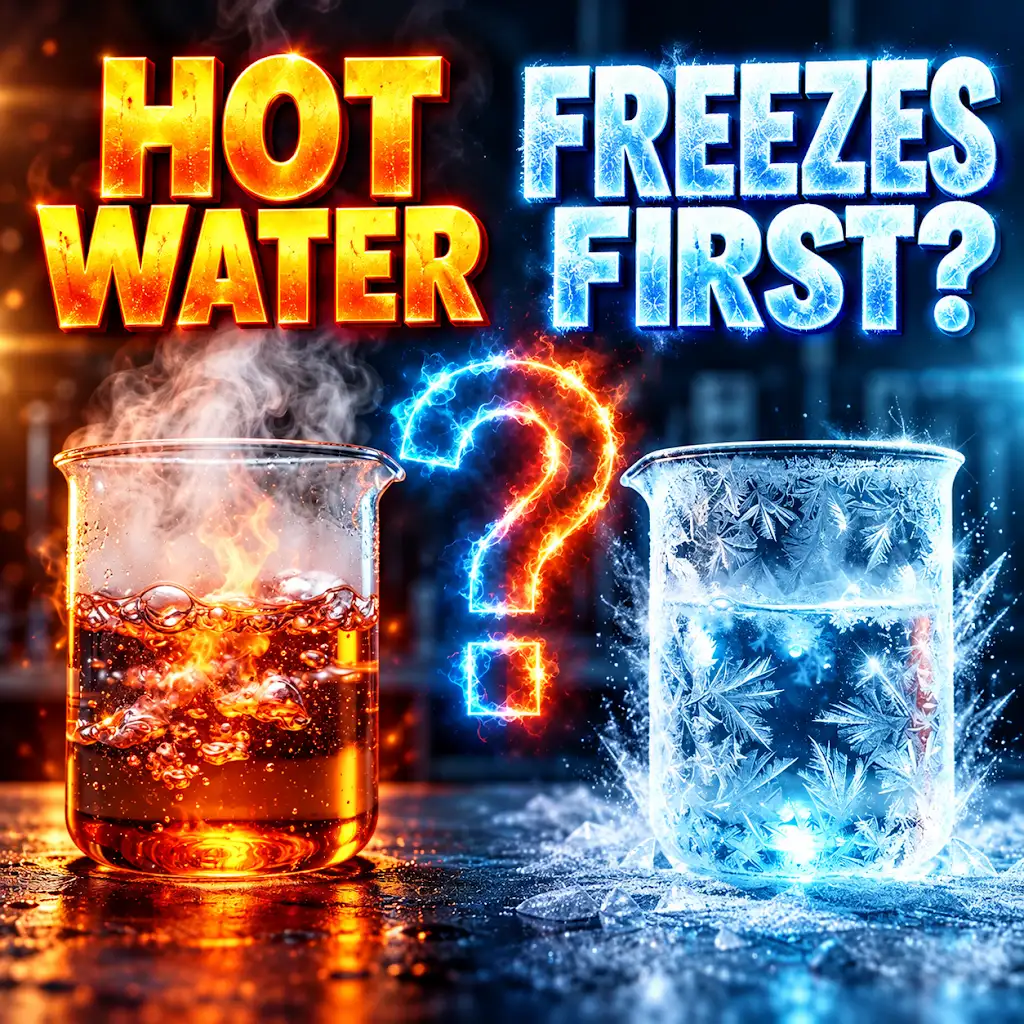
Why Hot Water Freezes Faster Than Cold (The Mpemba Effect)
FAQs
What factors affect the cooling rate of water?
The cooling rate of water can be influenced by various factors such as the initial temperature of the water, the surrounding temperature, the surface area of the container, and the presence of any insulating materials.
Does the shape of the container affect the cooling rate of water?
Yes, the shape of the container can impact the cooling rate of water. A container with a larger surface area will allow for more heat exchange with the surrounding environment, leading to a faster cooling rate compared to a container with a smaller surface area.
How does agitation affect the cooling rate of water?
Agitating the water, such as stirring it, can help distribute the heat more evenly throughout the water, which can result in a faster cooling rate. This is because agitation helps bring warmer water from the center to the surface where it can lose heat more efficiently.
Does the material of the container affect the cooling rate of water?
Yes, the material of the container can impact the cooling rate of water. Materials with higher thermal conductivity, such as metal, can facilitate heat transfer more effectively, leading to a faster cooling rate compared to materials with lower thermal conductivity like plastic.
How does the initial temperature of the water affect its cooling rate?
The initial temperature of the water plays a significant role in determining its cooling rate. Water at a higher initial temperature will have a larger temperature difference with the surrounding environment, resulting in a faster cooling rate compared to water at a lower initial temperature.