You’re likely intrigued by induction heating, the process that makes your stovetop glow and efficiently melts metals in industrial settings. At its core, induction heating relies on generating heat within a conductive material by exposing it to a changing magnetic field. But this heat isn’t generated by a single, monolithic force; it’s the product of two distinct, yet intertwined, phenomena: eddy currents and hysteresis. Understanding the nuances of each, and how they compare and contrast, is crucial for optimizing induction heating processes and designing effective systems.
Imagine a conductive object, say a metal workpiece, placed within a coil that’s carrying an alternating current. This alternating current in the coil generates a fluctuating magnetic field. According to Faraday’s law of induction, any change in magnetic flux through a conductive loop will induce an electromotive force (EMF) within that loop, which in turn drives a current.
The Mechanics of Induced Currents
Since your conductive workpiece is not a simple loop but a solid mass of conducting material, the changing magnetic field can induce numerous small, circulating currents within it. These are your eddy currents. Think of them as tiny whirlpools of electricity swirling within the metal. The magnetic field lines from the coil permeate the workpiece, and as this field oscillates, it effectively “sweeps” across the material, pushing and pulling electrons to create these closed current loops. The key here is the change in magnetic flux. A static magnetic field would not induce eddy currents. The faster the magnetic field changes (i.e., the higher the frequency of the AC current in the coil), the stronger the induced EMF and, consequently, the larger the eddy currents.
The Role of Material Properties
The magnitude of these eddy currents is heavily influenced by the electrical resistivity of the material. A material with low electrical resistivity, like copper or aluminum, will allow larger eddy currents to flow for a given induced EMF. Conversely, materials with higher resistivity will exhibit smaller eddy currents. The magnetic permeability of the material also plays a role. Materials with high magnetic permeability (ferromagnetic materials) can concentrate magnetic flux lines, leading to a more intense magnetic field within the material and thus stronger eddy currents.
Resistance as the Heat Generator
Now, where does the heat come in? These eddy currents, much like the current flowing through a simple wire, encounter resistance as they flow through the conductive material of your workpiece. This resistance opposes the flow of electrons, and this opposition is converted into heat energy, a phenomenon described by Joule’s law of heating ($P = I^2R$). The power dissipated as heat is directly proportional to the square of the eddy current’s magnitude and the material’s electrical resistance. This is why induction heating is so effective – you’re generating heat directly within the material itself, rather than relying on inefficient heat transfer from an external source.
Frequency Dependence and Skin Effect
The frequency of the alternating current in the induction coil is a critical parameter. At lower frequencies, eddy currents tend to distribute more uniformly throughout the workpiece. However, as the frequency increases, a phenomenon known as the “skin effect” becomes more pronounced. The skin effect dictates that alternating currents tend to flow along the surface of a conductor. This means that at higher frequencies, the eddy currents are concentrated in a thin layer near the surface of your workpiece. This is incredibly useful for applications like surface hardening, where you only need to heat the outer layer of a metal part without affecting its core. The depth of this heated layer, known as the “depth of penetration,” is inversely proportional to the square root of the frequency and the material’s conductivity.
In exploring the fascinating concepts of induction heating, a related article that delves into the differences between eddy currents and hysteresis is available at this link: Freaky Science. This article provides a comprehensive overview of how these two phenomena operate in induction heating applications, highlighting their unique characteristics and the implications for efficiency and effectiveness in various industrial processes. Understanding these differences is crucial for engineers and technicians working with induction heating systems.
The Subtle Force: Understanding Hysteresis Losses
While eddy currents are a dominant heating mechanism in most conductive materials, especially non-ferromagnetic ones like aluminum or copper, another important heat-generating process occurs, particularly in ferromagnetic materials: hysteresis.
Magnetic Domains and Their Alignment
Ferromagnetic materials, such as iron, nickel, and cobalt, possess a unique property: they can be strongly magnetized. This is due to the presence of tiny regions called magnetic domains, within which the magnetic moments of individual atoms are aligned. In an unmagnetized state, these domains are randomly oriented, resulting in no net magnetic field. When you introduce an external magnetic field, these domains begin to align themselves with the field.
The Hysteresis Loop Explained
As you cycle the external magnetic field back and forth (which you are doing with the alternating current in your induction coil), these magnetic domains are constantly trying to reorient themselves. This reorientation process is not perfectly efficient. Imagine trying to push a bunch of tiny magnets into alignment – there’s friction, resistance, and some energy is lost in the process. This energy loss manifests as heat.
The relationship between the applied magnetic field and the resulting magnetization in a ferromagnetic material is described by a hysteresis loop. When you plot the magnetic flux density (B) against the magnetic field strength (H), you get a characteristic loop. The area enclosed by this loop represents the energy lost per unit volume of the material per cycle, and this lost energy is dissipated as heat due to hysteresis.
Factors Influencing Hysteresis Loss
The amount of heat generated by hysteresis depends on several factors. Firstly, the material itself is paramount. Ferromagnetic materials with wider hysteresis loops will generate more heat. The frequency of the alternating magnetic field also plays a role. Higher frequencies mean more cycles of domain reorientation per unit time, leading to increased hysteresis losses. The strength of the applied magnetic field is also a factor; a stronger field will generally lead to larger domain rotations and thus more hysteresis heating.
Hysteresis vs. Eddy Currents in Ferromagnetic Materials
In ferromagnetic materials, both eddy currents and hysteresis contribute to heating. However, at lower frequencies, hysteresis can be the dominant heating mechanism, especially for materials with a high coercivity (a measure of the magnetic field required to demagnetize the material). As the frequency increases, the eddy currents tend to become more significant, particularly due to the skin effect concentrating current near the surface. For very high frequencies, eddy current losses often outweigh hysteresis losses.
Comparing the Heating Mechanisms: A Direct Confrontation
Now that you have a grasp of the individual mechanisms, let’s directly compare eddy currents and hysteresis in the context of induction heating.
Material Dependence: The Fundamental Divide
The most striking difference lies in the materials they primarily affect. Eddy currents are induced in any conductive material, regardless of its magnetic properties. This includes non-ferromagnetic conductors like copper, aluminum, and even graphite. Hysteresis, on the other hand, is exclusive to ferromagnetic materials. If your workpiece isn’t ferromagnetic, you won’t get any significant heating from hysteresis.
Frequency Sensitivity: A Tale of Two Intensities
Both mechanisms are sensitive to frequency, but in different ways and to varying degrees. Eddy current generation increases with frequency due to the rate of change of magnetic flux. The skin effect, as we discussed, concentrates these currents at higher frequencies. Hysteresis heating also increases with frequency because there are more cycles of domain reorientation per unit time. However, for ferromagnetic materials, there can be a point where further increases in frequency might not lead to a proportional increase in hysteresis loss, or the material might even become less susceptible to strong magnetization at extremely high frequencies, reducing the effectiveness of hysteresis heating.
Dominance in Different Scenarios
The relative contribution of eddy currents and hysteresis to the overall heating process depends heavily on the material and the operating frequency.
- Non-Ferromagnetic Materials: In materials like aluminum or copper, eddy currents are the sole source of induction heating. Hysteresis losses are negligible. Therefore, optimizing induction heating for these materials involves maximizing eddy current generation, primarily by adjusting frequency and coil design.
- Ferromagnetic Materials: In ferromagnetic materials, both eddy currents and hysteresis contribute.
- Low Frequencies: At lower frequencies (e.g., mains frequency or slightly above), hysteresis can be the dominant heating mechanism. This is because the material’s ferromagnetic properties allow for strong magnetic domain alignment and subsequent energy losses.
- Intermediate Frequencies: As the frequency increases, eddy currents begin to play a more significant role, especially with the onset of the skin effect.
- High Frequencies: At very high frequencies, eddy current losses often become the predominant heating mechanism. The skin effect concentrates the current in a thin surface layer, leading to rapid and intense heating of the surface.
Harnessing the Power: Applications and Optimization
Understanding the interplay between eddy currents and hysteresis is not just academic; it’s essential for practical applications of induction heating.
Surface Hardening: A Skin Effect Masterclass
The ability to concentrate heat on the surface is a hallmark of induction heating, and it’s primarily achieved through the skin effect driven by eddy currents. For processes like surface hardening of steel, you want to heat only the outer layer of the component to a specific temperature, and then quench it rapidly. This creates a hard, wear-resistant surface while keeping the core tough and ductile. Higher frequencies are chosen to ensure the eddy currents penetrate only a shallow depth. The ferromagnetic properties of steel also contribute to heating, but the precise control over the heated zone is largely a testament to the frequency-dependent nature of eddy currents and the skin effect.
Through Heating: Bulk Uniformity
In applications where you need to heat a larger volume of material uniformly, such as for annealing or hot forming, you might opt for lower frequencies. At lower frequencies, eddy currents penetrate deeper into the material, leading to more uniform bulk heating. In ferromagnetic materials, the contribution of hysteresis can also be significant at these lower frequencies, aiding in achieving the desired bulk temperature. However, careful consideration is needed to avoid localized overheating due to excessive eddy current buildup.
Melting and Refining: High Power, High Intensity
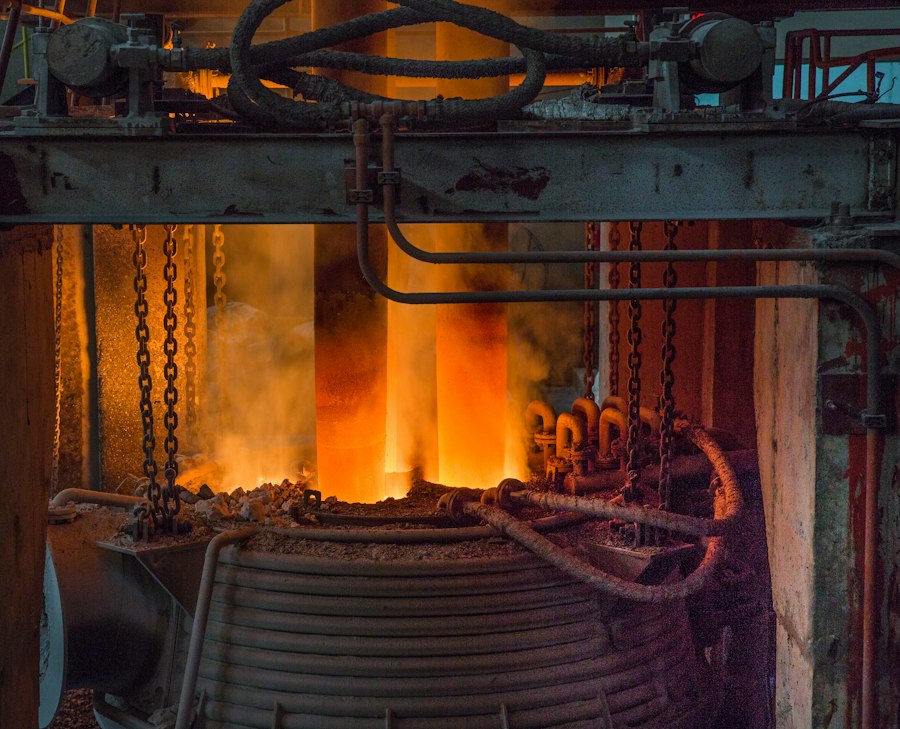
Induction melting furnaces rely on extremely high power levels to rapidly melt large quantities of metal. In these scenarios, eddy current generation is usually the primary driver of heat. The sheer magnitude of the alternating current in the induction coil creates very strong magnetic fields, leading to substantial eddy currents. While hysteresis might contribute in the initial stages of melting ferromagnetic materials, as the material transitions from solid to liquid and its magnetic properties change, eddy currents become the dominant force responsible for the intense heat required for melting.
Designing for Efficiency: The Role of Frequency and Coil
Optimizing an induction heating system involves carefully selecting the operating frequency and designing the induction coil.
- Frequency Selection: For surface treatments where shallow penetration is desired, high frequencies (e.g., hundreds of kHz to MHz) are used. For through heating or melting, lower frequencies (e.g., a few kHz to tens of kHz) are often preferred.
- Coil Design: The shape and size of the induction coil are critical for directing the magnetic field effectively and ensuring uniform heating. The coil must be closely matched to the geometry of the workpiece to maximize the coupling between the coil’s magnetic field and the workpiece. Complex geometries might require custom-designed coils to achieve even heating.
Eddy currents and hysteresis are two important concepts in the field of induction heating, each playing a crucial role in the efficiency of heating processes. For a deeper understanding of how these phenomena interact and affect various applications, you might find it helpful to explore a related article that delves into the science behind these concepts. This article provides insights into the practical implications of eddy currents and hysteresis in induction heating systems. You can read more about it in this fascinating article.
The Synergy and the Separation: When They Work Together and Apart
| Aspect | Eddy Currents Induction Heating | Hysteresis Induction Heating |
|---|---|---|
| Principle | Induced currents (eddy currents) in conductive materials generate heat due to electrical resistance. | Heat generated by magnetic hysteresis losses in ferromagnetic materials subjected to alternating magnetic fields. |
| Material Type | Conductive materials (e.g., copper, aluminum, steel). | Ferromagnetic materials (e.g., iron, nickel, cobalt alloys). |
| Heating Mechanism | Joule heating from circulating eddy currents. | Energy loss due to magnetic domain realignment and lag (hysteresis) in magnetic materials. |
| Frequency Range | Typically high frequency (kHz to MHz) to maximize eddy current generation. | Lower frequency range (Hz to kHz) to optimize hysteresis losses. |
| Efficiency | High efficiency in conductive, non-magnetic materials. | Efficient in magnetic materials with significant hysteresis loss. |
| Depth of Heating | Depends on skin depth, which decreases with frequency and material conductivity. | Generally shallow, limited by magnetic penetration and material properties. |
| Applications | Metal hardening, melting, brazing, cooking appliances. | Heat treatment of magnetic steels, annealing, tempering. |
| Temperature Range | Can reach very high temperatures rapidly. | Moderate to high temperatures depending on material and frequency. |
| Material Dependency | Requires good electrical conductivity. | Requires ferromagnetic properties and significant hysteresis loss. |
| Heat Distribution | More uniform in conductive materials; surface heating due to skin effect. | Localized heating in magnetic domains; may be less uniform. |
While we’ve discussed eddy currents and hysteresis as distinct phenomena, it’s important to recognize their relationship and how they can either work in concert or operate independently.
Ferromagnetic Materials: The Dynamic Duo
In ferromagnetic materials, you have a classic case of synergy. As the alternating magnetic field fluctuates, it simultaneously induces eddy currents and causes magnetic domain reorientation. Both processes contribute to the generation of heat. The relative dominance of each mechanism will shift based on the frequency and the specific material properties. For instance, at low frequencies, hysteresis might be the primary driver, but as the frequency increases, eddy currents become more prominent. This duality allows for a wider range of heating characteristics and applications.
Non-Ferromagnetic Materials: The Eddy Current Exclusive
For non-ferromagnetic conductive materials, the scenario is simpler: eddy currents are the sole mechanism for induction heating. There are no magnetic domains to align, so hysteresis losses are practically non-existent. This means that optimizing induction heating for these materials focuses entirely on maximizing eddy current generation. This involves carefully choosing the coil design, the frequency of the alternating current, and considering the material’s electrical conductivity and permeability.
The Impact of Temperature on Magnetic Properties
It’s also crucial to remember that the magnetic properties of ferromagnetic materials change with temperature, especially as they approach their Curie temperature (the temperature above which a ferromagnetic material loses its ferromagnetic properties and becomes paramagnetic). As a ferromagnetic material heats up and approaches its Curie temperature, its magnetic permeability decreases, and its hysteresis losses diminish. This means that the contribution of hysteresis to heating will decrease significantly as the workpiece gets hotter, and eddy current heating will become increasingly dominant. This transition is something to consider in applications that require heating to very high temperatures.
Conclusion: A Deeper Understanding for Smarter Heating
You now have a more comprehensive understanding of the two fundamental forces driving induction heating: eddy currents and hysteresis. You know that eddy currents are induced in any conductor and are the sole heating mechanism in non-ferromagnetic materials, while hysteresis is exclusive to ferromagnetic materials and arises from the reorientation of magnetic domains. You’ve seen how frequency plays a critical role in the depth of penetration and the relative contribution of each mechanism.
This knowledge empowers you to make more informed decisions when designing or selecting induction heating systems. Whether you’re aiming for precise surface hardening, uniform bulk heating, or rapid melting, understanding the nuances of eddy currents and hysteresis allows you to optimize your process for efficiency, speed, and desired outcome. It’s not just about applying a changing magnetic field; it’s about intelligently manipulating it to harness the unique properties of your materials and achieve your heating goals. The world of induction heating is a fascinating interplay of electromagnetism and material science, and by grasping these core principles, you’re well on your way to becoming an expert in this powerful heating technology.

The Pan Is the Heater: How Induction Cooking Really Works
FAQs
What is eddy current induction heating?
Eddy current induction heating is a process that uses electromagnetic induction to generate heat within a conductive material. This is achieved by creating eddy currents, which are loops of electrical current induced within the material due to a changing magnetic field.
How does hysteresis induction heating differ from eddy current induction heating?
Hysteresis induction heating relies on the magnetic properties of a material to generate heat, specifically through the hysteresis effect where energy is dissipated as heat when the material’s magnetic domains realign in response to a changing magnetic field. In contrast, eddy current induction heating generates heat through electrical resistance within the material.
What are the advantages of eddy current induction heating?
Eddy current induction heating offers fast and efficient heating of conductive materials, precise temperature control, uniform heating across the material, and the ability to heat only the desired areas without affecting the surrounding material.
What are the advantages of hysteresis induction heating?
Hysteresis induction heating is particularly effective for materials with high magnetic permeability, such as iron and steel, as it can achieve deep and uniform heating throughout the material. It also allows for precise control of the heating process and can be used for applications requiring high temperatures.
Which type of induction heating is more suitable for specific applications?
Eddy current induction heating is often preferred for applications requiring rapid heating of thin materials or localized heating, while hysteresis induction heating is more suitable for bulk heating of thick materials, especially those with high magnetic permeability. The choice between the two methods depends on the material properties, heating requirements, and desired heating outcomes.