The familiar, life-giving substance known as water, H2O, often fades into the background of our daily consciousness. It quenches our thirst, cleans our homes, and forms the vast oceans that dominate our planet. Yet, beneath its seemingly simple exterior lies a universe of scientific marvels, peculiar behaviors, and properties that defy conventional understanding. This article delves into the bizarre water wonders, exploring strange science facts about H2O that most people never encounter in their everyday lives, revealing a liquid far more complex and astonishing than it appears.
The Anomalous Nature of Water
Water is, in many ways, the oddball of the chemical world. Its molecular structure, a bent arrangement of one oxygen atom bonded to two hydrogen atoms, is not inherently unique. However, the consequences of this simple geometry, coupled with the polarity of the molecule, lead to a cascade of unusual properties that are fundamental to life as we know it. Without these anomalies, Earth would likely be a barren, frozen wasteland, devoid of the dynamic chemical processes that underpin biology.
Hydrogen Bonding: The Glue That Binds
The most significant factor contributing to water’s peculiar behavior is the phenomenon of hydrogen bonding. Due to oxygen’s higher electronegativity, the electrons in the O-H covalent bonds are pulled closer to the oxygen atom, giving it a partial negative charge and leaving the hydrogen atoms with partial positive charges. This creates a dipole moment within the water molecule, making it polar.
When water molecules come into proximity, the partially positive hydrogen atom of one molecule is attracted to the partially negative oxygen atom of another. This electrostatic attraction is known as a hydrogen bond. While individually weak, the sheer number of hydrogen bonds that can form between water molecules is immense, creating a dynamic, interconnected network. This network is responsible for many of water’s strange traits, from its unusually high boiling point to its remarkable surface tension. The constant breaking and reforming of these bonds at room temperature contribute to water’s fluid nature, but their cohesive force is what truly sets it apart.
Boiling Point Puzzlers
Compared to other hydrides of similar molecular weight, water exhibits an extraordinarily high boiling point. For instance, hydrogen sulfide (H2S), with a molecular weight slightly higher than water, boils at a frigid -60 degrees Celsius (-76 degrees Fahrenheit), while water remains liquid until it reaches a comparatively balmy 100 degrees Celsius (212 degrees Fahrenheit) at standard atmospheric pressure.
This discrepancy is directly attributable to hydrogen bonding. The extensive network of hydrogen bonds requires a significant amount of energy to overcome, meaning more heat must be applied to break these bonds and allow the water molecules to escape into the gaseous phase. Without this elevated boiling point, water would evaporate rapidly, making liquid water scarce on the Earth’s surface. This fundamental anomaly is a cornerstone of Earth’s climate and habitability, allowing for oceans, lakes, and rivers to persist.
Freezing Follies: Ice Floats!
Perhaps the most counterintuitive of water’s anomalies is its behavior when it freezes. Unlike most substances, which become denser as they solidify, water becomes less dense. When water freezes, the hydrogen bonds force the molecules into a crystalline lattice structure that is more open and spread out than the arrangement in liquid water. This means that ice, the solid form of water, floats on liquid water.
This seemingly simple fact has profound implications for aquatic ecosystems. If ice were denser than water, it would sink to the bottom of lakes and oceans, leading to a gradual freezing of these bodies from the bottom up. Life in these environments would be extinguished. Instead, the layer of ice on the surface acts as an insulator, protecting the liquid water beneath from freezing solid and allowing aquatic life to survive the winter. This phenomenon is a critical adaptation that sustains the vast biodiversity found in Earth’s water bodies.
If you’re intrigued by strange science facts about water, you might find the article on Freaky Science particularly fascinating. It delves into the unusual properties of water that often defy our expectations, such as its ability to exist in three states simultaneously and its role in supporting life on Earth. To explore more about these captivating aspects of water, check out the article here: Freaky Science.
The Curious Case of Supercooled Water
The transition from liquid to solid is often portrayed as a straightforward process: cool a liquid enough, and it will freeze. However, water has a peculiar tendency to resist this change under certain conditions, leading to the phenomenon of supercooling.
Resisting the Freeze
Supercooled water is liquid water that has been cooled below its freezing point (0 degrees Celsius or 32 degrees Fahrenheit) without forming ice crystals. This state is inherently unstable. For ice to form, there needs to be a nucleation site – a tiny impurity, a rough surface, or even a microscopic air bubble – around which the water molecules can arrange themselves into a crystal lattice. In the absence of such sites, water molecules can continue to move freely even at temperatures below freezing.
The extent to which water can be supercooled depends on its purity and the experimental conditions. Highly purified water in a smooth container can sometimes be cooled to as low as -40 degrees Celsius (-40 degrees Fahrenheit) before it spontaneously freezes. This resistance to freezing is a testament to the strong cohesive forces within liquid water, which need a significant disruption to initiate the phase change.
Spontaneous Crystallization and the “Water Hammer” Effect
When supercooled water is disturbed – perhaps by a slight bump, the introduction of an impurity, or even a change in air pressure – it can freeze almost instantaneously. This rapid and dramatic solidification is a vivid demonstration of its unstable state. The process can be so sudden that it resembles an explosion of ice crystals.
In some laboratory settings, this rapid freezing can create a noticeable pressure wave, often referred to informally as a “water hammer” effect, though it’s distinct from the plumbing phenomenon. This abrupt conversion of liquid to solid, which occupies a larger volume, can generate significant force. This demonstration of supercooling not only highlights water’s unusual properties but also underscores the delicate balance of forces at play in phase transitions.
Water’s Incredible Solubility Powerhouse
Water’s reputation as the “universal solvent” is well-earned, though it’s not entirely universal. Its polarity, a direct result of its bent molecular structure and the electronegativity difference between oxygen and hydrogen, is the key to its remarkable ability to dissolve a vast array of substances, making it indispensable for countless chemical reactions, particularly those occurring in biological systems.
The “Like Dissolves Like” Principle
The principle of solubility is often summarized by the adage “like dissolves like.” Polar solvents, such as water, tend to dissolve polar solutes and ionic compounds. Nonpolar solvents, on the other hand, dissolve nonpolar solutes. Water’s polarity allows it to interact favorably with ions and other polar molecules.
When an ionic compound, like table salt (NaCl), is placed in water, the partially negative oxygen atoms of water molecules surround the positively charged sodium ions (Na+), while the partially positive hydrogen atoms surround the negatively charged chloride ions (Cl-). These surrounding layers of water molecules, known as hydration shells, effectively isolate the ions from each other, dispersing them throughout the water and forming a solution. Similarly, polar molecules with partial charges can be surrounded and solubilized by water.
The Limits of “Universal”
Despite its impressive solvent capabilities, water does have limitations. Nonpolar substances, such as oils and fats, do not dissolve in water. This is because water molecules are strongly attracted to each other through hydrogen bonds. When nonpolar molecules are introduced, they cannot effectively disrupt these hydrogen bonds or form favorable interactions with water. Instead, water molecules tend to arrange themselves in a way that minimizes contact with the nonpolar substance, effectively pushing it away. This phenomenon is why oil and water separate. This selectivity, however, is crucial for many biological processes, such as the formation of cell membranes.
Water’s Unexpected States and Phenomena
Beyond its common liquid, solid (ice), and gaseous (steam) states, water exhibits some truly bizarre behaviors and can exist in states that challenge our everyday understanding. These less common states and phenomena further emphasize the complexity of this seemingly simple molecule.
High-Pressure Ice: More Than Just Cubes
The ice we are familiar with is known as Ice Ih (Ice one hexagonal). However, under extreme pressure, water can solidify into a variety of different crystalline forms, each with unique properties. Scientists have identified at least 18 different phases of ice, each requiring specific temperature and pressure conditions to form.
Some of these high-pressure ice phases are denser than liquid water, meaning they would sink if they formed in the ocean. Others have properties that are quite astonishing. For example, Ice VII, which forms at pressures exceeding 20,000 atmospheres, is cubic and can exist at temperatures far above the normal freezing point. The existence of these diverse ice phases has significant implications for understanding the interiors of icy planets and moons in our solar system, where such conditions might prevail.
The Mysterious Nature of Water Clusters
At extremely low pressures and temperatures, water molecules can exist in transient, loosely bound structures known as water clusters. These clusters are not stable solid phases but rather dynamic aggregates of a few to hundreds of water molecules held together by hydrogen bonds.
The study of water clusters is a challenging area of research, as they are difficult to isolate and observe. However, they are believed to play a role in various chemical and biological processes. Their existence suggests that even in its most sparse and isolated forms, water maintains a complex, interconnected molecular network, hinting at a level of organization that goes beyond simple molecular motion.
If you’re fascinated by unusual science facts about water, you might enjoy exploring more intriguing topics at this website. Water is not just essential for life; it also exhibits some bizarre properties that can surprise even the most seasoned scientists. From its ability to expand when frozen to its role in shaping weather patterns, the study of water reveals a world of wonders that challenge our understanding of the natural environment.
Water’s Role in Biological Extremes
| Fact | Metric/Value | Description |
|---|---|---|
| Water Expands When Frozen | 9% | Unlike most substances, water expands by about 9% when it freezes, causing ice to be less dense than liquid water. |
| Water’s High Surface Tension | 72.8 mN/m at 20°C | Water has one of the highest surface tensions among liquids, allowing insects like water striders to walk on its surface. |
| Water Can Exist in Three States Simultaneously | Triple Point at 0.01°C and 611.657 Pa | At the triple point, water can coexist as solid, liquid, and gas simultaneously. |
| Water’s Heat Capacity | 4.18 J/g°C | Water has a very high specific heat capacity, meaning it can absorb a lot of heat before increasing in temperature. |
| Water’s Anomalous Density | Maximum density at 3.98°C | Water reaches its maximum density at 3.98°C, which is unusual compared to most substances that become denser as they cool. |
| Water’s Electrical Conductivity | Pure water: ~0.055 µS/cm | Pure water is a poor conductor of electricity, but impurities can greatly increase its conductivity. |
Water’s unique properties are not only responsible for its physical anomalies but are also fundamental to the survival of life in some of the most extreme environments on Earth. Its ability to resist temperature fluctuations and its solvent power are critical for biological resilience.
Antifreeze Proteins: Nature’s Frost Guard
Many organisms living in frigid environments, such as polar fish and certain insects, have developed remarkable adaptations to survive temperatures below freezing. One of the most fascinating is the production of antifreeze proteins (AFPs).
These proteins bind to the surface of ice crystals, preventing them from growing larger and damaging the organism’s cells. AFPs work by lowering the freezing point of water in the organism’s body without significantly affecting its osmotic pressure. This allows the organism to remain liquid even when the external temperature is well below 0 degrees Celsius. The discovery and study of AFPs have not only shed light on biological survival strategies but have also inspired the development of new cryopreservation techniques and ice-retardant materials.
Water as a Biological Stabilizer
The high heat capacity of water, another consequence of hydrogen bonding, means that it takes a significant amount of energy to change its temperature. This property is crucial for regulating the internal temperature of living organisms. Cells are primarily composed of water, and this high heat capacity helps to buffer against rapid temperature fluctuations in the environment, preventing cells from overheating or freezing.
Furthermore, water’s role as a solvent is essential for nearly every biochemical reaction that occurs within living organisms. Nutrients are transported, waste products are removed, and complex metabolic processes take place within aqueous environments. The specific properties of water, including its polarity and its ability to form hydrogen bonds, create a unique medium that is perfectly suited for the intricate chemistry of life. Without water’s bizarre yet life-sustaining anomalies, the intricate tapestry of biological existence on Earth would simply not be possible. From the microscopic interactions within a single cell to the grand scale of oceanic circulation, water’s peculiar nature is the silent architect of our living world.
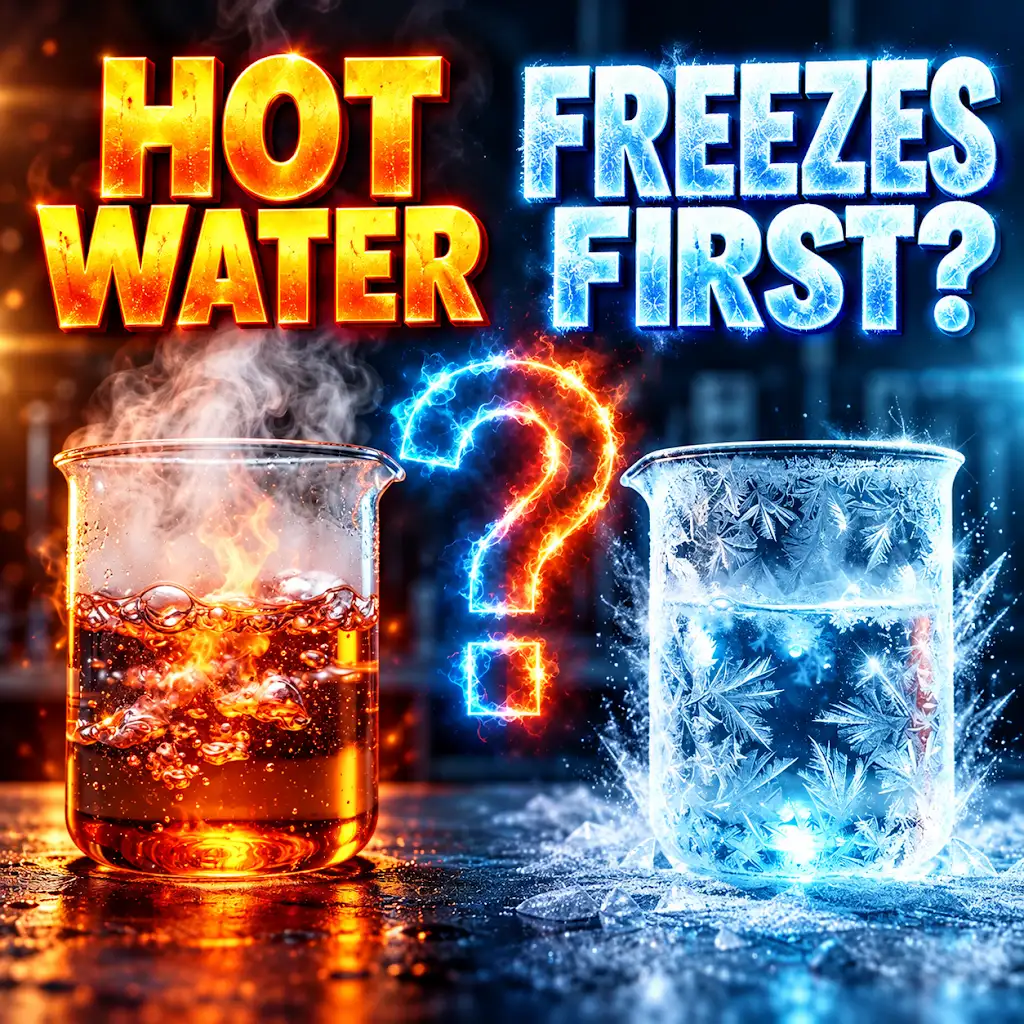
Why Hot Water Freezes Faster Than Cold (The Mpemba Effect)
FAQs
What is the only substance that can exist in all three states of matter naturally on Earth?
Water is the only substance that can exist as a solid (ice), liquid (water), and gas (water vapor) naturally on Earth.
Why does ice float on water?
Ice floats on water because it is less dense than liquid water. This is due to the unique structure of water molecules, which causes them to form a crystalline lattice when frozen, making ice less dense than liquid water.
How much of the Earth’s surface is covered by water?
Approximately 71% of the Earth’s surface is covered by water, with the majority of it being in the form of oceans and seas.
Can water exist in a supercooled state?
Yes, water can exist in a supercooled state, which means it remains liquid below its freezing point without turning into ice. This phenomenon occurs under specific conditions and is often used in scientific research.
What is the boiling point of water at sea level?
Water boils at 100 degrees Celsius (212 degrees Fahrenheit) at sea level. The boiling point of water can vary with changes in altitude and atmospheric pressure.