The cosmos, vast and filled with luminous islands of stars, has long been a subject of human fascination. For centuries, astronomers charted its contents, gradually revealing a universe far grander than imagined. Yet, as observational tools sharpened and the finesse of scientific inquiry grew, a profound revelation began to dawn: the universe is not merely expanding, it is doing so at an ever-increasing pace. This phenomenon, known as cosmic acceleration, stands as one of the most significant and perplexing discoveries in modern cosmology, fundamentally altering our understanding of the universe’s past, present, and ultimate fate. Accompanying this acceleration is the inexorable separation of galaxies, a dynamic dance dictated by the expansion itself.
The initial glimmer of understanding the universe’s dynamic nature emerged in the early 20th century. Observations by Vesto Slipher revealed that most nebulae, then thought to be distant gas clouds, exhibited redshift in their spectral lines. This redshift indicated that these objects were moving away from Earth. Later, Edwin Hubble, building upon Slipher’s work and the theoretical framework provided by Georges Lemaître, quantitatively demonstrated this outward motion.
Redshift as a Cosmic Yardstick
The concept of redshift is central to understanding cosmic expansion. As a light source moves away from an observer, the wavelengths of the light it emits are stretched, shifting towards the red end of the electromagnetic spectrum. This phenomenon, analogous to the Doppler effect for sound waves, where the pitch of a siren lowers as it moves away, serves as a direct indicator of recessional velocity. The greater the redshift, the faster the object is receding.
Hubble’s Law and the Expanding Cosmos
Hubble’s meticulous measurements of the distances to galaxies and their recessional velocities led to the formulation of Hubble’s Law. This empirical relationship, often expressed as $v = H_0 d$, states that the recessional velocity ($v$) of a galaxy is directly proportional to its distance ($d$) from us. The proportionality constant, $H_0$, is known as the Hubble constant, representing the rate of expansion of the universe at the present time. This law was a paradigm shift, suggesting that the universe is not static but is actively expanding, with galaxies moving away from each other like dots on an inflating balloon.
The Steady State vs. Big Bang: Early Debates
The implications of Hubble’s Law sparked intense debate within the scientific community. One prominent alternative to the Big Bang model was the Steady State theory, which proposed that the universe has always existed in roughly the same state, with new matter continuously created to maintain a constant density as it expands. However, accumulating evidence, particularly the discovery of the cosmic microwave background radiation by Arno Penzias and Robert Wilson in 1964, strongly favored the Big Bang model, which posits a universe that originated from an extremely hot and dense state and has been expanding and cooling ever since.
Recent studies on cosmic acceleration and the increasing separation of galaxies have sparked significant interest in the astrophysics community. A related article that delves into these phenomena can be found at Freaky Science, where researchers explore the implications of dark energy and its role in the expansion of the universe. This article provides insights into how the dynamics of galaxy formation and movement are influenced by the mysterious forces at play in our cosmos.
The Surprise of Acceleration: Challenging Expectations
For decades, the prevailing view, informed by the Big Bang model, was that the expansion of the universe should be slowing down. The gravitational pull of all the matter within the universe was expected to act as a cosmic brake, counteracting the initial outward push from the Big Bang. However, as the 1990s drew to a close, observational data began to paint a contradictory picture, hinting at a force that was not braking the expansion but was instead accelerating it.
Supernovae as Cosmic Candles
The key to unlocking the secret of cosmic acceleration came from an unlikely yet remarkably consistent celestial object: Type Ia supernovae. These exploding stars are not just spectacular cosmic events; they are also incredibly uniform in their intrinsic brightness, making them “standard candles.”
The Nature of Type Ia Supernovae
Type Ia supernovae occur when a white dwarf star in a binary system accretes matter from its companion star. When the white dwarf reaches a critical mass, known as the Chandrasekhar limit (approximately 1.4 times the mass of our Sun), a runaway nuclear fusion reaction is triggered, leading to a cataclysmic explosion. Because this mass limit is so consistent, the peak luminosity of Type Ia supernovae is remarkably similar across different events.
Measuring Distant Supernovae
By observing the apparent brightness of a Type Ia supernova and knowing its intrinsic brightness, astronomers can accurately determine its distance. The dimmer a supernova appears, the farther away it is. This ability to gauge distances precisely allowed scientists to probe the expansion history of the universe over vast cosmic timescales.
The Decelerating Universe Illusion
Early cosmological models, based on a matter-dominated universe, predicted that the expansion rate should be decreasing over time. Therefore, when astronomers observed distant Type Ia supernovae, they expected them to appear brighter than predicted by a constant expansion rate, as they would have been moving away more slowly in the past. This would indicate that the expansion had decelerated.
The Nobel Prize-Winning Revelation
Two independent teams – the Supernova Cosmology Project led by Saul Perlmutter, and the High-Z Supernova Search Team led by Brian Schmidt and Adam Riess – meticulously analyzed data from distant Type Ia supernovae. Their findings, published in 1998, were astonishing. The distant supernovae were, on average, dimmer than expected, implying that they were farther away than predicted by a decelerating universe. This could only mean one thing: the expansion of the universe was not slowing down; it was speeding up. This groundbreaking discovery earned Perlmutter, Schmidt, and Riess the Nobel Prize in Physics in 2011.
The Enigma of Dark Energy: The Driving Force
The discovery of cosmic acceleration immediately posed a profound question: what is causing this acceleration? The mere presence of matter and radiation, which exert gravitational attraction, cannot explain this outward push. This led to the hypothetical concept of “dark energy,” a mysterious form of energy that permeates all of space and possesses a negative pressure, thereby driving the accelerated expansion.
Dark Energy: A Cosmic Repellent
Imagine the universe as a stretched rubber sheet. Ordinary matter and dark matter are like weights placed on the sheet, causing it to curve inward and try to pull things together. Dark energy, on the other hand, acts like an anti-gravity force, pushing the sheet outward and making the expansion accelerate. Its influence becomes more dominant as the universe expands and the density of matter decreases.
Cosmological Constant and Beyond
The simplest explanation for dark energy is Einstein’s cosmological constant ($\Lambda$), which he introduced in his theory of general relativity to allow for a static universe, a concept later abandoned when expansion was discovered. However, if the cosmological constant represents a constant energy density of the vacuum, its value is incredibly small based on theoretical predictions, a discrepancy known as the “cosmological constant problem.”
Vacuum Energy
Quantum field theory suggests that even empty space is filled with fluctuating quantum fields, which possess a certain energy. This vacuum energy could, in principle, behave like dark energy. However, the predicted value of vacuum energy is vastly larger than what is observed, by a factor of around $10^{120}$. This immense gap remains one of the biggest puzzles in physics.
Quintessence and Other Theories
Other theoretical frameworks propose dynamic forms of dark energy, often referred to as “quintessence.” These theories suggest that dark energy is not a constant but rather a field that can evolve over time, similar to the scalar fields responsible for cosmic inflation in the early universe. Studying the precise behavior and evolution of dark energy is a major goal of ongoing cosmological research.
The Dominant Component of the Universe
Current cosmological models estimate that dark energy constitutes approximately 68% of the total energy density of the universe. Dark matter, another invisible yet gravitationally influential component, makes up about 27%, and ordinary matter, which forms stars, planets, and everything we can see, accounts for only about 5%. This means that the vast majority of the universe’s composition is made up of entities we do not fully understand.
Galaxy Separation: The Dance of Cosmic Expansion
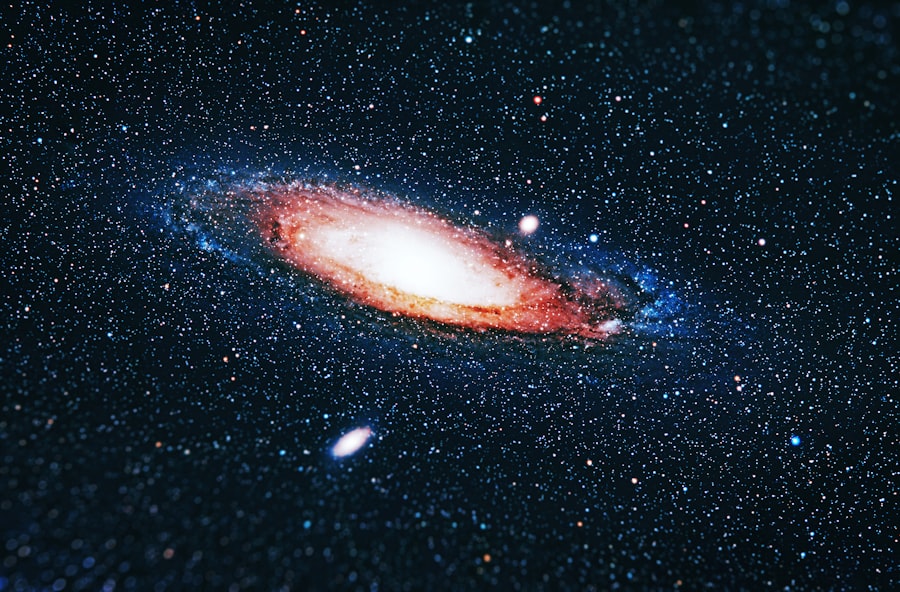
As the universe expands, the distances between gravitationally unbound objects, such as galaxies and clusters of galaxies, increase. This phenomenon, known as galaxy separation, is a direct consequence of the expanding space-time fabric itself.
Beyond Local Gravitation
Within gravitationally bound structures like galaxies, stars and gas clouds are held together by their mutual gravitational attraction. This local gravity overcomes the expansive force of the universe, preventing these structures from being torn apart. For instance, our Milky Way galaxy is not expanding; its stars are bound by gravity.
The Cosmic Web and Its Evolution
On larger scales, galaxies are distributed in a vast, filamentary structure known as the cosmic web. This web consists of dense clusters of galaxies, separated by immense voids. The expansion of the universe drives the separation of these galactic structures, causing the voids to grow larger and the filaments to become more stretched over cosmic time.
The Redshift-Distance Relationship Revisited
The redshift of distant galaxies, as established by Hubble’s Law, directly reflects their recession velocity due to cosmic expansion. Thus, observing a higher redshift for a particular galaxy indicates that it is farther away and is separating from us at a faster rate. This relationship allows astronomers to map the large-scale structure of the universe and study its expansion history.
Kinematic vs. Cosmological Redshift
It is important to distinguish between kinematic redshift, caused by the motion of an object through space (like the Doppler effect), and cosmological redshift, caused by the expansion of space itself. While local motions can contribute to the observed redshift of galaxies, the dominant component for distant galaxies is cosmological redshift.
The Future of Galaxy Separation
As cosmic acceleration continues, the rate at which galaxies separate will also increase. In the far future, galaxies that are now observable may recede from us so rapidly that their light will be stretched to wavelengths beyond our detection capabilities, effectively disappearing from our visible horizon.
Recent studies have shed light on the intriguing phenomenon of cosmic acceleration and its impact on galaxy separation, revealing how the expansion of the universe influences the distribution of galaxies over time. For a deeper understanding of this topic, you can explore an insightful article that discusses the implications of dark energy on cosmic structures. This article can be found at Freaky Science, where you will discover more about the relationship between cosmic forces and the vastness of our universe.
Probing Cosmic Acceleration: Observational Frontiers
| Metric | Value | Units | Description |
|---|---|---|---|
| Hubble Constant (H₀) | 70 | km/s/Mpc | Current rate of expansion of the universe |
| Dark Energy Density (ΩΛ) | 0.7 | Dimensionless | Fraction of total energy density attributed to dark energy |
| Matter Density (Ωm) | 0.3 | Dimensionless | Fraction of total energy density attributed to matter |
| Galaxy Separation Rate | ~70 | km/s/Mpc | Average rate at which galaxies move apart due to cosmic expansion |
| Acceleration Parameter (q₀) | -0.55 | Dimensionless | Indicates the acceleration of the universe’s expansion |
| Scale Factor Growth | ~1.7 | Since z=1 | Increase in the universe’s scale factor since redshift 1 |
Understanding cosmic acceleration and the nature of dark energy requires sophisticated observational techniques and large-scale cosmological surveys. Scientists are employing various methods to gather more precise data and test different theoretical models.
Supernovae Surveys: Refining the Data
Ongoing and future supernova surveys aim to detect and measure thousands, if not millions, of Type Ia supernovae across a wide range of redshifts. These surveys will provide more precise measurements of the expansion history of the universe, helping to constrain the properties of dark energy and distinguish between different models.
The Dark Energy Survey (DES)
The Dark Energy Survey, for example, has been a major effort to map the distribution of galaxies and the evolution of cosmic structure, using data from a large-format camera on the Victor M. Blanco 4-meter Telescope in Chile.
The Nancy Grace Roman Space Telescope
The upcoming Nancy Grace Roman Space Telescope will be equipped with a wide-field infrared survey instrument that will enable it to survey billions of galaxies and detect millions of supernovae, providing unprecedented data for dark energy research.
Baryon Acoustic Oscillations (BAO): A Cosmic Ruler
Baryon Acoustic Oscillations (BAOs) are relic patterns in the distribution of matter imprinted in the early universe. These patterns can be used as a “standard ruler” to measure distances in the universe. By observing the large-scale distribution of galaxies, astronomers can detect these BAO signatures and use them to measure the expansion rate at different cosmic epochs.
The imprint of the Early Universe
The BAO scale originated from the sound waves that propagated through the hot, dense plasma of the early universe before recombination. After recombination, these sound waves left a characteristic imprint on the density fluctuations of matter, which can still be observed today in the clustering of galaxies.
Weak Gravitational Lensing: Mapping Dark Matter and Dark Energy
Weak gravitational lensing is a technique that measures the subtle distortions in the shapes of distant galaxies caused by the gravitational pull of intervening matter, including dark matter. By studying these distortions across large areas of the sky, astronomers can map the distribution of dark matter and its evolution, which is influenced by dark energy.
The Influence of Dark Energy on Structure Formation
Dark energy’s repulsive force acts as a brake on the growth of cosmic structures. By measuring how structure formation has proceeded over time, scientists can infer the properties of dark energy.
Testing Dark Energy Models
Each of these observational probes provides complementary information. By combining data from supernovae, BAOs, and weak lensing, astronomers can rigorously test various dark energy models and search for deviations from the simplest cosmological constant explanation. The goal is to understand if dark energy is indeed a constant or if it evolves over cosmic time.
The Cosmic Future: A Lonely Destiny?
The continued acceleration of cosmic expansion has profound implications for the long-term future of the universe. If dark energy continues to dominate, the universe is destined for an increasingly cold and empty state, leading to a scenario known as the “Big Freeze” or “Heat Death.”
The Isolation of Galaxies
As galaxies continue to separate at an accelerating rate, those beyond our local group will eventually recede beyond our observable horizon. This means that over billions of years, our view of the cosmos will become increasingly impoverished, with only our gravitationally bound neighbors remaining visible.
The Fate of the Local Group
While galaxies outside our local group will recede, the galaxies within our local group, such as Andromeda, are gravitationally bound and will eventually merge with the Milky Way. This will result in a single, large elliptical galaxy in our cosmic neighborhood.
The Fading of Starlight
As the expansion continues, the stars in galaxies will eventually exhaust their fuel and cease to shine. The universe will become progressively darker, with only faint radiation from black holes and the lingering remnants of stellar death.
The End of Active Star Formation
With increasing isolation and the depletion of gas and dust in galaxies, star formation will eventually cease. This will lead to a universe populated by old, dim stellar remnants.
The Ultimate Fate: Big Freeze or Big Rip?
The “Big Freeze” scenario predicts a universe that continues to expand and cool indefinitely, eventually reaching a state of maximum entropy where no further work can be done. An even more speculative possibility, dependent on the precise nature of dark energy, is the “Big Rip.” If dark energy’s repulsive force were to grow stronger over time, it could eventually overcome all other forces, tearing apart galaxies, stars, planets, and even atoms themselves. However, current observational data do not strongly support this extreme scenario.
The study of cosmic acceleration and galaxy separation is a vibrant and evolving field. It pushes the boundaries of our understanding, revealing a universe far more dynamic and mysterious than previously imagined. The quest to unravel the nature of dark energy and its cosmic influence is one of the most compelling scientific endeavors of our time, promising to reshape our cosmic perspective for generations to come.

WATCH NOW ▶️ Our Galaxy Is Sliding Toward a Cosmic Drain
FAQs
What is cosmic acceleration?
Cosmic acceleration refers to the observed increase in the rate at which the universe is expanding. This phenomenon means that galaxies are moving away from each other faster over time, rather than slowing down due to gravitational attraction.
What causes the acceleration of the universe’s expansion?
The acceleration is primarily attributed to a mysterious form of energy known as dark energy, which makes up about 68% of the total energy content of the universe. Dark energy exerts a repulsive force that counteracts gravity, driving galaxies apart at an increasing rate.
How does cosmic acceleration affect the separation between galaxies?
As cosmic acceleration progresses, the distances between galaxies increase more rapidly. This means that galaxies not gravitationally bound to each other will move farther apart over time, making the universe appear more diffuse on large scales.
How do scientists measure cosmic acceleration?
Scientists measure cosmic acceleration by observing distant supernovae, the cosmic microwave background radiation, and large-scale structures in the universe. These observations help determine the rate of expansion and how it changes over time.
What implications does cosmic acceleration have for the future of the universe?
If cosmic acceleration continues indefinitely, it could lead to a scenario known as the “Big Freeze,” where galaxies move so far apart that stars eventually burn out, and the universe becomes cold and dark. Understanding cosmic acceleration is crucial for predicting the ultimate fate of the cosmos.