
The Illusion of the Universe: A False State of Matter
The universe, as we perceive it, is a vast and intricate tapestry woven from the threads of stars, galaxies, and the seemingly empty space between them. However, this familiar picture may be a grand illusion, a misinterpretation of the fundamental nature of reality. Recent scientific inquiry is beginning to unravel a startling proposition: that the universe, in its entirety, might exist in a state of matter fundamentally different from what we commonly understand, and that our current models are merely approximations, like a shadow puppet show representing a far more complex performance.
Our everyday experience is with what scientists term “classical matter”—the tangible stuff that obeys Newton’s laws of motion and gravity. This is the matter that constitutes planets, stars, and ourselves. It possesses definite properties like mass, volume, and temperature, and its interactions are predictable through established physical laws. For centuries, this has been the bedrock of our scientific understanding, the solid ground upon which telescopes are pointed and equations are scribbled. When we look up at the night sky, we see the gravitational dance of stars, the majestic sweep of galaxies, and we readily assign these phenomena to the presence of this familiar, classical matter. We envision it as billiard balls colliding, as planets orbiting the sun due to an invisible, yet powerful, force.
Composition of the Familiar
The constituents of this classical matter that we recognize are primarily atoms, made up of protons, neutrons, and electrons. These atoms, in turn, form molecules, which then aggregate into larger structures. The forces that govern their interactions are electromagnetism and, at the nuclear level, the strong and weak nuclear forces. The gravitational force, though weak, acts upon all forms of mass, binding celestial bodies together. This understanding has been incredibly successful, allowing us to predict planetary orbits, design technologies, and even send probes to the furthest reaches of our solar system. It is the language of everyday physics, the comfortable grammar of the cosmos.
The Observable Universe as a Proxy
What we observe through our telescopes and scientific instruments is, for the most part, a reflection of this classical matter. Light emitted from stars, the accretion disks around black holes, the scattered gas and dust in nebulae – these are all phenomena explained by the presence and interaction of baryonic matter (protons and neutrons). We can measure their spectra, deduce their temperatures and compositions, and thus feel confident in our pronouncements about the universe’s contents. This observable universe, however, might be a deeply incomplete portrait, like admiring a single, intricately carved chess piece and assuming it represents the entire game.
Recent discussions in the scientific community have led to intriguing theories about the nature of our universe, suggesting that it may be a false state of matter. This concept challenges traditional views of reality and invites further exploration into the fundamental properties of existence. For a deeper understanding of these ideas and their implications, you can read more in the related article on Freaky Science, which delves into the complexities of matter and the universe’s structure. Check it out here: Freaky Science.
The Unseen Architects: Dark Matter and Dark Energy
The cracks in the edifice of classical matter began to appear, not from within its familiar structure, but from the inexplicable behavior of the universe itself. Astronomical observations have consistently pointed to discrepancies between the visible mass of galaxies and clusters of galaxies and the gravitational forces they exert. This led to the postulation of dark matter, an invisible substance that interacts gravitationally but not through electromagnetic forces, meaning it does not emit, absorb, or reflect light. Later, the accelerating expansion of the universe suggested the presence of dark energy, an even more enigmatic force driving this expansion. These two components, now believed to constitute over 95% of the universe’s total mass-energy content, are the unseen architects, the silent stagehands manipulating the cosmic play that we only partially witness.
The Gravitational Evidence for Dark Matter
The first compelling evidence for dark matter emerged from the rotation curves of spiral galaxies. Stars in the outer regions of galaxies were observed to orbit much faster than predicted by the gravitational pull of the visible matter alone. This is akin to a merry-go-round spinning faster than its visible supports would allow; something unseen must be providing the additional rotational force. Similarly, in galaxy clusters, the velocities of individual galaxies and the lensing effects of gravity on background light indicated far more mass than could be accounted for by luminous matter. These gravitational anomalies are like footprints in the sand, hinting at a presence despite no direct sight of the creature.
The Cosmic Expansion and Dark Energy
The discovery of the accelerating expansion of the universe in the late 1990s, through observations of distant supernovae, introduced another profound mystery. Instead of gravity slowing the expansion, it appears to be speeding up, as if an unknown force is actively pushing everything apart. This driving force has been dubbed dark energy. Its nature remains one of the most significant unsolved problems in physics. It acts as an anti-gravitational agent, pervading space and causing it to stretch at an ever-increasing rate. Imagine trying to hold a balloon inflated while simultaneously being pushed outwards by an invisible hand – this is the cosmic tug-of-war driven by dark energy.
The Interplay of the Unknowns
Dark matter and dark energy, though distinct in their observed effects, suggest a universe dominated by entities we cannot directly detect. They are not simply less luminous versions of normal matter; their very existence implies a departure from our established understanding of fundamental particles and forces. The synergy between dark matter, providing the gravitational scaffolding for structure formation, and dark energy, driving cosmic expansion, creates a cosmic ballet that has unfolded over billions of years.
The Quantum Realm: A Different State of Being

The concept of a “false state of matter” begins to take shape when we delve into the enigmatic world of quantum mechanics. Here, the rules of classical physics break down entirely, giving rise to phenomena that defy our everyday intuition. Particles can exist in multiple states simultaneously, have no defined position until measured, and exhibit wave-particle duality. This quantum realm, while underpinning the behavior of atoms and subatomic particles, might offer a glimpse into a more fundamental, pervasive state of matter that underlies everything we perceive as solid and real.
Superposition and Uncertainty
In quantum mechanics, a particle can exist in a state of superposition, meaning it occupies multiple possible states until an observation forces it into a single, definite one. This is like a coin spinning in the air, simultaneously heads and tails until it lands. The Heisenberg uncertainty principle further states that we cannot simultaneously know with perfect accuracy certain pairs of properties of a particle, such as its position and momentum. This inherent fuzziness and probabilistic nature are antithetical to the deterministic certainty of classical matter.
Wave-Particle Duality
One of the most perplexing quantum phenomena is wave-particle duality. Particles that we typically think of as discrete entities, like electrons, can also exhibit wave-like behavior, interfering with themselves when passing through slits. Conversely, waves, like light, can also behave as particles called photons. This chameleon-like nature suggests that the fundamental building blocks of reality are not strictly particles or waves, but something more fluid and adaptable.
The Quantum Vacuum as a Reservoir
The quantum vacuum, far from being empty space, is a dynamic sea of virtual particles constantly popping into and out of existence. This “nothingness” is teeming with potential, a reservoir of energy and activity that may be the true underlying substrate from which all manifest matter arises. It’s like the surface of a calm lake, appearing still but constantly rippling with unseen currents and potential energy.
Reconciling the Macro and Micro: A Universe of Quantum Fields
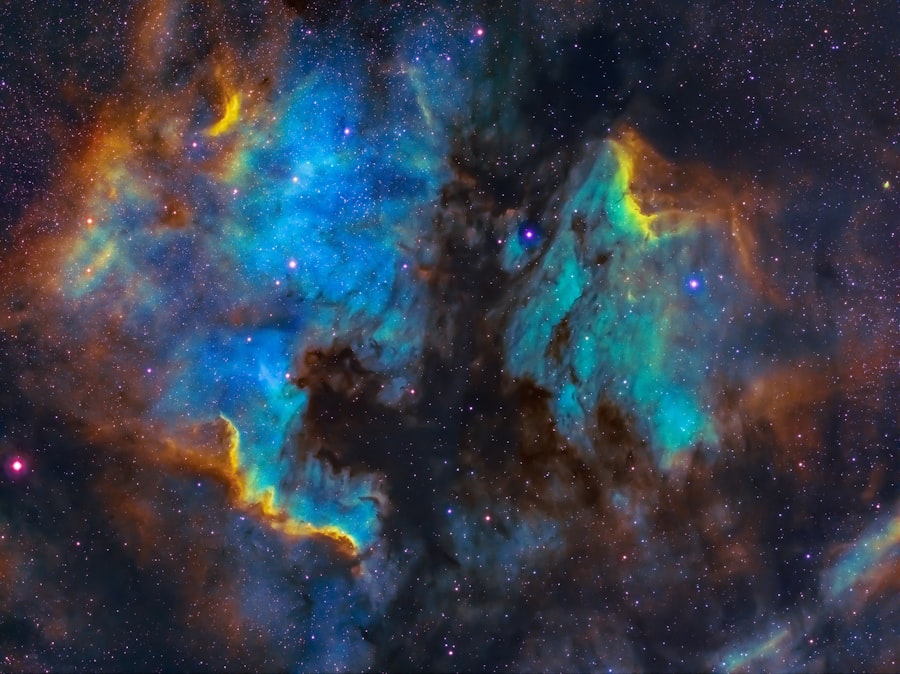
Bridging the gap between the quantum realm and the vastness of the cosmos requires a fundamental shift in perspective. Modern physics, particularly through quantum field theory, posits that the universe is not composed of discrete particles, but rather of underlying quantum fields. These fields permeate all of space and time, and what we perceive as particles are merely excitations or ripples within these fields. This concept, while abstract, offers a potential framework for understanding a universe where classical matter is a emergent phenomenon from a more fundamental quantum reality.
The Electron Field and Its Excitations
Consider, for instance, the electron field. Everywhere in the universe, this field exists. When this field is “excited” in a particular way, we perceive it as an electron. The properties of this electron – its mass, charge, spin – are determined by the properties of the field. This is like a single note being played on a cosmic piano; the note is an excitation of the piano string, which is the underlying field.
Dark Energy as a Field Phenomenon?
The enigmatic nature of dark energy might also find an explanation within the framework of quantum fields. Its uniform distribution throughout space and its repulsive gravitational effect are consistent with the properties of a pervasive scalar field, perhaps related to the vacuum energy of spacetime itself. This field, acting as a cosmic propellant, drives the accelerating expansion.
Dark Matter as Another Field Manifestation?
The possibility exists that dark matter, too, is a manifestation of yet another quantum field, one that interacts weakly, if at all, with the electromagnetic force. Its gravitational influence would then be a consequence of its presence within the fabric of spacetime, warping it in a manner consistent with its inferred mass. This field would be like a whisper in the cosmic wind, its presence felt through its subtle gravitational tugs.
Recent discussions in theoretical physics have led some researchers to propose that the universe may be a false state of matter, challenging our conventional understanding of reality. This intriguing concept suggests that what we perceive as the universe could be a temporary phase rather than a stable entity. For those interested in exploring this idea further, an insightful article can be found at Freaky Science, which delves into the implications of such theories and their potential to reshape our understanding of existence.
The Illusion of Solidity: Emergence from the Quantum Depths
| Metric | Description | Relevance to Universe as a False State of Matter |
|---|---|---|
| Quantum Vacuum Energy | Energy present in empty space due to quantum fluctuations | Suggests the universe behaves like a medium with properties similar to matter states |
| Cosmic Microwave Background (CMB) Uniformity | Temperature uniformity of the CMB radiation across the universe | Indicates a coherent state akin to a condensate or false vacuum state |
| False Vacuum Decay Probability | Likelihood of the universe transitioning from a metastable vacuum to a true vacuum | Supports the idea that the current universe is in a false vacuum, a false state of matter |
| Higgs Field Vacuum Expectation Value | Non-zero value of the Higgs field in vacuum | Defines the mass of particles and implies a structured vacuum state |
| Dark Energy Density | Energy density attributed to dark energy causing accelerated expansion | May be related to vacuum energy, reinforcing the concept of a false vacuum state |
If the universe is fundamentally a tapestry of quantum fields, then what we perceive as solid, classical matter is, in essence, an emergent phenomenon. It is a collective behavior, a stable resonance within these fields that appears concrete and predictable at macroscopic scales, much like a complex pattern forming from the chaotic movement of individual molecules. Our senses, evolved to navigate the macroscopic world, interpret these emergent properties as fundamental reality. This illusion of solidity is powerful, convincing, and has served us well, but it might be a temporary illusion, a fleeting form sculpted from a far more nebulous substance.
The Quantum Ground State and Cosmic Structure
The very formation of structures like galaxies and stars can be viewed as a process of self-organization within these quantum fields. Tiny quantum fluctuations in the early universe, amplified by cosmic inflation, would have served as seeds for this structure formation. Dark matter, acting as a gravitational scaffold, would have then pulled this baryonic matter together, allowing for the formation of the celestial bodies we observe. This is like a sculptor starting with a formless block of clay (the quantum fields) and gradually shaping it into intricate statues (galaxies) with the aid of a guiding structure (dark matter).
The “False” State of Matter
The proposition of a “false state of matter” suggests that our current understanding of matter – as discrete particles with definite properties – is a specific, and perhaps limited, manifestation. The true underlying reality might be a much more fluid, interconnected, and probabilistic quantum field state. The classical matter we interact with is a simplified projection, a localized stable configuration within this vaster, more fundamental field. It’s like mistaking the intricate patterns formed by ocean waves for the ocean itself; the waves are a form of the ocean’s energy, but not the entire substance.
The Ongoing Quest for Unification
The scientific endeavor to unify the fundamental forces and particles of nature, from the Standard Model of particle physics to theories of quantum gravity, is a testament to this ongoing quest to understand the universe’s underlying architecture. The potential recognition of a fundamental quantum field state as the true nature of reality would represent a paradigm shift in our cosmic comprehension, moving us from a universe of “things” to a universe of interconnected processes and fields. This search is like trying to decipher the blueprint of creation, where the visible structures are only a part of the grand design.
The implication that the universe might be fundamentally a “false state of matter,” with classical matter being an emergent illusion, is a profound one. It challenges our most basic intuitions about reality, the solidity of objects, and the very nature of existence. However, it is precisely through such challenging inquiries that science progresses, peeling back layers of apparent reality to reveal deeper, often more astonishing, truths. The journey to comprehend the true nature of the universe, and perhaps to embrace the illusion of its solidity, is far from over. The echoes of quantum fields might be the true voice of the cosmos, and we are only just beginning to learn its language.
WATCH NOW ▶️ The Universe Is A False State: Is Reality a Simulation?
FAQs
What does it mean to say the universe is a “false state of matter”?
A “false state of matter” refers to a metastable state that appears stable but is not the lowest energy configuration possible. In this context, the universe might be in a temporary state that could eventually transition to a more stable state with different physical properties.
How is the concept of a false vacuum related to the universe being a false state of matter?
The false vacuum is a theoretical state where the vacuum energy is not at its absolute minimum. If the universe is in a false vacuum, it means it is in a false state of matter that could decay to a true vacuum, potentially altering fundamental forces and particles.
What evidence supports the idea that the universe might be in a false state?
Current evidence comes from particle physics and cosmology, such as measurements of the Higgs boson mass and vacuum stability calculations. These suggest that the vacuum state of the universe might be metastable rather than absolutely stable.
What would happen if the universe transitioned from a false state to a true state?
A transition to a true vacuum state would release enormous energy, potentially causing a bubble of true vacuum to expand at the speed of light, fundamentally changing the laws of physics and possibly destroying existing structures.
Is the concept of the universe as a false state of matter widely accepted in the scientific community?
While it is a serious theoretical possibility supported by some models, the idea remains speculative. More experimental data and theoretical work are needed to confirm whether the universe is truly in a false state of matter.