
As you delve into the fascinating world of quantum computing, you may find yourself captivated by its potential to revolutionize technology as we know it. Unlike classical computing, which relies on bits as the fundamental unit of information, quantum computing harnesses the principles of quantum mechanics to process data in ways that were previously unimaginable. This emerging field promises to solve complex problems at unprecedented speeds, opening doors to innovations across various sectors, from cryptography to drug discovery.
As you explore this topic, you will uncover the intricacies of quantum mechanics and how they translate into practical applications that could reshape our future. The journey into quantum computing is not just about understanding new technology; it’s about grasping a paradigm shift in how we think about computation itself. The principles of superposition and entanglement challenge traditional notions of information processing, offering a glimpse into a realm where the rules of classical physics no longer apply.
As you navigate through the concepts and implications of quantum computing, you will begin to appreciate the profound impact it could have on industries and society at large.
Key Takeaways
- Quantum computing leverages qubits, which differ from classical bits by existing in superposition states.
- Superposition allows quantum computers to process multiple possibilities simultaneously, enhancing computational power.
- Entanglement is a key quantum phenomenon that enables complex correlations between qubits, boosting performance.
- Quantum algorithms offer significant advantages for certain problems compared to classical algorithms.
- Despite challenges, quantum computing holds transformative potential across various fields, with ongoing research shaping its future.
What are Qubits and How Do They Differ from Classical Bits?
At the heart of quantum computing lies the qubit, a fundamental unit of quantum information that distinguishes itself from classical bits.
This unique property allows qubits to represent and process a vast amount of information in parallel, significantly enhancing computational power.
As you explore this concept further, you will realize that the ability of qubits to exist in superpositions is what sets them apart from their classical counterparts. Moreover, qubits can be realized through various physical systems, such as photons, trapped ions, or superconducting circuits. Each implementation has its advantages and challenges, but they all share the common goal of harnessing quantum phenomena to perform calculations that would be infeasible for classical computers.
As you consider the implications of qubits, it becomes clear that their ability to exist in multiple states simultaneously is a game-changer for computational efficiency and problem-solving capabilities.
Understanding Superposition and its Role in Quantum Computing

Superposition is a cornerstone concept in quantum mechanics that plays a pivotal role in quantum computing. It refers to the ability of a quantum system, such as a qubit, to exist in multiple states at once. Imagine flipping a coin; while it is spinning in the air, it is neither heads nor tails but rather a combination of both until it lands.
In a similar vein, a qubit can represent both 0 and 1 simultaneously, allowing quantum computers to perform many calculations at once. This characteristic is what gives quantum computers their extraordinary potential for speed and efficiency. As you delve deeper into superposition, you will discover its implications for computational tasks.
For instance, when solving complex problems like factoring large numbers or searching unsorted databases, a quantum computer can evaluate multiple possibilities simultaneously due to superposition. This capability enables quantum algorithms to outperform classical algorithms significantly, making previously intractable problems solvable within a reasonable timeframe. Understanding superposition is essential for grasping how quantum computing can transform various fields and industries.
Harnessing the Power of Superposition for Quantum Computing
The power of superposition is not merely theoretical; it has practical applications that can lead to groundbreaking advancements in technology. By leveraging superposition, quantum computers can execute complex algorithms more efficiently than classical computers. For example, consider the task of searching through an unsorted database.
A classical computer would need to check each entry one by one, resulting in a time complexity proportional to the size of the database. In contrast, a quantum computer can utilize superposition to evaluate multiple entries simultaneously, drastically reducing the time required for such searches. Furthermore, superposition enables quantum computers to tackle optimization problems more effectively.
In fields like logistics and finance, where finding optimal solutions among numerous possibilities is crucial, quantum algorithms can explore multiple solutions at once. This capability not only accelerates problem-solving but also enhances decision-making processes across various industries. As you reflect on these applications, it becomes evident that harnessing the power of superposition is key to unlocking the full potential of quantum computing.
The Potential Applications of Quantum Computing
| Metric | Description | Typical Values / Notes |
|---|---|---|
| Number of Qubits | The count of quantum bits in a quantum processor | Ranges from 5 to 127+ in current devices |
| Superposition State | Qubit’s ability to be in multiple states simultaneously | Expressed as α|0⟩ + β|1⟩ where |α|² + |β|² = 1 |
| Coherence Time | Duration a qubit maintains superposition before decoherence | Typically 10 µs to 100 µs for superconducting qubits |
| Gate Fidelity | Accuracy of quantum gate operations on qubits | Above 99% for state-of-the-art gates |
| Entanglement | Correlation between qubits enhancing computational power | Measured by concurrence or entanglement entropy |
| Readout Fidelity | Accuracy of measuring qubit states after computation | Typically 90% to 99% |
| Quantum Volume | Overall performance metric combining qubit count, fidelity, and connectivity | Ranges from 16 to 128+ in recent devices |
The potential applications of quantum computing are vast and varied, spanning numerous fields and industries. In cryptography, for instance, quantum computers could break traditional encryption methods that rely on the difficulty of factoring large numbers. This capability raises concerns about data security but also paves the way for developing new cryptographic techniques that leverage quantum principles for enhanced security.
As you consider these implications, you will recognize that quantum computing could redefine how we approach data protection in an increasingly digital world. In addition to cryptography, quantum computing holds promise in drug discovery and materials science. The ability to simulate molecular interactions at an unprecedented level of detail could accelerate the development of new pharmaceuticals and materials with tailored properties.
By modeling complex chemical reactions and interactions more accurately than classical computers can manage, researchers could identify promising candidates for new drugs or materials much faster than ever before. As you explore these applications further, you will see how quantum computing could lead to significant advancements in healthcare and technology.
Overcoming the Challenges of Quantum Computing
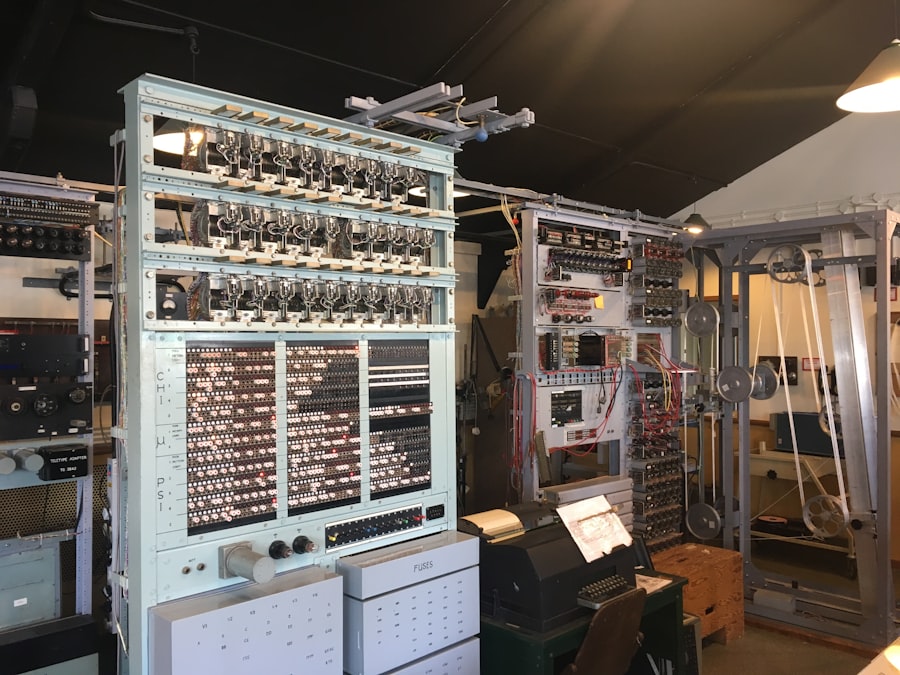
Despite its immense potential, quantum computing faces several challenges that must be addressed before it can become mainstream. One significant hurdle is maintaining qubit coherence—the ability of qubits to retain their quantum state long enough to perform calculations. Quantum systems are highly sensitive to their environment, and even minor disturbances can lead to decoherence, resulting in errors during computation.
Another challenge lies in scaling up quantum systems. While small-scale quantum computers have been developed successfully, creating larger systems with more qubits poses significant technical difficulties.
You may find it intriguing that researchers are exploring various approaches to overcome these obstacles, including hybrid systems that combine classical and quantum computing elements. As you consider these challenges, it becomes clear that while the path to practical quantum computing is fraught with difficulties, ongoing research and innovation hold promise for overcoming these barriers.
When comparing quantum computing with classical computing, it’s essential to recognize their fundamental differences in processing information. Classical computers operate on bits that represent either 0 or 1, performing calculations sequentially or in parallel using multiple processors. In contrast, quantum computers utilize qubits that can exist in superpositions of states, allowing them to perform many calculations simultaneously.
This distinction leads to significant differences in computational power and efficiency. As you analyze specific tasks, such as factoring large numbers or simulating complex systems, you will see how quantum computers can outperform classical counterparts dramatically. For example, Shor’s algorithm demonstrates how a quantum computer can factor large integers exponentially faster than the best-known classical algorithms.
This capability has profound implications for fields like cryptography and cybersecurity. By understanding these differences between quantum and classical computing, you will gain insight into why researchers are so excited about the future of quantum technology.
The Role of Entanglement in Quantum Computing
Entanglement is another fundamental principle of quantum mechanics that plays a crucial role in quantum computing. When two or more qubits become entangled, their states become interdependent regardless of the distance separating them. This phenomenon allows for instantaneous correlations between qubits, enabling them to work together in ways that classical bits cannot achieve.
As you explore entanglement further, you will appreciate its significance in enhancing computational capabilities and facilitating complex operations. In practical terms, entanglement can be harnessed to improve communication protocols and error correction methods within quantum systems. For instance, entangled qubits can be used for secure communication channels through techniques like quantum key distribution (QKD), which ensures that any eavesdropping attempts are detectable.
As you consider these applications of entanglement, it becomes evident that this phenomenon is not just a theoretical curiosity but a powerful tool for advancing both quantum computing and secure communication technologies.
Quantum Algorithms and their Impact on Computing
Quantum algorithms represent a significant leap forward in computational efficiency and problem-solving capabilities. These algorithms leverage the unique properties of qubits—such as superposition and entanglement—to perform tasks more efficiently than classical algorithms ever could. Notable examples include Shor’s algorithm for factoring large numbers and Grover’s algorithm for searching unsorted databases faster than any classical approach.
As you examine these algorithms closely, you will see how they exemplify the transformative potential of quantum computing. The impact of these algorithms extends beyond theoretical discussions; they have real-world implications for industries ranging from finance to logistics. For instance, Grover’s algorithm could revolutionize search engines by enabling faster data retrieval from vast databases.
Similarly, Shor’s algorithm poses challenges for current encryption methods used in securing online transactions and communications. As you reflect on these developments, it becomes clear that understanding and developing quantum algorithms is essential for harnessing the full potential of quantum computing.
The Future of Quantum Computing: Possibilities and Limitations
Looking ahead, the future of quantum computing is filled with both exciting possibilities and inherent limitations. On one hand, advancements in technology may lead to practical applications that were once thought impossible—such as solving complex optimization problems or simulating intricate biological processes with unprecedented accuracy. As researchers continue to innovate and refine quantum systems, you may find yourself inspired by the potential breakthroughs on the horizon.
However, it’s essential to remain grounded in reality; significant challenges still lie ahead before widespread adoption becomes feasible. Issues related to qubit coherence, error correction, and scalability must be addressed before we can fully realize the benefits of quantum computing. Additionally, ethical considerations surrounding data security and privacy will need careful attention as this technology evolves.
As you contemplate these factors, you will gain a nuanced understanding of both the promise and limitations inherent in the future landscape of quantum computing.
Embracing the Potential of Quantum Computing
In conclusion, as you reflect on your exploration of quantum computing, it becomes evident that this field holds transformative potential across various domains. From its foundational concepts like qubits and superposition to its practical applications in cryptography and drug discovery, quantum computing represents a paradigm shift in how we approach computation and problem-solving. While challenges remain on the path toward practical implementation, ongoing research and innovation continue to push boundaries.
Embracing the potential of quantum computing means recognizing its ability to reshape industries and enhance our understanding of complex systems. As you move forward in your journey through this captivating field, consider how these advancements might impact your life and society as a whole. The future is bright for those willing to explore the uncharted territories of quantum technology—an adventure filled with possibilities waiting to be realized.
Quantum computing relies heavily on the concept of qubits and their ability to exist in a state of superposition, allowing them to perform complex calculations at unprecedented speeds. For a deeper understanding of how qubits function and their implications for the future of technology, you can read more in this related article on quantum computing at Freaky Science.
WATCH THIS! 🧠 Your Brain Is Lying To You: The Double-Slit Experiment PROVES It
FAQs
What is a qubit in quantum computing?
A qubit, or quantum bit, is the basic unit of quantum information in quantum computing. Unlike a classical bit that can be either 0 or 1, a qubit can exist in a superposition of both states simultaneously.
What does superposition mean in the context of qubits?
Superposition refers to a qubit’s ability to be in multiple states at once, such as both 0 and 1 simultaneously. This property allows quantum computers to process a vast number of possibilities at the same time.
How does superposition benefit quantum computing?
Superposition enables quantum computers to perform complex calculations more efficiently than classical computers by exploring many potential solutions simultaneously, which can speed up certain types of computations.
How are qubits physically realized?
Qubits can be implemented using various physical systems, including trapped ions, superconducting circuits, quantum dots, and photons. Each technology has its own advantages and challenges.
What is the difference between a classical bit and a qubit?
A classical bit can only be in one of two states, 0 or 1, at any given time. A qubit, however, can be in a superposition of both 0 and 1 states simultaneously, enabling more complex computation.
What challenges exist in maintaining qubit superposition?
Qubits are highly sensitive to environmental disturbances, which can cause decoherence and collapse the superposition state. Maintaining coherence requires precise control and isolation from noise.
Can qubits be entangled?
Yes, qubits can be entangled, meaning the state of one qubit is directly related to the state of another, no matter the distance between them. Entanglement is a key resource for many quantum algorithms.
What role does measurement play in qubit superposition?
Measuring a qubit causes its superposition to collapse into one of the definite states, either 0 or 1. This collapse is probabilistic, with probabilities determined by the qubit’s state before measurement.
Are qubits used in current computers?
Qubits are used in experimental quantum computers, which are still in the early stages of development. They are not yet part of mainstream commercial computing but hold promise for future applications.
What applications could benefit from qubit superposition?
Applications such as cryptography, optimization problems, drug discovery, and complex simulations could benefit from the computational power enabled by qubit superposition in quantum computers.