The Humble Pressure Cooker: A Symphony of Thermodynamics
The kitchen, often a realm of culinary artistry, is also a fascinating laboratory where everyday physics principles are put to delicious use. Among the most ingenious of kitchen appliances, the pressure cooker stands as a testament to the power of understanding fundamental scientific concepts, primarily those related to pressure and the boiling point of water. Far from being a mere cooking vessel, a pressure cooker orchestrates a controlled environment where thermodynamics works its magic, transforming raw ingredients into tender, flavorful meals in a fraction of the time. This article delves into the everyday physics that makes this kitchen marvel so effective, exploring how manipulating pressure fundamentally alters the boiling point of liquids and accelerates the cooking process.
The seemingly simple act of sealing a pot and increasing the pressure within unlocks a cascade of physical phenomena. It’s a lesson in how altering one variable – pressure – can dramatically impact another – temperature – and consequently, the speed and efficiency of cooking. Understanding this interplay is not just about appreciating the technology; it’s about grasping core scientific principles that govern our physical world, from the boiling of water in our homes to the vast atmospheric pressures of distant planets. The pressure cooker, therefore, serves as a readily accessible, tangible demonstration of physics in action, making complex concepts approachable and even edible.
A pressure cooker is a fascinating kitchen appliance that teaches us about the principles of pressure and temperature in everyday physics. By trapping steam and increasing the pressure inside, it allows food to cook faster while retaining moisture and flavor. For a deeper understanding of the science behind pressure cookers and other intriguing physics concepts, you can explore the article on Freaky Science, which delves into various scientific phenomena that we encounter in our daily lives. Check it out here: Freaky Science.
The Science of Boiling: More Than Just Bubbles
At its core, cooking involves transferring heat to food, causing chemical and physical changes that make it palatable and digestible. Boiling is a particularly efficient method of heat transfer, but its effectiveness is intrinsically linked to temperature. Most people associate boiling with the vigorous bubbling of water at 100 degrees Celsius (212 degrees Fahrenheit) at standard atmospheric pressure. However, this is only true under specific conditions. The boiling point of a liquid is not a fixed constant but is, in fact, highly dependent on the surrounding pressure.
Understanding Vapor Pressure: The Engine of Boiling
To truly grasp why pressure cookers work, one must first understand the concept of vapor pressure. In any liquid, molecules are in constant motion. Some of these molecules, particularly those at the surface, possess enough kinetic energy to escape the liquid phase and become a gas. This escaping gas forms vapor above the liquid. As more molecules vaporize, the concentration of these gas molecules above the liquid increases, leading to collisions with the liquid surface. Some of these vapor molecules will condense back into the liquid. Eventually, a state of equilibrium is reached where the rate of vaporization equals the rate of condensation. The pressure exerted by this vapor at equilibrium is known as the vapor pressure of the liquid.
The vapor pressure of a liquid increases with temperature. As the temperature rises, more molecules gain the kinetic energy needed to escape the liquid, leading to a higher concentration of vapor and thus a higher vapor pressure. This relationship is crucial. Boiling occurs when the vapor pressure of the liquid becomes equal to the surrounding external pressure. At this point, bubbles of vapor can form not just at the surface but also within the bulk of the liquid, rising and bursting to release steam.
Atmospheric Pressure’s Influence: A Constant Battle
Standard atmospheric pressure at sea level is approximately 1 atmosphere (atm) or 101.3 kilopascals (kPa). Under this pressure, water needs to reach 100 degrees Celsius to achieve a vapor pressure of 1 atm, at which point it boils. However, imagine being at a higher altitude, such as Denver, Colorado. The atmospheric pressure is lower (around 0.83 atm). Consequently, water will boil at a lower temperature (around 95 degrees Celsius) because its vapor pressure can match the reduced atmospheric pressure with less heat. Conversely, in a deep mine or a submersible, the external pressure is higher, and water will require a temperature exceeding 100 degrees Celsius to boil. This inverse relationship between external pressure and boiling point is the fundamental principle exploited by the pressure cooker.
The Pressure Cooker’s Design: A Fortified Chamber
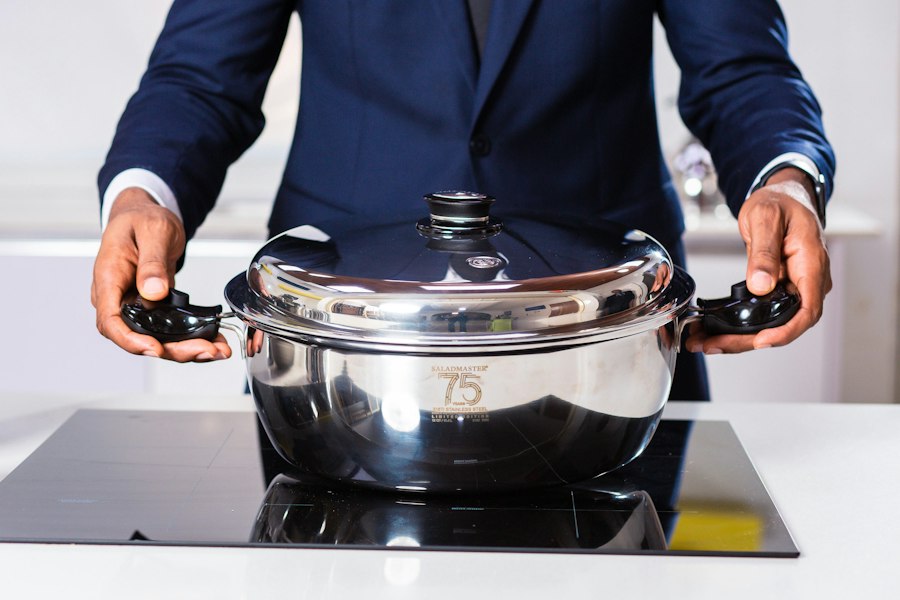
The design of a pressure cooker is elegantly simple yet remarkably effective in its application of physics. At its heart, it is a pot with a lid that can be sealed almost hermetically. This tight seal is critical. The lid is typically secured by locking mechanisms, often involving interlocking rims or robust clamps, ensuring that steam cannot escape during the cooking process. The pot itself is usually made from sturdy materials, such as stainless steel or aluminum, capable of withstanding the elevated pressures that will build up inside.
The Role of the Gasket: Creating the Seal
A crucial component in achieving a perfect seal is the gasket, usually made of rubber or silicone. This flexible band runs along the rim of the lid, pressing firmly against the pot’s edge when the lid is secured. The gasket’s elasticity allows it to compress and fill any microscopic gaps, preventing the escape of steam. Without this reliable seal, the pressure inside the cooker would not increase significantly, and it would simply function as a regular pot. The integrity and proper maintenance of the gasket are therefore paramount for the safe and effective operation of a pressure cooker.
Pressure Regulating Mechanisms: Safety and Control
While the goal is to increase pressure, uncontrolled pressure build-up would be dangerous. Pressure cookers are equipped with safety features to prevent over-pressurization. The most common is the pressure-release valve, often a spring-loaded mechanism. When the internal pressure exceeds a predetermined limit (typically around 15 psi above atmospheric pressure for stovetop models), this valve opens slightly, releasing excess steam. This controlled release of steam maintains the pressure within the desired operating range. Some modern electric pressure cookers also incorporate electronic sensors and control systems to monitor and regulate pressure with even greater precision.
The Magic of Increased Pressure: Faster Cooking, Better Flavor
The most significant advantage of a pressure cooker is its ability to cook food much faster than conventional methods. This speed is a direct consequence of the elevated temperatures achieved within the sealed pot. By preventing steam from escaping, the pressure inside the cooker rises. As the pressure increases, so does the boiling point of the water within.
Boiling Point Elevation: A Thermodynamic Triumph
Consider water in a standard pot at sea level boiling at 100 degrees Celsius. In a typical stovetop pressure cooker, the pressure is allowed to build up to approximately 2 atmospheres (atm), or about 15 psi above atmospheric pressure. At this elevated pressure, water’s boiling point increases to around 121 degrees Celsius (250 degrees Fahrenheit). This increase of over 20 degrees Celsius might seem modest, but it has a profound impact on cooking times. Heat transfer to food is driven by temperature differences. A higher cooking temperature means a greater temperature difference between the heat source (steam and hot liquid) and the food, leading to a more rapid transfer of thermal energy.
The Chemistry of Cooking Accelerated
Many chemical reactions that occur during cooking, such as the breakdown of connective tissues in meat (collagen to gelatin), the softening of vegetables, and the absorption of flavors, are temperature-dependent. The higher temperatures achieved in a pressure cooker accelerate these reactions. For instance, collagen breaks down much faster at 121 degrees Celsius than at 100 degrees Celsius. This accelerated breakdown results in meats becoming tender and succulent in significantly less time. Similarly, flavors from herbs and spices are released and infused into the food more quickly at these higher temperatures.
Moisture Retention: Tenderizing and Flavor Infusion
The sealed environment of a pressure cooker also plays a vital role in moisture retention. As food cooks in the pressurized steam, moisture is trapped inside, preventing it from evaporating into the atmosphere as it would in an open pot. This trapped moisture keeps the food moist and tender, preventing it from drying out. Furthermore, the pressurized steam can penetrate the food more effectively, aiding in the rapid infusion of flavors from liquids and seasonings added to the pot. This combination of accelerated chemical reactions and enhanced moisture retention contributes to the superior texture and deeply infused flavors often associated with pressure-cooked meals.
A pressure cooker is a fascinating kitchen appliance that teaches us about the principles of pressure and temperature in everyday physics. By trapping steam and increasing the pressure inside, it allows food to cook faster while retaining moisture and flavor. For those interested in exploring more about the science behind cooking and how it relates to physical principles, you can check out this insightful article on everyday science. Understanding these concepts not only enhances our cooking skills but also deepens our appreciation for the science that surrounds us in daily life.
Beyond Boiling: Applications and Safety Considerations
| Physics Concept | Description | Everyday Application in Pressure Cooker | Metric/Example |
|---|---|---|---|
| Pressure | Force exerted per unit area | Steam increases pressure inside the sealed cooker | |
| Boiling Point Elevation | Boiling point of liquid increases with pressure | Water boils above 100°C, cooking food faster | Boiling point ~ 120°C at 15 psi above atmospheric pressure |
| Gas Laws (Ideal Gas Law) | Relationship between pressure, volume, and temperature (PV=nRT) | Heating steam increases pressure as volume is fixed | Pressure rises as temperature increases inside sealed cooker |
| Heat Transfer | Conduction and convection transfer heat to food | Steam transfers heat efficiently to cook food evenly | Cooking time reduced by up to 70% compared to boiling |
| Phase Change | Water changes from liquid to vapor (steam) | Steam generation increases pressure and temperature | Water vapor pressure builds up inside cooker |
| Safety Valve Mechanics | Pressure relief to prevent explosion | Valve releases excess steam to maintain safe pressure | Valve opens at preset pressure (~15 psi above atmospheric) |
While the pressure cooker is most commonly associated with cooking foods that benefit from moist heat and tenderization, its principles extend beyond simply boiling water. The ability to control and elevate cooking temperatures opens up a wide range of culinary applications. However, like any appliance that manipulates physical forces, understanding and adhering to safety guidelines is paramount.
Diverse Culinary Applications: From Grains to Stews
Pressure cookers are incredibly versatile. They excel at cooking dried beans and legumes in a fraction of the time, making them a pantry staple for many. Tough cuts of meat, like beef brisket or pork shoulder, become fork-tender in under an hour. Grains such as rice and quinoa cook perfectly and rapidly, often with improved texture. Soups and stews benefit from the deep flavor infusion and tenderization of ingredients. Even some desserts, like custards and cheesecakes, can be prepared in a pressure cooker, yielding exceptionally smooth and creamy results. The fundamental principle remains the same: the pressurized steam acts as a highly efficient medium for heat transfer, accelerating the cooking process and enhancing flavor penetration.
Safety First: Understanding the Risks and Precautions
Despite their inherent safety features, pressure cookers do carry risks if not used correctly. Overfilling the pot is a common mistake that can lead to the pressure-release valve becoming clogged, potentially causing a dangerous pressure build-up. Manufacturers provide clear guidelines on maximum fill levels, and these should always be strictly followed. Ensuring that the pressure-release valve and other safety mechanisms are clean and free from debris before each use is also crucial. Never attempt to force open the lid while the cooker is still under pressure; always wait for the pressure to dissipate naturally or follow the manufacturer’s instructions for controlled pressure release. Inspecting the gasket for any signs of wear or damage and replacing it when necessary is another essential safety measure. Understanding the specific operation of your particular pressure cooker, whether stovetop or electric, and consulting the user manual are the best ways to ensure safe and enjoyable cooking.
Conclusion: Physics on Your Plate
The pressure cooker, a seemingly simple kitchen tool, is a profound illustration of everyday physics in action. It demonstrates the fundamental relationship between pressure and the boiling point of liquids, showcasing how manipulating one can dramatically alter the other. This thermodynamic principle, applied with ingenious design and safety features, allows for faster cooking, improved food texture, and enhanced flavor. From the molecular dance of water molecules in a sealed environment to the accelerated chemical reactions that transform raw ingredients, the pressure cooker offers a tangible and delicious lesson in the science that shapes our world. It is a reminder that even in the comfort of our kitchens, physics is a constant, powerful, and, in this case, incredibly flavorful presence.
Why This Water Doesn’t Boil at 100°C
FAQs
1. How does a pressure cooker demonstrate the concept of pressure?
A pressure cooker demonstrates the concept of pressure by increasing the pressure inside the pot as it heats up. The sealed lid traps steam, which raises the pressure and allows the water to reach a higher temperature before boiling.
2. What everyday physics principle is illustrated by the use of a pressure cooker?
The use of a pressure cooker illustrates the physics principle that increasing pressure raises the boiling point of water. This is due to the fact that higher pressure prevents water from boiling at its normal temperature, resulting in faster cooking times.
3. How does a pressure cooker utilize the physics of heat transfer?
A pressure cooker utilizes the physics of heat transfer by trapping steam and increasing the pressure inside the pot. This higher pressure allows the water to absorb more heat energy, resulting in faster cooking times compared to traditional cooking methods.
4. What role does the physics of thermodynamics play in the operation of a pressure cooker?
The physics of thermodynamics plays a crucial role in the operation of a pressure cooker. By increasing the pressure inside the pot, the cooker alters the thermodynamic properties of water, allowing it to cook food more quickly and efficiently.
5. How does a pressure cooker exemplify the physics concept of equilibrium?
A pressure cooker exemplifies the physics concept of equilibrium by reaching a balance between the pressure inside the pot and the pressure exerted by the steam. This equilibrium state is essential for maintaining the high pressure necessary for efficient cooking.