The world around us is in a constant state of transformation, with water playing a central role in these dynamic processes. Two fundamental phenomena that govern the water cycle and shape our planet’s climate are evaporation and freezing. While seemingly distinct, both are intricate manifestations of molecular behavior, driven by energy transfer and the inherent properties of matter. Understanding the science behind these processes offers profound insights into everything from the formation of clouds to the sustenance of life.
Molecular Motion and the Essence of Phase Change
At the heart of both evaporation and freezing lies the concept of molecular motion. Matter, whether solid, liquid, or gas, is composed of countless tiny particles – atoms and molecules – that are perpetually in motion. The intensity of this motion is directly related to the internal energy of the substance, which is most commonly associated with temperature. In a liquid, molecules are not rigidly fixed like in a solid, nor are they completely free to roam like in a gas. They possess enough kinetic energy to slide past one another, yet they are still held together by intermolecular forces. Evaporation and freezing represent transitions between these states of matter, specifically from liquid to gas and from liquid to solid, respectively. These phase changes are not spontaneous events; they are critically dependent on the energy available to the molecules and the forces that bind them.
The Kinetic Theory of Matter
The kinetic theory of matter provides a foundational framework for understanding molecular motion. It posits that the average kinetic energy of particles in a substance is proportional to its absolute temperature. In a liquid, this means that while most molecules have moderate kinetic energy, there exists a distribution of energies. Some molecules will inevitably possess higher kinetic energies than others. This energy distribution is crucial for understanding how a liquid can transform into a gas, even at temperatures below its boiling point. Similarly, in the context of freezing, the decrease in temperature directly corresponds to a reduction in the average kinetic energy of the molecules, making it easier for intermolecular forces to assert dominance and lock them into a more ordered structure.
Intermolecular Forces: The Unseen Hands
While kinetic energy drives molecules apart, intermolecular forces act to hold them together. These forces are attractive in nature and arise from the electrical interactions between molecules. In water, the polar nature of its molecules, with a slight positive charge on the hydrogen atoms and a slight negative charge on the oxygen atom, leads to strong hydrogen bonds between adjacent water molecules. These hydrogen bonds are significant players in both evaporation and freezing. During evaporation, molecules need to overcome these intermolecular forces to escape into the gaseous phase. Conversely, during freezing, these same forces, aided by the reduced kinetic energy of the molecules, facilitate the formation of a highly ordered crystalline structure – ice – where the molecules are held in fixed positions.
Evaporation and freezing are two fundamental processes that illustrate the behavior of substances in different states of matter. For a deeper understanding of these phenomena, you can explore an insightful article on the topic at Freaky Science, which delves into the science behind phase changes and their implications in everyday life. To read more, visit Freaky Science.
Evaporation: The Escape of Energetic Molecules
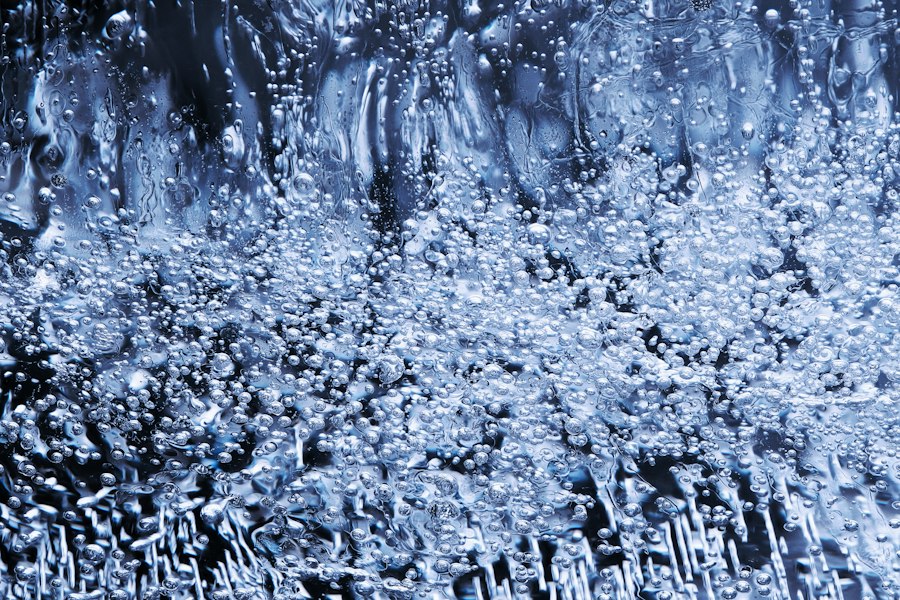
Evaporation is the process by which a liquid transforms into a gas (or vapor) at its surface. It is a ubiquitous phenomenon, observable in everyday occurrences like puddles drying up after rain or clothes drying on a line. Unlike boiling, which occurs throughout the bulk of a liquid at a specific temperature, evaporation can happen at any temperature, albeit at varying rates. The driving force behind evaporation is the presence of molecules at the liquid’s surface with sufficient kinetic energy to overcome the attractive intermolecular forces and escape into the surrounding atmosphere.
Surface Phenomena and Vapor Pressure
Evaporation is fundamentally a surface phenomenon. Only molecules at the interface between the liquid and the gas have the opportunity to escape. As these energetic molecules leave the liquid, they create a region of vapor above the surface. This vapor exerts a pressure, known as vapor pressure. In a closed container, as evaporation continues, the concentration of vapor molecules above the liquid increases, and so does the vapor pressure. Simultaneously, some of these vapor molecules will lose energy and condense back into the liquid. Eventually, an equilibrium is reached where the rate of evaporation equals the rate of condensation. This equilibrium vapor pressure is a characteristic property of a liquid at a given temperature and is indicative of its volatility.
Factors Influencing the Rate of Evaporation
Several factors influence how quickly evaporation occurs. The most significant of these is temperature. Higher temperatures mean higher average kinetic energy for the molecules, leading to a greater number of molecules possessing the energy required to escape. Surface area is another critical factor. A larger surface area exposed to the atmosphere provides more opportunities for molecules to escape, thus increasing the rate of evaporation. Humidity also plays a crucial role. If the air above the liquid is already saturated with vapor (high humidity), the rate of condensation will be higher, slowing down the net rate of evaporation. Wind or air movement also accelerates evaporation by removing the vapor molecules from the surface, thus reducing the partial pressure of the vapor and promoting further escape of liquid molecules. Finally, the nature of the liquid itself matters; liquids with weaker intermolecular forces (like alcohol) evaporate more readily than those with stronger forces (like water).
Freezing: The Solidification of Ordered Structure

Freezing, the inverse of melting, is the process by which a liquid transforms into a solid. For water, this occurs at its freezing point, 0 degrees Celsius (32 degrees Fahrenheit) at standard atmospheric pressure. This transformation is a consequence of a decrease in the kinetic energy of the molecules to a point where the attractive intermolecular forces can dominate and arrange them into a stable, ordered crystalline lattice.
Nucleation: The Genesis of Ice Crystals
The process of freezing is not instantaneous throughout the entire liquid. It typically begins with the formation of a tiny seed crystal, a process known as nucleation. Nucleation can occur spontaneously due to random fluctuations in molecular arrangement, but it is often facilitated by the presence of impurities or rough surfaces, which provide sites where ice crystals can more easily form. These initial small ice crystals then serve as templates for further ice crystal growth as more water molecules attach to them in a specific crystalline arrangement. Without nucleation sites, a liquid can become supercooled, meaning it remains in the liquid state below its freezing point.
Crystal Growth and Latent Heat of Fusion
Once nucleation has occurred, ice crystals begin to grow as water molecules attach themselves to the existing lattice. This growth is highly dependent on the rate at which energy is removed from the system. As water molecules transition from the disordered liquid state to the ordered solid state, they release energy in the form of latent heat of fusion. This heat must be efficiently dissipated for the freezing process to continue. The structure of ice is not a single, uniform crystal but rather a collection of interlocking ice crystals. The characteristic hexagonal structure of ice is a direct result of the geometry of hydrogen bonding between water molecules, leading to the often-observed hexagonal shapes of snowflakes.
The Interplay of Energy: Heat Transfer in Phase Changes
Both evaporation and freezing are profoundly linked to the transfer of thermal energy. These processes are not merely changes in state; they involve significant energy exchanges with the surroundings. Understanding these energy dynamics is key to grasping their impact on the environment and technology.
Latent Heat: The Hidden Energy of Transformation
During a phase change, the temperature of the substance does not change. Instead, the energy added or removed is used to break or form intermolecular bonds. This energy is known as latent heat. In evaporation, energy is absorbed from the surroundings to overcome the intermolecular forces holding the liquid together. This absorbed energy is called the latent heat of vaporization. It is why sweating cools the body; as sweat evaporates from the skin, it absorbs heat from the body. Conversely, in freezing, energy is released into the surroundings as latent heat of fusion. This release of energy can be significant, as seen when water freezes and releases enough heat to prevent nearby areas from dropping to the same low temperature as quickly.
The Role of Enthalpy in Phase Transitions
Thermodynamically, phase changes are described in terms of enthalpy, which is a measure of the total heat content of a system. The enthalpy of vaporization is the amount of heat required to convert a unit mass of a liquid into a gas at a constant temperature and pressure. The enthalpy of fusion is the amount of heat required to convert a unit mass of a solid into a liquid at its melting point. These values are specific to each substance and quantify the energy requirements for these transitions. For water, the high latent heat of vaporization is a crucial factor in regulating Earth’s temperature, as vast amounts of solar energy are absorbed during evaporation and released during condensation.
Evaporation and freezing are two fundamental processes that illustrate the behavior of water in different temperature conditions. Understanding these processes can provide insights into various natural phenomena, such as weather patterns and climate change. For a deeper exploration of how these processes interact and affect our environment, you can check out a related article on the topic at Freaky Science. This resource offers valuable information that can enhance your comprehension of the intricate balance between evaporation and freezing.
Broader Implications: Evaporation and Freezing in Nature and Technology
| Property | Evaporation | Freezing |
|---|---|---|
| Definition | Process of liquid turning into vapor | Process of liquid turning into solid |
| Phase Change | Liquid → Gas | Liquid → Solid |
| Energy Change | Endothermic (absorbs heat) | Exothermic (releases heat) |
| Temperature | Occurs at any temperature below boiling point | Occurs at freezing point (0°C for water) |
| Latent Heat | Latent heat of vaporization (~2260 kJ/kg for water) | Latent heat of fusion (~334 kJ/kg for water) |
| Effect on Surroundings | Cools the surface due to heat absorption | Warms the surroundings due to heat release |
| Examples | Drying of wet clothes, evaporation of sweat | Formation of ice, frost on surfaces |
The scientific principles governing evaporation and freezing have far-reaching implications, shaping natural processes and enabling various technological applications. Their influence is evident in meteorology, hydrology, and even in the design of essential equipment.
The Water Cycle: A Grand Symphony of Phase Changes
Evaporation and freezing are fundamental drivers of the Earth’s water cycle. Evaporation from oceans, lakes, and rivers, as well as transpiration from plants, lifts vast quantities of water vapor into the atmosphere. This vapor then cools and condenses to form clouds, a process that involves the release of latent heat. Eventually, this water returns to the Earth’s surface as precipitation in the form of rain, snow, or hail. Freezing plays a critical role in colder regions, forming ice and snow cover, which can significantly influence surface albedo (reflectivity) and insolation, impacting local and global temperatures. The formation of sea ice, for instance, is a major factor in regulating ocean circulation and climate.
Technological Applications and Everyday Life
The understanding of evaporation and freezing has led to numerous technological advancements. Refrigeration and air conditioning systems rely on the principle of evaporation and condensation of refrigerants to transfer heat and cool spaces. Dehydration of food products uses controlled evaporation to preserve them by reducing water content and inhibiting microbial growth. In industrial processes, evaporation is used for purification and concentration of solutions. Conversely, freezing is essential for food preservation in freezers and for medical applications like cryopreservation of biological samples. The design of buildings and infrastructure in cold climates must account for the effects of freezing and thawing cycles, which can cause significant damage to materials. The very act of cooking, whether boiling water or freezing ingredients, directly engages with these fundamental thermodynamic processes.

Why Hot Water Freezes Faster Than Cold (The Mpemba Effect)
FAQs
What is evaporation?
Evaporation is the process by which a liquid, such as water, changes into a gas or vapor due to an increase in temperature.
How does evaporation occur?
Evaporation occurs when the molecules in a liquid gain enough energy to break free from the liquid’s surface and turn into a gas.
What factors affect the rate of evaporation?
The rate of evaporation is influenced by factors such as temperature, humidity, surface area, and air movement. Higher temperatures, lower humidity, larger surface areas, and increased air movement all lead to faster evaporation.
What is freezing?
Freezing is the process by which a liquid changes into a solid when its temperature drops below its freezing point.
How does freezing differ from evaporation?
Freezing involves the transformation of a liquid into a solid, while evaporation involves the transformation of a liquid into a gas. Freezing occurs at low temperatures, while evaporation occurs at higher temperatures.