
The seemingly simple act of water transforming into ice involves a fascinating scientific phenomenon: expansion. Unlike most substances that contract when they solidify, water undergoes a significant increase in volume as it freezes. This unique characteristic of water is not merely an interesting quirk of nature; it is fundamental to countless geological, biological, and even everyday processes. Understanding the molecular dance that leads to ice’s expansion reveals the intricate and often counterintuitive nature of the universe.
The Molecular Structure of Water: A Foundation for Expansion
At the heart of water’s anomalous expansion lies its molecular structure and the peculiar way its molecules arrange themselves, particularly in its liquid and solid states. Water is composed of two hydrogen atoms covalently bonded to a single oxygen atom. This arrangement, with the hydrogen atoms angled away from the oxygen, creates a polar molecule. The oxygen atom has a partial negative charge, while the hydrogen atoms carry a partial positive charge. This polarity is crucial, as it allows water molecules to form hydrogen bonds with each other.
Hydrogen Bonding: The Invisible Glue
Hydrogen bonds are weak electrostatic attractions between the partially positive hydrogen atom of one water molecule and the partially negative oxygen atom of another. In liquid water, these hydrogen bonds are constantly forming, breaking, and reforming, allowing the molecules to flow past each other and take on the shape of their container. This dynamic network of bonds contributes to water’s relatively high surface tension and specific heat capacity. However, the arrangement of these bonds is somewhat disordered, with molecules in close proximity.
The Crystalline Lattice of Ice: A Structured Network
As water cools and approaches its freezing point, the kinetic energy of its molecules decreases. This reduced motion allows the hydrogen bonds to become more stable and persistent. When water freezes into ice, these hydrogen bonds dictate a highly ordered, crystalline structure. Specifically, ice typically forms a hexagonal crystalline lattice known as ice Ih. In this structure, each water molecule is tetrahedrally bonded to four other water molecules: two through its oxygen atom (accepting hydrogen bonds) and two through its hydrogen atoms (donating hydrogen bonds).
Open Frameworks and Increased Spacing
The key to ice’s expansion lies in the geometry of this hexagonal lattice. The hydrogen bonds, in their effort to achieve maximum stability and minimize repulsive forces, create a relatively open, cage-like structure. This open framework means that the water molecules are held further apart on average in ice than they are in liquid water, especially compared to liquid water at or near its freezing point. The angles and distances between molecules in the ice lattice are such that the overall volume occupied by a given number of water molecules increases significantly upon freezing. This is in stark contrast to most other substances, where intermolecular forces become stronger in the solid state, pulling molecules closer together and resulting in contraction. The energy released during freezing is primarily used to form these stable, widely spaced hydrogen bonds, rather than to increase the density of the solid.
The phenomenon of water expanding when it freezes is a fascinating aspect of its unique properties, which can be explored further in the article available at Freaky Science. This article delves into the molecular structure of water and explains how hydrogen bonding leads to a decrease in density when water transitions from liquid to solid form, resulting in ice that floats on water. Understanding this property is crucial not only for scientific studies but also for environmental and ecological implications.
Thermodynamics and Energy Considerations: Driving the Expansion
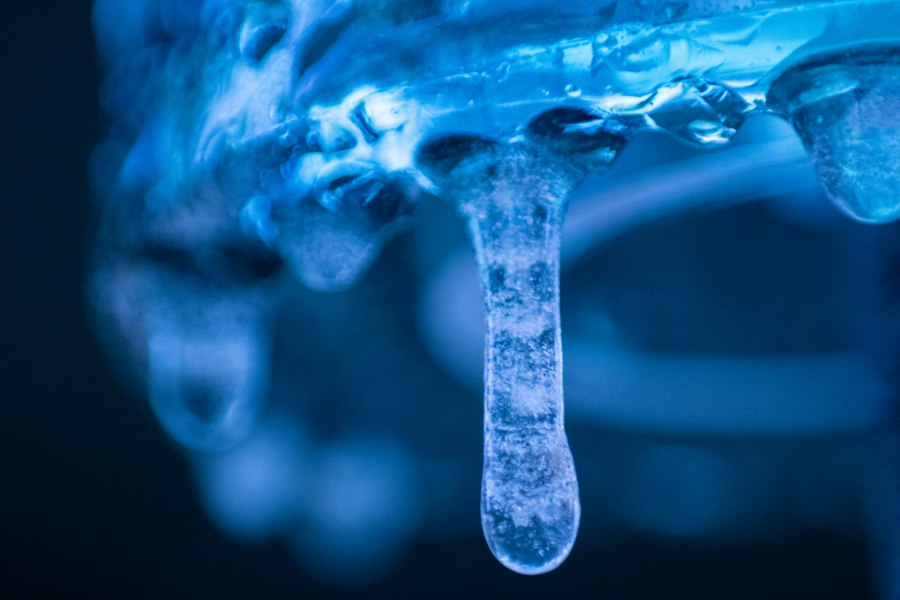
The expansion of water upon freezing is not just a matter of molecular arrangement; it is also governed by fundamental thermodynamic principles. The transition from liquid to solid is an exothermic process, meaning it releases energy. This released energy is a direct consequence of the formation of the more stable, ordered hydrogen bonds in the ice lattice. However, the arrangement that achieves this stability inherently leads to a less dense structure.
Enthalpy and Entropy in Phase Transitions
Phase transitions, such as melting and freezing, are driven by the interplay of enthalpy (heat content) and entropy (disorder). In liquid water, molecules have higher kinetic energy and a greater degree of disorder, resulting in higher entropy. As water freezes, it loses kinetic energy (enthalpy decreases) and becomes more ordered (entropy decreases). The formation of the ice lattice represents a state of lower enthalpy due to the stable hydrogen bonding network, but also a state of lower entropy due to increased molecular order. The balance between these two factors determines the favored state at a given temperature and pressure.
The Role of Intermolecular Forces in Energy Release
The energy released during freezing is the energy required to break the more transient hydrogen bonds in liquid water and reform the more stable, directional hydrogen bonds in the ice lattice. While the formation of these new bonds releases energy, the geometry they impose leads to a less compact arrangement. The system seeks the lowest free energy state, and in the case of water below 4 degrees Celsius, the crystalline structure of ice, despite its increased volume, is energetically favorable due to the stability of its hydrogen bonding network. The forces holding the molecules together are strong enough to create a solid, but the specific nature of these forces dictates a structure that is not maximally dense. This is a crucial distinction from substances where solidification involves the direct strengthening of Van der Waals forces or metallic bonds, leading to tighter packing.
Why Other Substances Contract: A Comparative Perspective
To truly appreciate water’s unique behavior, it is helpful to consider how most other substances behave. In most liquids, as the temperature decreases, the molecules slow down, and the intermolecular forces (like Van der Waals forces) become more dominant. These forces pull the molecules closer together, leading to a denser liquid and an even denser solid. When these substances freeze, the molecules settle into a tightly packed crystalline structure that occupies less volume than the disordered liquid state. For example, when molten iron cools and solidifies, its atoms arrange themselves in a very compact metallic lattice, resulting in a significant contraction in volume. Water’s expansion is an exception, highlighting the dominant role of directional hydrogen bonding in dictating its solid-state structure.
The Consequences of Expansion: Impact on the Natural World

The expansion of water upon freezing has profound and far-reaching consequences for the natural world, influencing everything from weather patterns to the survival of aquatic life. This seemingly small change in volume is responsible for some of the most dramatic geological and biological phenomena.
Frost Wedging and Geological Processes: Reshaping Landscapes
One of the most significant impacts of water’s expansion is its role in frost wedging, a crucial process in the weathering and erosion of rocks. When water seeps into cracks and crevices in rocks, it can freeze. As the water turns to ice, it expands, exerting immense pressure on the surrounding rock. Over repeated freeze-thaw cycles, this pressure can widen existing cracks and eventually fracture rocks, breaking them down into smaller pieces. This process is a major contributor to the formation of scree slopes, canyons, and other geological features. The expansive force of ice is substantial, capable of even splitting large boulders.
Protecting Aquatic Life: The Floating Ice Advantage
Perhaps the most biologically significant consequence of water’s expansion is the fact that ice floats. In bodies of water like lakes and rivers, as the surface water cools and freezes, the less dense ice forms a layer on top. This ice layer acts as an insulating blanket, preventing the deeper water from freezing completely. This insulation is critical for the survival of aquatic organisms, such as fish and invertebrates, which can continue to live in the unfrozen water beneath the ice. If water contracted when freezing, the densest, coldest water would sink to the bottom, leading to the complete freezing of ponds and lakes from the bottom up, making it impossible for most aquatic life to survive in temperate and polar regions.
Soil Expansion and Infrastructure Damage: A Human Impact
The expansion of water also has significant implications for human infrastructure. When water within the soil freezes, it expands, causing the soil to heave. This frost heave can damage roads, foundations, pipelines, and other structures built on or in the ground. In regions with significant frost penetration, engineers must account for the expansive forces of freezing water in their designs to prevent costly damage. This involves using materials that are less susceptible to frost heave, providing adequate drainage, and ensuring that structures are built below the frost line.
Microscopic Mechanisms and the Role of Impurities: Fine-Tuning the Expansion
While the fundamental principle of expansion in pure water is well-understood, several microscopic factors and the presence of impurities can influence the process and the resulting properties of ice. These nuances add further layers of complexity to this seemingly simple phenomenon.
Nucleation Sites and Crystal Growth: The Genesis of Ice
The formation of ice crystals does not happen spontaneously throughout a body of water. It requires the presence of nucleation sites, which are small imperfections or surfaces where ice can begin to form. These can include dust particles, air bubbles, or even imperfections on the surface of the container. Once a tiny ice crystal, or nucleus, forms, water molecules from the surrounding liquid begin to attach to it, guided by the existing hydrogen bond network. The crystal grows outward, adding more molecules in the characteristic hexagonal lattice structure. The rate of nucleation and subsequent crystal growth can influence the size and shape of the ice crystals formed.
The Influence of Dissolved Solutes: Altering the Freezing Point and Expansion
The presence of dissolved substances, such as salts or minerals, in water can significantly alter its freezing behavior. Dissolved solutes disrupt the formation of the regular hydrogen bond network required for ice crystallization. This means that a lower temperature is required for the water to freeze, effectively lowering the freezing point. Furthermore, the solutes themselves are generally excluded from the ice lattice, meaning they become more concentrated in the remaining liquid water. While the expansion phenomenon itself is still driven by the formation of the ice lattice, the presence of solutes can lead to less pure ice and potentially alter the extent of expansion compared to pure water. In some cases, highly concentrated solutions may not freeze at all within typical environmental temperature ranges.
Pressure Effects: Compressing the Expansion
External pressure can also influence the expansion of water during freezing. As pressure increases, it becomes more difficult for the water molecules to spread out into the less dense ice lattice. Consequently, under high pressure, the volume change during freezing can be reduced, and in extreme cases, it is even possible for water to freeze into denser phases of ice (known as Ice II, Ice III, etc.) that do not expand or even contract upon solidification. However, under typical atmospheric pressures experienced in everyday life and most natural environments, the expansion upon freezing to the common hexagonal ice (Ice Ih) is the dominant behavior.
Water is unique in that it expands when it freezes, a property that has significant implications for our environment and daily life. This phenomenon occurs because the molecular structure of water changes as it transitions from liquid to solid, forming a crystalline lattice that occupies more space. For a deeper understanding of this intriguing behavior, you can explore a related article that delves into the science behind water’s expansion when frozen. This article can be found here. Understanding this property is essential, as it affects everything from the weather patterns we experience to the way ice forms on lakes and rivers.
The Broader Significance of Water’s Unique Properties: A Foundation for Life
| Property | Value/Description |
|---|---|
| Density of Water (liquid at 4°C) | 1.00 g/cm³ |
| Density of Ice (solid at 0°C) | 0.92 g/cm³ |
| Volume Change on Freezing | Approximately 9% increase |
| Hydrogen Bonding | Water molecules form a hexagonal lattice in ice, increasing volume |
| Temperature Range of Expansion | 0°C to 4°C (water contracts above 4°C, expands below) |
| Effect on Molecular Arrangement | Open crystalline structure in ice causes lower density |
| Significance | Ice floats on water due to lower density, affecting aquatic life |
Water’s expansion upon freezing is not an isolated anomaly; it is part of a suite of unique properties that make water indispensable for life as we know it. These properties, stemming from its molecular structure and hydrogen bonding, collectively create an environment that is conducive to biological and geological processes.
Water as a Universal Solvent: Facilitating Chemical Reactions
Beyond its expansion behavior, water’s polarity makes it an excellent solvent for many polar and ionic compounds. This “universal solvent” property is fundamental to biological systems, as it allows for the transport of nutrients, the removal of waste products, and the facilitation of countless biochemical reactions within cells. The dissolved substances within water also play a role in modulating its physical properties, including its freezing point and expansion.
Specific Heat Capacity and Temperature Regulation: A Stable Environment
Water’s high specific heat capacity means that it can absorb or release a large amount of heat with only a small change in temperature. This property is crucial for regulating Earth’s climate and maintaining stable temperatures in aquatic environments, buffering against extreme temperature fluctuations. This stability is directly linked to the energy required to break and form hydrogen bonds, the same forces that drive the expansion upon freezing. The energy needed to raise the temperature of water is largely used to overcome these bonds.
Surface Tension and Capillary Action: Moving Water Against Gravity
The cohesive forces between water molecules, primarily due to hydrogen bonding, result in surface tension, which allows small insects to walk on water and contributes to the formation of water droplets. Adhesive forces between water molecules and other polar surfaces, coupled with cohesion, lead to capillary action, the ability of water to rise in narrow tubes against gravity. This phenomenon is essential for plants to transport water from their roots to their leaves. These properties, while seemingly unrelated to expansion, are all manifestations of the powerful and intricate hydrogen bonding network that defines water’s behavior. The ability of water to form a solid that floats is a direct consequence of the specific way these forces arrange themselves in the crystalline lattice, a testament to the elegance and complexity of molecular interactions.

Why Hot Water Freezes Faster Than Cold (The Mpemba Effect)
FAQs
Why does water expand when frozen?
Water expands when frozen because the molecules rearrange into a crystalline structure, forming a hexagonal lattice with empty spaces between the molecules. This causes the volume of the water to increase, leading to expansion.
What is the significance of water expanding when frozen?
The expansion of water when frozen is significant because it causes ice to be less dense than liquid water. This unique property allows ice to float on water, insulating the liquid below and providing a habitat for aquatic life during cold temperatures.
At what temperature does water start to expand when freezing?
Water starts to expand when freezing at 0 degrees Celsius (32 degrees Fahrenheit). As the temperature drops below this point, the water molecules slow down and begin to form the crystalline structure of ice, leading to expansion.
Does all substances expand when frozen like water does?
No, not all substances expand when frozen like water does. Water is one of the few substances that exhibit this unique behavior due to the hydrogen bonding between its molecules. Most substances contract and become denser when they freeze.
How does the expansion of water when frozen affect structures and objects?
The expansion of water when frozen can have damaging effects on structures and objects. When water inside pipes, containers, or porous materials freezes, it can exert pressure on the surrounding surfaces, leading to cracks, fractures, or even bursting of the material.