The Unseen Boundary: When Water Defies Expectations
The familiar story of freezing is one of predictability. Water, a substance so fundamental to life, transitions from a mobile liquid to a rigid solid at a well-defined temperature: 0 degrees Celsius (32 degrees Fahrenheit). This transition, driven by the collective behavior of its molecules, seems as immutable as gravity. Yet, beneath this apparent simplicity lies a fascinating phenomenon known as supercooling, a state where liquids, particularly water, can exist in a liquid form well below their normal freezing point. It is a testament to the delicate dance of molecular forces and the crucial role of nucleation, the spark that ignites the freezing process. To truly understand supercooling, one must delve into the molecular intricacies of phase transitions and the often-overlooked requirements for solidification.
Supercooling is a fascinating phenomenon where a liquid is cooled below its freezing point without actually solidifying. This process has intriguing implications in various scientific fields, including meteorology and materials science. For those interested in exploring more about the principles of supercooling and its applications, you can read a related article on this topic at Freaky Science. This resource delves into the mechanics of supercooling and its potential uses in technology and nature.
The Molecular Ballet of Freezing
Freezing, at its core, is a process of molecular organization. In the liquid state, water molecules are in constant, chaotic motion, their hydrogen bonds forming and breaking in rapid succession. They are held together by these bonds but possess enough kinetic energy to overcome them and slide past one another. As the temperature drops, this kinetic energy diminishes. Molecules slow down, and the hydrogen bonds begin to persist for longer durations. Eventually, at the freezing point, the thermal energy is no longer sufficient to overcome the attractive forces of the hydrogen bonds. The molecules start to align themselves into a structured, crystalline lattice – the hallmark of ice. This ordered arrangement minimizes the potential energy of the system, making it the thermodynamically favored state at low temperatures.
The Energy Landscape of Phase Change
The transition from liquid to solid is not instantaneous but rather a process that involves overcoming an energy barrier. This barrier exists because the formation of a stable solid structure requires a specific arrangement of molecules. In a perfectly pure liquid in an utterly devoid environment, the molecules might slow down to an almost imperceptible crawl, yet still retain their liquid characteristics. This is because the formation of these stable crystalline structures, the seeds of ice, requires a specific arrangement of molecules that can then act as a template for further growth. Without this initial organizing element, the molecules can remain in a metastable liquid state, poised on the edge of freezing but not quite tipping over.
The Role of Kinetic Energy and Intermolecular Forces
The interplay between kinetic energy and intermolecular forces dictates whether a substance is in a liquid or solid state. In liquids, kinetic energy dominates, allowing molecules to move freely. As temperature decreases, kinetic energy decreases, and intermolecular forces, like the hydrogen bonds in water, become more significant. At the freezing point, these forces are strong enough to lock molecules into a fixed, crystalline structure. However, this locking mechanism is not entirely automatic. It requires an initial step – the formation of a stable nucleus of the solid phase. If this nucleation event does not occur, the liquid can remain in its supercooled state, its molecules still exhibiting a degree of freedom that belies the ambient temperature.
The Elusive Spark: Understanding Nucleation
Nucleation is the critical, often invisible, step that initiates crystallization. For a liquid to freeze, a small cluster of molecules must spontaneously arrange themselves into the ordered structure of the solid phase. This nascent cluster, the “nucleus,” must be of a critical size to be stable. If it is too small, thermal agitation will break it apart before it can grow. Once a nucleus reaches this critical size, it can then act as a template, attracting more molecules from the surrounding liquid and growing into a macroscopic ice crystal. In pure, homogeneous systems, this spontaneous formation of a stable nucleus is statistically improbable, requiring a significant degree of molecular ordering to occur by chance.
Homogeneous vs. Heterogeneous Nucleation
Nucleation can occur in two primary ways: homogeneous and heterogeneous. Homogeneous nucleation happens spontaneously within the bulk of the liquid, without any external influence. This requires a significant degree of molecular ordering and is therefore less common, especially for water. Heterogeneous nucleation, on the other hand, occurs on the surface of impurities or defects within the liquid. These imperfections provide a pre-existing framework or catalytic surface that lowers the energy barrier for ice crystal formation. Dust particles, microscopic scratches on container walls, or even dissolved substances can serve as nucleation sites. These act as “scaffolding,” making it easier for water molecules to align themselves into the ice lattice.
The Impurities Factor: Why Pure Water Supercools Better
The presence of impurities significantly influences a liquid’s propensity to supercool. In a truly pure liquid, the chances of spontaneous homogeneous nucleation are very low. This means that, in the absence of any foreign particles, the liquid can be cooled far below its normal freezing point without solidifying. Conversely, even a tiny speck of dust or a slightly rough surface can provide the necessary site for heterogeneous nucleation, triggering freezing at or very near the expected freezing point. This is why experiments designed to demonstrate supercooling often employ meticulously purified water and specially prepared containers to minimize the availability of nucleation sites. The cleaner the liquid, the more likely it is to resist freezing.
Witnessing the Phenomenon: Demonstrating Supercooling
The captivating phenomenon of supercooling can be readily demonstrated with a simple experiment, albeit with careful preparation. The key is to minimize the presence of nucleation sites that would prematurely trigger freezing. This involves using highly purified water, such as distilled or deionized water, and ensuring that the container is exceptionally clean. Even a single microscopic impurity can spoil the experiment. The water is then gently placed in a very cold environment, such as a freezer, without any disturbance. The goal is to allow the temperature to drop significantly below 0°C without any ice crystals forming. The liquid will appear unchanged, still flowing freely, a liquid defying the expected solid state.
The Crucial Role of Container Preparation
The container plays a pivotal role in achieving supercooling. Standard glass or plastic containers often have microscopic imperfections on their inner surfaces that can act as nucleation sites. To circumvent this, specialized containers are often used. These might be made of materials that are less prone to harboring impurities or might undergo rigorous cleaning procedures. Sometimes, a coating of a non-stick substance is applied to further reduce the likelihood of heterogeneous nucleation. The idea is to create a pristine environment where the water molecules are left to their own devices, with no readily available “scaffolding” to initiate the freezing process. Even a seemingly smooth surface can harbor enough microscopic irregularities to trigger freezing prematurely.
Triggering the Freeze: The Shock of Solidification
Once a supercooled liquid has been achieved, the magic happens when this metastable state is disrupted. A gentle tap on the container, the introduction of a tiny ice crystal, or even the disturbance caused by dropping a grain of salt into the liquid can provide the necessary jolt. This disturbance provides the energy required for nucleation to occur or introduces a pre-formed nucleus, initiating a rapid and often dramatic cascade of crystallization. The liquid, which moments before was flowing freely, instantly transforms into a solid mass of ice. This sudden solidification is a visual representation of the energy barrier being overcome and the system rapidly moving to its thermodynamically favored solid state.
Supercooling is a fascinating phenomenon where a liquid is cooled below its freezing point without actually turning into a solid. This intriguing process can be observed in various scientific experiments and has applications in fields like cryogenics and food preservation. For those interested in exploring more about the principles of supercooling and its implications, you might find this related article on Freaky Science particularly enlightening. Understanding supercooling not only sheds light on the behavior of liquids under extreme conditions but also opens up new avenues for research and innovation.
Supercooling in the Natural World: Beyond the Lab
| Aspect | Description | Typical Values/Examples |
|---|---|---|
| Definition | Process of lowering the temperature of a liquid below its freezing point without it becoming solid | Water cooled below 0°C without freezing |
| Freezing Point of Water | Temperature at which water normally freezes | 0°C (32°F) |
| Supercooling Temperature Range | Typical temperature range where supercooling occurs for pure water | 0°C to approximately -40°C |
| Mechanism | Absence of nucleation sites prevents ice crystal formation | Pure, clean water in smooth containers |
| Applications | Used in cryopreservation, cloud physics, and food industry | Preserving cells, understanding frost formation, freezing food without ice crystals |
| Risks | Sudden crystallization can cause rapid freezing and damage | Can cause damage in biological tissues or mechanical systems |
| Example Experiment | Cooling purified water in a clean container to below 0°C without freezing | Water supercooled to -5°C to -10°C before crystallization |
While often demonstrated in controlled laboratory settings, supercooling is not merely a scientific curiosity; it plays a vital role in various natural processes. From the formation of hailstones to the survival strategies of organisms in frigid environments, supercooling contributes to the intricate workings of the natural world. Understanding its mechanisms provides insights into weather phenomena, the resilience of life in extreme conditions, and even the processes occurring within biological systems.
Hailstone Formation: A Frozen Symphony
Supercooling is a fundamental process in the formation of hailstones. In the upper atmosphere, where temperatures are well below freezing, water droplets can become supercooled. As these droplets are carried upwards by strong updrafts within cumulonimbus clouds, they collide with ice crystals or other frozen particles. These collisions provide nucleation sites, triggering the rapid freezing of the supercooled water droplets. As the hailstone grows, it may be tossed up and down within the cloud, collecting layers of supercooled water that freeze upon impact, thus building its characteristic layered structure. The degree of supercooling influences the density and appearance of the ice.
Arctic Organisms: Thriving in the Cold
Many organisms living in extremely cold environments have evolved sophisticated mechanisms to survive by exploiting supercooling. For instance, some fish, insects, and even plants can prevent ice crystals from forming within their cells and body fluids, even at temperatures significantly below their freezing point. This is often achieved by producing antifreeze proteins or glycoproteins. These molecules bind to small ice crystals that might form, preventing them from growing larger and damaging cells. This allows the organism to maintain a liquid state in its tissues, effectively supercooling itself to survive the harsh winter months.
Implications and Applications of Supercooling
The ability to manipulate the freezing point of liquids, either by inducing or preventing it, has numerous practical implications and applications across various industries. From food preservation to advanced materials science, understanding and controlling supercooling opens up new possibilities for technological innovation.
Food Preservation: Keeping it Fresh, Longer
Supercooling, or more precisely, a controlled form of it, is an area of active research in food preservation. By cooling food below its normal freezing point without allowing it to freeze solid, the texture and quality of the food can be better preserved compared to conventional freezing. This is because ice crystal formation, which can damage cell structures, is minimized or avoided. Supercooled storage can extend the shelf life of fresh produce, meats, and seafood, offering an alternative to traditional refrigeration or freezing methods that can lead to significant degradation of sensory attributes and nutritional value.
Cryopreservation and Medical Applications
In the medical field, supercooling plays a role in cryopreservation, the process of preserving biological materials, such as cells, tissues, and organs, at very low temperatures. While complete freezing is often employed, preventing ice crystal formation during the cooling process is crucial to minimize damage. Understanding supercooling helps in developing cryoprotective agents and optimizing cooling protocols to improve the viability of preserved biological samples. Furthermore, controlled supercooling is being explored for applications like organ transplantation, where organs could potentially be preserved in a supercooled state for longer periods, increasing the window for transplantation.
Advanced Materials and Scientific Research
Beyond biology and food, supercooling finds applications in materials science and fundamental scientific research. For example, the study of supercooled liquids is crucial for understanding glass formation, where a liquid is cooled so rapidly that it bypasses crystallization and solidifies into an amorphous solid. Researchers also utilize supercooling to create unique materials with specific properties, such as metallic glasses. In physics and chemistry, supercooling provides a unique window into the thermodynamics and kinetics of phase transitions, allowing scientists to probe the fundamental molecular processes that govern the change of state.
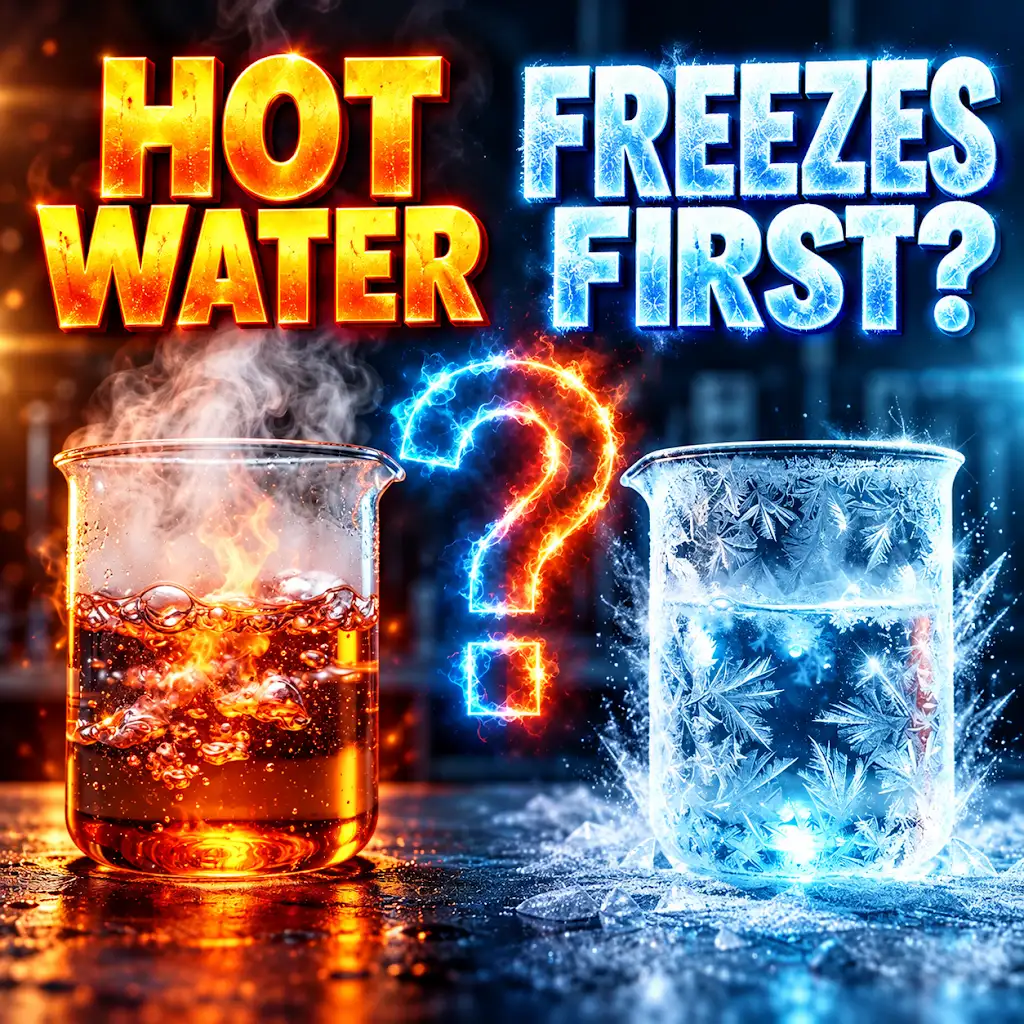
Why Hot Water Freezes Faster Than Cold (The Mpemba Effect)
FAQs
What is supercooling?
Supercooling is the process of cooling a liquid below its freezing point without it solidifying. This results in a liquid that is in a metastable state, meaning it is temporarily stable even though it is below its freezing point.
How is supercooling different from freezing?
Supercooling is different from freezing because in supercooling, the liquid remains in a liquid state even though it is below its freezing point. Freezing, on the other hand, is the process where a liquid solidifies into a solid state at its freezing point.
What are some examples of supercooling in nature?
One common example of supercooling in nature is when water droplets in the atmosphere remain in a liquid state even though the temperature is below freezing. This can lead to the formation of supercooled water droplets that can freeze instantly upon contact with a surface.
How is supercooling used in technology?
Supercooling is used in technology for various applications such as preserving biological samples, cooling superconducting materials, and in the production of high-quality ice cream. By supercooling certain materials, scientists and engineers can achieve unique properties and effects that are not possible at higher temperatures.
What are the risks associated with supercooling?
One of the risks associated with supercooling is the potential for rapid crystallization or solidification when the supercooled liquid is disturbed or comes into contact with a nucleation site. This can lead to sudden freezing and the release of stored energy, which can be dangerous in certain situations.