The Mpemba effect, a curious phenomenon where hot water can, under certain conditions, freeze faster than cold water, has captivated scientists and casual observers alike for centuries. It defies the intuitive understanding that something already at a higher temperature should require more time to cool down to the freezing point. This seemingly paradoxical observation, named after Tanzanian student Erasto Mpemba who brought it to the attention of physicists in the 1960s, has sparked numerous debates and investigations, leading to a complex web of proposed explanations. While a single, universally accepted answer remains elusive, a confluence of factors likely contributes to this intriguing effect, making it a fascinating subject of scientific inquiry.
Unpacking the Phenomenon: The Core of the Mpemba Effect
The Mpemba effect is not a guarantee; it’s a conditional observation. It hinges on a delicate interplay of variables, and under many everyday circumstances, cold water will indeed freeze faster. However, when the stars align, the hot water gains an advantage. The core of the phenomenon lies in the difference in initial states of the two water samples and how these states evolve during the cooling process. It’s not about hot water spontaneously “wanting” to freeze; it’s about the complex physical processes that occur as temperature decreases, and how these processes can be accelerated or altered by the initial thermal energy. Understanding the Mpemba effect requires delving into the fundamental properties of water and the thermodynamic principles governing phase transitions.
Defining the Observation: What Exactly Is Happening?
At its heart, the Mpemba effect describes the observation that a sample of water initially at a higher temperature can freeze solid before a sample of the same volume and composition, initially at a lower temperature, given identical cooling conditions. This is counterintuitive because, according to basic thermodynamics, the hotter sample has more thermal energy that needs to be dissipated to reach the freezing point of 0 degrees Celsius (32 degrees Fahrenheit). The cooling rate is generally proportional to the temperature difference between the object and its surroundings. Therefore, a colder object should cool down faster. The Mpemba effect challenges this simple model, suggesting that other factors come into play that can accelerate the cooling of the initially hotter water. This phenomenon is typically observed when comparing two containers of water, one filled with hot water and the other with cold, placed in the same freezer.
Historical Roots: From Ancient Wisdom to Modern Science
The observation that hot water can freeze faster than cold is not a modern discovery. Ancient Greek philosophers, including Aristotle, noted this phenomenon. Later, in the 17th century, René Descartes also briefly mentioned it. However, it was Erasto Mpemba, a Tanzanian student, who brought this observation to the forefront of modern scientific discussion. In 1963, while in school, Mpemba noticed that his hot ice cream mix froze faster than his classmates’ cold mix. He brought this to the attention of his physics teacher, who was initially skeptical. Mpemba persisted, and eventually, the teacher, Denis Osborne, collaborated with him to conduct experiments that seemed to confirm the effect. Osborne later presented their findings at a conference in 1969, and the phenomenon was named in Mpemba’s honor. This historical trajectory highlights how observations made in everyday life, even by those without formal scientific training, can lead to significant scientific inquiry.
The Mpemba effect, which describes the phenomenon where hot water can freeze faster than cold water under certain conditions, has intrigued scientists for decades. For a deeper understanding of this counterintuitive concept, you can explore a related article that delves into the scientific explanations and experiments surrounding the Mpemba effect. To read more about it, visit this article.
Probing the Mechanisms: What Explains This Anomaly?
The quest to explain the Mpemba effect has led to the proposal of several plausible mechanisms, each addressing different physical aspects of the cooling and freezing process. No single mechanism has definitively proven to be the sole cause, and it’s highly probable that a combination of these factors, or even varying combinations depending on the specific experimental setup, contributes to the observed phenomenon. Scientists have explored everything from evaporation and convection currents to dissolved gases and the properties of ice crystal formation.
Evaporative Cooling: The Silent Chill
One of the most commonly cited explanations for the Mpemba effect is evaporative cooling. When water is hot, its rate of evaporation is significantly higher than when it is cold. Evaporation is a process where liquid molecules with sufficient kinetic energy escape into the gaseous phase. This escape of molecules carries away a considerable amount of thermal energy from the remaining liquid, thus cooling it down. If the container is open, a hotter sample will lose mass through evaporation more rapidly. This loss of mass means there is less water to freeze, and the remaining water is cooled more effectively by the process of evaporation itself. The cooling effect of evaporation can be substantial, and in some experimental setups, it is believed to be a primary driver of the Mpemba effect.
The Role of Mass Loss: A Lighter Load to Freeze
As mentioned, a direct consequence of increased evaporation from hot water is a reduction in its total mass. A smaller volume of water will naturally require less time to reach its freezing point and solidify compared to a larger volume of the same substance. Imagine two buckets, one half-full and one full of water, both being cooled. The half-full bucket will freeze faster, not because it’s inherently “better” at freezing, but simply because there’s less water to cool. In the context of the Mpemba effect, the initial higher temperature of the hot water leads to a more significant loss of mass through evaporation during the cooling phase. This reduction in mass can be a critical factor in allowing the remaining hot water to freeze faster than the initially colder, but more massive, sample.
Convection Currents: Stirring Up the Cold
Convection is the process of heat transfer in fluids due to the movement of the fluid itself. In water, as it cools, the denser, colder water tends to sink, and the warmer, less dense water rises. This creates convection currents that help to distribute heat throughout the liquid, promoting a more uniform cooling rate. However, the initial temperature difference can influence the strength and behavior of these currents. It has been proposed that hotter water, with a larger initial temperature gradient, might establish stronger convection currents. These currents could potentially accelerate the heat transfer to the surroundings, leading to a faster overall cooling of the bulk of the water. Some theories suggest that these currents might even help to “flush” the colder layers away from the cooling surface more effectively.
Variations in Water Movement: From Gentle Flow to Vigorous Stirring
The nature of convection currents is highly dependent on the temperature gradients within the fluid. When hot water begins to cool, there can be significant temperature differences between the top and bottom layers, or between the edges and the center. These gradients drive the movement of water. In a hot sample, these initial gradients might be steeper, leading to more vigorous convection. As the water cools, these gradients will change, and the convection patterns will evolve. The specific geometry of the container, the surface area exposed to the cooling environment, and the rate of cooling all influence these convection patterns. The idea is that a more efficient or initially stronger convective flow in the hot water could contribute to its faster journey to the frozen state.
The Mpemba effect, which describes the phenomenon where hot water can freeze faster than cold water under certain conditions, has intrigued scientists and curious minds alike. For a deeper understanding of this fascinating topic, you can explore a related article that delves into the science behind this counterintuitive effect. This article not only explains the various theories surrounding the Mpemba effect but also discusses its implications in real-world scenarios. To read more about it, visit this insightful resource.
Dissolved Gases: The Invisible Players
Water, especially tap water, contains dissolved gases such as oxygen and nitrogen. These gases can affect the properties of water, including its freezing point and heat transfer characteristics. As water is heated, its solubility for dissolved gases decreases, meaning that more gas will be expelled from the water. Conversely, as cold water is cooled, it can hold more dissolved gases. It has been hypothesized that the lower concentration of dissolved gases in initially hot water might contribute to the Mpemba effect. This is because dissolved gases can potentially interfere with the formation of ice crystals, acting as nucleation sites that are not ideal for rapid freezing. Water with fewer dissolved gases might therefore freeze more readily.
Gas Escape and Its Impact: A Less Cluttered Freezing Process
When water is heated, dissolved gases are driven out. This process can be quite significant, especially if the water is heated to near boiling. The removal of these dissolved gases might make the water “cleaner” in terms of nucleation sites for ice crystal formation. Ice crystals typically form around impurities or dissolved substances. If the hot water has fewer of these, the formation of a solid ice lattice might be facilitated. Conversely, cold water, having retained more dissolved gases, might experience a more hindered freezing process as these gases interfere with the orderly arrangement of water molecules into ice. This hypothesis suggests that the chemical composition of the water, altered by temperature, plays a crucial role.
Exploring Other Contributing Factors: Beyond the Primary Hypotheses

While evaporation, convection, and dissolved gases are the most frequently discussed explanations, scientists have explored other factors that could potentially influence the Mpemba effect. These include supercooling, the influence of container materials, and even quantum mechanical effects, although the latter are considered more speculative for macroscopic phenomena. Each of these factors, when considered in isolation or in combination with others, adds another layer of complexity to understanding this perplexing observation.
Supercooling: The Delayed Freeze
Supercooling occurs when a liquid is cooled below its freezing point without solidifying. This is because the formation of ice crystals requires a nucleation site – a point where crystal growth can begin. In pure water, such sites might be absent, leading to a delay in freezing. The phenomenon of supercooling can differ between hot and cold water samples. It’s possible that hot water, due to its initial heating, might have had its potential nucleation sites disrupted or removed (e.g., through the expulsion of dissolved gases or organic impurities), making it less prone to supercooling and thus able to freeze more readily once it reaches the freezing point. Conversely, cold water might retain more of these potential nucleation sites, leading to more pronounced supercooling and a delayed onset of freezing.
The Influence of Ice Nucleation: A Seed for Freezing
Ice nucleation is the initial stage of ice formation, where a small, ordered cluster of water molecules forms. These clusters then grow into ice crystals. The presence of impurities or dissolved substances can act as nucleation sites, providing a surface or structure upon which ice crystals can more easily form. When water is heated, many of these impurities or dissolved gases can be expelled or altered. This can mean that hot water, upon cooling, might have fewer effective nucleation sites. If this is the case, once the hot water reaches its freezing point, it might begin to form ice more rapidly because it doesn’t have to overcome a significant supercooling hurdle. Cold water, on the other hand, might retain more of these nucleation sites, leading to a longer period of supercooling before freezing begins.
Container Properties and Impurities: The Unseen Architects
The material of the container holding the water, as well as any impurities present in the water or on the container surfaces, can also play a role. Different materials have different thermal conductivities, meaning they transfer heat at different rates. A container with higher thermal conductivity might accelerate the cooling of the water. Furthermore, the surface roughness or chemical composition of the container can influence convection currents and ice nucleation. Even microscopic impurities in the water can serve as nucleation sites, affecting the freezing process. It is conceivable that the initial heating of the water might interact with the container or impurities in a way that favors faster freezing upon subsequent cooling.
Surface Interactions and Material Transfer: A Subtle Exchange
The interaction between the water and its container is a critical aspect of heat transfer. The container’s material dictates how efficiently heat is drawn away from the water. Furthermore, subtle exchanges can occur at the interface. For example, heating might cause some components from the container to leach into the water, or it might alter the surface properties of the container itself. These changes, however small, could potentially influence the nucleation of ice crystals or the flow of heat. If, for instance, heating causes a beneficial impurity to be released from the container walls into the water, or if it primes the surface for more efficient heat transfer, this could contribute to the Mpemba effect.
Other Potential Influences: A Multifaceted Puzzle
Beyond the commonly discussed factors, scientists continue to explore other possibilities. Some research has pointed to the role of convection currents in specific geometric arrangements, suggesting that the shape of the container and the positioning of the samples within the cooling environment can significantly influence the outcome. There’s also ongoing investigation into the specific heat capacity and thermal conductivity of water, which can vary slightly with temperature and the presence of dissolved substances. More speculative theories sometimes venture into areas like the electromagnetic properties of water or even quantum effects, though these remain largely unproven for this macroscopic phenomenon. The complexity of water itself, with its hydrogen bonding and unique physical properties, means that subtle changes induced by temperature can have cascading effects.
The Peculiarities of Water: A Substance of Surprises
Water is an extraordinary substance with a peculiar set of properties that deviate from the behavior of many other liquids. Its anomalous expansion upon freezing (ice is less dense than liquid water), its high specific heat capacity, and its complex hydrogen bonding network all contribute to its unique behavior. These characteristics mean that even seemingly small changes in temperature or dissolved content can lead to significant alterations in its physical properties, such as viscosity, surface tension, and thermal conductivity. The Mpemba effect may simply be a manifestation of these inherent peculiarities of water, amplified under specific cooling conditions.
Experimental Challenges and Reproducibility: The Elusive Proof
The Mpemba effect, while fascinating, has proven surprisingly difficult to reproduce consistently in laboratory settings. The sensitivity of the phenomenon to subtle variations in experimental conditions makes it challenging to establish a definitive set of parameters under which it will always occur. This lack of consistent reproducibility has been a major hurdle in definitively proving any single explanation and has led to skepticism among some scientists. Precise control over variables such as water purity, container type, cooling rate, and even ambient atmospheric conditions is crucial for observing the effect.
Variables at Play: A Delicate Balancing Act
The Mpemba effect is notoriously sensitive to a multitude of variables. The initial temperatures of the hot and cold water samples, the volume and shape of the containers, the material of the containers, the purity of the water (including dissolved salts and gases), the surface area exposed to the cooling environment, and the precise cooling rate employed can all influence whether the effect is observed. Even the method of placing the containers in the freezer – for example, whether they are in direct contact with the cooling element or suspended – can have an impact. This intricate web of interconnected variables makes it difficult to isolate the exact cause.
The Importance of Precision: Eliminating Ambiguity
To reliably demonstrate the Mpemba effect, scientists must exercise extreme precision in their experimental design and execution. This involves using highly purified water, identical containers made of the same material, and controlling the cooling rate meticulously. Measuring the temperatures of both samples at regular intervals and determining the exact moment of complete solidification for each are critical steps. The process of defining “freezing” itself can be a source of ambiguity; some might consider the first ice crystal formation as the endpoint, while others require complete solidification. Establishing clear, objective criteria for observation is paramount for achieving reproducible results.
The Debate Continues: Ongoing Scientific Discourse
Despite decades of research, the Mpemba effect remains a subject of ongoing scientific
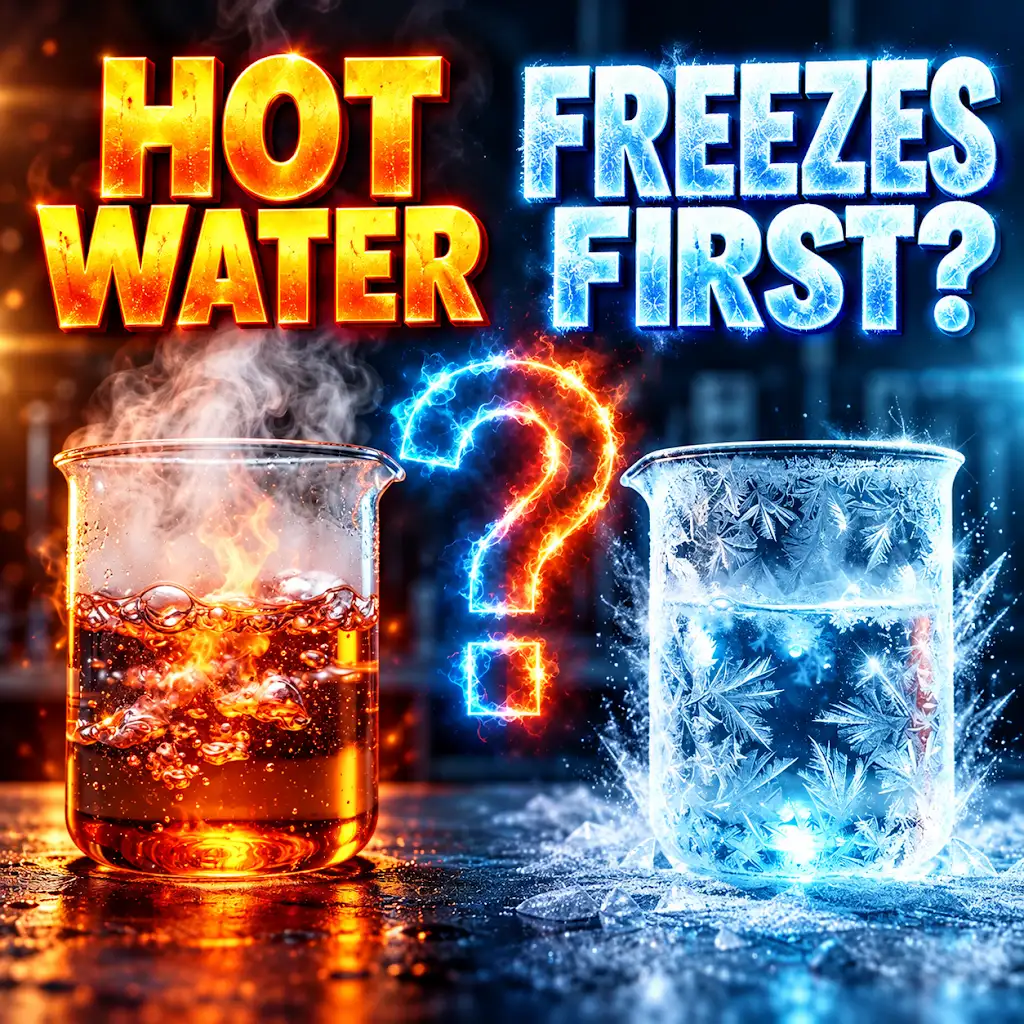
Why Hot Water Freezes Faster Than Cold (The Mpemba Effect)
FAQs
What is the Mpemba effect?
The Mpemba effect is the phenomenon where hot water freezes faster than cold water under certain conditions.
Who discovered the Mpemba effect?
The Mpemba effect was first described by a Tanzanian student named Erasto Mpemba in the 1960s.
What are some possible explanations for the Mpemba effect?
Possible explanations for the Mpemba effect include evaporation, dissolved gases, supercooling, and differences in the rate of heat transfer.
Are there any practical applications of the Mpemba effect?
The Mpemba effect has potential applications in industries such as food preservation, ice cream making, and cryopreservation.
Can the Mpemba effect be replicated consistently?
While the Mpemba effect has been observed in various experiments, replicating it consistently remains a subject of ongoing research and debate among scientists.