
The curious phenomenon known as the Mpemba effect, where under certain conditions, hot water appears to freeze faster than cold water, has long puzzled scientists and casual observers alike. This seemingly counterintuitive observation challenges our everyday understanding of thermodynamics. While many might dismiss it as a myth or a trick of the light, the Mpemba effect has been repeatedly observed and studied, prompting a significant amount of scientific inquiry. This article delves into the intricacies of this peculiar behavior, exploring its historical context, potential explanations, and the ongoing debate surrounding its validity and universality.
The Historical Enigma of the Mpemba Effect
The story of the Mpemba effect is often attributed to a Tanzanian student named Erasto Mpemba, who, in the early 1960s, noticed that ice cream mixture he was preparing froze faster when he put the hotter mixture into the freezer first. He presented his findings to his physics teacher, who initially dismissed them. However, Mpemba persisted, eventually presenting his observations to a visiting Russian physicist, who, intrigued, confirmed Mpemba’s findings. This anecdotal evidence, coupled with the lack of a readily available scientific explanation at the time, fueled the legend of the Mpemba effect.
The effect itself, however, was not entirely new. Philosophers and scientists have pondered this anomaly for centuries. Aristotle, in his writings, noted that “water that has been warmed freezes sooner than the same amount of cold water.” Later, in the 17th century, Francis Bacon also documented similar observations. Despite these historical accounts, the phenomenon remained largely unaddressed by mainstream science until Mpemba’s persistent curiosity brought it back into focus. The initial reluctance of the scientific community to accept such a counterintuitive phenomenon is understandable, as it appears to violate fundamental principles of heat transfer. However, the consistent observation across various settings, from school cafeterias to laboratory experiments, necessitated a deeper investigation. The term “Mpemba effect” itself became widely adopted, solidifying Erasto Mpemba’s place in the history of this intriguing scientific puzzle, even though he was not the first to observe it. This historical journey highlights how scientific understanding often evolves through a combination of serendipitous discovery, persistent questioning, and rigorous investigation.
Early Observations and Academic Skepticism
The initial reception of Mpemba’s findings was met with considerable skepticism within the academic community. Physics teachers and professors, grounded in established laws of thermodynamics, found it difficult to reconcile the idea that a hotter object could lose heat and solidify faster than a colder one. The prevailing understanding at the time suggested that the colder water, already closer to its freezing point, should naturally freeze first. This ingrained belief, supported by centuries of scientific inquiry, made the Mpemba effect appear as an anomaly that might be due to experimental error or misinterpretation. The very nature of scientific progress often involves challenging existing paradigms, but this requires robust evidence and compelling explanations. In the case of the Mpemba effect, the initial evidence, while observational, lacked the quantitative rigor and theoretical framework needed to overcome established scientific dogma. This period of skepticism, while seemingly dismissive, was a crucial part of the scientific process, demanding that proponents of the Mpemba effect provide more concrete proof and plausible mechanisms.
The Persistence of Erasto Mpemba
Erasto Mpemba’s unwavering belief in his observations played a pivotal role in keeping the Mpemba effect alive in scientific discourse. Despite the initial dismissal from his teacher and the broader academic community, Mpemba continued to conduct his own experiments and seek explanations. His dedication eventually led him to collaborate with a Russian physicist, who, upon witnessing Mpemba’s demonstrations, recognized the potential significance of the phenomenon. This encounter proved to be a turning point, as it brought the Mpemba effect to the attention of a wider scientific audience and sparked renewed interest in its investigation. Mpemba’s story is a testament to the importance of perseverance in scientific inquiry, demonstrating how a single individual’s curiosity and determination can reignite interest in long-standing puzzles and push the boundaries of scientific understanding.
The phenomenon of hot water freezing faster than cold water, known as the Mpemba effect, has intrigued scientists and researchers for years. For a deeper understanding of this counterintuitive concept, you can explore a related article that delves into the various theories and experiments surrounding this topic. To read more about it, visit this article.
Unraveling the Potential Explanations
The quest to explain the Mpemba effect has led to the proposal of numerous hypotheses, each attempting to account for the seemingly paradoxical behavior of hot water. While no single explanation has emerged as universally accepted, several compelling theories have been put forth, focusing on various physical processes that could influence the rate of cooling and freezing. These explanations often involve a complex interplay of factors, making it challenging to isolate a definitive cause. The scientific community continues to debate the relative importance of each of these proposed mechanisms and how they might interact under different experimental conditions.
Evaporative Cooling: A Significant Factor
One of the most widely cited explanations for the Mpemba effect is the role of evaporative cooling. When water is heated, its vapor pressure increases, leading to a higher rate of evaporation. Evaporation is an endothermic process, meaning it absorbs heat from its surroundings. Consequently, a hotter body of water will lose more heat through evaporation than a colder one, potentially causing it to cool down faster. This effect is particularly pronounced in open containers where there is ample surface area for evaporation to occur. The loss of mass due to evaporation also reduces the total amount of water that needs to be frozen, which can further contribute to a faster perceived freezing time. Researchers have conducted experiments where they have either prevented evaporation or attempted to control its rate, and these studies have often shown a reduction or even complete disappearance of the Mpemba effect, lending considerable weight to this explanation.
Convection Currents: The Role of Heat Transfer
Another significant factor that may contribute to the Mpemba effect is the difference in convection currents within the hot and cold water. As water cools, density changes occur. Colder water is generally denser than warmer water, and this density gradient drives convection currents. In colder water, as the surface cools, it becomes denser and sinks, while warmer water rises. This circulation helps to distribute heat evenly throughout the body of water. In hotter water, however, the initial temperature difference can lead to more vigorous convection currents. These vigorous currents can enhance heat transfer to the surroundings, leading to a faster overall cooling rate. Moreover, some theories suggest that the initial strong convection in hot water might temporarily transfer heat from the bottom to the top, where it can be dissipated more effectively through evaporation and convection at the surface, contributing to a faster initial cooling phase.
Dissolved Gases: Altering Freezing Properties
The presence of dissolved gases in water can also influence its freezing behavior. When water is heated, the solubility of gases like oxygen and nitrogen decreases, causing them to be expelled from the water. This reduction in dissolved gas content can affect the freezing point of water and the way ice crystals form. Some hypotheses suggest that water with fewer dissolved gases might freeze more readily or form a different ice structure that facilitates faster freezing. For instance, dissolved gases can act as nucleation sites for ice crystal formation, and their absence might lead to a delay or altered pattern of ice nucleation. While the exact mechanisms are still under investigation, the influence of dissolved gases on the thermodynamic properties of water during the cooling process is considered a plausible contributing factor to the Mpemba effect.
Supercooling and Nucleation: The Crystallization Process
Supercooling, the phenomenon where a liquid cools below its freezing point without solidifying, and the process of ice nucleation, the initial formation of ice crystals, are critical aspects of freezing. The Mpemba effect might be influenced by differences in supercooling behavior between hot and cold water. It is theorized that hot water, due to factors like reduced dissolved gases or different convection patterns, might be less prone to supercooling than cold water. If hot water is less likely to supercool, it could begin the process of ice crystal formation earlier, thus reaching a fully frozen state faster. The nature of the nucleation sites available in the water, which can be influenced by impurities, dissolved substances, and container surfaces, could also play a role in determining the initial ice formation and subsequent freezing rate.
The Role of the Container and Environment
The properties of the container and the surrounding environment can also play a role in the Mpemba effect. For example, the material of the container can affect heat transfer. A container that conducts heat well might facilitate faster cooling. The surface of the container can also influence the nucleation of ice crystals. Additionally, the geometry of the container can affect convection currents and the rate of evaporation. The ambient temperature and air circulation around the containers can also influence the cooling rates. Some experiments have shown that the Mpemba effect is more pronounced when using certain types of containers or under specific environmental conditions, suggesting that these factors are not merely passive influences but active participants in the phenomenon.
Experimental Approaches and Challenges
Investigating the Mpemba effect in a controlled laboratory setting presents numerous challenges. Precisely controlling all the variables that can influence the cooling and freezing of water is extremely difficult. Researchers have employed various experimental setups and methodologies to try and isolate the key factors at play, but the results have not always been consistent, leading to ongoing debate about the universality and reproducibility of the effect. The complexity of the interactions between different physical processes makes it hard to design experiments that definitively prove or disprove any single hypothesis.
Reproducibility Issues and Defining “Hot” and “Cold”
One of the primary challenges in studying the Mpemba effect is its apparent lack of consistent reproducibility. While many researchers have successfully observed the phenomenon, others have failed to do so, even when attempting to replicate experimental conditions. This inconsistency can be attributed to a multitude of factors, including subtle variations in water purity, dissolved gas content, container type, ambient temperature, and even the method of heating and cooling. Furthermore, the definition of “hot” and “cold” water can vary significantly. What one researcher considers “hot” might be perceived as “lukewarm” by another, and the temperature difference between the two samples can critically influence the outcome. Establishing standardized definitions and rigorous controls for these parameters is crucial for reproducible research.
Advanced Measurement Techniques
To overcome the challenges of reproducibility, scientists have employed increasingly sophisticated measurement techniques. High-speed cameras are used to observe the formation of ice crystals and the dynamics of convection. Thermocouples and infrared thermometers are used to precisely monitor temperature changes within the water and at the surface. Techniques like mass spectrometry can be used to analyze dissolved gases. Furthermore, computational fluid dynamics (CFD) simulations are increasingly being used to model the complex heat transfer processes occurring in the water. These advanced tools allow for a more detailed and nuanced understanding of the physical processes involved, helping to identify the subtle differences that might lead to the Mpemba effect.
The Role of Impurities and Dissolved Substances
The purity of the water used in experiments can significantly impact the Mpemba effect. Tap water, for instance, contains various dissolved minerals and impurities that can affect its freezing point and nucleation behavior. Distilled or deionized water might behave differently. Similarly, the presence of dissolved substances, such as salts or sugars, can alter the freezing point and the rate at which ice forms. Researchers have conducted experiments with water of varying purity and with added solutes to investigate these effects. The interaction between dissolved substances and the potential mechanisms of the Mpemba effect, such as altered convection or gas solubility, remains an active area of research.
The Mpemba Effect in Different Contexts
While often discussed in the context of freezing water in a freezer, the principles behind the Mpemba effect, if proven robust, could have implications in various scientific and engineering disciplines. Understanding how initial temperature influences cooling rates can be crucial in fields ranging from food preservation to industrial processes. The continued investigation of this phenomenon highlights the potential for unexpected behaviors in seemingly simple systems.
Industrial Applications and Food Science
In industrial settings, the ability to rapidly cool or freeze materials can be of significant economic importance. For example, in the food industry, faster freezing can lead to better preservation of texture and nutritional value. If the Mpemba effect can be reliably harnessed, it could lead to more efficient industrial cooling processes, reducing energy consumption and improving product quality. Similarly, in the manufacturing of certain materials, precise control over cooling rates is essential for achieving desired properties. Understanding the influence of initial temperature could allow for optimized manufacturing processes.
Meteorological and Climate Science
While a direct application of the Mpemba effect in everyday weather phenomena is less clear, the underlying principles of heat transfer and phase changes are fundamental to meteorology and climate science. Understanding how temperature gradients and evaporation influence cooling rates could indirectly contribute to more accurate climate models. For instance, the freezing of lakes and oceans, a crucial aspect of climate regulation, involves complex heat transfer dynamics where initial temperature conditions might play a subtle role. The scientific pursuit of the Mpemba effect, even if its direct applications are niche, contributes to a broader understanding of thermophysical processes.
Microscopic and Nanoscale Phenomena
As scientific investigations delve deeper into the microscopic and nanoscale, the Mpemba effect might find relevance in understanding phenomena at these levels. For example, in the behavior of nanoscale droplets or in the crystallization processes of various materials, subtle thermodynamic differences influenced by initial temperature could become more pronounced. The exploration of the Mpemba effect at these scales might reveal new physical principles or offer novel approaches to controlling material properties at the nanometer level.
The phenomenon of hot water freezing faster than cold water, often referred to as the Mpemba effect, has intrigued scientists and curious minds alike for years. For those interested in exploring this fascinating topic further, a related article can be found on Freaky Science, which delves into the various theories and experiments surrounding this counterintuitive observation. You can read more about it by visiting Freaky Science. Understanding the underlying principles of this effect can lead to a greater appreciation of the complexities of thermodynamics and the behavior of water.
Conclusion: The Enduring Mystery and Future Directions
| Experiment | Initial Temperature (°C) | Freezing Time (minutes) | Container Type | Water Volume (ml) | Observation |
|---|---|---|---|---|---|
| Experiment 1 | 80 | 35 | Plastic cup | 100 | Hot water froze faster than cold water |
| Experiment 2 | 25 | 45 | Plastic cup | 100 | Cold water froze slower than hot water |
| Experiment 3 | 90 | 30 | Glass beaker | 150 | Hot water froze faster |
| Experiment 4 | 20 | 50 | Glass beaker | 150 | Cold water froze slower |
| Experiment 5 | 70 | 40 | Metal container | 200 | Hot water froze faster |
| Experiment 6 | 10 | 55 | Metal container | 200 | Cold water froze slower |
The Mpemba effect continues to be a source of fascination and scientific investigation. While significant progress has been made in understanding the potential mechanisms, a definitive and universally accepted explanation remains elusive. The complexity of the phenomenon, involving the interplay of evaporation, convection, dissolved gases, and crystallization, makes it a challenging subject to fully elucidate. However, the ongoing research underscores the importance of questioning apparent paradoxes and exploring the nuances of physical processes.
The continued study of the Mpemba effect highlights the dynamic nature of scientific understanding. What might initially seem like a simple observation can lead to deep explorations into fundamental physics. Future research will likely focus on developing more precise experimental techniques, refining theoretical models, and perhaps even exploring the Mpemba effect in different liquids or under extreme conditions. The quest to fully unravel the Mpemba effect is not just about explaining a curious observation; it is about pushing the boundaries of our knowledge in thermodynamics and fluid dynamics, and potentially uncovering new principles that could have unforeseen applications. The enduring mystery of why hot water might freeze faster than cold water serves as a powerful reminder that even the most familiar substances can hold surprising secrets.
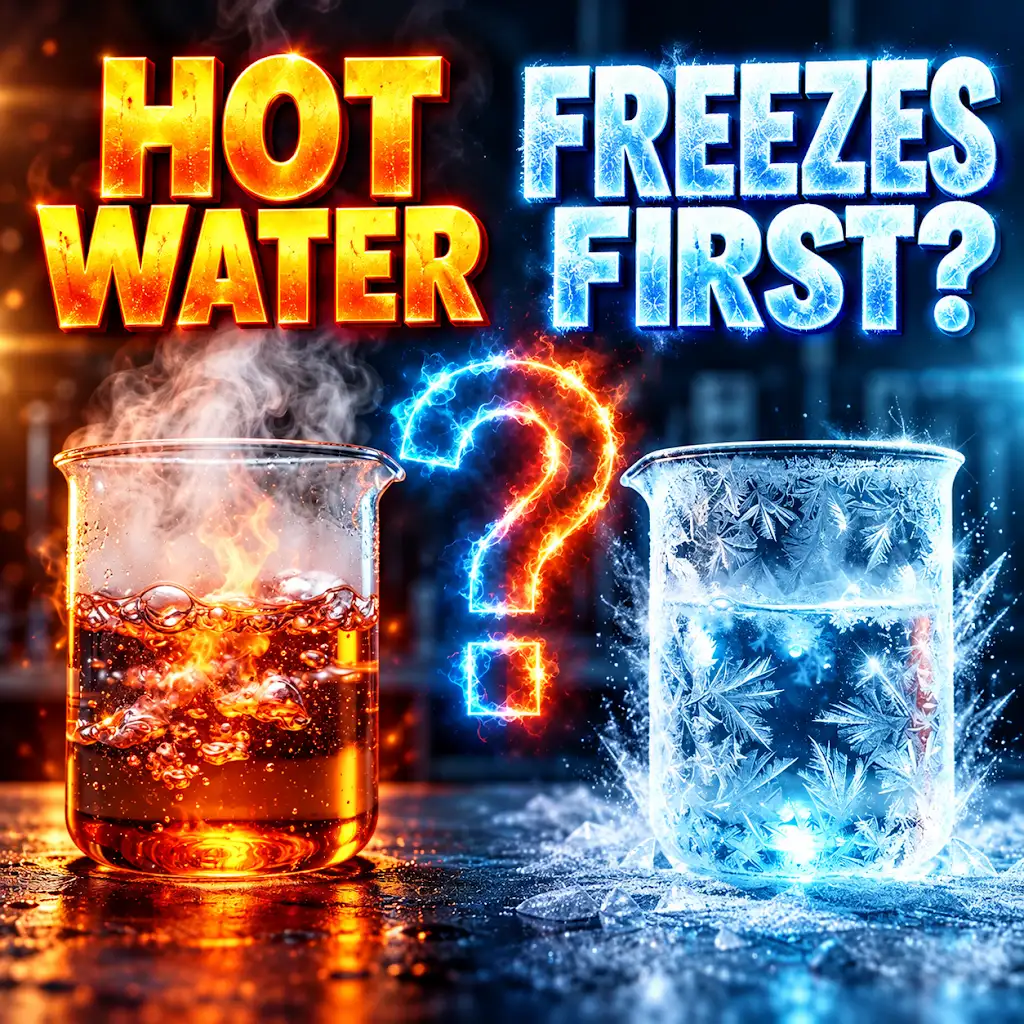
Why Hot Water Freezes Faster Than Cold (The Mpemba Effect)
FAQs
1. Does hot water freeze faster than cold water?
Yes, the Mpemba effect suggests that hot water can freeze faster than cold water under certain conditions. This phenomenon is still not fully understood by scientists.
2. What factors can affect the freezing time of hot water?
Factors such as the initial temperature of the hot water, the volume of water, the container’s material, and the surrounding environment can all influence how quickly hot water freezes.
3. Why does hot water sometimes freeze faster than cold water?
One possible explanation is that hot water may evaporate more quickly, leading to a decrease in volume and faster cooling. Additionally, hot water may have fewer dissolved gases, which could affect the freezing process.
4. Is the Mpemba effect always observed when hot water is placed in a freezer?
No, the Mpemba effect is not always observed, and the conditions under which hot water freezes faster than cold water can vary. It is a complex phenomenon that is still being studied by scientists.
5. Can hot water freeze instantly in extremely cold temperatures?
In extremely cold temperatures, hot water can freeze more quickly than in milder conditions, but it is unlikely to freeze instantly. The rate of cooling and the specific conditions will determine how quickly hot water can freeze.