The Vacuum’s Embrace: A Watery Transformation
Water, a substance so familiar and fundamental to life on Earth, behaves in astonishing ways when stripped of its atmospheric companions. The vacuum, a realm of near-total emptiness, presents a profound challenge to the very nature of liquid water, forcing it into a dramatic and often rapid metamorphosis. Understanding what happens to water in a vacuum requires a delve into the microscopic dance of its molecules, the concepts of vapor pressure, and the distinct phenomena of evaporation and boiling. Far from simply sitting still, water molecules in a vacuum are engaged in a constant struggle for freedom, a struggle dictated by the absence of external pressure.
When water is exposed to a vacuum, it undergoes rapid changes due to the decrease in pressure, leading to phenomena such as boiling at lower temperatures and even the formation of vapor bubbles. For a deeper understanding of this intriguing process, you can read more in the related article on Freaky Science, which explores the behavior of different substances in a vacuum. Check it out here: Freaky Science.
Molecules in Motion: The Energetics of Water
Water molecules, H₂O, are not static entities. They are in perpetual motion, vibrating, rotating, and translating, their kinetic energy determined by temperature. In liquid water, these molecules are held together by intermolecular forces, primarily hydrogen bonds. These bonds, though weaker than the covalent bonds within a water molecule, are strong enough to keep the molecules in close proximity, giving water its liquid form. However, these bonds are not unbreakable.
The Role of Kinetic Energy
The kinetic energy of water molecules is not uniformly distributed. At any given temperature, there exists a spectrum of energies, with some molecules possessing considerably more energy than others. Those molecules with sufficient kinetic energy to overcome the attractive intermolecular forces holding them within the liquid can escape into the gaseous phase. This process, the escape of individual molecules from the liquid surface, is the essence of evaporation.
Intermolecular Forces as a Barrier
The hydrogen bonds and van der Waals forces between water molecules act as a collective barrier, resisting the departure of individual molecules. In a typical Earth environment, the atmospheric pressure exerted by the air above the water surface provides an additional force that further hinders this escape. This external pressure pushes down on the liquid, making it more difficult for energetic molecules to break free.
Evaporation’s Silent Departure
Evaporation is the process by which a liquid transforms into a gas below its boiling point. In a vacuum, this process takes on a new urgency. Without the counteracting force of atmospheric pressure, the molecules at the water’s surface face significantly less resistance.
The Pressure Gradient’s Influence
The fundamental driving force behind evaporation is the difference in vapor pressure between the liquid and the surrounding environment. Vapor pressure is the pressure exerted by the vapor of a substance in thermodynamic equilibrium with its condensed phases (solid or liquid) at a given temperature in a closed system. In the context of a vacuum, this surrounding environment has virtually zero pressure. If the vapor pressure of water at a given temperature is greater than zero, there will be a net flux of water molecules from the liquid into the vacuum until equilibrium is reached, or until the liquid is depleted.
Sublimation as an Accelerated Evaporation
While we typically associate evaporation with liquid turning into gas, in a vacuum, even frozen water can undergo a similar transformation. This process, known as sublimation, is where a solid directly transitions into a gas without passing through the liquid phase. In a vacuum, sublimation can occur at a significantly accelerated rate compared to atmospheric conditions. The ice crystals, lacking the insulating blanket of air pressure, readily shed their molecules into the void. This is why you might see frost disappear from a frozen object left in a vacuum chamber, even if the temperature remains below freezing. The ice is not melting; it is directly turning into water vapor.
Boiling: A Violent Unveiling
Boiling is a phase transition that occurs when the vapor pressure of a liquid equals the external pressure acting upon it. This equality allows for the formation of vapor bubbles not just at the surface, but also within the bulk of the liquid. In a vacuum, the external pressure is virtually zero, which drastically alters the conditions required for boiling.
The Demise of Atmospheric Pressure
The most striking difference in a vacuum is the absence of atmospheric pressure. On Earth at sea level, water boils at 100°C (212°F) because at this temperature, its vapor pressure reaches approximately 1 atmosphere, which is the ambient atmospheric pressure. In a vacuum, however, the external pressure is infinitesimally small. Consequently, the vapor pressure of water only needs to be a tiny fraction of an atmosphere to equal the external pressure. This means that water can boil at extremely low temperatures.
Nucleation Sites and Bubble Formation
The formation of vapor bubbles during boiling, a process known as nucleation, typically requires imperfections or nucleation sites within the liquid or on the container walls. These sites provide surfaces where the initial formation of vapor clusters is energetically favorable. In a vacuum, even with seemingly pure water, the tendency to form these bubbles is amplified due to the minimal pressure resisting their expansion. As soon as a few water molecules gain enough energy to become vapor, they can readily expand into a bubble because there is almost no external force pushing back.
When water is placed in a vacuum, it undergoes a fascinating transformation due to the lack of atmospheric pressure, leading to rapid evaporation and even boiling at lower temperatures. This phenomenon is not only intriguing but also has practical implications in various scientific fields. For a deeper understanding of the behavior of liquids in different environments, you can explore this related article on Freaky Science, which discusses the unique properties of water and its interactions in a vacuum.
The Vacuum’s Impact on Water’s State
| Condition | Observation | Explanation | Temperature Effect |
|---|---|---|---|
| Water exposed to vacuum at room temperature | Rapid boiling and evaporation | Lower pressure reduces boiling point, causing water to boil at room temperature | Boiling occurs even at ~20-25°C |
| Water in vacuum at low temperature | Slow evaporation or sublimation | Water molecules escape slowly due to lower vapor pressure | Evaporation rate decreases as temperature drops |
| Water in vacuum over time | Complete evaporation or sublimation | Without atmospheric pressure, water eventually transitions to vapor phase | Time depends on temperature and initial volume |
| Water freezing in vacuum | Possible formation of ice crystals | Rapid evaporation cools remaining water, potentially freezing it | Freezing point can be reached due to evaporative cooling |
| Water vapor pressure in vacuum | Decreases with temperature | Vapor pressure is temperature dependent, lower temperature means lower vapor pressure | At 0°C, vapor pressure ~0.6 kPa; at 25°C, ~3.2 kPa |
The extreme conditions of a vacuum profoundly influence the physical state of water, leading to rapid phase changes and sometimes surprising outcomes. The interplay between molecular energy, intermolecular forces, and external pressure is what dictates the fate of water molecules in this unique environment.
Freezing and Boiling Simultaneously?
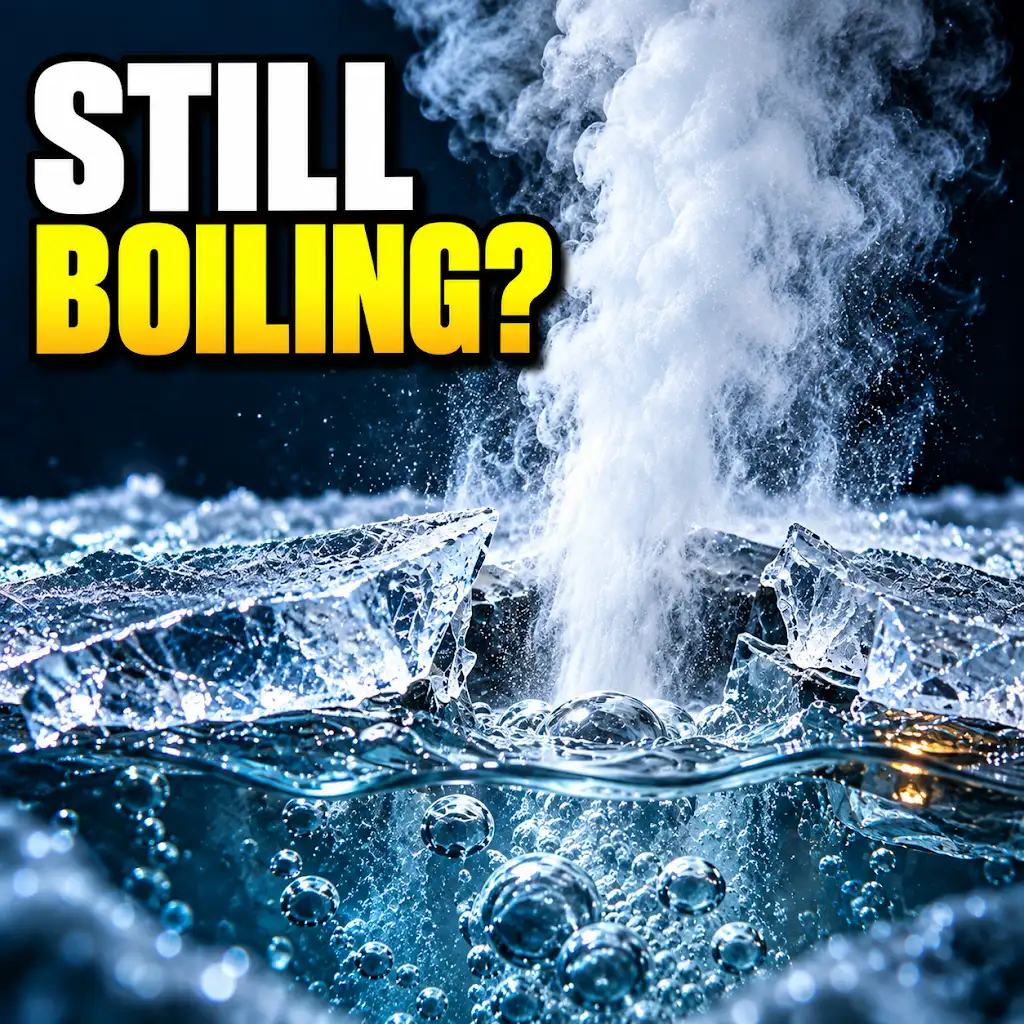
It might seem counterintuitive, but under certain conditions in a vacuum, water can appear to freeze and boil at the same time. This phenomenon occurs when the rate of evaporation (or sublimation from ice) is so rapid that it removes heat from the remaining liquid faster than heat can be supplied. The rapid escape of energetic molecules into the vacuum leads to a significant cooling effect. If this cooling is sufficiently rapid, the remaining liquid can reach its freezing point and begin to solidify, even as the surface of the ice continues to sublimate or the surface of the remaining liquid continues to boil. This is a testament to the powerful heat removal capabilities of rapid vaporization in a low-pressure environment. The energy required for a molecule to transition from liquid to gas (latent heat of vaporization) is substantial, and when this transition is happening at a high rate, it effectively draws heat away from the system.
The Importance of Initial Temperature
The initial temperature of the water plays a crucial role. If the water is initially at room temperature, it will begin to evaporate and then boil very quickly upon being introduced into a vacuum. The rapid loss of mass through vaporization will cause its temperature to drop. If the initial temperature is sufficiently high, it might even reach its boiling point before significant cooling occurs. However, if the water is initially very cold, closer to its freezing point, the rapid evaporation will lead to cooling, and it will freeze before it has a chance to boil vigorously, or it will enter the perplexing state of simultaneous freezing and boiling.
Practical Implications and Scientific Inquiry
The behavior of water in a vacuum is not merely a theoretical curiosity; it has significant practical implications in various scientific and technological fields. Understanding these phenomena is crucial for designing experiments, operating spacecraft, and even developing new materials.
Spacecraft and Life Support Systems
In the vacuum of space, water is a vital resource for astronauts and is integral to life support systems. Understanding how water behaves under vacuum conditions is paramount for the design of water storage, purification, and recycling systems on spacecraft. Preventing uncontrolled evaporation or freezing is essential for maintaining a stable supply of potable water and for the efficient operation of environmental control systems. For example, the rapid evaporation of water from exposed surfaces can lead to a loss of valuable resources and can also cause significant cooling of equipment.
Freeze-Drying and Material Science
The principle of rapid sublimation in a vacuum is the foundation of freeze-drying, a process used to preserve food, pharmaceuticals, and biological samples. By freezing the material and then exposing it to a vacuum, the ice is directly converted to vapor, leaving behind a dry, stable product that retains its original structure and properties. In material science, understanding the phase transitions of water in vacuum environments is important for the study of porous materials, geological processes in extraterrestrial environments, and the behavior of liquids in microgravity. The ability to control the rate of sublimation and evaporation can also be leveraged for the synthesis of nanomaterials and the creation of specialized coatings. The absence of atmospheric contaminants in a vacuum also allows for cleaner and more controlled experimental conditions, which is vital for high-precision scientific investigations. The study of water in vacuum also contributes to our understanding of planetary science, particularly the potential for liquid water on other celestial bodies where atmospheric pressure might be negligible or extremely low.
Water Boiled While Ice Formed. Could a Lander Sink Into It?
FAQs
1. What happens to water in a vacuum?
Water in a vacuum will evaporate rapidly due to the low pressure, causing it to turn into water vapor.
2. Can water freeze in a vacuum?
Yes, water can freeze in a vacuum if the temperature is low enough. The lack of air pressure does not prevent water from freezing.
3. Does water boil in a vacuum?
Water will boil in a vacuum at a lower temperature than normal atmospheric pressure. This is because the reduced pressure lowers the boiling point of water.
4. What is the effect of a vacuum on water’s boiling point?
In a vacuum, the boiling point of water decreases significantly compared to boiling water at normal atmospheric pressure. This is due to the reduced pressure causing the water to boil at a lower temperature.
5. How does water behave in a vacuum compared to in normal conditions?
In a vacuum, water behaves differently than in normal conditions. It evaporates faster, boils at a lower temperature, and freezes more easily due to the absence of air pressure.