The Interplay of Pressure and Molecular Freedom
Water, a substance seemingly as common and predictable as the rising sun, possesses a fascinating characteristic when its boiling point is considered. While commonly understood to boil at 100 degrees Celsius (212 degrees Fahrenheit) at standard atmospheric pressure, this value is not a universal constant. The temperature at which water transforms from a liquid to a gas, or boils, is intimately linked to the surrounding atmospheric pressure. In environments where the pressure is lower, such as at high altitudes or within a vacuum chamber, water will boil at significantly lower temperatures. This phenomenon, often counterintuitive at first glance, is a direct consequence of the fundamental physics governing the behavior of molecules and the nature of phase transitions. Understanding this relationship requires a closer look at the forces at play within a liquid and the role that external pressure exerts on these interactions.
At its core, boiling is a process driven by the kinetic energy of water molecules. In a liquid state, these molecules are in constant motion, bumping into each other and overcoming intermolecular forces to move around. As heat is added to water, this kinetic energy increases. The molecules vibrate more vigorously, move faster, and their collisions become more energetic. When a sufficient amount of energy is supplied, individual molecules gain enough momentum to break free from the attractive forces holding them within the liquid phase and escape into the gaseous phase as steam. This escape happens when the vapor pressure of the water equals or exceeds the external pressure acting upon its surface.
The Concept of Vapor Pressure
Vapor pressure is a crucial concept in understanding boiling. It represents the pressure exerted by the vapor of a substance in thermodynamic equilibrium with its condensed phases (solid or liquid) at a given temperature in a closed system. In simpler terms, it is the tendency of a liquid to evaporate. Even at temperatures below the boiling point, some molecules at the surface of the water will possess enough kinetic energy to overcome the intermolecular forces and escape into the air, forming a vapor. This vapor then exerts a pressure. As the temperature of the liquid increases, more molecules gain sufficient energy to escape, leading to a higher vapor pressure.
At the boiling point, the vapor pressure of the liquid is exactly equal to the external pressure. Imagine a pot of water on a stove. The heat from the stove increases the kinetic energy of the water molecules. As they gain energy, they begin to escape from the surface. This escaping vapor creates pressure. Simultaneously, the atmosphere above the water exerts its own pressure, pushing down on the surface. When the pressure exerted by the escaping water vapor becomes equal to the pressure of the atmosphere pushing down, the water is said to be boiling. Bubbles of steam form not just at the surface, but throughout the bulk of the liquid, as the vapor pressure within these pockets is sufficient to overcome the surrounding liquid pressure and the external atmospheric pressure.
Understanding why water boils at lower temperatures under reduced pressure is essential for various scientific and practical applications. When atmospheric pressure decreases, the boiling point of water also drops, allowing it to transition from liquid to gas more easily. This phenomenon is particularly important in high-altitude cooking and in industrial processes. For a deeper exploration of this topic, you can read more in the related article found here: Freaky Science.
The Influence of External Pressure on Boiling
The external pressure plays a direct and significant role in determining the boiling point of a liquid. This pressure acts as a barrier, resisting the escape of water molecules from the liquid phase. In environments with higher external pressure, more energy is required for the water molecules to overcome this resistance and transition into the gaseous state. Conversely, in environments with lower external pressure, this resistance is diminished.
Atmospheric Pressure and Altitude
The most common example of varying external pressure is atmospheric pressure, which decreases with increasing altitude. As one ascends to higher elevations, the column of air above becomes shorter and less dense, resulting in a lower atmospheric pressure. For instance, at sea level, standard atmospheric pressure is approximately 101.3 kilopascals (kPa) or 1 atmosphere (atm). At an altitude of 1,500 meters (about 5,000 feet), the atmospheric pressure drops to roughly 85 kPa, and at 3,000 meters (about 10,000 feet), it further decreases to around 70 kPa. This reduction in atmospheric pressure directly impacts the boiling point of water.
At sea level, water boils at 100°C because at this temperature, its vapor pressure reaches approximately 101.3 kPa, matching the atmospheric pressure. However, on a mountaintop where the atmospheric pressure is lower, water’s vapor pressure doesn’t need to reach 101.3 kPa to equal the external pressure. Instead, it only needs to reach the lower ambient pressure. Since vapor pressure increases with temperature, this means water will reach its boiling point at a lower temperature. For example, in Denver, Colorado, which is about 1,600 meters above sea level, water boils at approximately 95°C. This difference, while seemingly small, can have practical implications, especially in cooking. Foods that are boiled will take longer to cook at higher altitudes because the lower boiling temperature means less heat energy is being transferred to the food per unit of time.
The Mechanics of Reduced Pressure Environments
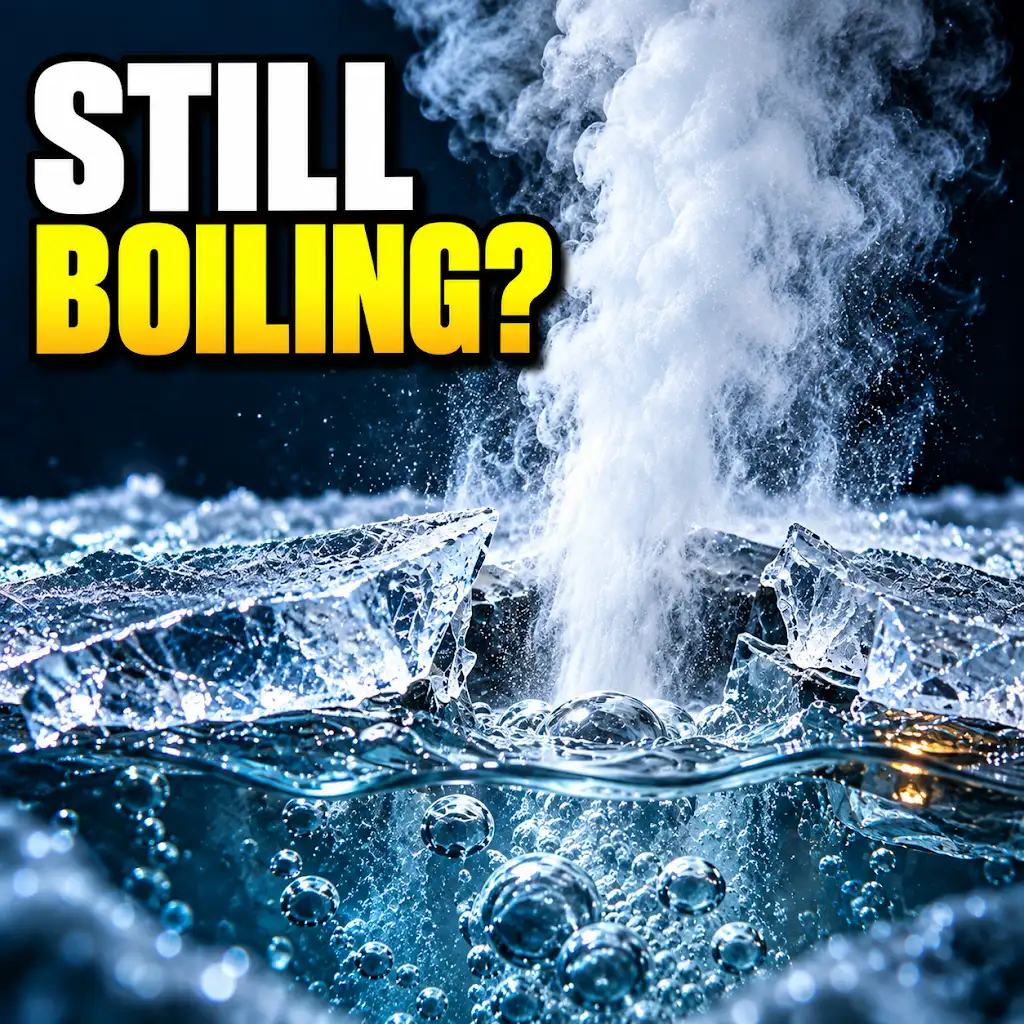
Beyond natural altitude variations, artificial low-pressure environments can also be created to observe this phenomenon. These environments are typically generated using vacuum pumps. In a laboratory setting, a vacuum chamber can be used to significantly reduce the pressure surrounding a sample of water. As the vacuum pump removes air molecules from the chamber, the pressure inside drops dramatically. At very low pressures, approaching a near-vacuum, water can boil at room temperature or even below. This is because the external pressure is so low that even the relatively low vapor pressure of water at ambient temperatures is sufficient to overcome it.
This principle is also utilized in industrial processes. For example, vacuum distillation is a technique used to separate liquids with high boiling points or those that decompose at their normal boiling points. By reducing the pressure, the boiling point of the substance is lowered, allowing it to vaporize at a much lower temperature, thus preventing degradation. Similarly, freeze-drying, a method used to preserve food and pharmaceuticals, relies on reducing the pressure to a point where ice sublimes directly from solid to gas, bypassing the liquid phase. This process is significantly more efficient and preserves the integrity of the material compared to traditional drying methods.
Molecular Behavior at Reduced Pressure
The behavior of water molecules is fundamentally altered by the external pressure. Pressure, in this context, can be viewed as a force that constrains the movement and freedom of these molecules. In a liquid, molecules are relatively close together, held by intermolecular forces such as hydrogen bonds. Boiling is the process by which these molecules gain enough energy to overcome these attractive forces and escape into the gas phase.
Intermolecular Forces and Kinetic Energy Balance
Intermolecular forces are the attractive forces between molecules that hold them together in a liquid or solid state. In water, hydrogen bonds are particularly strong and play a significant role. For a water molecule to escape into the gaseous phase, it must possess enough kinetic energy to break free from these attractions. The vapor pressure is a measure of the average kinetic energy of the molecules at the surface of the liquid.
In a high-pressure environment, the external pressure acts like an additional force pressing down on the liquid surface, making it harder for molecules to escape. It effectively increases the energy barrier that a molecule must overcome to transition into the gas phase. This means that a higher temperature, and thus higher kinetic energy, is needed for the vapor pressure to equal the external pressure and initiate boiling. Conversely, in a low-pressure environment, the external force pushing down on the surface is reduced. This lowers the energy barrier for molecules to escape. The same amount of kinetic energy, which might not have been sufficient to overcome the forces at higher pressure, is now enough to break free. Consequently, the vapor pressure only needs to reach a lower value to match the diminished external pressure, leading to boiling at a lower temperature.
The Role of Vaporization and Condensation Equilibrium
Boiling is a dynamic process involving both vaporization (liquid to gas) and condensation (gas to liquid). In a closed system at a given temperature, there is an equilibrium between these two processes. Vapor pressure is established when the rate of vaporization equals the rate of condensation. When water is heated, the rate of vaporization increases. At the boiling point, the rate of vaporization becomes so high that it not only matches the rate of condensation but also overcomes the external pressure, allowing bubbles of steam to form and rise.
In a low-pressure environment, the external pressure is less of an obstacle. The vapor molecules that escape from the liquid surface have more “room” to move away. The rate of condensation is effectively reduced because the vapor molecules have a lower probability of colliding with the liquid surface and being recaptured. This imbalance, where vaporization outpaces condensation at a lower temperature, signifies that the boiling point has been lowered. The energy required to maintain a net outward flow of molecules (boiling) is less when the external pressure is lower, as there is less resistance to the expanding vapor.
Practical Implications and Applications
The principle that water boils at lower temperatures in low-pressure environments has numerous practical implications and applications across various fields, from everyday cooking to industrial processes and scientific research.
Culinary Adjustments at High Altitudes
For individuals living at or visiting high altitudes, the lower boiling point of water has a direct impact on cooking. As mentioned earlier, foods that rely on boiling, such as pasta, rice, and vegetables, will take longer to cook because the water is not as hot. A recipe that calls for boiling for 10 minutes at sea level might require 15-20 minutes or even longer at higher elevations. To compensate for this, cooks at high altitudes often need to adjust cooking times or employ methods to increase the pressure around the boiling water.
One common method to mitigate this is using a pressure cooker. A pressure cooker seals the pot, trapping steam and increasing the internal pressure above atmospheric levels. This elevated pressure raises the boiling point of water inside the cooker, allowing food to cook faster at a higher temperature. Conversely, if one were to attempt to boil water in a very low-pressure environment, like a vacuum chamber, it would boil at a temperature that might not be sufficient to cook food effectively, and the rapid evaporation could lead to undesirable outcomes.
Scientific and Industrial Processes
Beyond the kitchen, the phenomenon is critical in many scientific and industrial applications. In laboratory settings, vacuum distillation is a cornerstone technique for purifying heat-sensitive compounds. By reducing the pressure, the boiling points of these compounds are lowered, allowing them to be vaporized and collected without thermal decomposition. This is essential in the production of pharmaceuticals, fine chemicals, and in research involving organic synthesis.
Another significant application is in the field of cryogenics, where substances are cooled to extremely low temperatures. Some cryogenic processes involve handling liquefied gases, and understanding their boiling points under varying pressures is crucial for safe storage and manipulation. Furthermore, in the aerospace industry, the behavior of liquids and their boiling points at the low pressures experienced in space are vital considerations for fuel systems, life support, and experimental setups. The design of spacecraft and space equipment must account for these altered boiling characteristics to ensure functionality and safety.
Understanding why water boils at lower temperatures under reduced pressure is a fascinating topic in physics and chemistry. When atmospheric pressure decreases, the boiling point of water also drops, allowing it to transition from liquid to gas more easily. This phenomenon is crucial in various applications, including cooking at high altitudes and industrial processes. For a deeper exploration of the science behind boiling points and pressure, you can read more in this insightful article on Freaky Science.
Understanding the Relationship Between Pressure and Boiling Point
| Factor | Description | Effect on Boiling Point |
|---|---|---|
| Atmospheric Pressure | The pressure exerted by the weight of the air above the liquid. | Lower pressure reduces the boiling point of water. |
| Vapor Pressure | The pressure exerted by the vapor in equilibrium with its liquid at a given temperature. | Water boils when vapor pressure equals external pressure; lower external pressure means lower boiling temperature. |
| Altitude | Height above sea level where atmospheric pressure is lower. | Higher altitude results in lower atmospheric pressure, causing water to boil at lower temperatures. |
| Boiling Point at Sea Level | Standard boiling point of water at 1 atm pressure. | 100°C (212°F) |
| Boiling Point at 0.5 atm | Boiling point of water at half atmospheric pressure. | Approximately 81°C (178°F) |
| Boiling Point at 0.1 atm | Boiling point of water at one-tenth atmospheric pressure. | Approximately 45°C (113°F) |
The relationship between pressure and boiling point is not arbitrary; it is governed by fundamental thermodynamic principles. The boiling point of a liquid is defined as the temperature at which its vapor pressure equals the surrounding atmospheric pressure. This definition itself highlights the direct link between these two factors.
Clausius-Clapeyron Relation
The thermodynamic relationship between pressure and temperature for a phase transition is quantitatively described by the Clausius-Clapeyron relation. While a full derivation is beyond the scope of a general article, the equation essentially states that the rate of change of the logarithm of the vapor pressure with respect to temperature is proportional to the enthalpy of vaporization divided by the temperature squared and the ideal gas constant. In simpler terms, it describes how the vapor pressure of a substance changes with temperature.
The Clausius-Clapeyron relation shows that as temperature increases, vapor pressure increases. Conversely, as temperature decreases, vapor pressure decreases. Crucially, it also implies that if the external pressure is higher, a higher temperature is needed for the vapor pressure to match it. If the external pressure is lower, a lower temperature is sufficient for this equilibrium to be reached. This mathematical framework provides a rigorous basis for the observed phenomenon and allows for precise calculations of boiling points at different pressures.
Visualization and Conceptualization
To visualize this, imagine the surface of the water as a boundary. Molecules within the liquid are constantly trying to escape into the air. The external pressure is like a lid pushing down on this boundary, preventing escape. To overcome this lid, the molecules need more energy, which means a higher temperature. In a low-pressure environment, the lid is lighter, and the molecules need less energy to push it open and escape. Boiling, therefore, is the point where the collective “push” of the vapor molecules from the liquid equals the “push” of the external pressure from the atmosphere. When the external push is weaker, the internal push (vapor pressure) doesn’t need to be as strong, and a lower internal energy state (lower temperature) is sufficient to achieve this balance. This continuous interplay between molecular kinetic energy, intermolecular forces, and external pressure dictates the precise temperature at which water, or any liquid, will boil.
Water Boiled While Ice Formed. Could a Lander Sink Into It?
FAQs
Why does water boil in low pressure?
Water boils in low pressure because the reduced atmospheric pressure lowers the boiling point of water. This means that the water molecules can escape into the air more easily, causing the water to boil at a lower temperature than normal.
What is the relationship between pressure and boiling point?
The boiling point of a substance is directly related to the pressure of the surrounding environment. As pressure decreases, the boiling point of a substance also decreases. Conversely, as pressure increases, the boiling point of a substance increases.
How does altitude affect the boiling point of water?
At higher altitudes, the atmospheric pressure is lower, which means that water boils at a lower temperature. This is why it takes longer to cook food at high altitudes, as the lower boiling point of water affects the cooking process.
Can water boil at room temperature in low pressure conditions?
Yes, water can boil at room temperature in low pressure conditions. If the atmospheric pressure is significantly reduced, water can boil at temperatures below 100 degrees Celsius (212 degrees Fahrenheit), which is the normal boiling point at sea level.
What are some real-life examples of low pressure causing water to boil at lower temperatures?
One common example is cooking food in high-altitude areas, where the lower atmospheric pressure causes water to boil at a lower temperature. Another example is using a pressure cooker, where the increased pressure inside the cooker raises the boiling point of water, allowing food to cook faster.