
The frigid, icy shell of Europa, Jupiter’s fourth-largest moon, conceals a profound secret: a vast, saline ocean that churns beneath the frozen crust. This subsurface ocean represents one of the most compelling potential abodes for life beyond Earth, and its very existence is a testament to the dynamic geological processes at play on this seemingly inert world. Among the most tantalizing evidence for this hidden ocean’s activity are the enigmatic plumes of water vapor and ice particles that have been observed erupting from Europa’s surface. These cryovolcanic outbursts, often referred to as cryovolcanoes, are not just dramatic spectacles; they are vital windows into the deep, dark workings of Europa’s interior, offering precious clues about the ocean’s composition, temperature, and the potential for habitability.
The Elusive Phenomenon of Europa’s Plumes
The existence of plumes on Europa has been a subject of intense scientific debate and investigation for decades. While direct visual confirmation has been challenging due to the moon’s vast distances and the fleeting nature of these eruptions, indirect evidence has mounted, compelling researchers to believe they are a real and significant feature of this Jovian satellite. The initial hints came from the Hubble Space Telescope, which in 2012 detected what appeared to be transient water vapor plumes extending hundreds of kilometers above Europa’s southern hemisphere. These observations, though fleeting, ignited a flurry of follow-up studies and renewed efforts to understand the source and nature of these mysterious outpourings.
Early Indications and Hubble’s Groundbreaking Discoveries
The journey to understanding Europa’s plumes began with indirect observations and theoretical modeling. Scientists speculated for years that a subsurface ocean, warmed by tidal forces from Jupiter, could drive geological activity, including cryovolcanism. The first concrete, albeit tentative, observational evidence emerged from the Galileo spacecraft’s flybys in the late 1990s and early 2000s. While Galileo did not directly image plumes, its instruments detected transient variations in the charged particle environment around Europa, which some scientists interpreted as being consistent with the injection of neutral gases from the surface. However, these interpretations remained controversial. It was the advanced capabilities of the Hubble Space Telescope that provided the most compelling visual evidence to date. In December 2012, an international team of astronomers, led by Lorenz Roth, announced the detection of ultraviolet (UV) emissions from Europa’s trailing hemisphere. These emissions were not consistent with solar radiation alone and were best explained by the presence of water vapor plumes erupting from the surface and being ionized by Jupiter’s intense radiation. The observed plumes extended to an altitude of approximately 200 kilometers (125 miles), a staggering height that implied a significant expulsion of material from beneath the ice shell. Subsequent observations by Hubble and other ground-based telescopes have continued to offer intermittent support for the existence of these plumes, though their variability and intermittent nature make them difficult to study consistently.
The Technical Challenges of Direct Observation
Observing these plumes is an extraordinary feat of astronomical detective work, fraught with significant technical challenges. Europa is an average of 628 million kilometers (390 million miles) from Earth, making detailed observation from our home planet a considerable undertaking. The plumes themselves are often ephemeral, appearing and disappearing on timescales that can be as short as hours or days. Furthermore, they are composed primarily of water vapor and ice particles, which are not easily detected across vast interstellar distances without specialized instrumentation and specific viewing conditions. The UV emissions detected by Hubble, for instance, require instruments sensitive to that particular part of the electromagnetic spectrum. When planning for missions to Europa, the spacecraft must be equipped with instruments capable of detecting water vapor directly, such as mass spectrometers, or instruments that can analyze the composition of erupted material. However, the sheer scale of Europa and the infrequency of plume activity mean that any spacecraft mission would need to be exceptionally lucky to be in the right place at the right time to directly sample or image a plume. This necessitates sophisticated orbital strategies and the ability to detect potential plume activity remotely, prompting the development of instruments that can analyze subtle changes in Europa’s atmospheric composition or surface features. The ongoing quest for more definitive proof relies on overcoming these observational hurdles through advanced telescope technology and strategically designed spacecraft missions.
Recent studies have shed light on the fascinating cryovolcano plumes of Europa, one of Jupiter’s moons, suggesting that these geysers may be ejecting subsurface ocean water into space. This discovery has significant implications for astrobiology, as it raises the possibility of finding signs of life beyond Earth. For a deeper understanding of this intriguing phenomenon and its potential impact on our search for extraterrestrial life, you can read more in this related article on Freaky Science.
Unraveling the Source: Mechanisms of Cryovolcanism
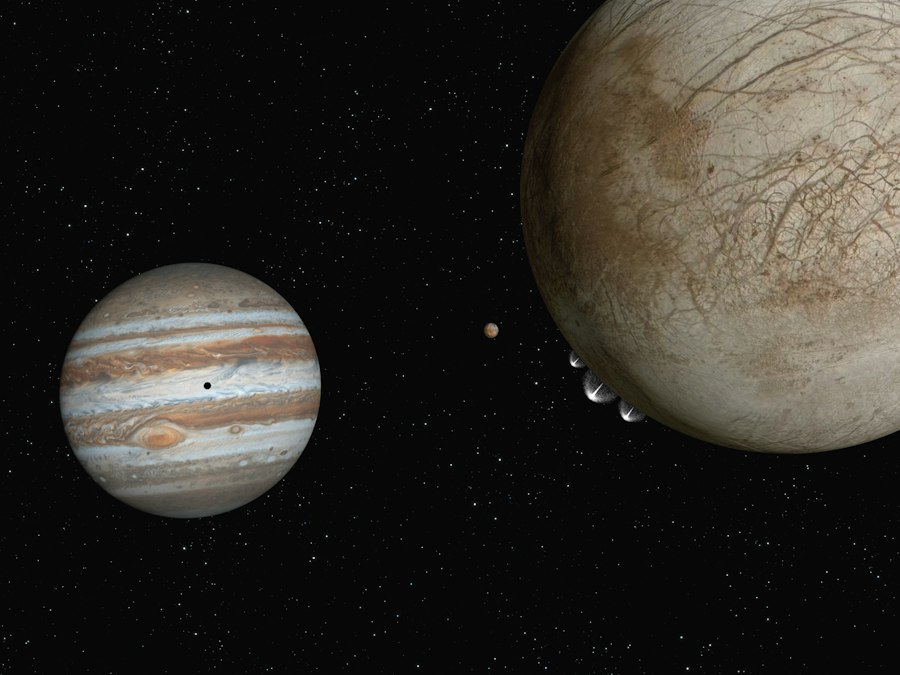
The presence of plumes on Europa points towards a dynamic geological engine beneath its icy exterior. Scientists have proposed several plausible mechanisms for how these icy eruptions might occur, each offering unique insights into the moon’s internal structure and thermal state. These models are crucial for understanding the potential for the subsurface ocean to interact with the surface and for transporting materials that could signal habitability.
Tidal Heating and Internal Warming
The primary driver of Europa’s internal activity is believed to be tidal heating. As Europa orbits Jupiter, it experiences immense gravitational forces that stretch and squeeze its rocky and icy interior. This constant deformation generates friction, which in turn produces heat. This internal heat is not only responsible for maintaining the subsurface ocean in a liquid state but can also lead to localized melting and geological activity. Think of it like bending a piece of metal repeatedly; the friction generates heat. In Europa’s case, this heating is intense and continuous due to Jupiter’s powerful gravitational pull and Europa’s slightly eccentric orbit, which means the distance between Europa and Jupiter varies. This tidal flexing can create stress fractures within the ice shell, potentially allowing water from the underlying ocean to migrate upwards. Regions of enhanced tidal heating are also considered prime locations for cryovolcanic activity, as they would likely experience greater internal melting and pressure build-up. This process is fundamental to understanding how the deep ocean can interact with the surface, a key question for astrobiology.
Hydrothermal Vents and Subsurface Plumbing Systems
One of the most exciting hypotheses for plume formation involves hydrothermal vents, similar to those found on Earth’s ocean floors. On Earth, these vents spew superheated, mineral-rich water from beneath the seafloor, supporting unique ecosystems. Scientists theorize that similar hydrothermal activity could occur at the base of Europa’s ice shell, where the ocean interfaces with the rocky mantle. Heated by radioactive decay within the core and residual heat from formation, or even by tidal friction in the rocky interior, water could circulate through fractures in the seafloor, dissolving minerals. If these mineral-rich waters are then forced upwards through cracks or fissures in the ice shell, they could erupt as plumes. The upward movement of this water would create a “plumbing system” within the ice. This system could involve buoyancy-driven convection currents within the ocean, or pressure differences created by tidal stresses forcing water through the ice. The composition of the erupted material would then directly reflect the chemistry of the ocean and any interactions it has had with the rocky seafloor, making plume sampling a potential treasure trove of information about the ocean’s habitability.
Subglacial Lakes and Meltwater Eruptions
Another proposed mechanism involves the existence of subglacial lakes or pockets of liquid water within the ice shell itself. These reservoirs could form through a variety of processes, including localized melting caused by heat escaping from the ocean, or even the partial melting of ice due to pressure variations. If these meltwater pockets become pressurized, perhaps due to further geological activity or the flexing of the ice shell, they could rupture through the overlying ice, leading to explosive eruptions of water vapor and ice. This scenario suggests that not all plumes necessarily originate directly from the main subsurface ocean. They could be derived from more localized, transient liquid water reservoirs trapped within the ice. The nature of these subglacial lakes and their connection to the main ocean would greatly influence the composition and characteristics of any resulting plumes. Studying the frequency and scale of such eruptions could provide insights into the thermal gradients and structural integrity of Europa’s ice shell.
The Chemical Fingerprints Within the Plumes

The true scientific value of Europa’s plumes lies in their potential to carry and deliver samples of the subsurface ocean to the surface, where they can be analyzed by spacecraft. The composition of these erupted materials could reveal crucial details about the ocean’s chemistry, its potential to support life, and the processes occurring at the ocean floor.
Evidence of Salts and Other Dissolved Minerals
Observations of Europa’s surface, particularly from the Galileo spacecraft, have revealed the presence of various salts and hydrated minerals, such as magnesium sulfate and sodium chloride. These salts are thought to have been deposited on the surface by the evaporation of water, implying that water has been expelled from the interior. When plumes erupt, they carry with them not just water vapor and ice but also any dissolved salts and minerals that were present in the ocean. By analyzing the chemical composition of these plume materials, scientists can deduce the salinity of the ocean and the types of minerals it contains. This is incredibly significant because the presence of dissolved salts is a key indicator of a liquid water environment and is essential for many biological processes. Furthermore, the specific types of salts can provide clues about the extent of interaction between the ocean and the rocky seafloor, and whether necessary elements for life are available.
The Potential Presence of Organic Molecules
The holy grail of Europa plume research is the detection of organic molecules. While not direct evidence of life itself, the presence of organic compounds would significantly bolster the argument that Europa possesses the necessary building blocks for life. Organic molecules, which contain carbon, are the fundamental components of all known life forms. They can be formed through various geological and chemical processes, both non-biological and biological. If plumes carry materials that have been in contact with a geologically active ocean floor, it is conceivable that they could also transport organic molecules formed through chemosynthesis or other subsurface processes. The detection of specific types of organic molecules, such as amino acids or nucleotides, would be particularly compelling evidence for a potentially habitable environment. Future missions will be specifically equipped with instruments designed to identify and quantify these complex organic compounds in any sampled plume material.
Isotopic Ratios as Clues to Origin and Evolution
Beyond the elemental and molecular composition, the isotopic ratios of elements within the plume materials can offer profound insights into Europa’s origin and evolution. Isotopes are atoms of the same element that have different numbers of neutrons. The relative abundance of different isotopes of elements like oxygen, hydrogen, or carbon can provide a unique signature that can be compared to other celestial bodies. For example, the isotopic ratio of deuterium to hydrogen in Europa’s water could indicate whether its water originated from comets or asteroids, or if it is primordial, dating back to the formation of the solar system. Furthermore, studying isotopic fractionation within the plumes can reveal information about the physical and chemical processes that have occurred within the ocean and during the plume’s ascent. These subtle but powerful clues help scientists build a more complete picture of Europa’s history and its potential to harbor life.
Implications for Astrobiology and Future Exploration
The study of Europa’s cryovolcanic plumes has profound implications for the search for extraterrestrial life and for shaping the design of future space missions. These icy geysers are considered a prime target for astrobiological investigation because they offer a relatively accessible way to sample the moon’s hidden ocean.
A Direct Pathway to the Subsurface Ocean
For decades, the vast, enigmatic ocean beneath Europa’s ice shell has been the focus of intense scientific interest. However, directly accessing this ocean is an immense engineering challenge. Drilling through hundreds of kilometers of solid ice would require revolutionary technology. Europa’s plumes offer a tantalizing alternative. They act as natural conduits, bringing samples of the ocean’s contents up to an altitude where they can be sampled by orbiting or flyby spacecraft. This bypasses the need for complex drilling operations and allows for the analysis of pristine ocean material without the risk of contamination from the surface or the spacecraft itself. The ability to directly sample plume material, rather than relying solely on remote sensing or surface analysis, would be a monumental leap forward in our understanding of Europa’s habitability. It offers the most promising pathway to directly investigate the chemical environment of the subsurface ocean and to search for biosignatures.
Designing the Next Generation of Europa Missions
The evidence for plumes has profoundly influenced the design and scientific objectives of upcoming missions to Europa. The Europa Clipper mission, currently in development by NASA, is specifically designed to investigate Europa’s habitability. A key part of its mission will be to fly through any detected plumes and analyze their composition with a suite of sophisticated instruments, including a mass spectrometer and an ultraviolet spectrometer. If plumes are detected, Clipper will perform multiple flybys through them, gathering as much data as possible about their chemical makeup, including the presence of salts, organic molecules, and potential biosignatures. Furthermore, future, more ambitious missions, such as the proposed Europa Lander, could potentially land near a region where plumes are known to erupt, allowing for in-situ analysis of deposited plume material. The search for plumes has thus become a critical element in the strategy for exploring Europa and assessing its potential to harbor life.
The Broader Search for Life in the Outer Solar System
Europa is not the only icy moon in the outer solar system thought to possess a subsurface ocean. Saturn’s moon Enceladus, for example, has been definitively shown to host active geysers that erupt into space, and these geysers have been directly sampled by the Cassini spacecraft, revealing a rich chemistry that includes organic molecules and evidence of hydrothermal activity. The success in detecting and studying plumes on Europa, and the lessons learned from Enceladus, significantly bolster the broader scientific effort to identify and explore other potentially habitable worlds within our solar system and beyond. These findings confirm that the conditions necessary for life, including liquid water and energy sources, may be far more common than previously thought, extending the potential for extraterrestrial life far beyond Earth. The study of Europa’s plumes is a crucial piece of this larger cosmic puzzle.
Recent studies have shed light on the fascinating cryovolcano plumes of Europa, one of Jupiter’s moons, which may harbor the potential for extraterrestrial life. These plumes, which eject water vapor and other materials into space, provide valuable insights into the moon’s subsurface ocean. For a deeper understanding of this phenomenon, you can explore a related article that discusses the implications of these findings on astrobiology and planetary science. To read more, visit this article for an in-depth analysis.
Future Prospects and Lingering Questions
| Metric | Value | Unit | Notes |
|---|---|---|---|
| Plume Height | 200 | km | Estimated maximum height of cryovolcanic plumes |
| Plume Temperature | -160 to -120 | °C | Estimated temperature range of ejected material |
| Plume Composition | Water vapor, salts, organic molecules | N/A | Detected components in plume material |
| Plume Duration | Minutes to hours | Time | Estimated duration of active plume events |
| Frequency of Plume Activity | Intermittent | N/A | Plumes are not continuously active |
| Source Region | Conamara Chaos, Pwyll Crater | N/A | Regions on Europa where plumes have been observed |
| Detection Method | Hubble Space Telescope UV imaging, Galileo spacecraft data | N/A | Primary methods used to detect plumes |
While significant progress has been made in understanding Europa’s cryovolcanic plumes, many questions remain unanswered, and the prospect of future discoveries is immense. The ongoing quest to unravel the mysteries of Europa’s plumes continues to push the boundaries of scientific inquiry and technological innovation.
Continued Observation and Characterization Efforts
Future observations of Europa will undoubtedly focus on further confirming the existence and frequency of plumes and on refining our understanding of their sources and compositions. Telescopes like the James Webb Space Telescope, with its unparalleled sensitivity in infrared wavelengths, may be able to detect water vapor plumes that were missed by previous instruments. Ground-based observatories will continue to monitor Europa for any signs of plume activity, particularly during periods of expected enhanced tidal stress. The Europa Clipper mission will play a pivotal role in this endeavor, not only by directly sampling plumes but also by mapping Europa’s surface in unprecedented detail to identify potential eruption sites and geological features associated with cryovolcanism. Continuous monitoring and detailed characterization are essential for building a comprehensive picture of this dynamic process.
The Challenge of Direct Sampling and Sample Return
While Europa Clipper aims to fly through plumes, the ultimate prize would be a lander capable of not only analyzing plume deposits on the surface but potentially even collecting and returning samples to Earth for more detailed study. Such a mission would be incredibly complex and costly, requiring sophisticated landing technology and stringent planetary protection protocols to avoid contaminating Earth’s biosphere with any potential extraterrestrial microbes. However, the scientific return from such a mission would be revolutionary, allowing for the most in-depth analysis of Europan ocean material ever achieved. The questions about the origin of life, the diversity of life in extreme environments, and the potential for life elsewhere in the universe could be addressed with unprecedented certainty.
The Deep Ocean: The Ultimate Frontier
Ultimately, the study of Europa’s plumes is a stepping stone to understanding the vast, hidden ocean that lies beneath. While plumes offer a tantalizing glimpse into this watery realm, they represent only a small fraction of the ocean’s total volume and composition. The true nature of the ocean’s chemistry, its thermal gradients, and its potential for harboring complex life remain largely unknown. Future exploration will likely focus on methods to probe deeper into the ice shell, perhaps through advanced radar systems or even proposals for cryobots capable of melting their way through the ice. The enigmatic plumes, however, will continue to serve as the most accessible and exciting indicators of the dynamic processes occurring within Europa’s enigmatic subsurface ocean, guiding our quest for answers about this tantalizing world.

Water Boiled While Ice Formed. Could a Lander Sink Into It?
FAQs
What are cryovolcano plumes on Europa?
Cryovolcano plumes on Europa are geysers of water vapor and icy particles that erupt from the moon’s surface, reaching heights of up to 200 kilometers.
How were the cryovolcano plumes on Europa discovered?
The cryovolcano plumes on Europa were discovered by the Hubble Space Telescope in 2012, providing evidence of possible subsurface oceans on the moon.
What do the cryovolcano plumes on Europa indicate about its subsurface?
The presence of cryovolcano plumes on Europa indicates that there may be a subsurface ocean beneath the moon’s icy crust, potentially harboring conditions suitable for life.
How do cryovolcano plumes on Europa differ from traditional volcanoes on Earth?
Cryovolcano plumes on Europa differ from traditional volcanoes on Earth in that they erupt water and icy particles instead of molten rock and lava due to the moon’s icy composition.
What implications do the cryovolcano plumes on Europa have for future exploration missions?
The discovery of cryovolcano plumes on Europa has sparked interest in future exploration missions to the moon to further study its subsurface ocean and potential for hosting extraterrestrial life.