
The Core Principle: Energy and Heat Transfer
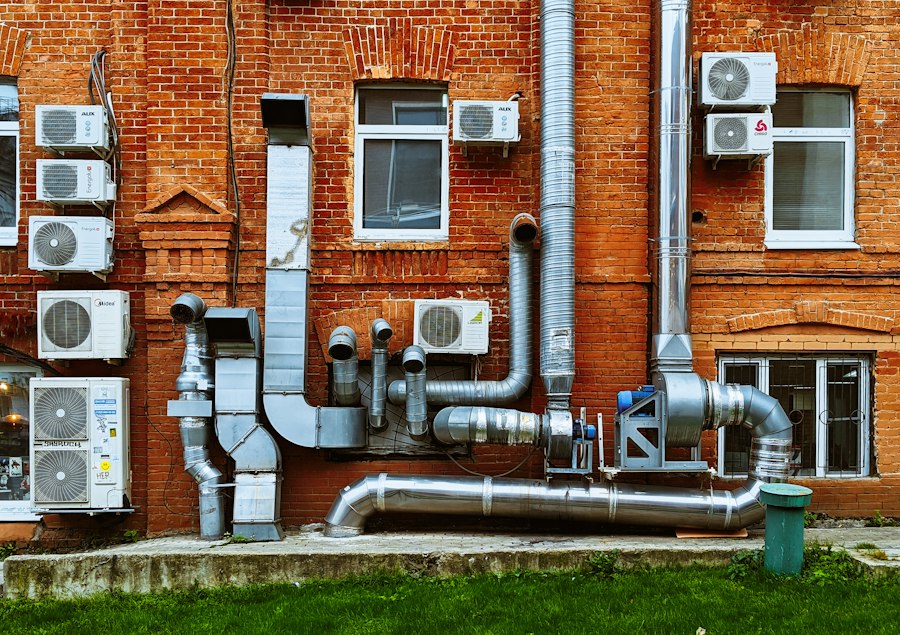
You’ve likely experienced it yourself – the back of your refrigerator feels warm, or the air conditioning unit outside your home hums with a noticeable heat. This isn’t a malfunction; it’s a fundamental consequence of how refrigeration systems work. At its heart, the process of cooling relies on manipulating the physical properties of a special substance called a refrigerant. The science behind why compressing this refrigerant makes it hotter is rooted in the fundamental laws of thermodynamics, specifically the relationship between energy, work, and heat.
Think of it this way: to move heat from one place to another, you need to expend energy. Refrigeration systems are essentially heat pumps, designed to move heat from a colder area (inside your fridge or home) to a warmer area (the surrounding environment). This act of “pumping” heat against its natural flow requires energy input, and this energy manifests as increased heat within the system. The compressor is the workhorse of this operation, and its primary function is to increase the pressure of the refrigerant. This increase in pressure is directly linked to an increase in the refrigerant’s temperature.
The Molecular Dance: Pressure and Kinetic Energy
To understand this phenomenon at a molecular level, consider the refrigerant as a collection of tiny particles – molecules – constantly in motion. These molecules possess kinetic energy, which is the energy of motion. When you compress a gas or vapor, like the refrigerant, you are essentially forcing these molecules into a smaller volume. Imagine trying to squeeze a crowd of people into a tiny room. They’ll bump into each other more frequently and with greater force. Similarly, as the refrigerant molecules are forced closer together in the compressor, their collisions become more energetic. Each collision transfers kinetic energy between molecules, and this increased overall kinetic energy of the molecular ensemble is what we perceive as an increase in temperature.
This isn’t just about more collisions; it’s about the work done on the gas. The compressor mechanically pushes on the refrigerant, doing work to reduce its volume. According to the first law of thermodynamics, energy cannot be created or destroyed, only transferred or changed in form. When the compressor does work on the refrigerant, it adds energy to the system. Since the refrigerant is largely contained within the compressor, this added energy has nowhere to go but to increase the internal energy of the refrigerant, which is directly related to its temperature.
Phase Changes: A Crucial Step in the Cycle
The behavior of the refrigerant isn’t just about its gaseous state. Refrigeration cycles rely on phase changes – transitioning between liquid and vapor states. This is where the compression and subsequent heating become particularly effective in the overall cooling process. Before the refrigerant enters the compressor, it’s typically in a low-pressure, low-temperature gaseous state, having absorbed heat from the area you want to cool.
The compressor’s job is to take this low-pressure gas and compress it into a high-pressure, high-temperature gas. This significant temperature rise is critical. It ensures that when this hot, high-pressure gas reaches the condenser (the coils on the back of your fridge or the outdoor unit of your AC), its temperature is higher than the surrounding environment. This temperature difference is what allows heat to flow out of the refrigerant and into the ambient air, enabling the refrigerant to condense into a high-pressure liquid. If the refrigerant wasn’t significantly heated during compression, it wouldn’t be hot enough to release its absorbed heat effectively in the condenser.
Compressing refrigerant makes it hotter due to the principles of thermodynamics, specifically the ideal gas law, which states that when the volume of a gas is reduced, its pressure and temperature increase. This phenomenon is crucial in refrigeration cycles, where the refrigerant absorbs heat from the environment and releases it after being compressed. For a deeper understanding of this process and its implications in various applications, you can read a related article on the topic at Freaky Science.
The Compressor’s Role: A Mechanical Engine of Heat

The compressor is the central component responsible for this temperature increase. It’s a mechanical device, typically a piston, scroll, or rotary screw mechanism, designed to squeeze the refrigerant vapor. This squeezing action is work being done. As you push down on a bicycle pump with your hand over the nozzle, you’ll feel the pump get warm. This is a simplified analogy of what happens inside a compressor. The mechanical energy supplied by the motor (either electric or in some cases, engine-driven) is converted into thermal energy within the refrigerant.
Piston Compressors: The Classic Design
In a piston compressor, a piston moves back and forth within a cylinder, much like in a car engine. As the piston moves down, it draws in low-pressure refrigerant vapor. As it moves up, it compresses this vapor, forcing it out at a higher pressure and temperature. The friction between the piston and cylinder walls, as well as the work done to overcome the resistance of the compressed vapor, all contribute to the heat generated. The rapid compression itself is the primary driver, but these ancillary factors also play a role in the overall temperature rise.
Rotary and Scroll Compressors: More Efficient but Still Hot
Modern refrigeration systems often employ rotary or scroll compressors. These designs offer greater efficiency and quieter operation. In a scroll compressor, two interleaved spiral-shaped scrolls rotate against each other. One scroll is stationary, while the other orbits eccentrically. This action creates pockets of refrigerant that gradually decrease in volume as they are moved towards the center, achieving compression. While the mechanics are different, the fundamental principle remains the same: work is done on the refrigerant, increasing its pressure and, consequently, its temperature. The continuous meshing of the scrolls generates friction, and the process of reducing the volume of the refrigerant directly translates to increased molecular kinetic energy and thus, heat.
Thermodynamics in Action: Work, Heat, and Internal Energy
The underlying scientific principle governing why compressing refrigerant makes it hotter is the relationship between work, heat, and internal energy as described by the laws of thermodynamics. Specifically, the first law of thermodynamics is paramount here.
The First Law of Thermodynamics: Conservation of Energy
The first law of thermodynamics states that the change in internal energy of a system is equal to the heat added to the system minus the work done by the system. Mathematically, this is often expressed as:
$\Delta U = Q – W$
Where:
- $\Delta U$ is the change in internal energy.
- $Q$ is the heat added to the system.
- $W$ is the work done by the system.
In the context of a compressor, we are doing work on the system (the refrigerant). So, it’s more accurate to consider the work done on the system, often represented as $-W$ in the equation above, or more commonly, we look at the change in internal energy due to work done on the gas. A more appropriate way to think about the compressor is that work is being done on the refrigerant. This work increases the refrigerant’s internal energy. Since internal energy is directly proportional to temperature (for an ideal gas, $\Delta U = n C_v \Delta T$, where $n$ is the number of moles, $C_v$ is the molar heat capacity at constant volume, and $\Delta T$ is the change in temperature), an increase in internal energy directly leads to an increase in temperature.
The refrigerant is largely contained within the compressor’s casing, so the heat generated ($Q$) is relatively minimal compared to the work done ($W$) in the context of the immediate compression. Therefore, the dominant factor leading to the temperature rise is the work done on the gas, which directly increases its internal energy and thus its temperature.
Adiabatic Compression: The Idealized Scenario
In an idealized scenario, we can consider the compression process to be adiabatic. An adiabatic process is one where no heat is exchanged between the system and its surroundings ($Q = 0$). In this case, the first law of thermodynamics simplifies to:
$\Delta U = -W$ (where W is work done by the system)
Or, if we consider work done on the system ($W_{on}$):
$\Delta U = W_{on}$
This means that any work done on the refrigerant will directly increase its internal energy. Since the refrigerant is a gas, an increase in internal energy translates directly to an increase in temperature. Real-world compression processes are not perfectly adiabatic, as some heat will inevitably be lost to the surroundings. However, the adiabatic model is a good approximation for understanding the primary driver of the temperature increase. The rapid nature of compression within a compressor also limits the time available for significant heat transfer to the surroundings, pushing the process closer to adiabatic conditions.
The Importance of Pressure-Temperature Relationship
The pressure-temperature relationship of the refrigerant is the very foundation upon which refrigeration cycles operate. The ability of a substance to absorb and release heat depends heavily on its phase at specific pressures and temperatures.
Saturation Curves and Phase Transitions
Every refrigerant has a unique saturation curve, which defines the pressure and temperature at which it transitions between liquid and vapor states. When you compress the refrigerant vapor, you are essentially raising its pressure and temperature along a path that eventually leads it to cross its saturation curve at a higher temperature and pressure. This is where it can then release heat and condense.
Consider a common refrigerant like R-134a. At low pressure and temperature, it exists as a vapor and has absorbed heat from the evaporator (the cold part of your fridge). The compressor then takes this vapor and increases its pressure and temperature. As the pressure and temperature rise, they reach a point where the refrigerant is above its saturation temperature for that elevated pressure. This superheated vapor is now significantly hotter than the surrounding air.
The Condenser’s Task: Releasing Heat
This temperature difference is crucial. The hot, high-pressure refrigerant vapor flows into the condenser. Because the refrigerant is hotter than the ambient air, heat naturally flows from the refrigerant to the air. This loss of heat causes the refrigerant to cool and condense into a high-pressure liquid. The compression and subsequent heating are therefore essential prerequisites for the refrigerant to effectively release the heat it has absorbed from the cooled space. Without this temperature boost from compression, the refrigerant wouldn’t be able to shed its heat to the warmer environment.
Compressing refrigerant increases its temperature due to the principles of thermodynamics, which explain how pressure and temperature are interrelated in gases. When the refrigerant is compressed, its molecules are forced closer together, resulting in increased kinetic energy and, consequently, a rise in temperature. For a deeper understanding of this phenomenon, you can explore a related article that discusses the science behind refrigeration systems and their efficiency. Check out this insightful piece on Freaky Science to learn more about how these processes work.
Why This Heat is a Necessary Evil
| Metric | Description | Value/Explanation |
|---|---|---|
| Pressure Increase | Raising the pressure of the refrigerant during compression | From low pressure (~2 bar) to high pressure (~10-15 bar) |
| Temperature Rise | Temperature increase due to compression | Can increase by 30-50°C depending on compressor and refrigerant |
| Ideal Gas Law | Relationship between pressure, volume, and temperature | PV = nRT; compressing reduces volume (V), increasing pressure (P) and temperature (T) |
| Work Done on Refrigerant | Energy input during compression converts to heat | Mechanical work increases internal energy, raising temperature |
| Adiabatic Compression | Compression without heat exchange with surroundings | Leads to temperature rise as energy is conserved within the refrigerant |
| Refrigerant Type | Different refrigerants have varying specific heat capacities | Impacts how much temperature rises during compression |
| Specific Heat Capacity (Cp) | Heat required to raise temperature of refrigerant | Varies by refrigerant, e.g., R-134a Cp ≈ 0.88 kJ/kg·K |
It might seem counterintuitive that a device designed to cool things down intentionally makes its working fluid hotter. However, this heat generation is not a byproduct to be eliminated, but rather a necessary step in the refrigeration cycle. You are not generating heat for its own sake; you are using the energy associated with that heat to achieve a greater thermodynamic goal: moving heat from a colder location to a warmer one.
The Energy Transfer Equation
The entire refrigeration process is a clever application of energy transfer. The compressor adds energy (in the form of work) to the refrigerant, increasing its temperature. This elevated temperature allows the refrigerant to transfer heat to the environment in the condenser. The refrigerant then passes through an expansion valve, where its pressure and temperature drop drastically, preparing it to absorb heat again in the evaporator. Each stage is interconnected and relies on the preceding one.
Efficiency and Heat Dissipation
While the compression process is designed to generate heat, engineers constantly strive to improve compressor efficiency. This means minimizing energy losses due to friction and optimizing the compression stroke itself. However, the fundamental principle of thermodynamics dictates that compressing a gas will always increase its temperature. The heat generated is a direct consequence of the work done. The goal isn’t to eliminate this heat, but to manage it effectively and ensure that the overall refrigeration cycle is as energy-efficient as possible. The dissipated heat from the compressor and condenser is simply the evidence that your refrigeration system is successfully performing its job of moving heat. You’re paying for that heat to be moved, and the compressor’s warmth is the tangible result of that energy expenditure.

Your AC Blows Hot Air Outside. Is That Heat From Your Room?
FAQs
1. Why does compressing refrigerant make it hotter?
When refrigerant is compressed, its molecules are forced closer together, which increases the temperature of the refrigerant.
2. How does compressing refrigerant affect its pressure?
Compressing refrigerant increases its pressure, as the molecules are packed closer together, resulting in higher pressure within the system.
3. What role does the compressor play in the refrigeration cycle?
The compressor is responsible for compressing the refrigerant gas, which raises its temperature and pressure, allowing it to release heat energy when it reaches the condenser.
4. Why is it important for refrigerant to release heat energy in the condenser?
Releasing heat energy in the condenser allows the refrigerant to cool down and change from a gas to a liquid state, which is essential for the refrigeration cycle to continue effectively.
5. How does the process of compressing refrigerant contribute to the overall efficiency of a refrigeration system?
By compressing the refrigerant, the system is able to transfer heat more effectively, leading to better cooling performance and energy efficiency in the overall operation of the refrigeration system.