Cosmic Echoes and Gravitational Ripples: A New Window on the Early Universe
The faint afterglow of the Big Bang, the Cosmic Microwave Background (CMB), is an unparalleled repository of information about the universe’s infancy. For decades, cosmologists have meticulously analyzed its temperature fluctuations and polarization patterns, piecing together a remarkably consistent picture of cosmic evolution. However, recent advancements in observational techniques and theoretical frameworks are beginning to reveal subtler, more complex phenomena imprinted on this ancient light. Among these, the integrated Sachs-Wolfe (ISW) effect, a subtle distortion of CMB photons as they traverse the evolving cosmic gravitational potential, has long been a subject of intense study. Now, the emerging evidence for an “integrated Sachs-Wolfe effect” that is itself influenced by interactions with other cosmological phenomena, a phenomenon termed the “integrated Sachs-Wolfe effect,” promises to open a new frontier in our understanding of dark energy and the very fabric of spacetime.
This article delves into the sophisticated interplay that constitutes the integrated Sachs-Wolfe effect. It will explore the fundamental principles behind the ISW effect, the observational challenges in detecting it, and the groundbreaking theoretical work that predicts its integrated nature. Finally, it will discuss the profound implications of this newly unveiled effect for cosmology, particularly its potential to shed light on the enigmatic nature of dark energy and the large-scale structure of the cosmos.
The integrated Sachs-Wolfe effect is a fascinating phenomenon that highlights the interplay between cosmic structures and the cosmic microwave background (CMB). For those interested in exploring this topic further, a related article can be found at Freaky Science, which delves into the implications of the integrated Sachs-Wolfe effect on our understanding of dark energy and the evolution of the universe. This resource provides valuable insights into how gravitational potential wells influence the temperature fluctuations observed in the CMB.
The Genesis of the Sachs-Wolfe Effect: Photons on a Gravitational Journey
The Sachs-Wolfe (SW) effect, in its original formulation, describes a temperature anisotropy in the CMB caused by photons gaining or losing energy as they climb out of or fall into gravitational potential wells and hills, respectively, that are present at the time of recombination. At the epoch of recombination, approximately 380,000 years after the Big Bang, the universe transitioned from a hot, opaque plasma to a transparent gas, releasing the photons that now form the CMB. These photons, on their subsequent journey to us, traverse a universe that is not static but dynamically evolving, dominated by gravity.
Gravitational Redshifts and Blueshifts: The Foundation of the SW Effect
Imagine a photon in the early universe. If it encounters a region of higher gravitational potential (a potential well, like a nascent galaxy cluster), it will expend energy to escape, resulting in a redshift – a decrease in its energy and thus a cooler apparent temperature. Conversely, if it encounters a region of lower gravitational potential (a potential hill), it will gain energy as it falls in, experiencing a blueshift – an increase in its energy and a hotter apparent temperature.
At the time of recombination, the gravitational potential fluctuations were imprinted on the CMB. These fluctuations were a direct consequence of the primordial density variations, which were amplified by inflation. The observed anisotropy in the CMB temperature is a direct manifestation of these early potential fluctuations. However, the original SW effect is limited in its scope. It only accounts for the energy shifts caused by potentials that exist at the moment of recombination and are still present when the photons reach us. The universe, however, continues to evolve.
The Expanding Universe and its Influence: Beyond the Static Picture
The key limitation of the original SW effect lies in its assumption of a static gravitational landscape. In reality, the universe is expanding. This expansion has profound implications for how gravitational potentials evolve over time. As the universe expands, the depth of gravitational potential wells can effectively decrease, and the height of potential hills can be smoothed out. This means that a photon passing through a potential well at recombination might not experience the full energy loss if that well has shallowed by the time the photon reaches us. Conversely, a photon traversing a potential hill might not gain as much energy if that hill has flattened.
The standard SW effect, therefore, is a snapshot of the gravitational landscape at recombination. It doesn’t fully capture the dynamic interplay between photons and the evolving gravitational potentials throughout the subsequent cosmic history. This is where the integrated Sachs-Wolfe effect comes into play, offering a more comprehensive picture of how gravitational potentials influence the CMB.
The Integrated Sachs-Wolfe Effect: A Deeper Cosmic Imprint
The integrated Sachs-Wolfe (ISW) effect, as distinct from the primary Sachs-Wolfe effect, arises from the change in gravitational potentials after recombination. While the primary SW effect is due to potentials at recombination, the ISW effect accounts for the cumulative effect of photons traversing potentials that are evolving due to the expansion of the universe. This evolution is primarily driven by the presence of matter and, more importantly, dark energy.
The Role of Dark Energy: Shaping Gravitational Dynamics
Dark energy, the mysterious component driving the accelerated expansion of the universe, plays a crucial role in the ISW effect. In a universe dominated by matter, gravitational potentials tend to decay over time as the universe expands. However, the presence of dark energy counteracts this decay. As the universe accelerates, the gravitational influence of dark energy can cause existing potential wells to deepen or new ones to form, and potential hills to become more pronounced.
When a CMB photon travels through such an evolving gravitational potential, it undergoes a net energy change. If a photon climbs out of a potential well that has deepened since recombination, it will lose more energy than it would have in a static potential. Conversely, if it falls into a potential hill that has become steeper, it will gain more energy. This cumulative effect over the photon’s entire journey from recombination to the present day is what constitutes the integrated Sachs-Wolfe effect.
Observational Signatures and the Quest for Detection
The ISW effect is a subtle phenomenon. The temperature fluctuations it causes are typically much smaller than those arising from the primary SW effect or from the acoustic oscillations in the early universe. This makes its detection a significant observational challenge. The primary SW effect imprints anisotropies on the largest angular scales of the CMB, while the ISW effect also manifests as temperature variations on these large scales, but it is a consequence of the evolution of potentials, not their initial imprint.
Early attempts to detect the ISW effect involved searching for correlations between CMB temperature fluctuations and large-scale structures in the universe, such as galaxy clusters and superclusters. The logic is that these massive structures represent significant gravitational potentials. If the ISW effect is present, then CMB photons that have passed near these structures should show a subtle temperature shift correlated with the gravitational influence of the structure.
Challenges and Triumphs: Unveiling the Signal
Despite the theoretical predictions, unequivocally detecting the ISW effect proved to be an arduous task. The signal is weak and easily drowned out by other CMB anisotropies and observational noise. Early analyses of CMB data provided hints, but lacked the statistical significance to be conclusive.
However, with increasingly precise CMB measurements from missions like WMAP and Planck, and improved surveys of large-scale structure, the tide began to turn. By cross-correlating the CMB temperature maps with catalogues of galaxies and other cosmic structures, scientists have been able to extract a statistically significant ISW signal. This detection is a landmark achievement, confirming a key prediction of cosmological models and providing direct evidence for the evolving nature of gravitational potentials in our universe, a testament to the influence of dark energy.
The Integrated Sachs-Wolfe Effect and Dark Energy: A Cosmic Interplay
The detection of the integrated Sachs-Wolfe effect has profound implications for our understanding of dark energy. The amplitude and correlation pattern of the ISW signal are directly linked to the presence and properties of dark energy. Its presence provides a unique probe into the nature of this enigmatic force that is accelerating the expansion of the cosmos.
Dark Energy’s Influence on Potential Evolution: The Driving Force
As mentioned earlier, dark energy’s dominant role in the universe’s late-time acceleration directly impacts how gravitational potentials evolve. In a matter-dominated universe, potentials decay. However, dark energy’s repulsive gravitational effect effectively counteracts this decay. This means that gravitational potentials, especially those associated with large structures, can remain more significant or even deepen over cosmic time.
The ISW effect captures this evolving potential. The more pronounced the effect of dark energy in slowing down the decay of gravitational potentials (or even causing them to deepen), the stronger the ISW signal is expected to be. Therefore, the amplitude of the observed ISW effect serves as a direct measure of dark energy’s influence on the large-scale structure and its dynamics.
Probing Dark Energy Models: Constraints and Distinctions
Different models of dark energy predict different evolutionary behaviors of the cosmic expansion rate and, consequently, different evolutions of gravitational potentials. For instance, a cosmological constant ($Lambda$) as dark energy behaves differently from dynamical dark energy models where the dark energy density changes over time. The ISW effect, by providing a direct observational handle on potential evolution, can help distinguish between these models.
A strong ISW signal, particularly when correlated with specific types of large-scale structures, can be used to constrain parameters within various dark energy models. It allows cosmologists to test whether the observed ISW signal is consistent with a simple cosmological constant or if it requires more complex explanations for dark energy’s behavior. This makes the ISW effect a crucial tool in the ongoing quest to understand the fundamental nature of dark energy, whether it’s a constant property of spacetime or a dynamic field.
Beyond Simple Correlations: Towards a Unified Picture
The “integrated Sachs-Wolfe effect” as a concept goes beyond just the ISW effect itself. It implies a deeper integration with other cosmological phenomena. For instance, the interaction of gravitational potentials with the evolving dark energy field can lead to more complex patterns in the CMB that are not captured by the standard ISW description. This could involve subtle modifications to the power spectrum of CMB anisotropies or new correlations with other cosmological probes.
This broader interpretation suggests that the ISW effect is not an isolated phenomenon but rather an integral part of the complex tapestry of cosmic evolution. Studying its integrated nature allows for a more holistic understanding of how gravity, dark energy, and the large-scale structure of the universe conspire to shape the CMB we observe today. Future research will focus on disentangling these intricate interactions and extracting even more precise information about the fundamental forces governing our universe.
The integrated Sachs-Wolfe effect is a fascinating phenomenon that highlights the interplay between cosmic microwave background radiation and the gravitational influence of large-scale structures in the universe. For those interested in exploring this topic further, a related article can be found at Freaky Science, which delves into the implications of this effect on our understanding of dark energy and the evolution of the cosmos. This connection between the CMB and gravitational fields provides valuable insights into the fundamental nature of our universe.
The Integrated Sachs-Wolfe Effect and the Large-Scale Structure of the Universe
| Metric | Description | Typical Value / Range | Unit |
|---|---|---|---|
| Redshift Range | Epoch over which the ISW effect is significant | 0 < z < 2 | Dimensionless |
| Angular Scale | Multipole moment range where ISW effect is prominent | l < 30 | Multipole moment (l) |
| Temperature Fluctuation Amplitude | Typical ISW-induced CMB temperature anisotropy | ~10-6 | Kelvin (K) |
| Cross-correlation Coefficient | Correlation between CMB temperature and large-scale structure | 0.2 – 0.5 | Dimensionless |
| Detection Significance | Statistical significance of ISW detection in surveys | 2 – 4 | σ (sigma) |
| Cosmological Parameter Sensitivity | ISW effect sensitivity to dark energy density (ΩΛ) | ΔΩΛ ~ 0.05 | Dimensionless |
The ISW effect is inextricably linked to the distribution of matter in the universe, particularly on large scales. The gravitational potentials that give rise to the ISW effect are created by these matter overdensities and underdensities, and their evolution is influenced by the cosmic expansion, which is in turn governed by the total energy density of the universe, including dark energy.
Gravitational Potential Gradients: The Architects of the ISW Signal
The ISW effect is generated by the time-varying nature of gravitational potentials. These potentials are strongest in regions of high matter density, such as galaxy clusters and superclusters, and weakest in regions of low matter density (voids). As the universe expands, these potentials evolve. If the universe is accelerating due to dark energy, the rate of decay of these potentials is altered, leading to a net energy change for CMB photons traversing them.
The correlation between the ISW signal and large-scale structures is therefore a direct consequence of this interplay. Photons that have passed through regions that have experienced significant potential evolution will exhibit temperature anisotropies that are correlated with the distribution of matter. Detecting this correlation allows cosmologists to map out the gravitational potential landscape of the universe and, by extension, the distribution of matter on the largest scales.
Complementary Probes: Combining ISW with other Observations
The ISW effect provides a unique window into the universe’s large-scale structure and its evolution. However, to gain a comprehensive understanding, it is crucial to combine ISW observations with other cosmological probes. Galaxy surveys, which map the distribution of galaxies, provide direct information about the matter distribution. Weak gravitational lensing, which measures the distortion of light from distant galaxies by intervening matter, also maps out the distribution of mass.
By cross-correlating the ISW signal with these other observations, cosmologists can build a more robust picture of the universe. For example, comparing the ISW-induced temperature fluctuations with the distribution of galaxy clusters can confirm the presence of evolved gravitational potentials. Similarly, comparing it with weak lensing maps can provide independent measurements of dark matter distribution. This synergy between different observational techniques strengthens the statistical power of each and allows for more precise constraints on cosmological parameters.
Testing Cosmological Models: Consistency and Deviations
The ISW effect, by probing the interplay between dark energy and large-scale structure, serves as a critical test for our standard cosmological model, the Lambda Cold Dark Matter ($Lambda$CDM) model. The $Lambda$CDM model predicts a specific rate of potential evolution based on its parameters, including the dark energy density and the matter density.
The observed ISW signal provides an independent measurement that can be compared to the predictions of the $Lambda$CDM model. If the observed ISW amplitude and correlation patterns are in good agreement with the model’s predictions, it strengthens our confidence in the $Lambda$CDM paradigm. However, if there are significant discrepancies, it could indicate that the model needs to be modified or that new physics is at play, perhaps related to the nature of dark energy or gravity on large scales. The ongoing precision measurements of the ISW effect are thus crucial for either validating or challenging our current understanding of the universe.
Future Prospects: Unveiling Deeper Cosmic Truths
The discovery and ongoing study of the integrated Sachs-Wolfe effect represent a significant leap forward in observational cosmology. However, this is just the beginning. Future advancements in observational technology and theoretical modeling promise to unlock even deeper insights into the universe’s fundamental properties.
Next-Generation CMB Experiments: Sharpening the Vision
Upcoming CMB experiments, such as CMB-S4 and LiteBIRD, are designed with unprecedented sensitivity and angular resolution. These instruments will provide much more detailed maps of the CMB, allowing for a more precise measurement of the ISW effect. They will also be able to probe smaller angular scales, potentially revealing more subtle variations in gravitational potentials and their evolution.
These advanced experiments will enable cosmologists to extract the ISW signal with higher statistical significance, reducing uncertainties and allowing for tighter constraints on dark energy models and the parameters of the $Lambda$CDM model. Furthermore, their improved capabilities may reveal previously undetected correlations between the ISW effect and other cosmological phenomena, opening new avenues of investigation.
Advanced Theoretical Frameworks: Refining Our Understanding
The theoretical understanding of the ISW effect is also continuously evolving. Researchers are developing more sophisticated models that account for the complex interplay between dark energy, dark matter, and baryonic matter in shaping gravitational potentials. These models aim to predict not only the overall amplitude of the ISW signal but also its finer details, such as non-Gaussianities and specific correlation patterns with different types of cosmic structures.
The development of these advanced theoretical frameworks is crucial for interpreting the increasingly precise observational data. By providing more accurate predictions, these models will enable cosmologists to draw more robust conclusions about the nature of dark energy, the growth of structure, and the fundamental laws of gravity that govern our universe.
The Quest for Dark Energy and Beyond: A New Era of Discovery
The integrated Sachs-Wolfe effect has emerged as a powerful tool in the ongoing quest to understand dark energy, the dominant constituent of the universe that drives its accelerated expansion. By providing a direct observational link to the evolution of gravitational potentials, the ISW effect allows us to probe the behavior of dark energy over cosmic time.
Looking ahead, the detailed study of the integrated Sachs-Wolfe effect holds the promise of resolving some of the most profound mysteries in cosmology. It could reveal the true nature of dark energy, whether it is a constant cosmological constant or a dynamic field. It could also shed light on possible deviations from Einstein’s theory of gravity on large scales or provide clues about the very early universe beyond the reach of current probes. The integrated Sachs-Wolfe effect is not merely a subtle distortion of ancient light; it is a key that may unlock a deeper understanding of the cosmos and its ultimate destiny.
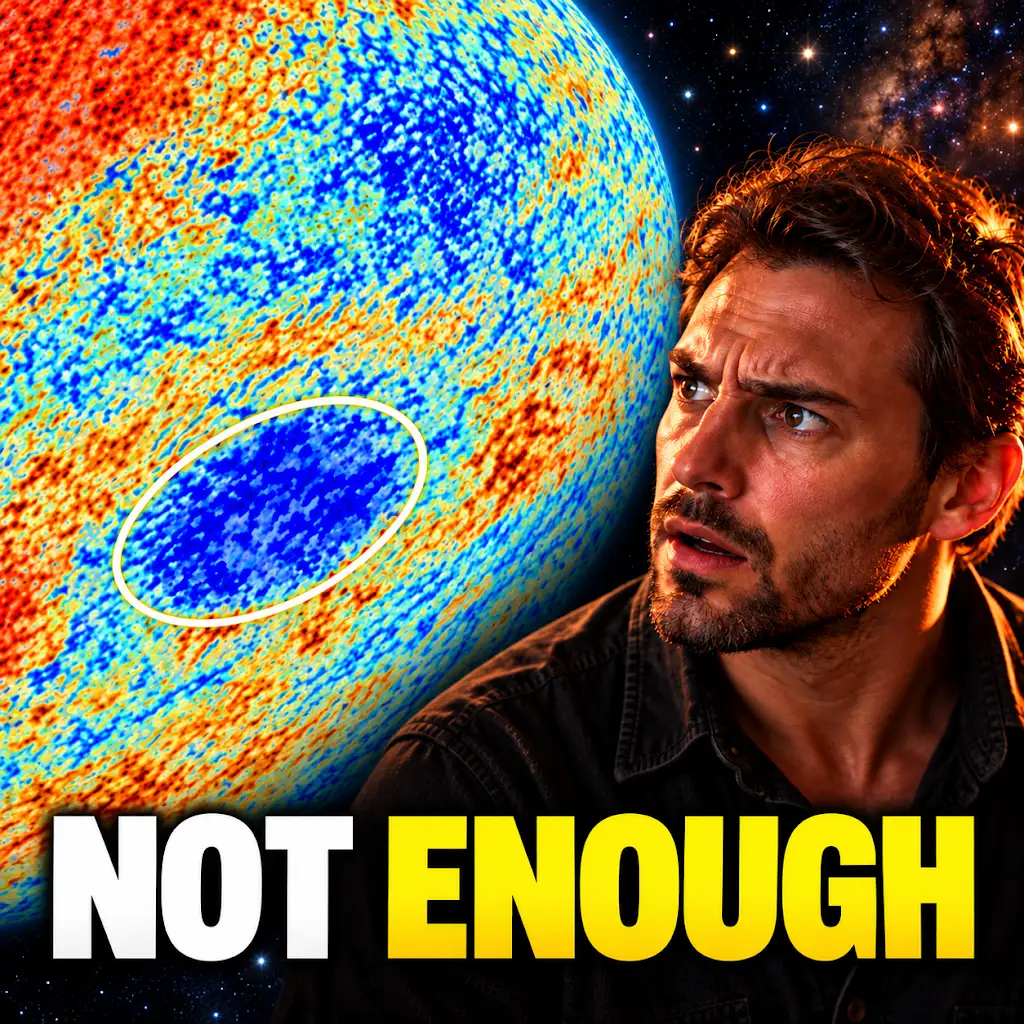
The Universe’s Cold Spot Has an Explanation. It’s Not Enough.
FAQs
What is the Integrated Sachs-Wolfe Effect (ISW) in the Cosmic Microwave Background (CMB) radiation?
The Integrated Sachs-Wolfe Effect refers to the phenomenon where the CMB photons passing through large-scale structures in the universe experience gravitational redshift or blueshift, leading to temperature fluctuations in the CMB.
How does the Integrated Sachs-Wolfe Effect impact our understanding of the universe?
Studying the ISW effect in the CMB allows scientists to probe the distribution of matter in the universe and the expansion history of the cosmos. It provides valuable insights into the nature of dark energy and dark matter.
What causes the temperature fluctuations in the Cosmic Microwave Background due to the Integrated Sachs-Wolfe Effect?
The temperature fluctuations in the CMB due to the ISW effect are caused by the changing gravitational potentials as CMB photons travel through evolving large-scale structures such as galaxy clusters and voids.
How do scientists detect and study the Integrated Sachs-Wolfe Effect in the Cosmic Microwave Background?
Scientists use sophisticated telescopes and instruments to measure the temperature fluctuations in the CMB. By analyzing the patterns and correlations in these fluctuations, researchers can infer the presence and impact of the ISW effect.
What are some of the key implications of studying the Integrated Sachs-Wolfe Effect in the Cosmic Microwave Background?
Studying the ISW effect in the CMB helps refine our understanding of the universe’s evolution, the properties of dark energy and dark matter, and the overall structure and dynamics of the cosmos. It also provides valuable constraints on cosmological models and theories.