The universe, a vast tapestry woven with threads of light and darkness, often conceals its grandest structures in the deepest recesses of space. For decades, astronomers have been mapping the cosmic web, a colossal network of galaxies and dark matter that stretches across billions of light-years. Within this intricate web, colossal voids – regions largely devoid of matter – have been discovered, dwarfing our understanding of cosmic emptiness. Among these, one anomaly has consistently perplexed cosmologists: the Eridanus Supervoid. This article will delve into the discovery, characteristics, and implications of this gargantuan cosmic emptiness, exploring its place in our understanding of the universe’s evolution and the mysteries it continues to hold.
The Birth of a Cosmic Void
The tale of the Eridanus Supervoid’s discovery is one of meticulous observation and the persistent questioning of cosmic homogeneity. In the early 2000s, a team of astronomers, led by Dr. Robert G. Wilson and Dr. Robert L. Brandenberger, utilizing data from the Wilkinson Microwave Anisotropy Probe (WMAP), identified a peculiar region in the constellation Eridanus. WMAP, a NASA spacecraft launched in 2001, was designed to measure the cosmic microwave background (CMB) radiation – the faint afterglow of the Big Bang. This radiation, a snapshot of the universe when it was just a few hundred thousand years old, contains subtle temperature fluctuations that represent the seeds of all cosmic structures we observe today.
Early Anomalies in the Cosmic Microwave Background
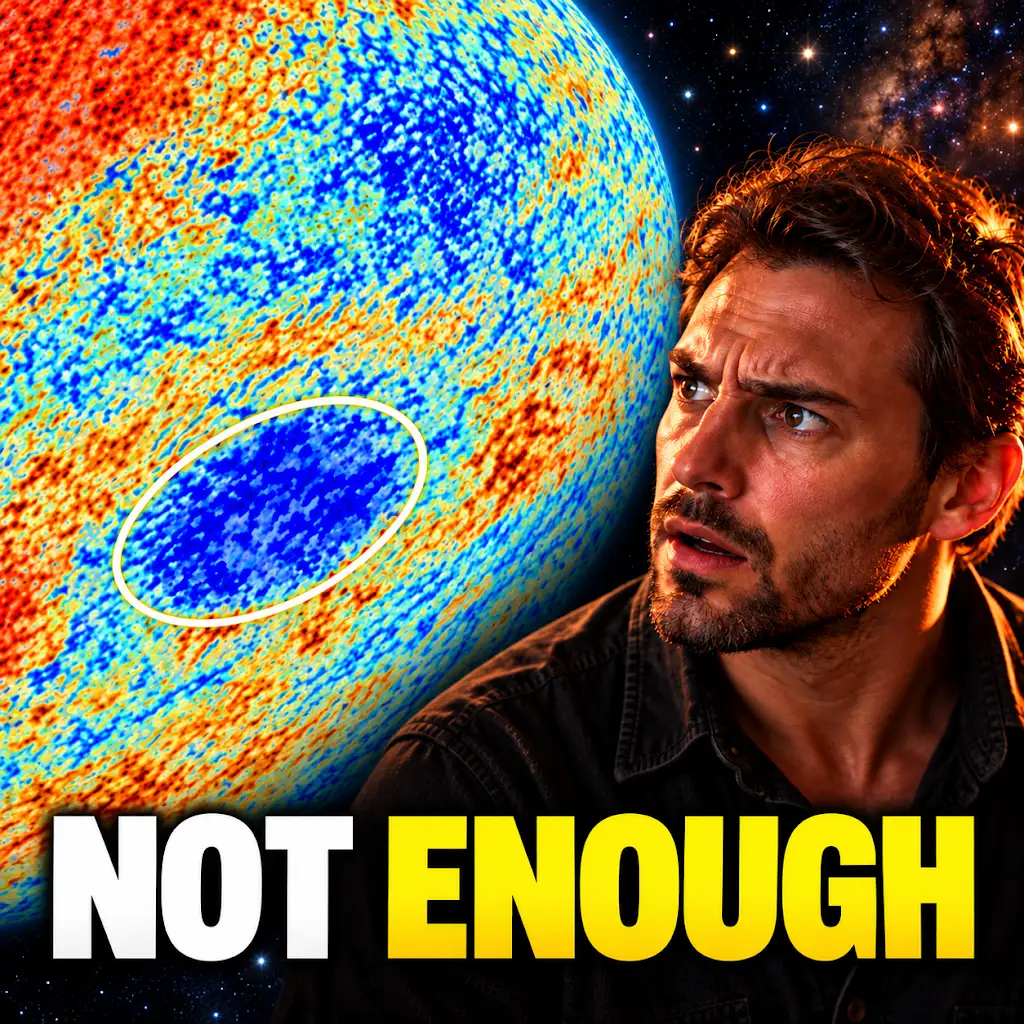
The CMB map, when analyzed, revealed an unusually cold spot in the direction of the Eridanus constellation. This region was statistically unlikely to arise from the random distribution of matter and energy in the early universe. While the CMB exhibits slight temperature variations, this particular area was significantly colder than expected, suggesting a deficit of matter – and thus gravitational influence – in that part of the cosmos. The initial observations were met with a mixture of excitement and skepticism. The sheer scale of the observed cold spot, and its implications for standard cosmological models, prompted further investigation. Could this be a statistical fluke, a misinterpretation of the data, or the first glimpse of something truly extraordinary?
The WMAP Data and the Unveiling of Emptiness
The WMAP data provided unprecedented detail of the CMB. Scientists analyzed the distribution of temperature fluctuations across the entire sky. The Eridanus Supervoid region stood out as a persistent anomaly. It wasn’t just a slightly cooler spot; it was a vast expanse where the CMB temperature was measurably lower than the average. This indicated that the light passing through this region had to travel further through less dense space, allowing it to cool down more than light that traversed denser regions. This initial discovery, while pointing to a significant deficit of matter, did not immediately reveal the full extent or nature of the Eridanus Supervoid. It was a hint, a tantalizing clue in the grand cosmic puzzle, suggesting that something was profoundly different about this patch of the universe.
The Eridanus Supervoid, a vast region of space that appears to be largely empty, has intrigued astronomers and cosmologists due to its immense size and the implications it holds for our understanding of the universe. For a deeper exploration of this phenomenon and its significance in the context of cosmic structures, you can read a related article on the topic at Freaky Science. This article delves into the characteristics of the supervoid and its potential impact on the cosmic microwave background radiation.
Mapping the Immense Expanse

Once the initial anomaly was detected, the scientific community was galvanized to investigate further. The challenge was to confirm the existence of such a vast void and to delineate its boundaries. This required a multi-pronged approach, combining observations of the CMB with galaxy surveys and the study of gravitational lensing. The sheer scale of the Eridanus Supervoid demanded the collaboration of numerous telescopes and research teams across the globe.
Galaxy Distribution and the Cosmic Web
The prevailing model of the universe, the Lambda-CDM model, predicts that galaxies are not uniformly distributed but are arranged in a cosmic web of filaments and clusters, with vast, empty voids in between. The Eridanus Supervoid fits into this picture as an unusually large and deep void. Astronomers utilized large-scale galaxy surveys, such as the Sloan Digital Sky Survey (SDSS), to map the distribution of millions of galaxies. By plotting the positions of these galaxies, they could identify regions where galaxies were conspicuously absent. The absence of galaxies in the direction of Eridanus provided strong supporting evidence for the existence of a void. The larger and deeper the void, the fewer galaxies would be found within its boundaries.
Gravitational Lensing as a Cosmic Scale
Gravitational lensing, the bending of light by mass, provided another crucial tool for probing the Eridanus Supervoid. According to Einstein’s theory of general relativity, massive objects warp spacetime, causing light from distant sources to bend as it passes by. In regions of low matter density, like a supervoid, this bending effect is less pronounced. Astronomers measured the distortions of light from distant quasars and galaxies as they passed through the Eridanus region. The observed lensing effects were significantly weaker than expected for a region of average cosmic density, further confirming the presence of a vast expanse of emptiness. This technique allowed scientists to indirectly “weigh” the matter content of the supervoid, revealing its profound lack of mass.
The Dimensions and Characteristics of a Cosmic Chasm

Defining the precise dimensions of a cosmic supervoid is an inherently challenging task. These structures are not sharply defined entities with clear boundaries but rather vast regions where the density of matter is significantly lower than the cosmic average. The Eridanus Supervoid is no exception, presenting a complex three-dimensional structure that continues to be refined with ongoing research.
Size and Scale of the Void
Estimates for the diameter of the Eridanus Supervoid vary, but it is generally considered to be one of the largest known voids in the observable universe. Its estimated size ranges from approximately 1 to 1.5 billion light-years in diameter. To put this into perspective, the observable universe is about 93 billion light-years across. This means the Eridanus Supervoid occupies a significant fraction of the cosmic landscape. It is not merely a gap between galaxy clusters but a colossal expanse where the cosmic web is sparsely populated. The sheer scale of this void challenges intuitive notions of the universe’s uniformity.
Composition and Matter Deficit
The defining characteristic of the Eridanus Supervoid is its extreme deficit of matter. While no region of the universe is entirely devoid of everything, this supervoid contains significantly less dark matter, luminous matter (stars and galaxies), and gas than typically found. The CMB cold spot, the initial indicator of its existence, is a direct consequence of this matter deficit. Light from the early universe that passed through this region encountered less gravitational pull, causing it to lose less energy and thus appear colder. The void is not entirely empty; it contains some diffuse gas and a few scattered galaxies, but their density is far below the cosmic average. This absence of matter has profound implications for the formation and evolution of structures within and around the void.
Implications for Cosmic Evolution and Cosmology
The existence of such a massive void like Eridanus has significant implications for our understanding of how the universe evolved from its early, homogeneous state to the complex structure we observe today. It challenges some of the fundamental assumptions of standard cosmological models and prompts a re-examination of cosmic history.
Challenging the Cosmological Principle
The Cosmological Principle is a fundamental assumption in modern cosmology that states that on large scales, the universe is homogeneous (the same everywhere) and isotropic (the same in all directions). The discovery of the Eridanus Supervoid, and other large voids, raises questions about the extent to which this principle holds true. While the universe may be statistically homogeneous and isotropic on sufficiently large scales, the existence of a void of this magnitude suggests that deviations from perfect uniformity can be significant. It prompts cosmologists to consider whether these anomalies might hint at an incomplete understanding of gravity or the initial conditions of the universe.
The Role of Inflation and Cosmic Structure Formation
Cosmic inflation, a theoretical period of rapid expansion in the very early universe, is thought to have smoothed out initial irregularities and laid the groundwork for the formation of large-scale structures. However, some scientists have proposed that extreme fluctuations during inflation could have led to the formation of supervoids. The Eridanus Supervoid could be a direct consequence of such a rare, large-scale fluctuation. Alternatively, it might suggest that the process of structure formation, driven by gravity, has led to the formation of such vast empty regions as a natural consequence of the clustering of matter into filaments and clusters. Understanding how such a massive void formed requires a deeper understanding of the interplay between the initial conditions of the universe and the subsequent evolution of matter.
The Eridanus Supervoid, an enormous cosmic structure, has intrigued astronomers due to its vast size and the implications it holds for our understanding of the universe. Recent studies suggest that this supervoid may challenge existing theories about cosmic evolution and the distribution of galaxies. For a deeper insight into the implications of such cosmic phenomena, you can explore a related article that discusses the significance of voids in the universe. This article delves into how these massive empty regions can influence the behavior of surrounding galaxies and the overall structure of the cosmos. To read more about this fascinating topic, visit this article.
Mysteries and Future Investigations
| Metric | Value | Unit | Description |
|---|---|---|---|
| Diameter | 1.8 | Gigaparsecs (Gpc) | Approximate diameter of the Eridanus Supervoid |
| Radius | 0.9 | Gigaparsecs (Gpc) | Approximate radius of the Eridanus Supervoid |
| Distance from Earth | 2 | Gigaparsecs (Gpc) | Estimated distance to the center of the supervoid |
| Density Contrast | -0.3 | Dimensionless | Relative underdensity compared to average cosmic density |
| Volume | 3.05 | Gigaparsec³ (Gpc³) | Estimated volume of the supervoid |
Despite considerable progress in understanding the Eridanus Supervoid, many mysteries remain. Its existence continues to fuel debate and inspire new avenues of research, pushing the boundaries of our cosmological knowledge.
The “Cold Spot” Controversy and Alternative Explanations
The Eridanus Supervoid’s associated CMB cold spot has been a subject of intense scrutiny and debate. While the void hypothesis is the most widely accepted explanation, other theories have been proposed to account for the anomaly. One such idea suggests that the cold spot might be a remnant of a collision between our universe and another, parallel universe. Another possibility is that it is caused by an unusual statistical fluctuation in the CMB, or perhaps an unknown astrophysical phenomenon. Ongoing research, particularly with more advanced CMB observatories like the Planck satellite, aims to refine the measurements of the cold spot and its surrounding region, potentially ruling out some of these speculative explanations.
The Search for Other Supervoids and the Cosmic Landscape
The discovery of the Eridanus Supervoid has spurred a concerted effort to search for other such colossal voids. Astronomers are employing increasingly sophisticated techniques and analyzing vast datasets to map the distribution of matter across the observable universe. The
The Universe’s Cold Spot Has an Explanation. It’s Not Enough.
FAQs
What is the Eridanus Supervoid?
The Eridanus Supervoid is a vast region of space that is unusually empty of galaxies, located in the constellation Eridanus.
How large is the Eridanus Supervoid?
The Eridanus Supervoid is one of the largest voids known in the universe, spanning approximately 1.8 billion light-years in diameter.
What is the significance of the Eridanus Supervoid?
The Eridanus Supervoid is significant because its size challenges current theories of the structure and evolution of the universe, raising questions about the nature of dark energy and cosmic expansion.
How was the Eridanus Supervoid discovered?
The Eridanus Supervoid was discovered through observations made by the Wilkinson Microwave Anisotropy Probe (WMAP) satellite, which detected an unusually cold spot in the cosmic microwave background radiation.
What impact does the Eridanus Supervoid have on the universe?
The Eridanus Supervoid’s presence has implications for our understanding of the large-scale structure of the universe, as its emptiness influences the distribution of matter and the formation of galaxy clusters.