The universe, in its immense and silent expanse, holds secrets that have captivated humanity for millennia. Among these, one of the most profound and enigmatic is the Cosmic Microwave Background (CMB) radiation. This faint, pervasive glow, bathing the cosmos in a microwave hum, is not merely a scientific curiosity; it is a direct window into the very earliest moments of our universe, a snapshot of an epoch so distant and so primal that it challenges our very comprehension of existence. Unveiling the CMB has been a monumental endeavor, a testament to human ingenuity and our unyielding desire to understand our cosmic origins.
Echoes from the Dawn of Time
The story of the CMB begins not with a grand observatory, but with an accidental discovery. In 1964, Arno Penzias and Robert Wilson, two Bell Labs engineers, were working with a horn antenna designed for satellite communication. They encountered a persistent, low-level hiss of radio noise that they could not eliminate, no matter how carefully they calibrated their equipment. This extraneous signal seemed to come from every direction, equally strong at all times. They meticulously ruled out terrestrial interference, even considering pigeons nesting in the antenna as a potential culprit, humorously attributing their persistent noise to “white dielectric material.” However, the signal remained stubbornly present. Unbeknownst to them, this mysterious static was the faint afterglow of the Big Bang, a cosmic lullaby sung by the universe itself from its infancy.
The Birth of the Universe and the Formation of the CMB
To understand the significance of the CMB, one must journey back to the universe’s very beginning. The prevailing cosmological model, the Big Bang theory, posits that the universe originated from an extremely hot, dense state approximately 13.8 billion years ago. In these initial moments, the universe was a seething plasma of fundamental particles and radiation, a chaotic soup where light could not travel freely. Photons were constantly scattering off charged particles, effectively trapping light. It was an opaque inferno.
As the universe expanded and cooled, a pivotal event occurred around 380,000 years after the Big Bang. This epoch, known as recombination, marked a crucial transition. The temperature had dropped sufficiently for electrons to combine with protons and helium nuclei, forming neutral atoms. This act of neutralization dramatically reduced the scattering of photons. Suddenly, the universe became transparent. The photons that had been trapped in the primordial plasma were finally free to travel unimpeded through space. The CMB radiation we observe today is essentially the redshifted light from this moment of transparency, stretched by the subsequent expansion of the universe over billions of years into the microwave spectrum.
Penzias and Wilson’s Serendipitous Encounter
Penzias and Wilson’s persistent noise was, in fact, this ancient light. Their accidental detection, though initially a perplexing anomaly, coincided with theoretical predictions made by physicists like George Gamow, Ralph Alpher, and Robert Herman in the 1940s. They had theorized that the early universe would have been filled with thermal radiation, and that this radiation should still be detectable today as a faint microwave background. When Penzias and Wilson learned of these predictions, the pieces of the cosmic puzzle clicked into place. Their discovery was later corroborated by Robert Dicke and his colleagues at Princeton University, who had been actively searching for this very radiation. The Nobel Prize in Physics was awarded to Penzias and Wilson in 1978 for their monumental discovery, a testament to the power of both theoretical prediction and accidental observation in pushing the boundaries of scientific understanding.
The cosmic microwave background radiation (CMB) is a fascinating remnant from the early universe, providing crucial insights into its formation and evolution. For a more in-depth exploration of this topic, you can read the related article that delves into the significance of the CMB and its implications for cosmology. To learn more, visit this article.
The CMB as a Cosmic Fingerprint
The CMB is far more than just a uniform glow; it is a meticulously detailed map of the early universe, imprinted with subtle variations that tell us about the universe’s composition, evolution, and ultimate fate. These tiny fluctuations, or anisotropies, are incredibly important. If the CMB were perfectly uniform, it would suggest a universe that had no structure to begin with, which is clearly not the case. The presence of these minute temperature differences is crucial evidence for the formation of the large-scale structures we see today, such as galaxies and galaxy clusters.
Tiny Temperature Variations, Monumental Implications
The anisotropies in the CMB are incredibly small, on the order of a few parts in 100,000. These temperature variations, though minuscule, represent density fluctuations in the primordial plasma. Regions that were slightly denser would eventually, under the relentless pull of gravity, coalesce to form the stars, galaxies, and clusters of galaxies that populate our universe. Conversely, regions that were slightly less dense would become the vast voids between these cosmic structures.
The precise pattern and amplitude of these fluctuations provide a wealth of information. By studying the angular power spectrum of the CMB, which describes how the temperature variations are distributed across the sky at different angular scales, cosmologists can infer fundamental properties of the universe. This includes the relative abundance of ordinary matter (baryonic matter), dark matter, and dark energy, as well as the geometry of the universe and the rate of its expansion.
The Cosmic Spectrum and the Composition of the Universe
The CMB is remarkably close to a perfect blackbody spectrum, a characteristic that further supports its origin from a hot, dense state. The blackbody spectrum is a universal relationship between temperature and emitted radiation, and its near-perfect adherence in the CMB is a strong indicator of its thermal origin.
However, it is the subtle deviations from this perfect spectrum, the anisotropies,
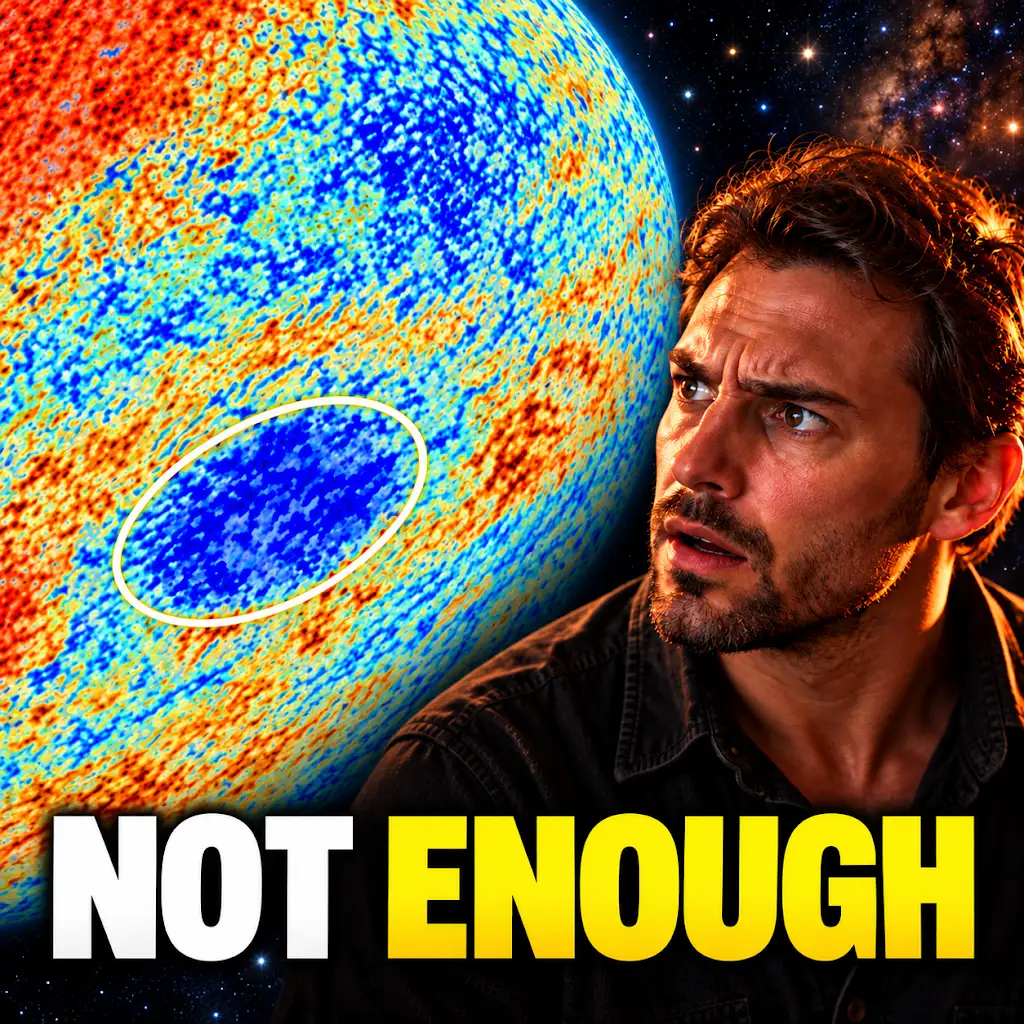
The Universe’s Cold Spot Has an Explanation. It’s Not Enough.
FAQs
What is cosmic microwave background radiation?
Cosmic microwave background radiation is a faint glow of light that fills the universe, leftover from the Big Bang. It is the oldest light in the universe, dating back to about 380,000 years after the Big Bang.
How was cosmic microwave background radiation discovered?
Cosmic microwave background radiation was first discovered in 1965 by Arno Penzias and Robert Wilson, who were awarded the Nobel Prize in Physics for their discovery. They detected the radiation as a constant, uniform background noise in their radio antenna.
What does cosmic microwave background radiation tell us about the universe?
Studying cosmic microwave background radiation provides valuable insights into the early universe, such as its age, composition, and evolution. It also supports the Big Bang theory and helps scientists understand the formation of galaxies and large-scale structures in the universe.
How is cosmic microwave background radiation measured?
Cosmic microwave background radiation is measured using specialized instruments called microwave telescopes or radiometers. These instruments are designed to detect and analyze the faint signals of the radiation coming from all directions in the sky.
What are some key features of cosmic microwave background radiation?
Some key features of cosmic microwave background radiation include its nearly uniform temperature of about 2.7 Kelvin, its isotropic nature (same in all directions), and its polarization, which carries important information about the early universe.