You’re standing in your kitchen, perhaps a little baffled. You’ve heard the buzz, seen the sleek new appliances, and now you’re staring at your induction stove, its glass-ceramic surface a tempting, flat canvas. But how does it actually work? The magic, you might suspect, lies within those invisible coils beneath the surface. You’ve probably heard the term “magnetic field” thrown around, and you’re ready to demystify it. This article is your guide, your key to unlocking the secrets of your induction stove’s magnetic field, transforming you from a curious observer into an informed user.
When you think about how a traditional stove works, you might picture glowing red coils or a gas flame licking upwards. Induction is different. It’s less about direct heat and more about creating a dynamic, invisible force that interacts with your cookware. The primary components responsible for this sorcery are the induction coils, nestled snugly beneath the smooth glass surface. These aren’t just passive metal wires; they are intricately designed to generate and manipulate a magnetic field, the engine that drives the entire cooking process.
The Coil’s Construction: More Than Just Wire
You might imagine a simple coil of copper wire, like you might find in an old radio. While copper is indeed the material of choice for its excellent conductivity, the induction coils in your stove are far more sophisticated. They are typically made of high-purity copper, wound in a precise helical or flat spiral shape. The number of turns, the diameter of the wire, and the spacing between them are all carefully calculated to optimize the magnetic field generation.
Why Copper? Its Electrical Prowess
Copper’s supremacy in this application is due to its exceptionally low electrical resistance. This means that as electricity flows through the coil, very little energy is lost as heat within the coil itself. This is crucial for efficiency, as you want the energy to be transferred to your cookware, not wasted in the stove’s internal components. Furthermore, copper’s malleability allows for precise winding into the required shapes, ensuring a consistent and predictable magnetic field.
The Shape Matters: Engineering the Field
The helical or spiral winding of the copper wire isn’t arbitrary. This specific configuration is designed to create a strong, concentrated magnetic field that extends outwards and upwards, directly towards your cookware. The geometry of the coil influences the distribution and intensity of the magnetic field, ensuring that the majority of the energy is directed where it’s needed most – into the base of the pot or pan.
The Electrical Symphony: From Wall to Coil
The journey of energy to your induction stove is a fascinating interplay of electricity. The power from your home’s electrical outlet is first directed to the stove’s control panel, where you select your desired heat setting. From there, this electrical current is routed to the induction coils. But it’s not a simple on-off switch. A critical component, often referred to as an inverter or a switching circuit, plays a vital role in transforming the alternating current (AC) from your wall into a high-frequency alternating current (AC) that the coils can effectively utilize.
The Inverter’s Crucial Role: High-Frequency Magic
The electricity from your home’s power grid operates at a relatively low frequency (typically 50 or 60 Hz). For induction to work efficiently, you need a much higher frequency, often in the range of 20 to 100 kHz. This is where the inverter comes in. It rapidly switches the direction of the electrical current, essentially “chopping up” the standard AC into a series of high-frequency pulses. This rapid oscillation is what allows the magnetic field to fluctuate intensely and rapidly, which is essential for inducing eddy currents in the cookware.
Alternating Current (AC): The Driving Force
Understanding AC is fundamental to grasping induction. Unlike direct current (DC), where electricity flows in one constant direction, AC constantly reverses its direction. This back-and-forth motion is what generates the fluctuating magnetic field around the coil. The higher the frequency of this alternating current, the faster the magnetic field changes, and the more effectively it can induce currents in conductive materials.
Induction stoves utilize a magnetic field to generate heat directly in the cookware, making them an efficient cooking option. For a deeper understanding of how induction technology works and its benefits, you can refer to a related article on the subject. This article provides insights into the science behind induction cooking and its advantages over traditional methods. To read more, visit Freaky Science.
Unveiling the Invisible Force: How the Magnetic Field Works
Now that you understand the coil and the electricity that powers it, let’s delve into the star of the show: the magnetic field. This is the invisible force that your induction stove generates, and it’s the direct reason your pans get hot. It’s not heat radiation, nor is it a microwave beam. It’s a phenomenon rooted in electromagnetism, a fundamental principle of physics.
The Principle of Electromagnetic Induction: Faraday’s Discovery
The entire concept of induction cooking is a direct application of Faraday’s Law of Electromagnetic Induction, named after the brilliant scientist Michael Faraday. His groundbreaking discovery, made in the 19th century, states that a changing magnetic field will induce an electromotive force (EMF), which in turn can drive an electrical current, in a nearby conductor. This is precisely what happens when your induction stove is active.
Faraday’s Law in Action: The Core Mechanism
When the high-frequency alternating current flows through the induction coil, it generates a constantly changing magnetic field. This magnetic field extends outwards from the coil. When you place a compatible pot or pan on the stove, its metallic base enters this changing magnetic field. According to Faraday’s Law, this changing magnetic field “pushes” and “pulls” on the electrons within the conductive metal of your cookware, forcing them to move. This movement of electrons is, by definition, an electric current.
Not All Metals Are Created Equal: Ferrous Requirements
It’s crucial to understand that not all cookware will work on an induction stove. The key lies in the material’s magnetic properties. Induction relies on ferromagnetic materials – metals that are strongly attracted to magnets. This includes materials like cast iron and most stainless steel. Aluminum, copper, and glass, while excellent conductors, are not ferromagnetic. Therefore, they cannot be effectively heated by an induction stove unless they have a special ferromagnetic layer integrated into their base.
The Magnetic Field’s Geometry: Focusing the Power
The shape and arrangement of the induction coils are meticulously designed to focus the magnetic field directly upwards, towards the cookware. This isn’t a wide, diffuse field that spreads erratically. Instead, it’s concentrated to maximize its interaction with the base of your pot or pan. This focused approach is a key factor in the efficiency and precise control offered by induction cooking.
Field Lines: Visualizing the Invisible
While we can’t see magnetic fields directly, we can visualize them as “field lines.” These lines represent the direction and strength of the magnetic force. In an induction coil, the field lines emanate from one pole and loop back to the other, creating a region of magnetic influence. The density of these lines indicates the strength of the field; closer lines mean a stronger magnetic force. The design of the coil aims to concentrate these field lines vertically.
Eddy Currents: The True Source of Heat
The electric currents induced in the cookware are known as “eddy currents.” These are swirling currents that flow within the conductive metal of the pan’s base. As these eddy currents flow, they encounter resistance within the metal. This resistance causes the electrons to collide with the atoms of the metal, generating heat through a phenomenon called Joule heating. The more intense the eddy currents, the greater the resistance, and therefore, the more heat is produced.
The Dance of Induction: From Magnetic Field to Cooked Food
Now you have a clearer picture of the magnetic field’s genesis. But how does this invisible force translate into the sizzle of your food? It’s a direct consequence of the eddy currents generated within your cookware. This is where the true cooking power of induction lies, and it’s a testament to the efficiency and precision of this modern technology.
Joule Heating: The Principle of Resistance
The fundamental principle behind how your food gets cooked is Joule heating, also known as resistive heating. When an electric current flows through a conductor with resistance, energy is dissipated in the form of heat. In the case of induction, the eddy currents induced in the cookware are the electric currents, and the metal of the pan’s base provides the resistance. The faster and more intensely these eddy currents flow, the more heat is generated.
Resistance: The Ingredient for Heat
Imagine trying to push water through a narrow pipe versus a wide one. The narrow pipe offers more resistance, making it harder for the water to flow. Similarly, the resistance of the metal in your cookware dictates how much heat is generated by the eddy currents. While you can’t change the inherent resistance of the pan’s material, the induction system is designed to generate currents strong enough to overcome this resistance and produce significant heat.
The Cookware as the Element: A Direct Connection
Unlike conventional stoves where a heating element transfers heat to the cookware, in induction, the cookware itself becomes the heating element. The magnetic field directly interacts with the pan, generating the heat within it. This is a crucial distinction, leading to several advantages like faster heating and more precise temperature control.
Hysteresis Heating: An Added Bonus in Ferromagnetic Materials
While eddy currents are the primary source of heat in induction cooking, ferromagnetic materials experience an additional heating mechanism called hysteresis heating. This occurs because the rapidly changing magnetic field causes the magnetic domains within the ferromagnetic material to align and realign. This constant manipulation of magnetic domains generates heat within the material itself.
Magnetic Domains: Tiny Magnets Within Metal
Ferromagnetic materials are composed of small regions called magnetic domains, each acting like a tiny magnet with its own north and south pole. In the absence of an external magnetic field, these domains are randomly oriented. However, when exposed to a magnetic field, they attempt to align themselves with the external field.
The Reversal Process: Generating Friction and Heat
As the magnetic field from the induction coil rapidly alternates, it forces these magnetic domains to constantly flip and realign. This process is not perfectly smooth; there’s a degree of internal friction as the domains move past each other. This internal friction results in the generation of heat. For materials like cast iron, which have strong ferromagnetic properties, hysteresis heating can contribute a significant portion of the overall heat generated.
Beyond the Coil: The Interplay with Your Cookware
The induction stove’s magnetic field doesn’t operate in a vacuum. Its effectiveness and the resulting heat are directly influenced by the cookware you use. Understanding this symbiotic relationship is key to optimizing your cooking experience and ensuring you get the most out of your induction appliance.
The Role of Cookware Material: Ferromagnetism is Key
As mentioned earlier, the fundamental requirement for induction cookware is that it must be ferromagnetic. This means it needs to be attracted to a magnet. If a magnet sticks to the bottom of your pot or pan, it will work on an induction stove. This is because ferromagnetic materials are the most efficient at interacting with the changing magnetic field and generating strong eddy currents and hysteresis heating.
Testing Your Cookware: The Magnet Trick
A simple and effective way to check if your existing cookware is induction-compatible is to use a common magnet. Place it on the underside of the pot or pan. If the magnet adheres firmly, your cookware is likely induction-ready. If it doesn’t stick at all, or only weakly, it won’t work efficiently, or at all, on an induction stove.
Multi-Layered Cookware: Engineered for Induction
Many modern cookware sets designed for induction feature multiple layers of metal. These often include a ferromagnetic core (like stainless steel or cast iron) sandwiched between layers of aluminum or copper. This design combines the heating efficiency of the ferromagnetic core with the excellent heat distribution properties of aluminum and copper, providing both effective induction compatibility and superior cooking performance.
The Importance of a Flat Bottom: Maximizing Contact
For the magnetic field to effectively induce currents, there needs to be close and consistent contact between the cookware and the glass surface of the stove. This is why induction-compatible cookware typically has a flat, smooth bottom. Warped or uneven bottoms will create air gaps, reducing the efficiency of the magnetic field coupling and leading to uneven heating.
Eliminating Air Gaps: Ensuring Optimal Transfer
The magnetic field lines are most concentrated and effective when there’s minimal space between the coil and the conductive material. Any air gap acts as an insulator, hindering the transfer of magnetic energy. A flat-bottomed pan ensures that the entire base of the cookware is in close proximity to the induction coil, allowing for maximum magnetic coupling and efficient heat generation.
Beyond Flatness: The ‘Cookware Detection’ Feature
Many induction stoves are equipped with a “cookware detection” feature. This sensor recognizes when compatible cookware is placed on the hob. If no cookware, or incompatible cookware, is detected, the stove will typically shut off automatically, or display an error message. This is a safety feature and also ensures that energy isn’t wasted by the coils operating without a target.
Induction stoves operate using a magnetic field generated by coils beneath the cooking surface, which directly heats the cookware. This innovative technology not only enhances cooking efficiency but also improves safety by minimizing the risk of burns. For a deeper understanding of how these magnetic fields work and their impact on cooking, you can explore a related article on the topic at Freaky Science. This resource provides valuable insights into the science behind induction cooking and its advantages over traditional methods.
Advantages of Understanding the Magnetic Field
| Parameter | Typical Value | Unit | Description |
|---|---|---|---|
| Coil Current | 20-40 | Amperes (A) | Current flowing through the induction coil |
| Frequency | 20-100 | kHz | Operating frequency of the induction coil |
| Magnetic Field Strength (B) | 10-50 | milliTesla (mT) | Magnetic flux density near the coil surface |
| Coil Diameter | 10-20 | cm | Diameter of the induction coil |
| Power Output | 1000-3000 | Watts (W) | Power delivered to the cookware |
| Magnetic Field Penetration Depth | 1-3 | mm | Depth of magnetic field penetration into cookware |
| Coil Resistance | 0.1-0.5 | Ohms (Ω) | Electrical resistance of the coil wire |
By comprehending how your induction stove’s magnetic field operates, you unlock a deeper appreciation for its capabilities and can leverage them to your advantage in the kitchen. This understanding goes beyond mere curiosity; it translates into practical benefits for your cooking.
Efficiency and Energy Savings: A Smarter Way to Cook
The focused nature of the magnetic field and the direct heating of the cookware make induction stoves incredibly energy-efficient. Because the heat is generated directly within the pan, there’s minimal heat loss to the surrounding air, unlike traditional electric or gas stoves. This means less energy is wasted, resulting in lower electricity bills and a more environmentally friendly cooking method.
Direct Energy Transfer: No Lost Heat
Think of it like this: a gas stove heats the air around the pot, and some of that heat rises up. An electric coil heats up, and then transfers that heat to the pot. With induction, the magnetic field directly energizes the pot, meaning virtually all the energy goes into heating your food. This efficiency is a significant advantage.
Faster Heating Times: More Time for You
The direct energy transfer also leads to significantly faster heating times. Water can boil much quicker on an induction stove compared to other methods. This means less time spent waiting for your pans to heat up, allowing you to prepare meals more efficiently and enjoy them sooner.
Precise Temperature Control: Culinary Mastery
The ability to precisely control the intensity of the magnetic field translates into incredibly precise temperature control for your cooking. You can make minute adjustments to the heat setting, and the induction system responds almost instantaneously. This level of control is invaluable for delicate cooking tasks, such as simmering sauces, tempering chocolate, or achieving the perfect sear.
Instantaneous Response: No More Guesswork
Unlike the lag you might experience with some other stovetops, induction offers an almost immediate response to your adjustments. Turn the dial down, and the heat reduces instantly. Turn it up, and it quickly intensifies. This real-time feedback allows for greater precision and confidence in your cooking.
Versatility in Cooking Techniques: From Simmer to Sear
The precise control offered by induction makes it ideal for a wide range of cooking techniques. You can achieve a gentle, consistent simmer for hours without fear of scorching, or crank up the power for a rapid, high-heat sear that locks in flavor. This versatility makes induction a powerful tool for both novice and experienced chefs.
Safety Features: Peace of Mind in Your Kitchen
The unique nature of the magnetic field also contributes to enhanced safety features on induction stoves. Since the glass surface itself doesn’t get directly heated by an element, it remains cooler to the touch than on conventional electric stovetops. The “cookware detection” feature, as mentioned earlier, prevents the stove from operating when no pot or pan is present, reducing the risk of accidental burns or fires.
Cooler Surface: Reduced Burn Risk
While the cookware gets hot, the induction hob itself primarily heats up as a byproduct of the heat from the cookware. This means the glass surface is generally much cooler than on a radiant electric hob. This significantly reduces the risk of accidental burns, especially if you have children or pets.
Automatic Shut-Off: Preventing Accidents
The intelligent cookware detection systems are a key safety feature. If you accidentally leave the stove on without cookware, it will automatically shut off after a short period. This is a crucial safeguard against potential hazards and provides an extra layer of peace of mind.
By understanding the intricate workings of your induction stove’s magnetic field, you’re not just appreciating a piece of technology; you’re empowering yourself to cook more efficiently, precisely, and safely. The invisible forces at play beneath that sleek glass surface are a testament to modern engineering, transforming your kitchen into a hub of culinary innovation.
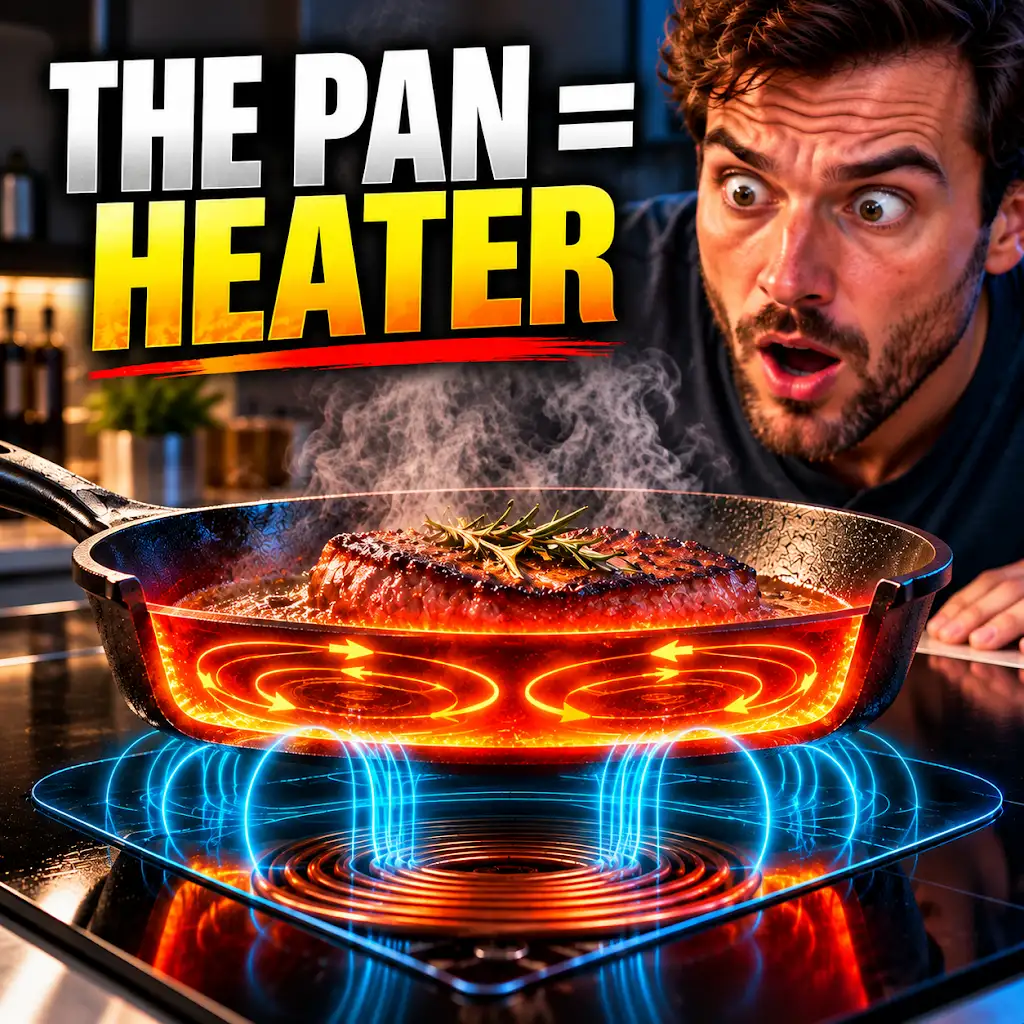
The Pan Is the Heater: How Induction Cooking Really Works
FAQs
What is an induction stove coil?
An induction stove coil is a component of an induction cooktop that generates a magnetic field when electricity passes through it. This magnetic field is used to heat up the cookware placed on top of the stove.
How does the magnetic field work in an induction stove coil?
The magnetic field created by the induction stove coil induces an electric current in the metal cookware placed on top of the stove. This current generates heat directly in the cookware, allowing for efficient and precise cooking.
Is the magnetic field generated by an induction stove coil harmful?
The magnetic field generated by an induction stove coil is generally considered safe for everyday use. It is confined to the cookware and does not emit harmful radiation like traditional stovetops.
Can the magnetic field from an induction stove coil interfere with electronic devices?
The magnetic field from an induction stove coil is localized and should not interfere with most electronic devices. However, it is recommended to keep sensitive electronics away from the immediate vicinity of the cooktop while it is in use.
Are there any safety precautions to consider when using an induction stove coil?
To ensure safe use of an induction stove coil, it is important to follow manufacturer’s instructions, use compatible cookware with magnetic properties, and avoid touching the coil directly while it is in operation. Additionally, always turn off the stove when not in use to prevent accidents.