
You’re standing in your kitchen, ready to whip up a meal. You grab a pot, place it on a sleek, flat surface, and with a simple touch, a powerful heat emanates directly from the cooking zone, instantly bringing your water to a boil. No glowing coils, no visible flames, just pure, controlled energy. This isn’t magic; it’s induction heating, a fascinating application of fundamental physics, specifically Michael Faraday’s groundbreaking Law of Induction, brought right into your home. You’re about to delve into how this seemingly futuristic technology makes your cooking faster, more efficient, and safer, all thanks to the principles that have shaped our understanding of electromagnetism.
At the heart of induction heating lies Faraday’s Law of Induction, a cornerstone of electromagnetism. You might recall learning about it in school, a concept that describes how a changing magnetic field can induce an electric current in a conductor. In your kitchen, this principle is harnessed to create heat directly within your cookware.
The Electromagnetism Connection
Imagine an electric current flowing through a wire. This current, as you might know, generates a magnetic field around the wire. Now, what if you could change that magnetic field? This is where Faraday’s Law comes in. It states that the magnitude of the induced electromotive force (EMF) – essentially, a voltage – in any closed circuit is equal to the negative of the time rate of change of the magnetic flux through the circuit. In simpler terms, a changing magnetic field will create an electric current.
Magnetic Fields: More Than Meets the Eye
You interact with magnetic fields every day, from refrigerator magnets to the Earth’s own magnetic field. These fields are invisible lines of force that exert influences on magnetic materials and moving electric charges. In induction heating, a strong, rapidly changing magnetic field is crucial. This field is generated by an alternating current (AC) flowing through a coil beneath the cooktop surface.
The Role of Alternating Current (AC)
Unlike direct current (DC), where electricity flows in one direction, AC electricity oscillates back and forth, constantly changing its direction. This constant change in current direction is the key to generating the necessary changing magnetic field. The frequency of this AC is important; higher frequencies lead to more rapid changes in the magnetic field, which in turn induce stronger currents in your cookware.
Faraday’s Law in Action: The Induction Process
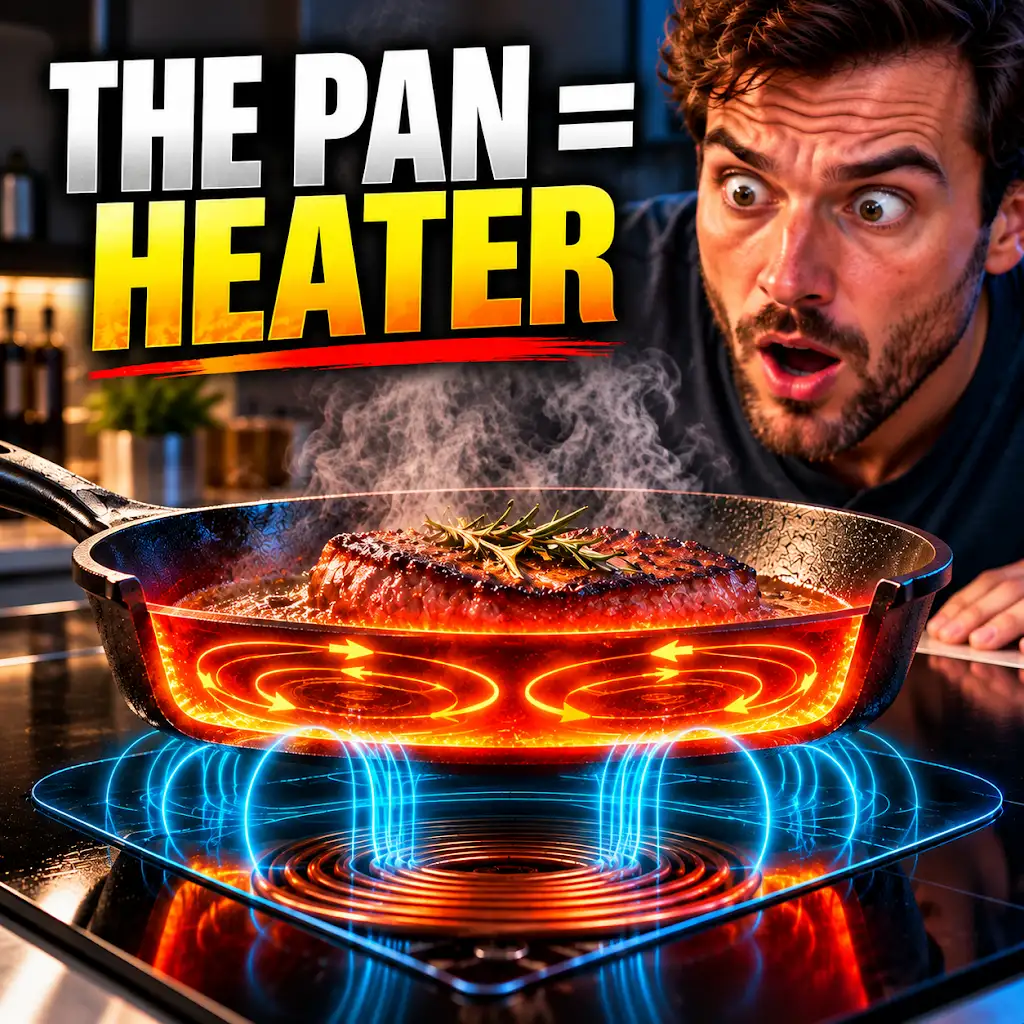
So, how does this translate to cooking? When you place a compatible pot or pan on the induction cooktop, you are essentially completing a circuit. The changing magnetic field generated by the coil beneath the cooktop penetrates the base of your cookware.
Inducing Eddy Currents
According to Faraday’s Law, this changing magnetic field induces circulating electric currents within the conductive material of your pot or pan. These are known as “eddy currents.” Think of them as tiny whirlpools of electricity swirling within the metal.
The Heating Mechanism: Resistance and Joule Heating
These eddy currents, though induced, don’t flow unimpeded. The metal of your cookware possesses electrical resistance. As these eddy currents flow through this resistance, they generate heat. This phenomenon is precisely described by Joule’s Law of Heating, which states that the heat produced is proportional to the square of the current, the resistance, and the time for which the current flows ($H = I^2 R t$). In induction heating, the high frequency of the AC and the efficient induction process create significant eddy currents, leading to rapid and intense heating.
Faraday’s law of electromagnetic induction plays a crucial role in the operation of induction cooktops, which are increasingly popular for their efficiency and speed in heating cookware. When an alternating current passes through a coil beneath the cooktop, it generates a magnetic field that induces an electric current in the metal of the pan placed on top. This process not only heats the pan directly but also allows for precise temperature control, making cooking more efficient. For a deeper understanding of the principles behind this technology, you can read more in this related article: Freaky Science.
The Science of Cookware Compatibility: Why Not All Pots Work
You’ve probably noticed that not every pot or pan you own will work on an induction cooktop. This isn’t some marketing ploy; it’s a direct consequence of the physics at play, stemming from the need for your cookware to interact effectively with the magnetic field.
Ferrous Materials: The Key Ingredient
The most critical factor for induction cookware is its magnetic property. Specifically, you need cookware made from ferromagnetic materials. These are materials that can be strongly magnetized, like iron and steel.
The Magnetic Attraction Test
A simple way to determine if your cookware is induction-compatible is the magnet test. If a magnet sticks firmly to the base of your pot or pan, it’s likely made of a ferromagnetic material and will work on an induction cooktop.
Understanding Ferromagnetism
Ferromagnetic materials have a unique atomic structure where their magnetic domains align when exposed to an external magnetic field. This alignment allows them to efficiently interact with the magnetic field generated by the induction cooktop, leading to strong eddy current induction.
Non-Ferrous Materials: The Imposters
Materials like aluminum, copper, and glass, while excellent conductors of heat in their own right, are not ferromagnetic. This means they don’t respond strongly to the magnetic field generated by the induction coil.
Why Aluminum and Copper Don’t Cut It (Alone)
While aluminum and copper can have eddy currents induced in them, the lack of ferromagnetism means the magnetic flux linkage is weaker, and therefore the induced currents are less significant. This results in insufficient heat generation for practical cooking. Some cookware manufacturers address this by incorporating a ferromagnetic layer (usually stainless steel) to the base of aluminum or copper pots, making them induction-compatible.
The Case of Glass and Ceramic Cookware
Glass and ceramic are generally non-magnetic and non-conductive. They simply don’t have the properties to have eddy currents induced within them. Therefore, you cannot use standard glass or ceramic pots directly on an induction cooktop.
The Anatomy of an Induction Cooktop: Beneath the Sleek Surface

You see a smooth, flat surface, but beneath it lies a sophisticated system of components working in harmony to deliver that instant heat. Understanding these components helps you appreciate the engineering behind this modern kitchen marvel.
The Induction Coil: The Heart of the Operation
At the core of each induction cooking zone is a precisely wound copper coil. This coil is the engine that generates the changing magnetic field.
Copper’s Conductivity: A Vital Choice
Copper is chosen for the induction coil due to its excellent electrical conductivity. This allows AC electricity to flow through it with minimal resistance, ensuring that the maximum possible magnetic field is generated.
AC Power Supply and Frequency Control
The induction coil is connected to an AC power supply. The cooktop’s internal electronics control the frequency and power of this AC supply, dictating the strength and rate of change of the magnetic field, and thus the heating power delivered to your cookware. This precise control is what allows for such accurate temperature regulation.
The Electronic Control Module: The Brains of the Operation
This is where the magic of precise control happens. The electronic control module manages the flow of electricity to the induction coil, adjusting the frequency and power output based on your settings.
IGBTs and Power Switching
At the heart of the control module are Insulated Gate Bipolar Transistors (IGBTs). These are semiconductor devices that act as high-speed switches. They rapidly turn the AC current on and off at the required frequency, effectively creating the oscillating magnetic field needed for induction.
User Interface and Sensor Integration
The user interface – the buttons or touch controls you interact with – sends signals to the control module. Additionally, sensors within the cooktop detect the presence and temperature of your cookware, allowing the system to optimize heating and prevent overheating.
The Cooktop Surface: More Than Just Aesthetics
The sleek, flat surface you see is usually made of ceramic glass. It’s not just for looks; it plays a role in the efficiency and safety of the induction system.
Ceramic Glass: Heat Resistance and Durability
Ceramic glass is chosen for its excellent thermal shock resistance and durability. It can withstand the rapid temperature changes without cracking. Importantly, it’s also a poor conductor of electricity and heat, meaning it doesn’t get as hot as the cookware itself, contributing to safety.
Heat Transfer: Direct and Efficient
The ceramic glass allows the magnetic field to pass through to the cookware with minimal loss. This direct energy transfer is a key reason for the efficiency of induction heating.
The Advantages of Induction: Why You Should Embrace It
Moving to an induction cooktop offers a compelling array of benefits that go beyond just the novelty of the technology. You’ll experience a tangible improvement in your cooking process.
Speed: Boiling Water in a Flash
One of the most immediate and striking advantages of induction is its speed. Because the heat is generated directly within the cookware, there’s no energy wasted heating up the air around the element or the cooktop surface itself.
Faster Heat Transfer
The direct transfer of energy to the cookware means that water boils significantly faster than on conventional electric or gas stoves. You’ll spend less time waiting for your ingredients to reach cooking temperature.
Responsive Temperature Control
Induction cooktops offer incredibly precise and responsive temperature control. Turn the dial down, and the heat diminishes almost instantly. Turn it up, and you get rapid heating. This responsiveness is a game-changer for delicate cooking tasks.
Efficiency: Saving Energy and Money
Induction heating is remarkably energy-efficient. Because the energy is directed precisely to the cookware, very little heat is lost to the surrounding environment.
Reduced Heat Loss
Compared to gas stoves, where a significant portion of the heat dissipates into the air, and conventional electric stoves, which heat a resistive element that then heats the pot, induction loses minimal energy. Studies have shown induction to be up to 85% efficient, compared to gas at around 40% and conventional electric at around 75%.
Lower Energy Bills
This increased efficiency translates directly into lower energy consumption, leading to potential savings on your utility bills over time.
Safety: A Cooler, Safer Kitchen
The inherent design of induction cooktops makes them significantly safer than other cooking methods.
The Cool Surface Advantage
Since the cooktop surface itself is not the primary heat source, it remains much cooler than the cookware. This drastically reduces the risk of accidental burns from touching the surface, a common hazard with gas and conventional electric stoves.
Automatic Shut-Off Features
Many induction cooktops incorporate safety features like automatic shut-off when cookware is removed, preventing accidents if you forget to turn off the burner. The absence of an open flame also eliminates the risk of gas leaks or fires.
Faraday’s law of electromagnetic induction plays a crucial role in the functioning of induction cooktops, which heat pans efficiently by generating currents directly in the cookware. This process not only saves energy but also allows for precise temperature control, making cooking more efficient. For a deeper understanding of the science behind this technology, you can explore a related article that delves into the principles of electromagnetic induction and its applications in everyday life. Check out this insightful piece at Freaky Science to learn more about how these concepts are applied in modern cooking methods.
The Future of Induction: Innovations on the Horizon
| Parameter | Description | Typical Value | Unit |
|---|---|---|---|
| Magnetic Field Strength (B) | Intensity of the magnetic field applied to the pan | 0.3 – 0.5 | Tesla (T) |
| Frequency (f) | Frequency of the alternating current generating the magnetic field | 20,000 – 50,000 | Hertz (Hz) |
| Induced Eddy Current (I) | Current induced in the pan by changing magnetic flux | 10 – 50 | Amperes (A) |
| Pan Material Resistivity (ρ) | Electrical resistivity of the pan material | 1.7 x 10^-7 (for stainless steel) | Ohm meter (Ω·m) |
| Power Dissipated (P) | Heat generated in the pan due to eddy currents | 500 – 2000 | Watts (W) |
| Heating Time | Time taken for the pan to reach cooking temperature | 30 – 90 | Seconds (s) |
| Temperature Rise Rate | Rate at which the pan temperature increases | 5 – 10 | Degrees Celsius per second (°C/s) |
Induction technology is not static; it continues to evolve, promising even more exciting possibilities for your kitchen.
Larger and More Flexible Cooking Zones
Manufacturers are pushing the boundaries of induction by offering larger cooking zones that can accommodate various pot sizes. Some models even feature “bridge” zones that can be combined to create one continuous heating area.
Smart Cookware Integration
The integration of smart technology is becoming increasingly prevalent. Future induction cooktops may communicate directly with smart cookware, automatically adjusting temperature settings based on the specific dish being prepared.
Advanced AI and Automation
Imagine a cooktop that can guide you through recipes, adjust cooking times and temperatures automatically, and even suggest cooking methods based on the ingredients you’re using. Artificial intelligence is poised to play a significant role in making cooking more intuitive and enjoyable.
Enhanced Precision and Control
The inherent precision of induction is being further refined. Innovations are focusing on even finer temperature adjustments for perfect searing, simmering, and melting.
Sous Vide Capabilities
Some high-end induction cooktops are now capable of maintaining extremely precise temperatures, making them suitable for sous vide cooking directly on the cooktop without the need for a separate water bath.
Multi-Zone Synchronization
The ability to synchronize multiple cooking zones to work together for specific cooking techniques, like sautéing and simmering simultaneously, is another area of development.
Improved Energy Management and Sustainability
As the world focuses more on sustainability, induction technology is being optimized for even greater energy efficiency and integration with renewable energy sources.
Integration with Smart Grids
Induction cooktops may become more integrated with smart grids, allowing them to automatically adjust their power consumption based on energy availability and demand, further contributing to grid stability and efficiency.
You’ve now journeyed from the fundamental principles of Faraday’s Law to the advanced innovations shaping the future of your kitchen. Induction heating isn’t just a cooking method; it’s a testament to how scientific discovery can be elegantly and practically applied to enhance your everyday life, making your time in the kitchen more efficient, safer, and ultimately, more enjoyable.
The Pan Is the Heater: How Induction Cooking Really Works
FAQs
What is Faraday’s law of electromagnetic induction?
Faraday’s law of electromagnetic induction states that a changing magnetic field induces an electromotive force (EMF) in a conductor, which in turn creates an electric current.
How does Faraday’s law heat a pan?
When a pan made of a conductive material is placed on an induction cooktop, alternating current flows through a coil beneath the cooktop. This alternating current creates a changing magnetic field, which induces an electric current in the pan according to Faraday’s law. The resistance of the pan to this induced current causes it to heat up and cook the food.
What are the advantages of using Faraday’s law to heat a pan?
Using Faraday’s law to heat a pan is more energy-efficient compared to traditional gas or electric stoves because the heat is generated directly in the pan itself. It also allows for precise control of the cooking temperature and faster heating times.
Are there any limitations to using Faraday’s law to heat a pan?
One limitation of using Faraday’s law to heat a pan is that only pans made of ferromagnetic materials, such as cast iron or stainless steel, can be used on induction cooktops. Additionally, the cookware must have a flat bottom and be in direct contact with the cooktop for efficient heating.
Is Faraday’s law safe for cooking?
Faraday’s law is considered safe for cooking as there are no open flames or exposed heating elements involved. Additionally, induction cooktops only generate heat in the pan itself, reducing the risk of burns from accidental contact with the cooktop surface.