You’re standing in your workshop, a familiar scent of oil and metal in the air. You’ve got a stubborn pipe fitting that just won’t budge, or perhaps you need to precisely heat a component for a delicate repair. Your mind drifts to the roaring flames of a torch, the accompanying hiss and flare. But what if there was a cleaner, more controlled way to achieve the same, or even better, results? Welcome to the world of Induction Heating, a flameless heat technology that’s quietly revolutionizing how you approach heat-intensive tasks. Forget the open flame, the unpredictable hotspots, and the potential for collateral damage. Induction heating offers you a precise, efficient, and remarkably safe alternative.
At its heart, induction heating is a marvel of electromagnetic physics. You’re not directly applying heat from a flame or a resistive element. Instead, you’re harnessing the power of electromagnetism to generate heat within the workpiece itself. It’s a bit like magic, but it’s entirely based on scientific principles. When you understand how it works, you’ll appreciate its elegance and its versatility.
The Basics of Electromagnetism
To grasp induction heating, you first need a foundational understanding of electromagnetism. You’re probably familiar with magnets and how they attract or repel. You might also know that an electric current creates a magnetic field. Induction heating takes these fundamental concepts and intertwines them.
Generating Magnetic Fields
When you pass an electric current through a conductor, like a wire, it generates a magnetic field around that conductor. The strength and direction of this magnetic field depend on the magnitude and direction of the current. In induction heating, this is achieved by an alternating current (AC).
The Inductor Coil: The Heart of the Operation
The key component in any induction heating system is the inductor coil. This is typically a hollow copper tube, often water-cooled to prevent it from overheating itself, wound into a specific shape designed to fit around or hold the workpiece. This coil is connected to an AC power supply. As the alternating current flows through the inductor coil, it creates a powerful, rapidly changing magnetic field that permeates the space within the coil.
Faraday’s Law of Induction: The Generation of Current
Now comes the crucial part. When a conductive material, like the metal you want to heat, is placed within this rapidly changing magnetic field, Faraday’s Law of Induction comes into play. This law states that a changing magnetic field passing through a conductor will induce an electromotive force (EMF), which in turn drives an electric current within that conductor.
Induced Currents (Eddy Currents)
The currents induced within the workpiece are called eddy currents. Because the magnetic field is alternating, the eddy currents also alternate, flowing in closed loops within the material. These eddy currents are where the heat is generated.
Joule Heating: The Conversion of Electrical Energy to Thermal Energy
The final piece of the puzzle is Joule heating, also known as resistive heating. As these eddy currents flow through the metal workpiece, they encounter resistance. Just like a wire in a toaster gets hot when current flows through it, the resistance of the metal causes the eddy currents to dissipate energy in the form of heat. The more resistance the material has, and the stronger the eddy currents, the faster and hotter it will get. This is the flameless heat you’re after.
Induction heating is an innovative technology that allows for heating without the use of an open flame, making it a safer and more efficient alternative for various applications. For a deeper understanding of this fascinating process, you can explore the article on Freaky Science that delves into the principles and advantages of induction heating. To read more, visit Freaky Science.
The Advantages of Induction Heating: Why You Should Consider It
You might be thinking, “Why bother with all this electromagnetic stuff when a torch works fine?” The answer lies in the significant advantages that induction heating offers over traditional heating methods. These benefits translate directly into improved efficiency, better results, and a safer working environment for you.
Precision and Control: Heat Exactly Where You Want It
One of the most compelling reasons to adopt induction heating is its unparalleled precision. Unlike a flame, which can be difficult to control and can spread heat unevenly, induction heating allows you to pinpoint the exact area you want to heat.
Targeted Heating
The shape and position of the inductor coil are critical here. You can design coils to precisely surround a specific pipe fitting, a gear, or any other component. This means you’re only heating the area that needs it, minimizing the risk of damaging adjacent materials or components.
Temperature Control
Modern induction heating systems offer sophisticated temperature control. You can set precise temperature targets, and the system will automatically regulate the power output to maintain that temperature. This is invaluable for applications where overheating can lead to material degradation or undesirable phase changes. Imagine trying to achieve a specific tempering temperature with a torch – it’s a game of guesswork. With induction, it’s a controlled process.
Speed and Efficiency: Getting the Job Done Faster and Better
Induction heating is remarkably fast. Because the heat is generated directly within the workpiece, there’s no need to wait for heat to transfer from an external source. This can significantly reduce cycle times and increase your productivity.
Rapid Heating
In many cases, induction heating can bring a component to temperature in seconds or minutes, rather than the much longer times associated with other methods. This is particularly beneficial in high-volume production environments or when you’re under a tight deadline.
Energy Efficiency
When used correctly, induction heating is highly energy-efficient. Because the heat is generated directly where it’s needed, there’s minimal wasted energy lost to the surrounding environment. This can lead to significant cost savings, especially in industrial settings. Think about how much heat dissipates into the air around a torch – that’s energy you’re paying for but not effectively using.
Safety and Environmental Benefits: A Cleaner and Safer Workspace
The absence of open flames and combustion products makes induction heating a much safer and cleaner alternative. This is a major consideration for any workshop or production facility.
Reduced Fire Hazards
Open flames are a significant fire hazard. Induction heating eliminates this risk entirely, creating a safer working environment and reducing insurance premiums. You no longer have to worry about stray sparks igniting flammable materials.
No Combustion Byproducts
Torches produce fumes and combustion gases, which can be harmful to your health and require proper ventilation. Induction heating produces no such byproducts, leading to a cleaner and healthier working environment. This means fewer masks, less ventilation equipment, and a generally more pleasant atmosphere.
Improved Operator Comfort
Working with open flames can be uncomfortable, especially in warmer environments. Induction heating generates less ambient heat, making the working area more comfortable for you and your colleagues.
Applications of Induction Heating: Where You’ll Find This Technology at Work
You might be surprised by the sheer breadth of applications for induction heating. While it’s a staple in heavy industry, its precision and efficiency are making it increasingly accessible and valuable for smaller workshops and specialized tasks.
Metalworking and Fabrication: Shaping and Joining with Precision
This is arguably the most common arena for induction heating. Its ability to quickly and precisely heat metal makes it ideal for a wide range of metalworking processes.
Heat Treatment
Induction is widely used for hardening, tempering, annealing, and normalizing metals. These processes involve carefully controlled heating and cooling cycles to alter the microstructure and mechanical properties of the metal, making it stronger, harder, or more ductile. For example, you might use it to harden the cutting edge of a tool.
Brazing and Soldering
Achieving strong, reliable joints is crucial. Induction heating allows for precise heating of the joint area, ensuring efficient melting of brazing alloys or solder without overheating the base materials. This is far more controlled than trying to heat a joint with a torch.
Forging
In industrial settings, induction heating is used to rapidly heat ingots or billets of metal to forging temperatures. This allows for faster production cycles and more consistent results.
Shrink Fitting
When you need to fit a bearing onto a shaft, or a ring onto a larger component, induction heating can be used to expand the outer part, allowing it to slide easily into place. As it cools, it shrinks, creating a tight, secure fit.
Automotive Industry: From Repair to Manufacturing
The automotive sector leverages induction heating for a variety of critical applications, ensuring the performance and longevity of vehicles.
Case Hardening Components
Many automotive components, such as gears, shafts, and crankshafts, require hardened surfaces for wear resistance. Induction hardening is a fast and efficient way to achieve this.
Straightening Bent Components
If you’ve ever dealt with a bent axle or driveshaft, you know how challenging straightening can be. Induction heating allows for localized heating and controlled bending to bring these components back into spec.
Manufacturing of Engine Parts
From heating cylinder liners for insertion to heat-treating crankshafts, induction plays a vital role in the efficient and precise manufacturing of engine components.
Electronics and Semiconductor Industry: Delicate Processes with Precision Control
While not involving massive amounts of metal, induction heating’s precision makes it invaluable in the delicate world of electronics and semiconductors.
Soldering and Brazing of Components
Similar to metalworking, induction is used for precise soldering of electronic components and for creating strong bonds in specialized electronic assemblies.
Growing Crystals
In the semiconductor industry, induction heating is used to melt and grow high-purity crystals, such as silicon, which are the foundation of integrated circuits. This requires extremely precise temperature control.
Heat Sinks and Thermal Management
Induction can be used to manufacture and assemble heat sinks and other components used in thermal management systems for electronic devices.
Types of Induction Heating Systems: Finding the Right Fit for Your Needs
The world of induction heating isn’t a one-size-fits-all affair. Different applications and power requirements call for different types of induction heating systems. Understanding these variations will help you choose the best option for your specific tasks.
Frequency and Power: The Key Variables
The two most important characteristics of an induction heating system are its operating frequency and its power output. These determine the depth of heat penetration and the speed at which the workpiece can be heated.
Low Frequency (LF): For Larger Workpieces and Deeper Penetration
Systems operating at lower frequencies (typically 50-400 Hz) are generally used for heating larger components or when deeper heat penetration is required. The lower frequency magnetic field can penetrate further into the material.
Medium Frequency (MF): A Versatile Range
Medium frequency systems (typically 400 Hz to 10 kHz) offer a good balance between penetration depth and surface heating. They are suitable for a wide range of applications, including hardening, brazing, and annealing.
High Frequency (HF) / Radio Frequency (RF): For Surface Hardening and Rapid Heating
High frequency systems (typically 10 kHz to several MHz) are ideal for applications requiring very rapid heating and shallow case hardening. The higher frequency magnetic field tends to stay closer to the surface of the workpiece.
System Architectures: From Basic to Sophisticated
Beyond frequency, induction heating systems can be categorized by their overall architecture and complexity.
Standalone Induction Heaters
These are self-contained units that include the power supply, control electronics, and the inductor coil (often integrated or easily attachable). They are ideal for general-purpose heating tasks, repairs, and smaller-scale production.
Integrated Induction Systems
In larger manufacturing facilities, induction heating units are often integrated into automated production lines. These systems are highly customized and designed for specific processes, often incorporating robotic handling and advanced control systems.
Handheld Induction Tools
For certain applications, like removing stubborn fasteners or localized heating for repairs, you might find handheld induction heating tools. These are compact and portable, offering a convenient flameless alternative to torches for smaller jobs.
Induction heating is an innovative technology that allows for heating without the use of a flame, making it a safer and more efficient option for various applications. For those interested in exploring this fascinating topic further, you can read a related article that delves into the principles and benefits of induction heating. This method utilizes electromagnetic fields to generate heat directly within the material, which can be particularly useful in industrial processes. To learn more about this cutting-edge technology, check out this informative piece here.
Getting Started with Induction Heating: Practical Considerations for You
| Metric | Description | Typical Values | Units |
|---|---|---|---|
| Frequency | Operating frequency of the induction coil | 20 – 400 | kHz |
| Power Input | Electrical power supplied to the induction heater | 1 – 50 | kW |
| Heating Time | Time required to reach target temperature without flame | 1 – 60 | seconds |
| Target Temperature | Temperature achieved by induction heating | 100 – 1500 | °C |
| Efficiency | Ratio of heat generated to electrical energy consumed | 80 – 95 | % |
| Material Type | Type of material heated (affects induction heating effectiveness) | Ferrous, Non-ferrous | N/A |
| Penetration Depth | Depth of heat penetration into the material | 0.1 – 10 | mm |
| Coil Design | Shape and size of induction coil affecting heating pattern | Helical, Pancake, Solenoid | N/A |
You’re intrigued. You see the benefits. Now, how do you actually get started with induction heating? It’s not as daunting as it might seem, especially with the availability of increasingly user-friendly systems.
Assessing Your Needs: What Do You Want to Achieve?
Before you dive in, take a moment to consider your specific requirements. What types of tasks do you intend to perform with induction heating? What materials will you be working with? What size are the components you’ll typically be heating?
Material Type
Different metals have different electrical conductivities and magnetic properties, which will affect how they respond to induction heating. Understanding these properties is important for selecting the right system. For instance, ferrous metals (like iron and steel) are ferromagnetic and respond very well to induction, while non-ferrous metals (like aluminum and copper) are less so and may require different frequencies or higher power.
Component Size and Geometry
The size and shape of the workpiece are crucial in determining the appropriate inductor coil design and the required power output of the heating system. A large pipe will require a different setup than a small gear.
Desired Temperature and Heating Time
Knowing your target temperature and how quickly you need to reach it will help you select a system with sufficient power and the correct frequency range.
Choosing the Right Equipment: Making Informed Decisions
Once you’ve assessed your needs, you can start looking at equipment. There’s a wide range of options available, from basic benchtop units to more advanced industrial systems.
Power Output (kW)
This is a measure of how much energy the system can deliver. Higher power means faster heating and the ability to handle larger workpieces.
Frequency Range (Hz or kHz)
As discussed earlier, the frequency determines the depth of heat penetration and the heating speed.
Inductor Coil Design
The inductor coil is the interface between the power supply and the workpiece. It needs to be designed to efficiently couple the magnetic field to the material you’re heating. You may need different coils for different jobs. Some systems offer interchangeable coils.
Control Features
Modern induction heaters often come with a range of control features, including temperature controllers, power adjustments, and timers. The level of control you need will depend on the complexity of your applications.
Safety First: Always Prioritize Safe Operation
Even though induction heating is safer than open-flame methods, it’s still essential to follow proper safety procedures.
Wear Appropriate Personal Protective Equipment (PPE)
This includes safety glasses to protect your eyes from any potential sparks or debris, and heat-resistant gloves to protect your hands from residual heat.
Proper Ventilation
While induction heating doesn’t produce combustion fumes, it can still generate heat that could cause materials to off-gas. Ensure adequate ventilation in your workspace.
Keep Combustibles Away
Even without an open flame, localized heating can still pose a fire risk if there are flammable materials too close to the heated workpiece. Maintain a clear workspace.
Understand Your Equipment
Read the manufacturer’s instructions thoroughly and ensure you understand how to operate the equipment safely and effectively.
Practical Tips for Success
- Start Simple: If you’re new to induction heating, begin with simpler applications and gradually move to more complex ones as you gain experience.
- Experiment with Coils: The inductor coil is key to efficient heating. Don’t be afraid to experiment with different coil designs or consider custom-made coils for specialized tasks.
- Use Water Cooling: For higher power systems or extended use, ensure your induction coil is properly water-cooled to prevent overheating and damage.
- Consider Consumables: Brazing alloys, solder, and fluxes are essential for joining applications and will be a part of your induction heating toolkit.
The Future of Induction Heating: Continuous Innovation and Wider Adoption
You’re witnessing a technology that’s not just established but is also in a constant state of evolution. The principles of induction heating are well-understood, but the engineering and control systems are continually improving, pushing the boundaries of what’s possible.
Advancements in Power Electronics
The efficiency and control of induction heating systems are directly tied to advancements in power electronics. Newer solid-state power supplies are becoming more efficient, compact, and capable of finer control, leading to improved performance and reduced energy consumption. This means more power in smaller packages, making induction heating more accessible for a wider range of applications.
Sophisticated Control Systems and Automation
The integration of advanced control systems, including microprocessors and artificial intelligence, is enabling more sophisticated automation of induction heating processes. This leads to greater precision, repeatability, and the ability to adapt to changing conditions in real-time. Imagine a system that can automatically adjust its output based on the precise temperature of the workpiece, ensuring perfect results every time.
Growing Environmental and Sustainability Focus
As the world increasingly prioritizes sustainability, induction heating’s energy efficiency and lack of emissions are making it an even more attractive option. Its ability to reduce energy consumption and minimize waste aligns perfectly with green manufacturing initiatives. You’re not just performing a task; you’re doing it in a way that’s better for the environment.
Expansion into New and Niche Applications
The versatility of induction heating means it’s continually finding its way into new and niche applications. From advanced medical device manufacturing to specialized aerospace components, its ability to deliver precise, controlled heat is opening doors in fields that were once unimaginable for this technology. You might even see it making its way into more everyday tools and devices as the technology becomes more affordable and user-friendly.
Induction heating is more than just a way to apply heat; it’s a sophisticated technology that offers you unparalleled control, efficiency, and safety. Whether you’re a seasoned professional in a heavy industrial setting or a hobbyist looking for a better way to tackle your projects, embracing flameless heat technology is a step towards a smarter, cleaner, and more effective way of working. The future of heat is here, and it’s powered by electromagnetism.
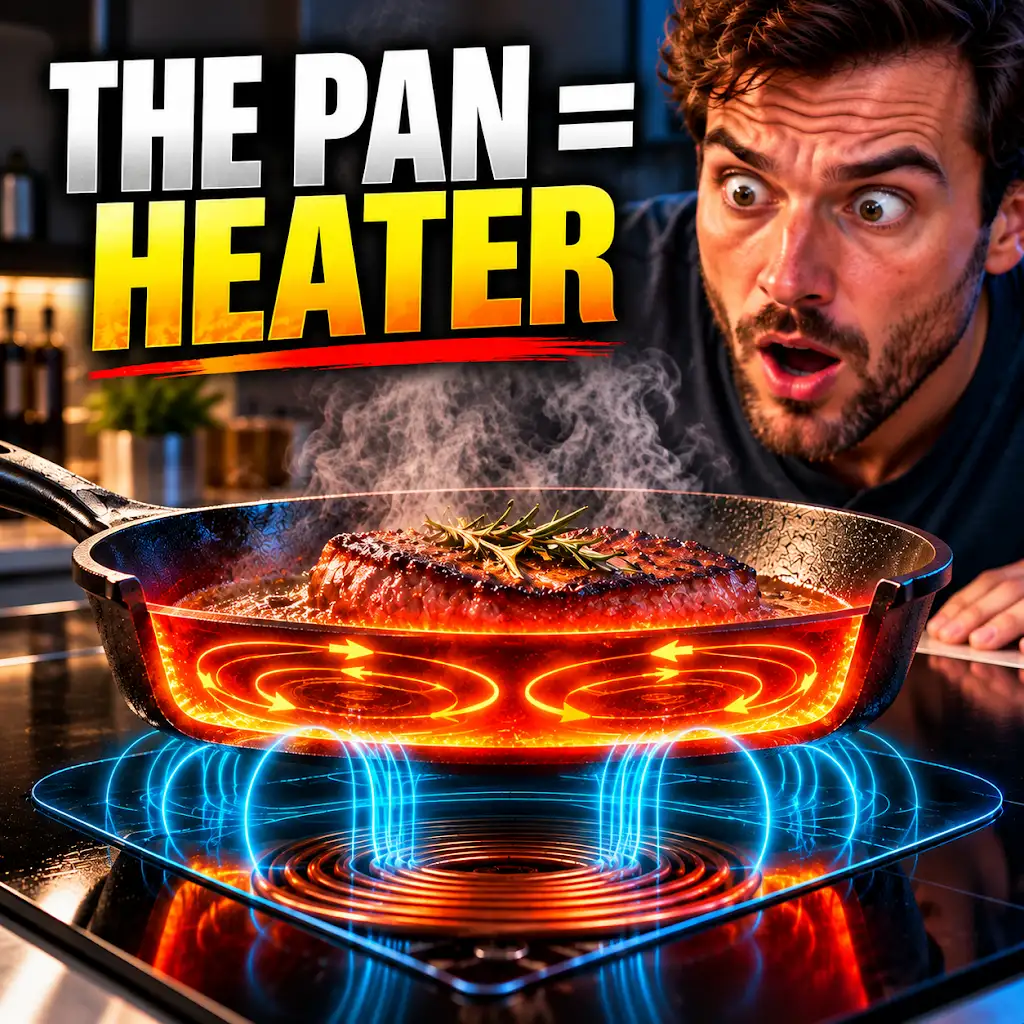
The Pan Is the Heater: How Induction Cooking Really Works
FAQs
1. What is induction heating?
Induction heating is a method of heating an electrically conductive material by using electromagnetic induction to generate heat within the material itself.
2. How does induction heating work without a flame?
Induction heating works without a flame by using an alternating magnetic field to induce electric currents within the material being heated. These currents generate heat due to the material’s electrical resistance, without the need for a direct flame.
3. What are the advantages of using induction heating without a flame?
Some advantages of using induction heating without a flame include precise and controllable heating, energy efficiency, faster heating times, and a cleaner working environment without the emissions associated with combustion.
4. What materials can be heated using induction heating without a flame?
Induction heating can be used to heat a wide range of electrically conductive materials, including metals such as steel, aluminum, copper, and brass. Non-metallic materials with high electrical conductivity, such as graphite or some ceramics, can also be heated using this method.
5. Are there any safety considerations when using induction heating without a flame?
While induction heating without a flame is generally considered safe, it is important to follow proper safety precautions, such as using appropriate protective gear, ensuring proper ventilation in the workspace, and being aware of the potential for electrical hazards.