
You’re standing in your kitchen, a sleek induction cooktop gleaming before you. You place a pot on it, twist a dial, and instantly, the bottom of your pan begins to glow with heat. No flames, no glowing coils, just pure, rapid thermal magic. But what’s actually happening beneath that shimmering surface? You’re about to dive into the fascinating physics of induction cooking, a culinary revolution powered by electromagnetism. This isn’t just about convenience; it’s about understanding a fundamental force of nature harnessed for your everyday meals.
At its heart, induction cooking is a masterful application of electromagnetic induction, a phenomenon first described by Michael Faraday in the 19th century. You might recall Faraday’s experiments involving coils of wire and magnets, demonstrating how a changing magnetic field can generate an electric current. Induction cooktops leverage this very principle to heat your cookware directly, bypassing the need for an intermediate heating element.
Faraday’s Law: The Foundation of Induction
The cornerstone of induction cooking is Faraday’s Law of Electromagnetic Induction. In essence, this law states that a changing magnetic flux through a circuit (in this case, your pot) induces an electromotive force (EMF), which drives an electric current. Imagine the cooktop as a powerful electromagnet, and your pot as a conductor situated within its magnetic field.
Understanding Magnetic Flux
Magnetic flux is a measure of the total magnetic field passing through a given area. Think of it like counting the number of magnetic field lines that pierce a surface. In an induction cooktop, the coil beneath the ceramic surface generates a magnetic field. This field extends upwards and interacts with the pot placed above it.
The Role of a Changing Magnetic Field
The crucial element is that this magnetic field isn’t static; it’s rapidly changing. The induction cooktop’s electronics create an alternating current (AC) that flows through a coil, generating a magnetic field that oscillates at a high frequency, typically between 20 kHz and 50 kHz. This rapid oscillation means the magnetic field is constantly growing, shrinking, and reversing direction.
Induced Current: The Birth of Heat
As this oscillating magnetic field from the cooktop penetrates the base of your pot, it interacts with the conductive material. Because the magnetic field is constantly changing, it induces circulating electric currents within the pot itself. These are known as eddy currents.
Lenz’s Law: The Counter-Reaction
While Faraday’s Law explains why a current is induced, Lenz’s Law explains how it behaves. Lenz’s Law states that the direction of the induced current will be such that it opposes the change in magnetic flux that produced it. This opposition is fundamental to the functioning of an induction cooktop.
Opposing the Change
The eddy currents generated in the pot create their own magnetic field. This induced magnetic field is oriented in such a way that it tries to counteract the original changing magnetic field from the cooktop. It’s a sort of electromagnetic tug-of-war, but it’s this very interaction that is key to heating.
The Source of Heat: Joule Heating
The real magic happens when these eddy currents flow through the resistance of the pot’s material. Just like any electrical conductor, cookware has a certain electrical resistance. As the eddy currents move through this resistance, they encounter friction at the atomic level, and this friction converts electrical energy into thermal energy. This phenomenon is known as Joule heating or resistive heating. It’s the same principle that makes the heating element in a toaster glow red hot, but in induction, it happens directly within your pot.
Induction cooking is a fascinating application of physics that utilizes electromagnetic fields to heat cookware directly, making it an efficient and modern cooking method. For a deeper understanding of the principles behind induction cooking, you can explore the article available at Freaky Science, which delves into the science of electromagnetism and its practical applications in everyday life.
The Anatomy of an Induction Cooktop
Understanding the physics requires a peek inside the cooktop itself. It’s a marvel of modern engineering, combining electrical components, magnetic coils, and a durable ceramic glass surface.
The Magnetic Coil: The Heart of the Operation
Beneath the smooth ceramic surface lies a carefully designed coil, typically made of copper. This coil is the primary component responsible for generating the oscillating magnetic field. The shape and winding of this coil are optimized to create a strong and uniform magnetic field that effectively penetrates the cookware placed above it.
Material Matters: Copper’s Conductivity
Copper is chosen for its excellent electrical conductivity. This means it can carry the alternating current with minimal energy loss, allowing for efficient generation of the magnetic field. A less conductive material would require more energy to achieve the same magnetic field strength, leading to inefficiency and increased heat generation within the coil itself, which needs to be managed.
Coil Geometry: Shaping the Field
The way the copper wire is wound into a coil is critical. It’s not just a random bundle; it’s precisely engineered to produce a magnetic field that is most effective at inducing eddy currents in the cookware. The diameter and number of turns in the coil, along with its spacing from the ceramic surface, all play a role in optimizing this field distribution.
The Electronic Control Unit: The Brains of the Operation
The induction cooktop isn’t just a coil; it’s a sophisticated system controlled by an electronic unit. This unit takes the standard household alternating current, modifies it, and sends it to the magnetic coil at the required high frequency. It also manages the power levels, safety features, and user interface.
Power Inversion: AC to High-Frequency AC
Your home’s electrical outlets provide a standard alternating current at 50 or 60 Hz. Induction cooktops require a much higher frequency. The electronic control unit contains an inverter circuit that converts the standard AC into a high-frequency AC. This high frequency is essential for generating a rapidly changing magnetic field, which in turn is necessary for efficient eddy current induction.
Power Regulation: From Simmer to Sear
The control unit also allows you to precisely regulate the power output. By adjusting the amplitude and duty cycle of the high-frequency AC supplied to the coil, the cooktop can control the intensity of the magnetic field and, consequently, the strength of the induced eddy currents and the resulting heat. This translates to the intuitive heat settings you see on the cooktop’s interface.
Safety Circuits: Ensuring Peace of Mind
Modern induction cooktops are equipped with numerous safety features managed by the control unit. These include automatic shut-off if no pot is detected, overheating protection, and sensors to ensure the cookware is compatible.
The Ceramic Glass Surface: A Protective Barrier
The smooth, durable ceramic glass surface is more than just aesthetically pleasing; it serves as a crucial barrier between the electronic components and the cookware.
Thermal Insulation and Strength
Ceramic glass is chosen for its ability to withstand high temperatures and thermal shock. It provides a smooth, easy-to-clean surface while insulating the sensitive electronics beneath from direct contact with the hot cookware. Its inherent strength also makes it resistant to scratches and cracks from everyday kitchen use.
Non-Magnetic Properties
Crucially, the ceramic glass itself is not magnetic. This ensures that the magnetic field generated by the coil passes through it unimpeded to interact with the cookware, and the glass doesn’t absorb energy and heat up itself, which would reduce efficiency and pose a burn risk.
Cookware: The Indispensable Partner

You can’t just use any pot or pan on an induction cooktop. The physics dictates that the cookware must be made of a material that can be easily magnetized and heated by eddy currents.
Ferromagnetic Materials: The Key to Induction
The most important property for induction-compatible cookware is ferromagnetism. Ferromagnetic materials, such as cast iron and most types of stainless steel, are strongly attracted to magnets. This attraction is a direct indicator of their ability to interact effectively with the magnetic field generated by the induction cooktop.
Magnetic Permeability: The Ease of Magnetization
Ferromagnetic materials have high magnetic permeability. This means they are easily magnetized and can support a strong magnetic field within themselves. When placed in the cooktop’s oscillating magnetic field, they readily develop strong eddy currents due to their high permeability and inherent electrical resistance.
Electrical Resistance: The Source of Heat
While ferromagnetism is essential for interaction, the material also needs sufficient electrical resistance to generate heat efficiently through Joule heating. Purely ferromagnetic materials with very low resistance might not heat up as effectively. A balance is struck in most induction-compatible cookware.
Types of Induction-Friendly Cookware
- Cast Iron: This is a classic choice for induction. It’s highly ferromagnetic, durable, and retains heat exceptionally well. Unenameled cast iron is ideal.
- Enameled Cast Iron: While the enamel coating is not magnetic, the cast iron core underneath is. As long as the enamel isn’t too thick and the iron is of good quality, these pans will work effectively.
- Stainless Steel: Many types of stainless steel are induction-compatible. Look for cookware that has a magnetic base or is specifically labeled for induction use. Higher quality stainless steel often incorporates a layer of ferromagnetic material (like a disc or core) for better performance.
- Carbon Steel: Similar to cast iron, carbon steel is ferromagnetic and heats up quickly and evenly.
Cookware That Won’t Work
- Aluminum: Pure aluminum is not ferromagnetic and will not work on an induction cooktop. Some aluminum cookware has a ferromagnetic base added, making it induction-compatible.
- Copper: Like aluminum, pure copper is not magnetic. It’s an excellent conductor of heat but cannot be heated directly by induction. Again, some copper cookware has a magnetic core.
- Glass and Ceramic: Unless they have a metal core, these materials are non-magnetic and will not work.
- Non-Magnetic Stainless Steel: Not all stainless steel is ferromagnetic. Some alloys are designed to be non-magnetic.
The Magnet Test: A Simple Verification
You can easily check if your existing cookware is induction-compatible by placing a magnet on the bottom. If the magnet sticks firmly, the cookware will likely work on an induction cooktop.
The Physics of Heat Transfer: Direct and Efficient
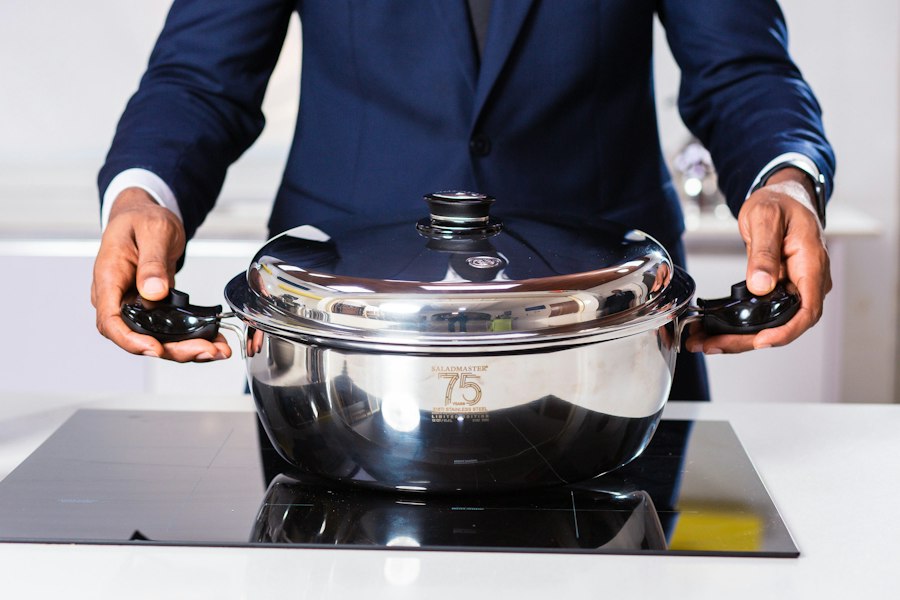
One of the most significant advantages of induction cooking is its incredibly efficient heat transfer. Unlike conventional methods that lose a considerable amount of heat to the surrounding air, induction focuses the heat directly into the cookware.
Direct Energy Transfer
The eddy currents generated within the pot are the direct source of heat. This means the energy from the cooktop is transformed into heat precisely where it’s needed – the bottom of your cooking vessel. There’s no wasted energy heating the air around the pan or the cooktop surface itself (beyond incidental contact).
Minimal Heat Loss
Traditional electric and gas cooktops lose a substantial percentage of their energy to the environment through convection and radiation. The radiant heat from a glowing electric coil, or the flames of a gas burner, dissipates into the kitchen. With induction, this loss is drastically reduced. The ceramic glass surface does get warm from contact with the hot pot, but it’s not the primary source of heat.
Speed and Responsiveness
The direct transfer of energy and minimal heat loss contribute to the remarkable speed and responsiveness of induction cooking. When you turn up the power, the pot heats up almost instantly. When you turn it down, it cools down quickly, allowing for precise control over cooking temperatures. This is a stark contrast to the lag often experienced with electric coil or even gas cooktops.
Energy Efficiency: A Greener Choice
Because of its direct heating mechanism, induction cooking is generally more energy-efficient than other electric cooking methods. A higher percentage of the electrical energy consumed is converted into usable heat for cooking, leading to lower energy bills and a reduced carbon footprint. While gas cooktops might be perceived as having a faster initial response, their overall energy efficiency in transferring heat to the food is often lower due to significant heat loss.
Induction cooking is a fascinating topic that combines principles of electromagnetism and thermal dynamics to create an efficient cooking method. For those interested in exploring the science behind this innovative technology, a related article can provide deeper insights into how induction cooktops generate heat directly in the cookware. You can read more about it in this informative piece on Freaky Science, which delves into the underlying physics that makes induction cooking both effective and energy-efficient.
The Advantages of Induction: A Fusion of Physics and Culinary Excellence
| Metric | Description | Typical Value / Range | Unit |
|---|---|---|---|
| Frequency of AC Current | Alternating current frequency used to generate changing magnetic field | 20 – 100 | kHz |
| Magnetic Field Strength | Intensity of magnetic field produced by the induction coil | 10 – 100 | mT (millitesla) |
| Induced Eddy Current Density | Current density induced in the cookware by the magnetic field | 10^4 – 10^6 | A/m² |
| Skin Depth | Depth at which the induced current density falls to 1/e of its surface value | 0.1 – 1 | mm |
| Power Transfer Efficiency | Ratio of power delivered to cookware to power consumed by the induction coil | 80 – 90 | % |
| Cookware Material | Material properties affecting induction heating (magnetic permeability, resistivity) | Cast iron, stainless steel (ferromagnetic) | N/A |
| Heat Generation Mechanism | Conversion of eddy current losses and hysteresis losses into heat | N/A | N/A |
| Typical Power Output | Power delivered to cookware for cooking | 1000 – 3000 | Watts |
The underlying physics of induction cooking translate into a host of practical benefits that make it a superior choice for many home cooks and professional chefs alike.
Unparalleled Speed
The direct and efficient transfer of energy means that water boils significantly faster on an induction cooktop compared to conventional methods. This can shave minutes off meal preparation times, a welcome advantage in today’s fast-paced world.
Precise Temperature Control
The ability to rapidly adjust power levels allows for incredibly precise temperature control. You can go from a rapid boil to a gentle simmer with immediate effect, enabling delicate tasks like melting chocolate or tempering eggs without fear of scorching. This fine-tuned control is a chef’s dream.
Enhanced Safety
Since the cooktop surface itself doesn’t get as hot as conventional electric elements, the risk of accidental burns is significantly reduced. The cooktop only heats up from the residual heat of the cookware. Many models also feature automatic shut-off when cookware is removed, further enhancing safety.
Easy Cleaning
The smooth, flat ceramic glass surface is incredibly easy to clean. Spills and splatters don’t bake onto a hot element; they can simply be wiped away once the surface has cooled. This makes kitchen cleanup a much less arduous task.
Superior Energy Efficiency
As discussed, induction cooktops are more energy-efficient, leading to lower electricity bills. This, combined with faster cooking times, makes them an economically and environmentally conscious choice.
Modern Aesthetics
Induction cooktops often boast a sleek, minimalist design that complements modern kitchen aesthetics. Their flush integration with countertops provides a clean and sophisticated look.
You’ve now journeyed through the fascinating world of induction cooking, from the fundamental laws of electromagnetism to the practical advantages it offers. The next time you place a pot on that gleaming surface and witness the instant heat, you’ll understand the intricate dance of magnetic fields, eddy currents, and electrical resistance that makes your culinary creations possible. It’s a testament to how understanding physics can transform our everyday experiences, making cooking not just a chore, but a truly electrifying art.

The Pan Is the Heater: How Induction Cooking Really Works
FAQs
What is induction cooking?
Induction cooking is a method of cooking that uses electromagnetic induction to heat cookware directly, without the need for a traditional heating element like a gas flame or electric coil.
How does induction cooking work?
Induction cooking works by creating a magnetic field between the cooktop and the cookware. When the cookware is placed on the cooktop, the magnetic field induces electrical currents in the cookware, generating heat to cook the food inside.
What are the advantages of induction cooking?
Some advantages of induction cooking include faster heating times, precise temperature control, energy efficiency, and safety features such as automatic shut-off when cookware is removed.
Is induction cooking more energy-efficient than other cooking methods?
Yes, induction cooking is more energy-efficient than traditional gas or electric cooking methods because it heats the cookware directly, resulting in less heat loss and faster cooking times.
Are there any limitations to using induction cooking?
One limitation of induction cooking is that it requires cookware that is magnetic, such as cast iron or stainless steel. Non-magnetic cookware, like aluminum or copper, will not work on an induction cooktop.