
You’ve seen them in sleek kitchens, perhaps even own one yourself. The smooth, flat surface, the way the heat appears almost instantaneously. Induction stoves are the modern marvel of culinary technology, and behind their seemingly magical operation lies a fascinating world of physics. Prepare to dive into the principles that make your induction cooktop sizzle, boil, and sauté with such efficiency and precision.
At its core, your induction stove is a master of electromagnetism. Unlike traditional stoves that heat a burner and then transfer that heat to your cookware, induction directly heats the pot or pan itself. This fundamental difference stems from the interaction of magnetic fields.
The Eddy Currents: The Invisible Dance of Electrons
The secret to induction cooking lies in generating powerful, rapidly alternating magnetic fields. Beneath that smooth glass-ceramic surface, you’ll find a coil of copper wire. When you turn on your induction stove and place a compatible pot on it, an electric current is sent through this coil. This current doesn’t just flow; it oscillates back and forth at a high frequency, typically in the range of 20 to 100 kilohertz. This rapid oscillation creates a fluctuating magnetic field that extends upwards from the coil, through the glass, and into the base of your cookware.
Now, here’s where the physics gets really interesting. Metals, particularly ferromagnetic metals like iron and steel, are excellent conductors of electricity. When this alternating magnetic field encounters the conductive base of your pot, it induces a flow of electrical currents within the metal itself. These induced currents are called eddy currents. Think of them as tiny, circular whirlpools of electrons swirling within the metal. The faster the magnetic field alternates, the more vigorously these eddy currents are induced.
Resistance is Not Futile: The Birth of Heat
These eddy currents, however, don’t flow unimpeded through the metal. All materials, including the metal of your cookware, have a certain electrical resistance. As these eddy currents surge through the resistance of the pot’s base, they encounter friction. This friction, much like rubbing your hands together vigorously, generates heat. This is the primary mechanism by which your induction stove cooks your food. The heat is generated directly within the cookware, not from a separate heating element.
Hysteresis Losses: An Additional Thermal Contribution
While eddy currents are the main heat generator, especially in more resistive cookware materials, another phenomenon contributes to the heating process: hysteresis loss. This is particularly relevant in ferromagnetic materials. When a magnetic field is applied to a ferromagnetic material, the magnetic domains within the material align themselves with the field. As the magnetic field alternates, these domains are constantly being reoriented. This constant reorientation requires energy, and this energy is dissipated as heat. While less significant than eddy current heating, hysteresis losses do add to the overall thermal output of the induction process, especially in materials with high magnetic permeability.
Induction stoves operate on the principles of electromagnetism and thermal conduction, making them a fascinating topic in the realm of physics. For those interested in a deeper understanding of how induction cooking works, you can explore a related article that delves into the science behind this technology. It explains the underlying physics in an accessible manner, making it perfect for both enthusiasts and novices alike. To read more, visit this article on Freaky Science.
The Importance of Pot Material: Not Just Any Pan Will Do
This direct heating mechanism explains a crucial characteristic of induction stoves: they only work with specific types of cookware. This is where the physics of magnetism and conductivity becomes paramount.
Ferromagnetic Properties: The Key to Compatibility
The most effective induction cookware materials are ferromagnetic. This means they are strongly attracted to a magnet. Common examples include cast iron and most stainless steel cookware. The ferromagnetic nature of these materials is essential for two reasons:
- Efficient Magnetic Field Coupling: Ferromagnetic materials have high magnetic permeability, meaning they can concentrate magnetic field lines. This allows the magnetic field generated by the induction coil to more effectively penetrate and induce eddy currents within the cookware.
- Hysteresis Heating: As mentioned earlier, ferromagnetic materials also benefit from hysteresis losses, providing an additional source of heat.
Non-Ferromagnetic Metals: A Different Story
Materials like aluminum, copper, and glass, while excellent conductors of heat and electricity in other applications, are typically not ferromagnetic. This means they don’t strongly interact with the alternating magnetic field generated by the induction coil. While you might induce some weak eddy currents in them, the magnetic coupling is poor, and hysteresis losses are negligible. As a result, these materials alone will not heat up on an induction stove.
The “Magnet Test”: A Simple Diagnostic
This is why the “magnet test” is so effective. If a magnet readily sticks to the base of your pot or pan, it’s likely compatible with your induction stove. If the magnet slides off or shows very little attraction, it’s probably not.
Composite Cookware: Clever Engineering
Many modern cookware sets use composite designs to bridge the gap. They might have an aluminum or copper core for excellent heat conductivity and even heating, sandwiched between layers of ferromagnetic stainless steel. This outer ferromagnetic layer ensures efficient interaction with the induction coil, while the inner core distributes the heat evenly throughout the pan.
Precision Control: The Art of Temperature Management

One of the most celebrated aspects of induction cooking is its unparalleled precision and responsiveness. This is a direct consequence of how the heat is generated.
Direct Heat Transfer: Instantaneous Response
Unlike traditional electric resistance stoves, where heat builds up in the burner and then transfers to the pot, induction heats the pot directly and almost instantaneously. This means that when you adjust the power setting on your induction stove, you are directly altering the intensity of the magnetic field and, consequently, the rate at which eddy currents are generated and heat is produced.
Rapid Power Adjustments: No More Lag
This direct relationship translates to incredibly fast adjustments. Turn the dial down, and the heat output drops immediately. Turn it up, and your pan begins to heat up in seconds. This eliminates the frustrating lag time you might experience with other cooktops, allowing for much finer control over cooking temperatures. You can go from a rolling boil to a gentle simmer with a simple flick of a dial.
Minimal Heat Loss to the Environment: Efficiency Personified
Because the heat is generated within the cookware, very little energy is lost to the surrounding air or the stovetop surface. This makes induction stoves significantly more energy-efficient than their gas or electric resistance counterparts. The energy you’re supplying is primarily directed towards heating your food.
Sophisticated Electronics: The Brains Behind the Brawn
Modern induction stoves are equipped with sophisticated electronic controls. These systems precisely regulate the frequency and amplitude of the current flowing through the induction coil, allowing for a wide range of power levels and remarkably consistent temperatures. They can often deliver very low power settings, ideal for delicate tasks like melting chocolate or keeping sauces warm without scorching.
Safety First: The Physics of a Cooler Cooktop

The unique heating mechanism of induction also contributes significantly to its safety features.
The Surface Remains Cool: A Key Differentiator
Perhaps the most striking safety feature of an induction stove is that the cooking surface itself doesn’t get hot. Remember, the heat is generated within the cookware. The glass-ceramic surface might get warm from residual heat radiating from the pot, but it never reaches the searing temperatures of a traditional electric coil or radiant ceramic cooktop.
Reduced Burn Risk: Peace of Mind
This significantly reduces the risk of accidental burns, a major advantage in households with children or pets, or simply for anyone who’s ever accidentally brushed a hand against a hot stovetop.
Automatic Shut-Off: Intelligent Design
Many induction stoves also incorporate automatic shut-off features. If no pot is detected on the surface, or if a pot is removed during cooking, the stove will automatically stop generating the magnetic field and therefore stop heating. This prevents wasted energy and further enhances safety.
Spillover Protection: A Cleaner Kitchen
Because the surface doesn’t get extremely hot, spills that might occur on the cooktop are less likely to burn on and create stubborn messes. This makes cleanup considerably easier and more pleasant.
Induction stoves operate on fascinating principles of electromagnetism, which are crucial for understanding their efficiency and effectiveness in cooking. For those interested in delving deeper into the physics behind induction cooking, a related article can provide valuable insights into how these stoves utilize magnetic fields to generate heat. You can explore more about this topic in the article found here, where the underlying science is explained in detail.
The Underlying Electromagnetism: A Deeper Dive
| Parameter | Description | Typical Value / Range | Unit |
|---|---|---|---|
| Operating Frequency | Frequency of the alternating current generating the magnetic field | 20 – 100 | kHz |
| Magnetic Field Strength | Intensity of the magnetic field produced by the coil | 0.1 – 0.5 | Tesla (T) |
| Induced Eddy Currents | Electric currents induced in the cookware base causing heating | Depends on cookware material and coil current | Amperes (A) |
| Cookware Material | Material must be ferromagnetic or conductive for induction heating | Cast iron, stainless steel (magnetic grade) | — |
| Power Output | Energy delivered to the cookware for heating | 500 – 3500 | Watts (W) |
| Skin Depth | Depth at which the magnetic field penetrates the cookware | 0.1 – 1 | mm |
| Efficiency | Ratio of energy transferred to cookware vs. energy consumed | 80 – 90 | Percent (%) |
| Heat Generation Mechanism | Joule heating due to eddy currents and hysteresis losses | — | — |
To truly appreciate the physics, let’s delve a little deeper into the electromagnetic principles at play.
Faraday’s Law of Induction: The Genesis of Eddy Currents
The generation of eddy currents is a direct application of Faraday’s Law of Electromagnetic Induction. This fundamental law states that a changing magnetic flux through a closed circuit induces an electromotive force (EMF), which in turn drives an electric current. In the case of an induction stove:
- The alternating current in the copper coil creates a changing magnetic field.
- This changing magnetic field passes through the conductive base of the cookware.
- The cookware itself acts as a series of closed circuits (due to the continuous nature of the metal).
- The changing magnetic flux through these circuits induces eddy currents within the cookware.
Lenz’s Law: The Counteracting Force
Lenz’s Law complements Faraday’s Law. It states that the direction of the induced current will be such that it creates a magnetic field that opposes the change in magnetic flux that produced it. While this doesn’t directly contribute to heating, it’s an integral part of the electromagnetic interaction. The interaction of the induced magnetic field from the eddy currents with the original magnetic field from the coil contributes to the forces and resistances that ultimately generate heat.
Magnetic Permeability and Electrical Resistivity: The Material Properties
The efficiency of induction cooking is heavily influenced by the magnetic permeability and electrical resistivity of the cookware material.
- High Magnetic Permeability: Materials with high magnetic permeability, like iron, allow magnetic field lines to concentrate, leading to a stronger induced magnetic flux in the cookware and thus more vigorous eddy currents.
- High Electrical Resistivity: Materials with higher electrical resistivity offer more resistance to the flow of eddy currents. According to Joule’s first law of heating ($P = I^2R$), where P is power (heat), I is current, and R is resistance, higher resistance leads to greater heat generation for a given current. The interplay between these two properties determines how effectively a material will heat up on an induction stove.
The Role of Frequency: Tuning the Heat
The frequency of the alternating current supplied to the induction coil is also crucial. Higher frequencies lead to more rapid changes in the magnetic field, inducing stronger eddy currents and generating heat more quickly. However, there are practical limits. At extremely high frequencies, the eddy currents tend to flow more on the surface of the conductor (the “skin effect”), which can reduce the overall heating efficiency in very thick cookware. Induction stoves are designed with frequencies optimized for efficient heating of typical cookware thicknesses.
In conclusion, your induction stove is far more than just a sleek appliance. It’s a testament to the elegant interplay of fundamental physics principles. From the invisible dance of eddy currents to the precise control offered by sophisticated electronics, understanding the physics behind induction cooking reveals a remarkable level of engineering and scientific ingenuity that transforms the way you prepare your meals.
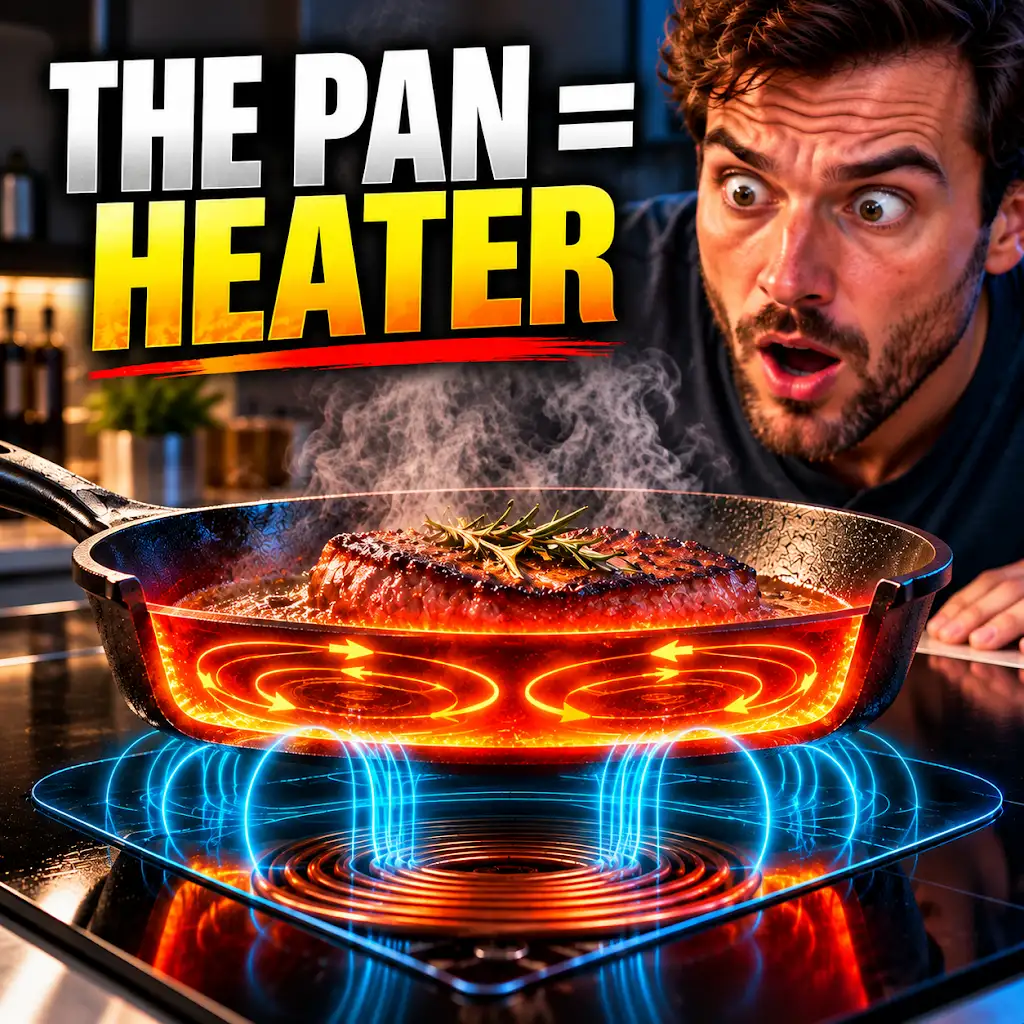
The Pan Is the Heater: How Induction Cooking Really Works
FAQs
What is an induction stove?
An induction stove is a type of cooktop that uses electromagnetic induction to heat cookware directly, without the need for a traditional heating element like gas or electric coils.
How does an induction stove work?
An induction stove generates a high-frequency electromagnetic field, which induces a current in the metal cookware placed on top of it. This current creates resistance in the cookware, generating heat to cook food.
What are the advantages of using an induction stove?
Some advantages of using an induction stove include faster heating times, precise temperature control, energy efficiency, and safety features such as automatic shut-off when cookware is removed.
Can any cookware be used on an induction stove?
Not all cookware is compatible with induction stoves. Cookware must be made of ferrous metal, such as cast iron or stainless steel, to work effectively on an induction stove.
Are there any safety concerns with using an induction stove?
While induction stoves are generally considered safe to use, there are some safety concerns to be aware of, such as the potential for burns from hot cookware and the electromagnetic fields emitted by the stove. It is important to follow manufacturer instructions and use caution when cooking on an induction stove.