
You’re standing in your kitchen, eyeing your current stove. It’s served you well, but you’ve heard whispers about these newfangled induction cooktops. Maybe you’re a seasoned cook looking to upgrade, or perhaps you’re setting up a new kitchen from scratch. The world of electric cooking offers two main contenders: the familiar electric coil or smooth-top ceramic, and the sleek, modern induction. But how do they actually work, and what’s the difference that matters when you’re trying to whip up a masterpiece (or just boil some water)? This guide is here to demystify the science behind these two popular electric cooking methods, helping you understand precisely what’s happening beneath your cookware and make the best choice for your culinary adventures.
You’ve likely grown up with, or at least used, an electric coil stove. They’re a staple in many homes, and for good reason. They’re generally robust, affordable, and straightforward to understand. But how does that red-hot coil actually transfer heat to your food?
The Principle of Resistance Heating
The magic, or rather the physics, behind your electric coil stove lies in a fundamental concept: resistance. Inside that familiar black or silver coil is a metal alloy, typically made of Nichrome, a combination of nickel and chromium. This alloy is specifically chosen for its high electrical resistance.
When you turn the knob to “high,” you’re essentially telling your stove to send a significant electrical current through this Nichrome wire. Metals are excellent conductors of electricity, meaning electrons can flow through them relatively easily. However, even the best conductors offer some degree of resistance to this flow.
Think of it like trying to push water through a pipe. If the pipe is wide and smooth, the water flows easily. If the pipe is narrow and rough, it’s harder to push the water through, and some of the energy you expend is lost as friction. In the case of electrical current, this “friction” is resistance.
As the electrical current encounters the resistance of the Nichrome wire, the energy of the moving electrons is converted into heat. This is precisely the same principle that makes a toaster glow red-hot or a space heater warm a room. The more current you push through the resistive wire, the more energy is converted into heat, and the hotter the coil becomes.
The Coil’s Physical Form and Heat Transfer
The coiled shape of the heating element isn’t just for aesthetics. It serves a practical purpose in maximizing heat transfer.
Maximizing Surface Area
The coiled design dramatically increases the surface area of the heating element compared to a straight wire of the same length. A larger surface area allows for more direct contact with the base of your pot or pan. This enhanced contact area is crucial for efficient heat transfer.
Radiant Heat Emission
As the Nichrome wire heats up, it begins to emit radiant heat. This is a form of electromagnetic radiation, much like the light you see from a lamp, but at a longer wavelength and primarily in the infrared spectrum. This radiant heat travels outwards from the coil in all directions, warming anything in its path.
Conduction Through Direct Contact
When you place a pot or pan directly on the hot coil, you establish a conductive pathway for heat. Conduction is the transfer of heat through direct physical contact. The heat energy from the coil is transferred molecule by molecule to the base of your cookware. The more intimate and consistent this contact, the more efficiently heat is conducted.
This dual mechanism – radiant heat and direct conduction – is how your electric coil stove cooks your food. The coil heats up, radiating heat and warming anything it touches.
The Control Knobs: A Simple Thermostat
The control knobs on your electric coil stove, while appearing simple, are essentially acting as basic thermostats.
Varying Resistance or Current
When you turn the knob to a lower setting, you’re not simply reducing the amount of heat the coil produces; you’re typically altering how the stove manages the electrical current. Different stove models achieve this in slightly different ways.
Some knobs might work by cycling the power on and off at a slower rate. For example, at a “medium” setting, the coil might heat up for a period, then cool down for a period, creating an average heat output. The lower the setting, the longer the “off” periods.
Other designs might employ a variable resistor in the circuit. By adjusting the resistance, the stove can limit the amount of current flowing through the heating element, thus controlling the overall heat generated.
The Lag in Response
One of the most noticeable characteristics of electric coil stoves is their slow response time. When you turn the heat up, it takes time for the coil to reach its desired temperature. Similarly, when you turn the heat down, the coil retains a significant amount of residual heat. This lag is due to the thermal mass of the coil itself – it takes time to absorb and dissipate heat. This means you need to be mindful of anticipating temperature changes, often adjusting the heat a few minutes before you want the cooking to slow down or speed up.
When considering the differences between induction stoves and electric stoves, it’s essential to understand how each technology operates. Induction stoves use electromagnetic fields to directly heat pots and pans, making them more energy-efficient and faster in cooking compared to traditional electric stoves, which rely on heating elements to warm the cookware. For a deeper dive into the mechanics and advantages of these cooking technologies, you can read a related article at Freaky Science.
The Smooth-Top Ceramic Electric Stove: Elegance Meets Resistance
The smooth-top ceramic electric stove, often referred to as a glass-ceramic cooktop, offers a more modern and aesthetically pleasing alternative to the traditional coil. While it uses the same underlying principle of resistance heating, the way the heat is delivered to your cookware is quite different.
Beneath the Surface: Radiant Heating Elements
Don’t be fooled by the smooth, uninterrupted surface. Beneath the glass-ceramic top, you’ll find hidden heating elements. These are typically made of a coiled resistance wire, similar to those on an electric coil stove, but instead of being exposed, they are housed within a radiant heat emitter.
The Radiant Heat Emitter
This emitter is often a spiral or grid-like element made of a metal alloy. When electricity flows through it, it heats up intensely, just like the electric coil. However, this element is designed to efficiently radiate its heat upwards through the glass-ceramic surface.
The glass-ceramic material itself is chosen for its unique properties. It’s incredibly durable, can withstand high temperatures, and, importantly, is a poor conductor of heat. This last point is crucial: it allows the heating element beneath to get very hot while the surface you touch (though still hot!) doesn’t reach the same scorching temperatures as an exposed coil.
How Heat Reaches Your Pan
The heat transfer process on a smooth-top ceramic stove relies primarily on two mechanisms:
Radiant Heat Transfer Through the Glass
The hot heating element beneath the surface emits radiant heat. This infrared radiation passes through the glass-ceramic. Think of it like the sun’s rays warming you on a clear day. The heat is traveling through space (or in this case, the glass).
Conduction Via the Glass Surface
When your cookware is placed on the glass surface, it directly contacts the heated glass. Heat is then conducted from the glass to the bottom of your pot or pan. Because the glass is a relatively poor conductor, it needs to become quite hot itself to transfer sufficient heat to the cookware. This is why smooth-top stoves can take a bit longer to heat up compared to coil tops, and why the surface can remain hot for a while after you turn it off.
The Importance of Flat Cookware
The effectiveness of a smooth-top ceramic stove is highly dependent on the quality of the contact between your cookware and the glass surface.
Maximizing Surface Contact
For optimal heat transfer, the bottom of your pots and pans must be perfectly flat and smooth. Any unevenness or warping will create air gaps between the cookware and the glass. These air gaps act as insulators, hindering the transfer of heat.
Consequences of Uneven Cookware
If your cookware has a warped bottom, you’ll experience hot spots and cold spots in your food. One side might burn while the other remains undercooked. This is because the areas with good contact will get hotter more quickly than the areas with poor contact. It’s a good reminder to check the flatness of your pots and pans before using them on a ceramic cooktop.
The Control System: Similar to Coils
The control knobs on a smooth-top ceramic stove function in a very similar manner to those on electric coil stoves. They regulate the amount of electricity flowing to the hidden heating elements, cycling the power on and off or varying the current to achieve different heat levels. The responsiveness is also similar, with a noticeable lag as the elements heat up and cool down.
The Induction Cooktop: A Magnetic Revolution
Now, let’s shift gears to the seemingly futuristic induction cooktop. You’ve probably seen them in high-end kitchens or heard about their lightning-fast cooking times. But the science behind induction is entirely different from its electric predecessors. It doesn’t rely on heating a metal element; instead, it directly heats your cookware through electromagnetism.
The Underlying Principle: Electromagnetic Induction
Induction cooking harnesses the power of electromagnetism. At the heart of an induction cooktop is a coil of copper wire located directly beneath the smooth glass-ceramic surface. When you turn on the cooktop, an alternating electric current is passed through this copper coil.
Generating a Magnetic Field
This alternating current creates a rapidly changing magnetic field that extends upwards from the coil. Imagine it like a wave of invisible magnetic energy emanating from the cooktop.
Eddy Currents in Cookware
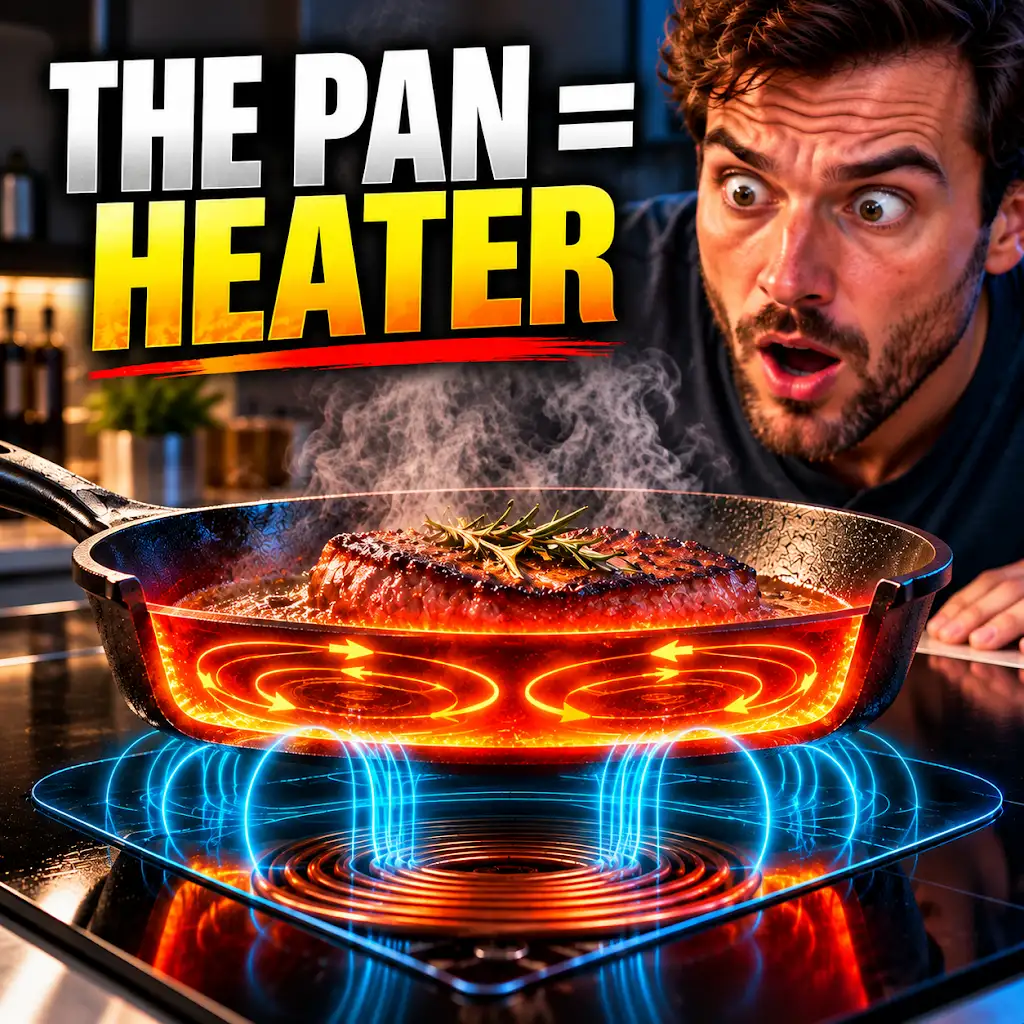
This is where your specialized cookware comes into play. For induction to work, your pots and pans must be made of a ferromagnetic material. This means they must contain iron. When the fluctuating magnetic field from the cooktop passes over the ferromagnetic base of your cookware, it induces electrical currents within the metal itself. These induced currents are called “eddy currents.”
Resistance Within the Cookware
Just like the Nichrome wire in an electric stove, the metal of your ferromagnetic cookware has electrical resistance. As these eddy currents flow through the metal, they encounter this resistance. This resistance causes the metal to heat up directly, generating heat from within the pot or pan itself.
Direct Heating of Cookware
The most significant difference between induction and other electric stoves is that induction doesn’t heat the cooktop surface. The magnetic field passes through the glass-ceramic with very little loss of energy. The heat is generated within the metal of your cookware.
Minimal Heat Loss to the Cooktop
Because the glass-ceramic surface itself isn’t the primary source of heat, it remains relatively cool during cooking. It will get warm from residual heat radiating from the cookware, but it won’t glow red-hot like an electric coil or get as intensely hot as a ceramic surface. This is a major safety advantage.
Energy Efficiency
This direct heating of the cookware makes induction incredibly energy-efficient. Nearly all the energy produced by the cooktop is transferred to the food, with very little wasted into the surrounding air or the cooktop surface. This can translate to faster cooking times and lower energy bills.
The Requirement for Magnetic Cookware
This is a crucial distinction for anyone considering an induction cooktop. Not all cookware is compatible.
Ferromagnetic Materials are Key
As mentioned, your pots and pans must be made of a ferromagnetic material. This typically means stainless steel with a magnetic core, cast iron, or enameled cast iron. Aluminum, copper, and glass cookware will not work on an induction cooktop because they are not ferromagnetic and cannot have eddy currents induced within them.
The Magnet Test
The easiest way to test if your existing cookware is induction-compatible is to hold a magnet to the bottom. If the magnet sticks firmly, your cookware should work. If it doesn’t stick, or if it barely holds on, it’s unlikely to be induction-compatible.
Control and Responsiveness: Unmatched
The responsiveness of induction cooktops is one of their most celebrated features.
Instantaneous Heat Adjustment
Because the heat is generated directly within the cookware, adjustments to the power setting translate almost instantaneously to changes in cooking temperature. Turn the dial down, and the heat in your pan drops immediately. Turn it up, and it heats up incredibly fast.
Precision Temperature Control
This near-instantaneous response allows for incredibly precise temperature control. You can go from a rolling boil to a gentle simmer with a simple adjustment, making delicate tasks like melting chocolate or poaching eggs much easier and more reliable.
Comparing the Heat Transfer Mechanisms: A Direct Versus Indirect Approach
To truly grasp the differences between these electric stove types, it’s helpful to visualize how the heat actually gets from the electricity to your food.
Electric Coil: Radiant and Conductive Heat Blob
Imagine your electric coil as a glowing ember. It’s red-hot and radiating heat outwards. When you place a pan on it, you have direct physical contact (conduction) and the heat radiating from the coil hitting the pan (radiation).
The “Hot Spot” Phenomenon
The heat distribution from a coil is often uneven. The areas of the pan directly over the hottest parts of the coil will get hotter faster. This can lead to a “hot spot” in your pan if it’s not moved around frequently. The entire coil needs to heat up, and then that heat needs to transfer through the pan. This is a slower, more indirect process of heating.
Ceramic Smooth-Top: Indirect Radiant Heat Through Glass
With a ceramic smooth-top, think of the heating element as a radiant heater hidden beneath a window. The heat passes through the glass. The glass then becomes hot and transfers that heat to your pan through conduction.
Slower Heat-Up, Residual Heat
The glass itself acts as a buffer. It takes time for the heating element to heat the glass, and then for the glass to heat the pan. This results in a slower initial heat-up compared to induction. However, the glass retains a lot of heat, meaning the cooktop can stay hot for a while after you turn it off, which can be a safety concern. The heat transfer is still largely indirect, relying on the intermediary of the glass surface.
Induction: Direct Magnetic Power to Cookware
Induction is like a direct energy beam that excites the molecules in your cookware. The electricity in the cooktop creates a magnetic field, which then creates electrical currents within the metal of your pan. These currents generate heat directly where the food is.
The Cookware is the Heater
The key takeaway here is that the cookware itself becomes the heat source. The cooktop provides the magnetic field, but the pan does the actual heating. This is why the glass surface stays relatively cool. The heat is localized to the base of your pot or pan, leading to more even and rapid heating. This is a fundamentally different and more direct approach to cooking.
When considering the differences between induction stoves and electric stoves, it’s essential to understand how each technology operates. Induction stoves use electromagnetic fields to directly heat pots and pans, making them more energy-efficient and faster in cooking. In contrast, electric stoves rely on heating elements that warm up and transfer heat to the cookware. For a deeper dive into the mechanics and benefits of these cooking methods, you can read a related article on this topic at Freaky Science. This resource provides valuable insights that can help you make an informed decision about which stove might be best for your kitchen.
Conclusion: Making Your Choice for the Perfect Heat
| Feature | Induction Stove | Electric Stove |
|---|---|---|
| Heating Method | Uses electromagnetic induction to directly heat cookware | Uses electric resistance coils to heat the cooktop surface |
| Cookware Compatibility | Requires ferromagnetic cookware (e.g., cast iron, stainless steel) | Compatible with any type of cookware |
| Heat-up Time | Very fast; heats cookware almost instantly | Slower; takes time to heat the coil and then the cookware |
| Energy Efficiency | High efficiency (~85-90%) due to direct heating | Lower efficiency (~70-75%) due to heat loss to surroundings |
| Surface Temperature | Cooktop remains relatively cool except under cookware | Cooktop surface gets very hot |
| Safety | Safer; less risk of burns and automatic shut-off features | Higher risk of burns due to hot surface |
| Control Precision | Precise and quick temperature adjustments | Slower response to temperature changes |
| Noise | May produce a humming or buzzing sound during operation | Generally silent |
| Cost | Generally higher initial cost | Generally lower initial cost |
So, you’ve navigated the science behind electric coil, ceramic smooth-top, and induction cooktops. You understand the principles of resistance heating, radiant heat, conduction, and the magnetic magic of induction. Now, how do you translate this knowledge into a decision for your own kitchen?
Considering Your Cooking Style and Needs
Your culinary habits should be the primary driver of your decision.
For the Budget-Conscious and Simplicity Seeker
If affordability and straightforward operation are your top priorities, an electric coil stove remains a solid, reliable choice. They are generally the least expensive to purchase and maintain, and their operation is incredibly intuitive. If you’re not particularly concerned with lightning-fast heating or precise temperature control for highly technical dishes, a coil top will serve you well.
For the Aesthetically Inclined and Ease of Cleaning
If you prioritize a sleek, modern look and effortless cleaning, a ceramic smooth-top is a great option. They offer a beautiful, uninterrupted surface that’s easy to wipe down. However, remember the importance of flat cookware and the slower response times. If you enjoy the look but are frustrated by the lag in temperature changes, you might find yourself wishing for something more immediate.
For the Culinary Enthusiast and Efficiency Advocate
If you’re a passionate cook who values speed, precision, and energy efficiency, induction is likely your winner. The ability to instantly control heat, the rapid cooking times, and the safety benefits of a cooler surface make it an incredibly attractive option for serious home chefs. The upfront cost and the need for specific cookware are the main considerations here, but many find the benefits far outweigh these factors.
The Practical Implications for Your Kitchen
Beyond the science, consider how each type of stove will integrate into your daily life.
Cookware Compatibility
This is a non-negotiable factor for induction. If you have a treasured collection of copper or aluminum pots, you’ll need to invest in new induction-compatible cookware. For electric coil and ceramic, most cookware will work, though flat bottoms are always best for ceramic.
Energy Consumption and Bills
Induction is demonstrably the most energy-efficient, meaning lower running costs. Electric coil and ceramic stoves are less efficient, with more energy being lost as ambient heat. Over time, this can add up.
Safety Features
The cooler surface of an induction cooktop makes it a safer option, especially in households with children or pets. While ceramic tops are safer than exposed coils, they still get very hot.
Installation and Maintenance
Generally, all electric stoves have similar installation requirements. Maintenance for coil tops is straightforward. Ceramic tops require careful cleaning to avoid scratches. Induction cooktops are generally easy to clean, but the glass surface should still be treated with care.
Ultimately, the “better” stove is the one that best fits your individual needs, budget, and cooking aspirations. By understanding how each of these electric cooking technologies works, you’re empowered to make an informed decision that will bring delicious results to your kitchen for years to come.
The Pan Is the Heater: How Induction Cooking Really Works
FAQs
What is an induction stove and how does it work?
An induction stove uses electromagnetic energy to heat pots and pans directly. When a pot made of ferrous metal is placed on the stove, the magnetic field induces a current that generates heat within the pot itself.
How does an electric stove work?
An electric stove uses heating elements, typically made of coils, to generate heat. When electricity flows through these coils, they heat up and transfer that heat to the cookware placed on top of them.
Which type of stove is more energy-efficient, induction or electric?
Induction stoves are generally more energy-efficient than electric stoves. This is because induction stoves heat the cookware directly, resulting in less heat loss compared to electric stoves that heat up the coils first.
Are there any safety concerns with using an induction stove?
Induction stoves are considered safer than electric stoves because they do not generate heat on the surface of the stove itself. The cookware needs to be magnetic for the stove to work, reducing the risk of accidental burns.
Which type of stove is faster in terms of heating up, induction or electric?
Induction stoves are faster in heating up compared to electric stoves. This is because the heat is generated directly in the cookware, leading to quicker cooking times.