
You’re standing in your kitchen, a sleek, modern countertop gleaming beneath the overhead lights. You place a pot of water on its surface, twist a dial, and within moments, steam begins to billow. It seems like magic, doesn’t it? This isn’t a riddle or a trick; this is the quiet marvel of induction cooking. You might have seen these cooktops, perhaps admired their minimalist design, but you likely haven’t delved into the “hidden science” that makes them work. It’s a world of invisible forces, precise engineering, and a fundamentally different approach to heating your food.
The Ghost in the Machine: Unveiling Electromagnetic Induction
At its core, induction cooking is a masterclass in applied physics, specifically harnessing the power of electromagnetism. You’re not directly heating the cooktop itself, which is a crucial distinction. Instead, you’re creating a dynamic, invisible field that interacts directly with your cookware. Think of it like this: the cooktop is the conductor, and your pot is the orchestra, responding to its silent commands. The magic happens thanks to a carefully orchestrated dance between electricity and magnetism.
The Coil Under the Surface
Beneath the smooth, ceramic glass surface of your induction cooktop lies a copper coil. This coil is the unsung hero, the engine that drives the entire operation. When you turn on the cooktop, an alternating electrical current flows through this copper coil. This alternating current is the key; it’s not a steady, predictable flow. Instead, it’s constantly switching direction, creating a fluctuating magnetic field.
What is Alternating Current (AC)?
You’ve probably heard of AC and DC power. DC (Direct Current) is like a river flowing steadily in one direction. AC (Alternating Current) is like a tide, constantly reversing its flow. This back-and-forth motion is precisely what’s needed to generate a changing magnetic field. The frequency of this alternation is critical for induction, typically in the range of 20 to 100 kilohertz (kHz), meaning the current flips direction tens of thousands of times per second.
The Magnetic Field: An Invisible Force
As this alternating current surges through the copper coil, it generates a rapidly changing magnetic field that emanates outwards. This field extends from the coil, passes through the ceramic glass, and reaches your cookware. You can’t see it, you can’t feel it, but it’s there, a palpable force shaping the way your food gets hot.
The Metal Interacts: Faraday’s Law in Action
Now, this is where the magic truly begins to unfold, and it’s all thanks to a fundamental principle in physics known as Faraday’s Law of Electromagnetic Induction. This law states that a changing magnetic field will induce an electric current in a nearby conductor. And what is your cookware, if not a conductor?
The Crucial Role of Ferrous Metals
This is the reason why not all pots and pans will work on an induction cooktop. The cookware must contain ferrous metals – metals that are magnetic. Think cast iron, certain types of stainless steel, and enameled cast iron. When these ferrous metals are placed within the fluctuating magnetic field generated by the cooktop’s coil, the changing magnetic field causes electrons within the metal to move. This movement of electrons is precisely what constitutes an electric current, known as eddy currents.
Eddy Currents: The True Heaters
These eddy currents don’t just appear; they flow in swirling patterns within the base of your cookware. And here’s the critical part: as these currents flow through the metal, they encounter electrical resistance. This resistance converts the electrical energy of the eddy currents into heat. It’s not the cooktop getting hot; it’s the cookware itself, generating its own heat directly where it’s needed – at the point of contact with your food.
Hysteresis: A Little Extra Heat
There’s another, albeit smaller, contribution to the heat generated in some magnetic cookware, and that’s hysteresis. In certain ferromagnetic materials, the rapid alternating magnetic field causes the magnetic domains within the material to repeatedly align and misalign. This process also generates a small amount of heat, further contributing to the overall temperature of the cookware.
Induction cooking is a fascinating topic that combines culinary art with cutting-edge technology, revealing the hidden science behind its efficiency and precision. For those interested in exploring this subject further, a related article can be found at Freaky Science, which delves into the principles of electromagnetic induction and how they revolutionize the way we cook. This resource provides valuable insights into the benefits of induction cooking, making it a must-read for anyone looking to enhance their kitchen experience.
The Precision of Power: How Induction Controls Temperature
One of the most lauded benefits of induction cooking is its incredible precision in temperature control. You can go from a gentle simmer to a rolling boil in mere seconds, and maintain that temperature with remarkable accuracy. This isn’t by chance; it’s a direct consequence of the underlying science.
Direct Heat Transfer: No Wasted Energy
Unlike traditional electric or gas cooktops, where heat is generated by a resistive element or a flame and then transferred to the cookware through conduction and radiation, induction cooking bypasses these intermediary steps. The heat is generated within the cookware itself. This means there’s virtually no wasted energy heating the surrounding air or the cooktop surface.
Efficiency Ratings Speak Volumes
This direct energy transfer is why induction cooktops are so incredibly efficient. They boast energy efficiency ratings often exceeding 85-90%, compared to around 70% for electric coil cooktops and about 40% for gas. You’re essentially directing the energy precisely where it needs to go, leading to faster cooking times and lower energy bills.
The Role of the Cooktop’s Electronics
The control you experience isn’t just about the magnetic field; it’s also about the sophisticated electronics embedded within your induction cooktop. These electronics constantly monitor the power output and adjust it based on your settings.
Variable Power Settings Explained
When you select a specific power level – say, “medium-high” – you’re not just setting a knob. You’re instructing the electronics to regulate the flow of alternating current to the copper coil, thereby controlling the intensity of the magnetic field and, consequently, the rate at which eddy currents are generated in your cookware. This allows for incredibly fine-tuned heat adjustments.
The Feedback Loop: Sensing and Adjusting
Many modern induction cooktops incorporate temperature sensors that work in conjunction with the electronics. These sensors can monitor the temperature of the cookware directly. If the cookware starts to overheat or cool down too rapidly, the electronics can instantaneously adjust the power output to maintain your desired temperature. This creates a sophisticated feedback loop, ensuring consistent and precise cooking.
Safety First: A Cooler Cooktop and a Safer Kitchen
You’ve probably noticed that the surface of an induction cooktop remains relatively cool to the touch, even while you’re actively cooking. This is another significant advantage, born directly from its scientific
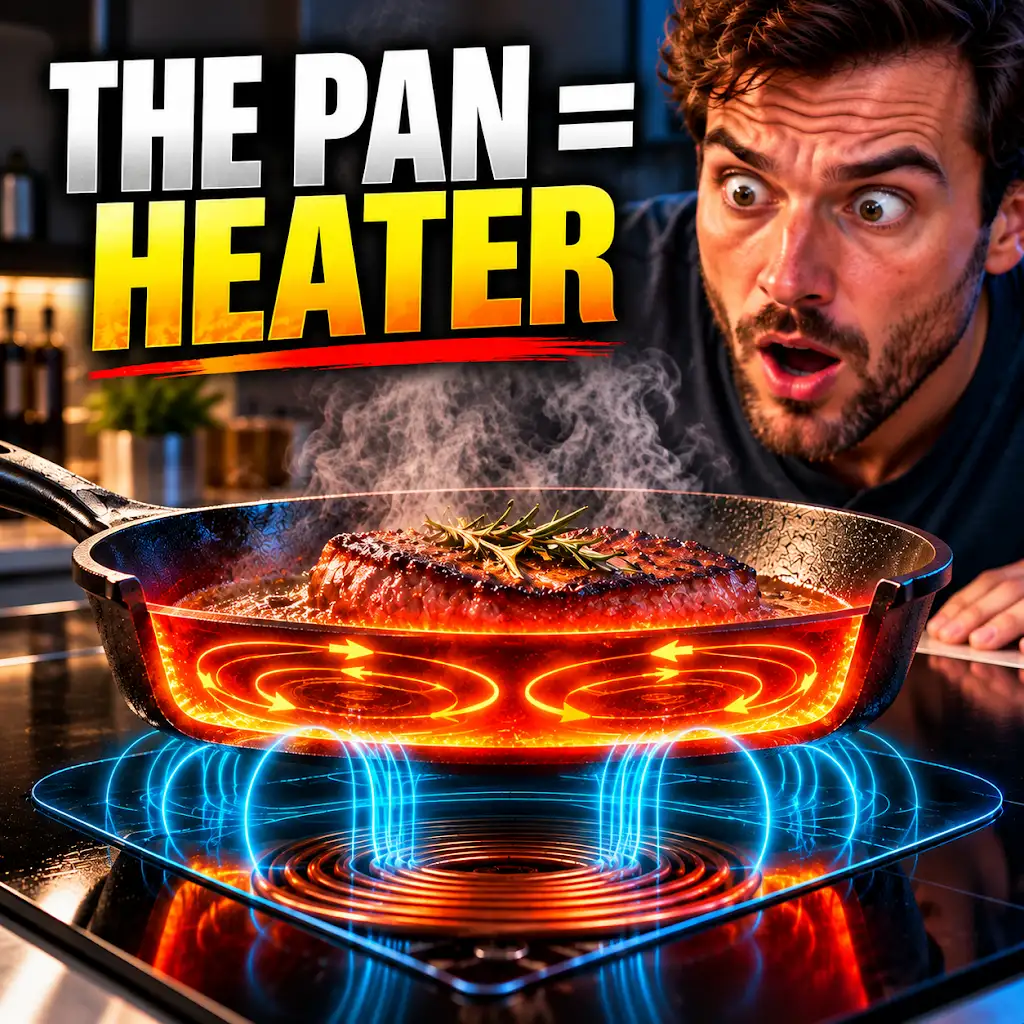
The Pan Is the Heater: How Induction Cooking Really Works
FAQs

What is induction cooking?
Induction cooking is a method of cooking that uses electromagnetic energy to heat cookware directly, without the need for a traditional heating element like a gas flame or electric coil.
How does induction cooking work?
Induction cooking works by creating a magnetic field between the cooktop and the cookware. This magnetic field induces electrical currents in the cookware, which generates heat and cooks the food inside the cookware.
What are the advantages of induction cooking?
Some advantages of induction cooking include faster heating times, precise temperature control, energy efficiency, and a cooler cooking surface compared to traditional gas or electric stoves.
Are there any safety concerns with induction cooking?
Induction cooking is generally considered safe, as the cooktop itself does not get hot during cooking. However, it is important to be cautious when using induction cookware, as the cookware can become very hot and cause burns if not handled properly.
Is induction cooking more environmentally friendly than traditional cooking methods?
Induction cooking is considered more environmentally friendly than traditional cooking methods like gas or electric stoves, as it is more energy efficient and produces less waste heat. Additionally, induction cooking does not produce any emissions or pollutants during use.