The tantalizing prospect of objects defying the fundamental force of gravity has long captivated the human imagination. For centuries, the idea of items floating weightlessly, seemingly by their own volition, has been relegated to the realm of fantasy and myth. However, as scientific understanding and technological capabilities advance, the line between the impossible and the achievable continues to blur. Modern physics, while still grappling with the ultimate nature of gravity, offers compelling explanations and avenues for achieving levitation, moving it from the realm of magic to the cutting edge of scientific endeavor. This exploration delves into the principles, methods, and implications of levitating objects, revealing a world where gravity’s grip can indeed be loosened, and sometimes, even broken.
Gravity, a force that governs the motion of celestial bodies and keeps our feet firmly planted on the ground, has been a subject of intense study and philosophical debate throughout history. Isaac Newton’s law of universal gravitation provided a groundbreaking framework, describing gravity as a force of attraction between any two objects with mass. Albert Einstein’s theory of general relativity later revolutionized our understanding, portraying gravity not as a force, but as a curvature of spacetime caused by the presence of mass and energy. Despite these monumental advances, the fundamental nature of gravity, particularly its quantum mechanical underpinnings, remains one of the biggest mysteries in physics.
Newton’s Gravitational Paradigm
Newton’s formulation, published in 1687, posited that the force of gravity between two objects is directly proportional to the product of their masses and inversely proportional to the square of the distance between their centers. This elegant equation, F = G (m1 m2) / r², allowed for remarkably accurate predictions of planetary orbits and terrestrial phenomena. It became the bedrock of classical physics, explaining why apples fall from trees and why the moon orbits the Earth. However, Newton’s theory did not explain why gravity exists or how it propagates. It was a descriptive model, not an explanatory one at its core. The concept of “action at a distance” – the idea that objects could influence each other across empty space without any physical medium – was a point of philosophical unease, even for Newton himself.
Einstein’s Spacetime Revolution
Einstein’s general relativity, introduced in 1915, offered a profound shift in perspective. Instead of a force, gravity is the manifestation of mass and energy warping the fabric of spacetime. Imagine placing a heavy ball on a stretched rubber sheet; it creates a dip. Smaller objects rolling nearby will be drawn towards the heavier ball, not because of a direct pull, but because they are following the curvature of the sheet. This analogy, while simplistic, captures the essence of general relativity. This new understanding explained phenomena that Newtonian gravity could not, such as the anomalous precession of Mercury’s orbit and the bending of starlight by massive objects. While a more accurate description of gravity, general relativity still faces challenges, particularly when trying to reconcile it with quantum mechanics, the theory that governs the subatomic world. The quest for a unified theory of everything, which would encompass both gravity and quantum mechanics, is ongoing.
The Challenge of Counteracting Gravity
The very essence of gravity is its attractive nature. To levitate an object means to counteract this constant downward pull. This requires an opposing force of equal or greater magnitude, acting in the opposite direction. For a long time, the only readily available means to achieve this was through mechanical means – building structures that lifted objects, or using buoyant forces in fluids. However, the dream of levitation often implied a more direct and perhaps elegant means of overcoming gravity, one that didn’t rely on bulky support systems. This pursuit has driven scientists to explore a diverse range of physical phenomena that can generate repulsive forces or manipulate the very fabric of existence.
In the realm of physics, one particularly intriguing article explores the concept of time travel, a topic that often seems impossible yet captivates the imagination. This article delves into the theoretical frameworks proposed by physicists, examining the potential of wormholes and the implications of Einstein’s theory of relativity. For those interested in the fascinating intersection of science and speculation, you can read more about this mind-bending subject in the article available at Freaky Science.
Electromagnetic Levitation: Harnessing the Power of Fields
One of the most successful and widely implemented methods of achieving levitation relies on the principles of electromagnetism. By carefully manipulating magnetic fields, it is possible to create forces strong enough to counteract gravity. This approach has found applications ranging from high-speed trains to scientific research.
Diamagnetic Levitation: The Power of Repulsion
Diamagnetism is a property exhibited by all materials, though it is often very weak. In diamagnetic materials, an external magnetic field induces a magnetization in the opposite direction to the applied field. This creates a repulsive force. While the diamagnetic effect is generally feeble, it is strong enough to levitate small, lightweight diamagnetic objects above powerful magnets.
The Meissner Effect in Superconductors
Superconductors are materials that, when cooled below a critical temperature, exhibit zero electrical resistance and expel magnetic fields from their interior. This phenomenon, known as the Meissner effect, is a powerful form of diamagnetism. When a superconductor is placed above a magnet, it expels the magnetic field lines, and in turn, the magnet exerts an upward repulsive force on the superconductor, causing it to levitate. This is a spectacular demonstration of levitation and has been a significant area of research, with potential applications in frictionless bearings and magnetic suspension systems. The ability of a superconductor to stably levitate above a magnet, with its position precisely controlled by the magnetic field, is a testament to the strength of electromagnetic forces.
Levitation of Everyday Diamagnetic Materials
While superconductors are the most dramatic examples, even everyday diamagnetic materials like water, graphite, and bismuth can be levitated under specific conditions. The diamagnetic susceptibility of these materials is low, meaning the repulsive force is weak. To achieve levitation, exceptionally strong magnetic fields are required. Researchers have successfully levitated small samples of graphite and even live frogs (for scientific study) using powerful superconducting magnets. The forces involved, though seemingly small on a macroscopic scale, are sufficient to overcome the gravitational pull on these tiny specimens. This highlights the potential of diamagnetic levitation for delicate experiments where physical contact could interfere with results.
Electromagnetic Suspension (EMS) and Electromagnetic Propulsion (EMP)
Electromagnetic Suspension (EMS) and Electromagnetic Propulsion (EMP) are two closely related technologies that underpin magnetic levitation systems, most notably in maglev trains. These systems utilize powerful electromagnets to generate the necessary forces.
The Principles of Magnetic Bearing
In EMS systems, electromagnets on the vehicle are attracted to a ferromagnetic guideway. Sensors constantly monitor the gap between the vehicle and the guideway, and the current to the electromagnets is adjusted to maintain a stable, contactless gap, effectively suspending the vehicle. This creates a frictionless bearing, allowing for extremely high speeds. EMP systems, on the other hand, often use linear motor principles. Coils along the track interact with magnets on the vehicle, generating thrust that propels it forward while simultaneously contributing to levitation. The precise control of these electromagnetic forces is crucial for maintaining stability and preventing collisions.
Applications in Maglev Trains and Beyond
Maglev trains are the most prominent application of electromagnetic levitation. By eliminating friction with the rails, these trains can achieve speeds far exceeding those of conventional trains, offering a glimpse into the future of high-speed transportation. Beyond trains, electromagnetic levitation finds applications in:
- Frictionless Bearings: For high-speed rotating machinery where reducing wear and tear is critical.
- Vibration Isolation: Suspending sensitive equipment from external vibrations.
- Material Handling: Moving delicate or heavy objects without physical contact.
- Scientific Experiments: Creating controlled environments for research, such as in particle accelerators.
The ability to precisely control magnetic fields allows for intricate manipulation of objects, opening up a vast array of technological possibilities.
Acoustic Levitation: Sound Waves as a Lifting Force
Acoustic levitation harnesses the power of sound waves to counteract gravity. By using precisely controlled sound fields, it is possible to create points of high and low pressure that can trap and suspend small objects. This method offers a unique, non-contact way to manipulate matter.
The Physics of Acoustic Radiation Pressure
Sound waves, though invisible, carry energy and exert pressure. When sound waves are reflected and interfere with each other, they can create standing waves – patterns of nodes (points of minimum pressure) and antinodes (points of maximum pressure). Acoustic levitation utilizes the principle of acoustic radiation pressure, which is the force exerted by sound waves on an object. In a standing wave, objects can be trapped at the pressure nodes, where the opposing forces from the surrounding sound field balance each other and gravity.
Creating Standing Waves with Transducers
To create these standing waves, acoustic levitators typically employ an array of ultrasonic transducers. These devices emit sound waves at frequencies above the range of human hearing. By carefully controlling the phase and amplitude of the sound waves emitted by each transducer, complex sound fields can be generated. When these waves encounter a surface or another set of transducers, they interfere, forming the necessary standing wave patterns. The precise arrangement and control of these transducers are key to achieving stable levitation.
Manipulating Objects with Sound
Once an object is trapped at a pressure node, it can be manipulated by moving the nodes themselves. By dynamically altering the sound field, researchers can move the levitated object in three dimensions, rotate it, or even assemble it with other levitated objects. This makes acoustic levitation a powerful tool for manipulating small, delicate items without any physical contact, which is crucial in fields like microassembly and pharmaceutical research. The ability to precisely steer objects with sound is a remarkable feat of acoustic engineering.
Applications of Acoustic Levitation
Acoustic levitation offers a unique, contactless method for manipulating matter, leading to a variety of intriguing applications:
Pharmaceutical and Medical Applications
- Drug Delivery Research: Studying the behavior of drug particles in controlled, contactless environments.
- Bioprinting: Precisely positioning biological cells and materials for tissue engineering.
- Sterile Manipulation: Handling delicate biological samples without contamination.
- Protein Crystallization: Growing high-quality protein crystals for structural analysis without the interference of a solid support.
Materials Science and Manufacturing
- Microassembly: Assembling miniature components with high precision.
- 3D Printing with Granular Materials: Creating complex structures from powders without binders.
- Studying Material Properties: Investigating the behavior of materials under controlled, non-contact conditions.
Consumer and Entertainment Uses
While still largely in the research phase for consumer applications, the spectacle of levitating objects has undeniable appeal. Future applications might include:
- Novel Displays: Creating floating visual effects.
- Interactive Art Installations: Engaging audiences with dynamic, levitating sculptures.
- Hands-free Devices: Imagine a future where small devices can be controlled and positioned purely by sound.
The gentle yet powerful nature of acoustic levitation makes it ideal for handling sensitive materials and for research that requires the complete absence of physical interaction.
Optical Levitation: Using Light to Trap Particles
Optical levitation, also known as optical trapping or optical tweezers, utilizes the force exerted by focused laser beams to trap and manipulate microscopic particles. This technology has revolutionized fields like cell biology and nanotechnology.
The Principles of Light Pressure
Light, despite being massless, carries momentum and can exert a force. This phenomenon, known as light pressure, arises from the interaction of photons with matter. When photons are absorbed or scattered by a particle, they transfer momentum to it. In optical tweezers, tightly focused laser beams create gradients in light intensity. Particles are then drawn towards regions of highest light intensity due to the forces exerted by the light.
Gradient Force and Scattering Force
Two primary forces are at play in optical tweezers: the gradient force and the scattering force. The gradient force, arising from the intensity gradient of the laser beam, pulls the particle towards the point of highest intensity. The scattering force, on the other hand, pushes the particle in the direction of the laser beam. By carefully shaping the laser beam and controlling its intensity, the gradient force can be made to dominate, effectively trapping the particle. Think of it like trying to hold a tiny ball in a dimple created by a bright light – the light’s intensity pulls it into the dimple.
Manipulating Microscopic Particles
Once trapped, optical tweezers allow for exquisite control over microscopic objects. The laser beam can be moved, enabling researchers to precisely position and move trapped particles. This has opened up unprecedented possibilities for studying individual cells, manipulating DNA strands, and assembling nanostructures. The precision with which light can be focused and controlled allows for manipulation at the single-molecule or even single-atom level.
Applications of Optical Levitation
Optical levitation has become an indispensable tool in numerous scientific disciplines:
Advancements in Biology and Medicine
- Single-Cell Analysis: Studying the physical properties and behavior of individual cells, such as their elasticity and motility.
- DNA and Protein Manipulation: Stretching and manipulating individual molecules to study their structure and function.
- Cell Sorting and Separation: Isolating specific cell types for research or therapeutic purposes.
- Drug Discovery: Screening potential drug compounds by observing their interaction with individual cells or molecules.
Nanotechnology and Materials Science
- Nanoparticle Assembly: Precisely arranging nanoparticles to create novel materials with tailored properties.
- Fabrication of Microdevices: Assembling miniature components for microelectromechanical systems (MEMS).
- Studying Quantum Phenomena: Manipulating and studying the quantum behavior of atoms and other quantum systems.
Fundamental Physics Research
- Testing Theories of Light-Matter Interaction: Investigating the fundamental principles of how light interacts with matter.
- Creating and Studying Exotic States of Matter: Manipulating atoms at extremely low temperatures to create Bose-Einstein condensates and other quantum states.
The ability of light to exert force, seemingly a gentle phenomenon, is leveraged in optical tweezers to perform incredibly precise and delicate manipulations, pushing the boundaries of scientific understanding and technological innovation.
In the fascinating realm of physics, the concept of time travel often seems like a mere fantasy, yet intriguing theories continue to emerge. One such theory proposes the existence of wormholes as potential shortcuts through spacetime, challenging our understanding of the universe. For those curious about the implications of these ideas, you can explore a related article that delves deeper into the science behind these extraordinary concepts. Check it out here to discover more about the possibilities that lie beyond our current comprehension.
Gravitational Anomalies and Future Possibilities: Beyond Current Understanding
| Phenomenon | Description | Key Metric | Why It Seems Impossible |
|---|---|---|---|
| Quantum Entanglement | Particles remain connected so that the state of one instantly influences the other, regardless of distance. | Spooky action at a distance occurs faster than the speed of light | Violates classical ideas of locality and causality |
| Time Dilation (Relativity) | Time passes slower for objects moving close to the speed of light compared to stationary observers. | At 99.9% speed of light, time slows by a factor of ~22.4 | Contradicts everyday experience of absolute time |
| Superconductivity | Certain materials conduct electricity with zero resistance below a critical temperature. | Resistance drops to 0 Ω below ~10 K (varies by material) | Defies classical electrical resistance expectations |
| Wave-Particle Duality | Particles like electrons exhibit both wave-like and particle-like properties. | Electron interference pattern observed in double-slit experiment | Contradicts classical physics categorization of matter |
| Negative Absolute Temperature | Systems can have temperatures below zero on the Kelvin scale in certain quantum states. | Negative temperature states achieved in spin systems | Temperature below absolute zero seems thermodynamically impossible |
While electromagnetic, acoustic, and optical levitation offer impressive demonstrations of overcoming gravity, they all rely on generating opposing forces through known physical interactions. The ultimate dream of levitation, however, often involves directly manipulating or neutralizing gravity itself. This area remains largely theoretical and speculative, touching upon the frontiers of physics.
Theoretical Concepts of Gravity Manipulation
Scientists and science fiction enthusiasts have long pondered whether gravity could be directly controlled. This often involves exploring exotic physics beyond our current understanding.
Exploiting Exotic Matter and Energy
Some theoretical frameworks suggest that certain types of exotic matter or energy, such as negative mass or negative energy density, could exert repulsive gravitational effects. If such matter could be found or created, it might offer a path to true gravitational repulsion, allowing for levitation without the need for external forces. However, the existence and properties of such matter are highly speculative and have not been experimentally confirmed.
Manipulating Spacetime Curvature
General relativity describes gravity as the curvature of spacetime. If it were possible to actively manipulate this curvature, one could theoretically create regions of reduced or even reversed gravitational pull. This is a highly complex and currently unachievable proposition, requiring an immense understanding and control over the fundamental structure of the universe. Concepts like warp drives in science fiction are imaginative explorations of this idea.
The Search for a Unified Theory of Gravity and Quantum Mechanics
The quest for a “theory of everything” that unifies gravity with the other fundamental forces of nature (electromagnetism, the weak nuclear force, and the strong nuclear force) is a central goal of modern physics. Such a theory could potentially unlock new insights into the nature of gravity and perhaps reveal novel ways to interact with it.
Quantum Gravity and its Implications
Understanding quantum gravity could lead to a deeper comprehension of phenomena like black holes and the early universe. It might also reveal mechanisms for manipulating gravity at the quantum level, which could have profound implications for technology, including levitation. However, developing and experimentally verifying a theory of quantum gravity is an enormous challenge.
Unforeseen Discoveries and the Future of Levitation
The history of science is replete with examples of unexpected discoveries that have fundamentally altered our understanding of the world. It is entirely possible that future breakthroughs in physics will uncover phenomena that allow for direct and efficient gravitational manipulation, leading to forms of levitation far beyond what we can currently conceive. The ongoing exploration of dark matter and dark energy, for instance, could reveal entirely new forces or interactions that could be harnessed.
Conclusion: A Glimpse into a Gravity-Defying Future
Levitating objects, once the stuff of magic and fantasy, are increasingly becoming a reality through the ingenious application of scientific principles. From the powerful forces of electromagnetism to the subtle pressures of sound and light, humanity is finding ever more sophisticated ways to defy gravity. Electromagnetic levitation powers our fastest trains, acoustic levitation enables contactless manipulation of delicate materials, and optical tweezers allow us to explore the microscopic world with unprecedented precision.
While these methods rely on generating opposing forces, the ultimate frontier lies in directly understanding and manipulating gravity itself. The ongoing pursuit of a unified theory of physics holds the promise of unlocking deeper secrets about the universe, potentially leading to technologies that can truly counteract gravity. As our scientific understanding expands and our technological capabilities evolve, the concept of levitating objects will continue to push the boundaries of what we deem possible, offering a tantalizing glimpse into a future where gravity’s reign might not be as absolute as it once seemed. The journey from ancient myths to practical applications is a testament to human curiosity, ingenuity, and the relentless pursuit of knowledge.
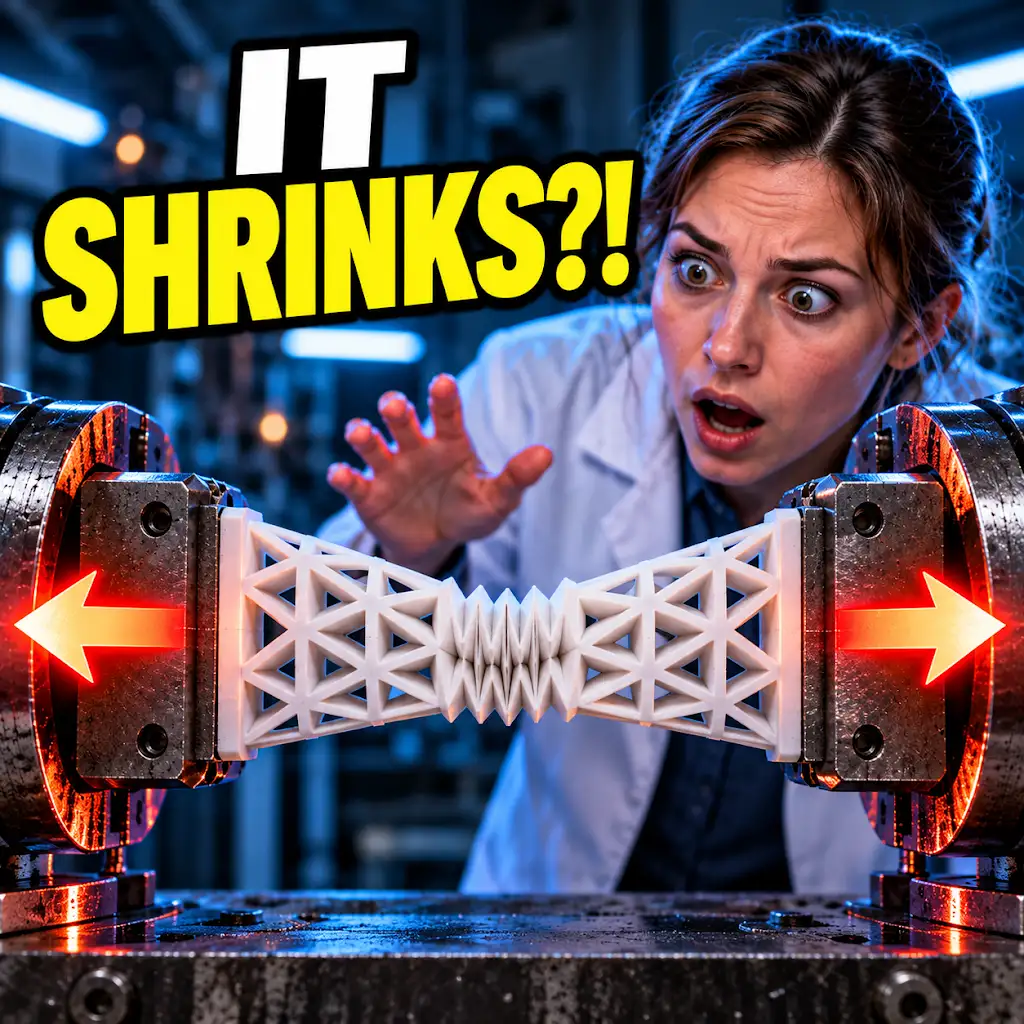
Pull Harder… and This Material Suddenly Gets Shorter
FAQs
What is the article “Physics that looks impossible” about?
The article discusses various physics phenomena that may seem impossible or counterintuitive at first glance, but can be explained through scientific principles.
Can you provide examples of physics phenomena that look impossible?
Examples of physics phenomena that may appear impossible include quantum entanglement, the double-slit experiment, time dilation in special relativity, and the concept of Schrödinger’s cat in quantum mechanics.
How do scientists explain these seemingly impossible physics phenomena?
Scientists use mathematical models, experimental evidence, and theoretical frameworks to explain these phenomena. For example, quantum entanglement is explained through the concept of non-locality, while the double-slit experiment demonstrates the wave-particle duality of light.
Why is it important to study physics phenomena that look impossible?
Studying these phenomena challenges our understanding of the natural world and pushes the boundaries of scientific knowledge. It also leads to the development of new technologies and advancements in various fields.
Are there any real-world applications of these seemingly impossible physics phenomena?
Yes, many of these phenomena have practical applications in areas such as quantum computing, cryptography, and medical imaging. Understanding and harnessing these phenomena can lead to groundbreaking innovations in technology and science.