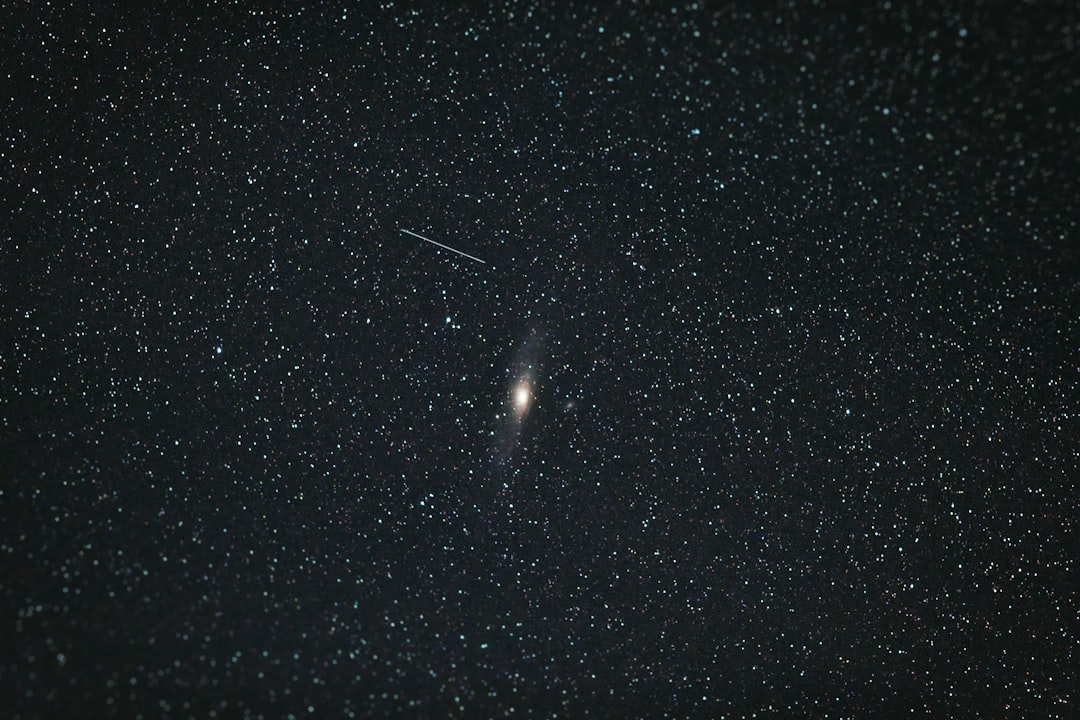
The night sky, a canvas often dominated by the brilliant brushstrokes of familiar constellations and the sharp pinpricks of individual stars, harbors a more subtle grandeur for those willing to look closer. Among these celestial wonders, the Andromeda Galaxy, Messier 31, stands as a testament to this understated beauty. Its glow, often described as muted, offers a different kind of awe, one that whispers of vast distances and the quiet power of cosmic structures. To truly marvel at Andromeda’s muted glow is to embark on a journey of perception, of understanding the faint luminescence that has traversed unimaginable gulfs of space to reach our eyes.
Andromeda, visible to the naked eye under dark skies, presents itself not as a blinding beacon, but as a delicate smudge, a ghostly presence against the velvet backdrop of night. This muted glow is a crucial clue to its nature and its immense distance. Unlike the sharp, individual lights of stars within our own galaxy, Andromeda’s faintness is a direct consequence of its extragalactic origin. It is the combined light of billions of stars, an entire galaxy, diluted by the staggering expanse of the universe.
Understanding Stellar Luminosity
The light we perceive from celestial objects is a direct measure of their intrinsic brightness, or luminosity, and their distance from us. Stars within our Milky Way galaxy are relatively close, their light reaching us with a considerable intensity, allowing us to distinguish their individual brilliance. For instance, Sirius, the brightest star in our night sky, is a mere 8.6 light-years away. This proximity ensures its potent radiance.
The Immensity of Intergalactic Space
In stark contrast, Andromeda resides approximately 2.537 million light-years away. This unfathomable distance means that the light we see tonight began its journey when early hominids were just beginning to master the use of tools. The light has been traveling, unimpeded by anything substantial, across a void so vast that our terrestrial imaginations struggle to grasp it. This immense journey naturally attenuates the light emitted by Andromeda’s constituent stars.
The Collective Glow of Billions
The muted nature of Andromeda’s glow is not a sign of weakness, but rather a testament to the sheer number of stars it contains. Within its spiral arms and central bulge, an estimated one trillion stars burn and twinkle. Each of these stars emits its own light, but the light from each individual star is too faint to be resolved by the naked eye at Andromeda’s distance. Instead, our eyes perceive the combined, averaged light of this vast stellar population, resulting in the characteristic hazy, diffuse glow. It’s akin to observing a distant city at night; you don’t see individual streetlights, but rather the collective luminescence of a vast urban sprawl.
The Andromeda Galaxy, our nearest spiral galaxy neighbor, presents a stunning view to the human eye, especially under dark skies where its faint glow can be observed as a smudge of light. For those interested in learning more about the visual wonders of the universe, including detailed descriptions and images of Andromeda, I recommend checking out this related article on Freaky Science. You can explore more about the galaxy’s appearance and its significance in astronomy by visiting Freaky Science.
Unveiling Andromeda’s Structure: A Celestial Spectacle
While its naked-eye appearance is subtle, binoculars and telescopes reveal the more intricate beauty of Andromeda. These instruments allow us to perceive beyond the faint haze and begin to discern the galaxy’s majestic structure, showcasing the diversity of its stellar populations and the grand design of its spiral arms.
The Distinctive Spiral Arms
The most striking feature of Andromeda, even in its fainter form, is its spiral structure. Through a telescope, these arms become more apparent, swirling outwards from a bright central nucleus. These arms are not mere static formations but dynamic regions, teeming with newly born stars, nebulae, and star clusters. The dust and gas within these arms, though contributing to the overall muted glow by scattering and absorbing light, are also the cradles of future stellar generations.
Star-Forming Regions
Within the spiral arms lie pockets of intense stellar activity. These are the nurseries where vast clouds of gas and dust collapse under their own gravity, igniting nuclear fusion and giving birth to new stars. These regions often appear as brighter knots or patches within the arms, hinting at the ongoing cosmic creation processes. The light from these young, hot stars, though still diminished by distance, adds vibrancy to the otherwise diffuse glow.
Stellar Populations
Andromeda, like our own Milky Way, comprises stars of various ages and types. The spiral arms are generally populated by younger, bluer stars, which are hotter and more luminous. The central bulge, on the other hand, tends to harbor older, redder stars. This difference in stellar populations contributes to the subtle variations in brightness and color across the face of the galaxy, creating a more complex and nuanced visual experience for the observer.
The Central Bulge: A Dense Core of Ancient Light
At the heart of Andromeda lies its central bulge, a spheroidal concentration of stars. This region is incredibly dense, packed with older, cooler stars that have long since exhausted their primary hydrogen fuel. The light from this bulge, though also dimmed by distance, contributes significantly to Andromeda’s overall luminosity and gives it a concentrated brightness at its core. It’s here that the galaxy’s gravitational heart beats strongest.
Gravitational Dominance
The central bulge is the gravitational anchor of the galaxy. The immense mass concentrated within this region dictates the orbital paths of stars and gas throughout Andromeda, including those in the spiral arms. This gravitational influence is a key factor in maintaining the galaxy’s structural integrity over cosmic timescales.
Age and Stellar Evolution
The stars in the bulge have lived much longer, more stable lives than those in the spiral arms. Their light, though redder and less energetic per star, collectively forms a significant luminous mass. Studying the stellar populations within the bulge provides astronomers with insights into the early history and evolution of Andromeda.
Companion Galaxies: Andromeda’s Celestial Entourage
Andromeda is not alone in its cosmic journey. It is surrounded by a retinue of smaller companion galaxies, gravitational satellites that orbit the larger spiral. These smaller galaxies, such as M32 and M110, are often visible in the same telescopic field of view and add another layer of complexity and fascination to the Andromeda system.
M32: A Compact Elliptical Neighbor
M32 is a small, compact elliptical galaxy that orbits Andromeda closely. It appears as a bright, fuzzy patch near the main galaxy’s nucleus. Its high surface brightness suggests a dense concentration of stars. Astronomers believe that M32 might be the remnant core of a larger galaxy that has been tidally disrupted by Andromeda’s gravitational pull.
M110: A Faint Dwarf Irregular
M110 is a dwarf irregular galaxy, appearing as a more diffuse and elongated smudge. It is fainter than M32 and is located further from Andromeda’s core. Its irregular shape suggests a history of interactions and gravitational disturbances, perhaps from Andromeda itself or other members of the Local Group. The presence of these companions underscores the dynamic nature of galactic evolution and the complex gravitational dance of the universe.
The Science Behind the Muted Glow: Distance and Light
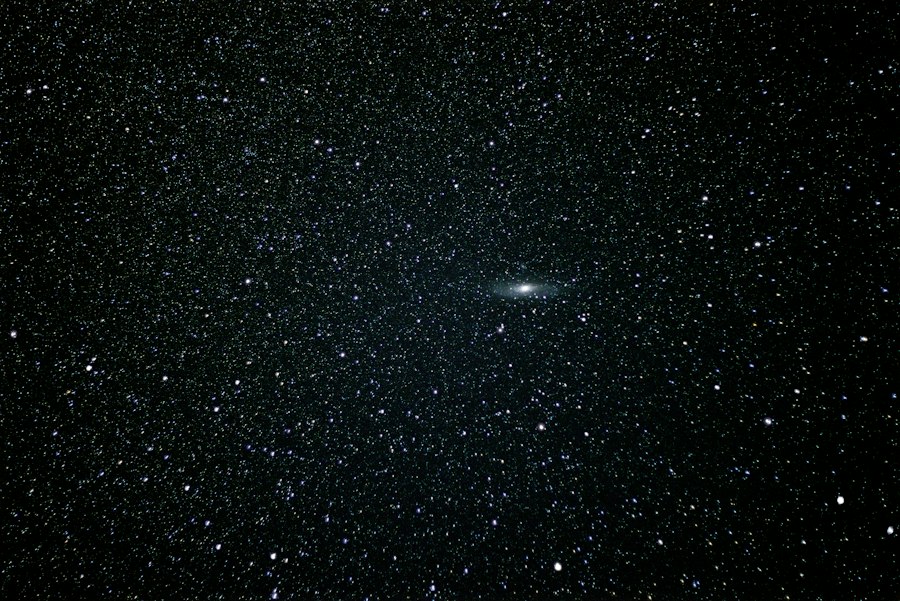
The muted nature of Andromeda’s glow is not merely an aesthetic observation; it is a fundamental indicator of its immense distance and the physics of light. Understanding this relationship is key to appreciating the scientific significance of this celestial neighbor.
The Inverse Square Law of Light
The intensity of light decreases with the square of the distance from its source. This fundamental principle of physics, known as the inverse square law, is directly responsible for the faintness of distant objects. For every doubling of distance, the apparent brightness of an object decreases by a factor of four. Given Andromeda’s distance of over 2.5 million light-years, the light from its individual stars is spread over an enormous area by the time it reaches Earth, resulting in a drastically reduced intensity.
Applying the Law to Celestial Distances
Imagine a light bulb. If you are one meter away, it appears quite bright. If you move to two meters, it appears four times dimmer. If you move to ten meters, it appears one hundred times dimmer. Now, scale this up to millions of light-years, and the dimming effect becomes astronomical. The light from Andromeda’s stars, even though individually bright within their own context, is so attenuated by the vastness of space that it registers as a subtle glow to our eyes.
The Role of Intervening Dust and Gas
While space is largely a vacuum, it is not entirely empty. Throughout the intergalactic medium, there are diffuse clouds of dust and gas. These particles can absorb and scatter the light traveling from distant galaxies, further dimming their appearance. While the Milky Way’s own dust can obscure our view of distant objects, the intergalactic dust and gas also play a role in modulating the light from galaxies like Andromeda.
Cosmic Obscuration
The path between our galaxy and Andromeda is not a perfectly clear channel. Even though these intergalactic clouds are very tenuous compared to those within galaxies, over millions of light-years, they can have a cumulative effect on the light that reaches us. This cosmic obscuration, though subtle, contributes to the overall muted presentation of Andromeda.
The Redshift of Andromeda
A crucial piece of evidence for Andromeda’s distance and its movement relative to us comes from the phenomenon of redshift. As light from distant galaxies travels towards us, the expansion of the universe stretches the wavelengths of this light, shifting it towards the red end of the spectrum.
Doppler Effect in Cosmology
This cosmological redshift is a manifestation of the Doppler effect applied to the expansion of spacetime itself. Because Andromeda is receding from us (albeit slowly, as it is gravitationally bound to us in the Local Group), its light is redshifted. While this redshift doesn’t directly contribute to its muted visual glow in the everyday sense, it’s a fundamental property of the light we receive that is intrinsically linked to its distance and the universe’s expansion, thereby reinforcing the understanding of why its light is so faint and spread out. The fainter, redshifted light is a signature of its immense journey.
Observing Andromeda’s Muted Glow: Tools and Techniques
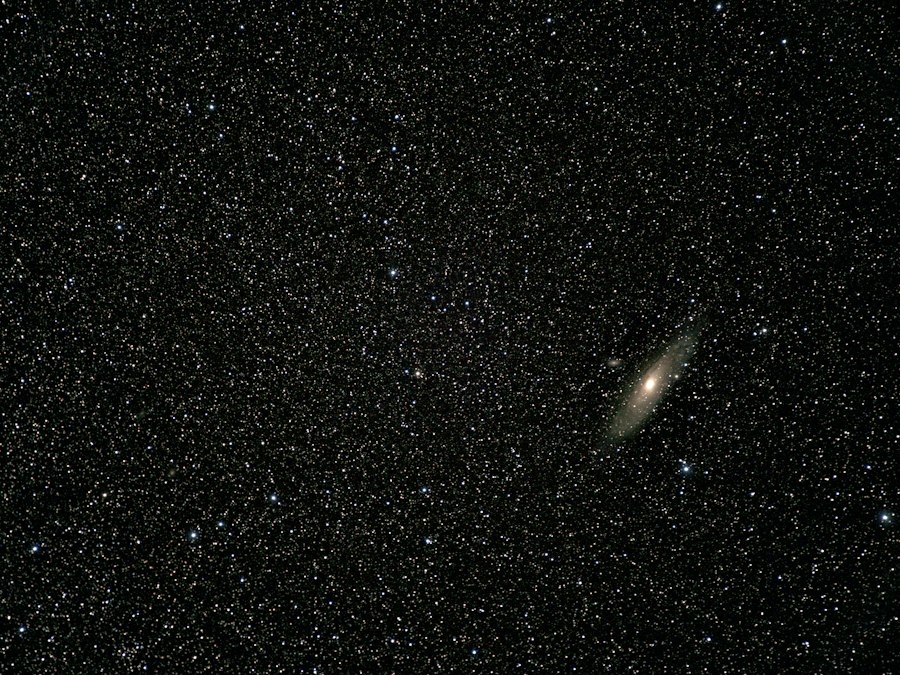
To fully appreciate Andromeda’s subtle beauty, one must employ the right tools and techniques. While a keen eye under a dark sky can offer a glimpse, the true marvels are revealed with a little assistance.
Naked-Eye Observation: The First Encounter
Under ideal conditions – away from light pollution, on a moonless night, and with clear skies – Andromeda can be seen with the naked eye. It appears as a faint, elongated patch of light, roughly three times as long as it is wide, located in the constellation of Andromeda. Its appearance is often described as a small, cloudy smudge. This initial encounter, though understated, is the first step in connecting with this distant galaxy.
Finding Andromeda in the Night Sky
Locating Andromeda requires familiarity with its namesake constellation. The constellation Andromeda lies to the north of the more prominent constellation Pegasus. Once Pegasus is identified (easily recognizable by its “Great Square”), Andromeda can be found by following its stars upwards. With patience and a dark sky, the faint oval of the galaxy will become apparent.
The Impact of Light Pollution
The greatest impediment to naked-eye observation of Andromeda is light pollution. The pervasive glow from artificial lights in urban and suburban areas overwhelms the faint light of the galaxy, rendering it invisible. Therefore, seeking out dark sky locations is paramount for experiencing this celestial spectacle with the unaided eye.
Binocular Vision: Enhancing the Subtle Details
Binoculars offer a significant upgrade for observing Andromeda. Even modest binoculars, such as 7×50 or 10×50, can reveal more of its elliptical shape and hint at its extended nature. The muted glow becomes more defined, and the presence of companion galaxies like M32 and M110 may also become apparent.
Bridging the Gap Between Naked Eye and Telescope
Binoculars serve as an excellent intermediary, providing a richer view than the naked eye without the complexity of setting up a telescope. They allow for a more comfortable and accessible exploration of the night sky, making Andromeda a more tangible object of observation.
Telescopic Exploration: Unveiling the Grandeur
For a truly immersive experience, a telescope is indispensable. Even a modest amateur telescope can reveal the distinct spiral arms of Andromeda, the brighter core, and the subtle variations in its texture. Larger telescopes will resolve more detail, showcasing star-forming regions, dust lanes, and the structure of its companion galaxies with increasing clarity.
Choosing the Right Telescope
The aperture of a telescope is the most critical factor for observing faint, extended objects like galaxies. Larger apertures gather more light, allowing for fainter details to be seen. For Andromeda, a telescope with an aperture of at least 4-6 inches is recommended for a rewarding view, with larger instruments offering progressively more impressive sights.
Observing Techniques for Faint Objects
When observing faint galaxies like Andromeda, averted vision is a crucial technique. By looking slightly to the side of the object, you engage the more light-sensitive peripheral cells in your retina, allowing you to perceive fainter details that might be missed when looking directly at the object. Patience and allowing your eyes to adapt to the darkness are also key.
The Andromeda Galaxy, our nearest galactic neighbor, presents a stunning view to the human eye, appearing as a faint, elongated smudge in the night sky. This celestial wonder can be observed without the aid of a telescope under dark conditions, captivating stargazers with its beauty. For those interested in learning more about how Andromeda looks and its significance in astronomy, you can explore this fascinating article that delves deeper into its characteristics and the science behind our observations of this magnificent galaxy.
The Scientific Significance of Andromeda’s Muted Glow
| Aspect | Description |
|---|---|
| Shape | Andromeda appears as a spiral galaxy with a bright central bulge and spiral arms extending outward. |
| Color | Andromeda is predominantly bluish in color, with some areas appearing reddish due to older stars. |
| Size | Andromeda is about 220,000 light-years in diameter, making it the largest galaxy in the Local Group. |
| Distance | Andromeda is approximately 2.537 million light-years away from Earth. |
Andromeda’s muted glow is not just a visual curiosity; it is a profound indicator of its place in the cosmos and a cornerstone of our understanding of galactic evolution and the universe’s structure.
A Window into Galactic Evolution
The study of Andromeda provides invaluable insights into the life cycle and evolution of spiral galaxies. By observing its structure, stellar populations, and interactions with its companions, astronomers can test and refine theories about how galaxies form, grow, and change over billions of years. Its relative proximity makes it an ideal laboratory for this research.
Comparison with the Milky Way
Andromeda is the closest large spiral galaxy to our own Milky Way. This proximity allows for direct comparisons between the two galaxies, helping scientists to understand the commonalities and differences in their formation and evolutionary paths. The ongoing collision course between Andromeda and the Milky Way, predicted to occur in billions of years, is a testament to the dynamic and interactive nature of galactic evolution.
Studying Stellar Populations and Dynamics
The detailed observation of Andromeda’s stellar populations, from young, hot stars in its arms to the older, redder stars in its bulge, allows astronomers to study the processes of star formation and stellar evolution in a galactic context. The dynamics of its stars and gas also reveal information about the distribution of dark matter within galaxies.
Evidence for the Vastness of the Universe
Andromeda’s faintness and its nature as a distinct, separate galaxy were crucial in overturning the prevailing view in the early 20th century that all visible “nebulae” were within our own Milky Way. Edwin Hubble’s observations of Cepheid variable stars within Andromeda provided the definitive proof of its extragalactic nature and its immense distance, fundamentally altering our understanding of the scale of the universe.
The Great Debate
Before Hubble’s groundbreaking work, astronomers debated the nature of spiral nebulae. Some believed they were gas clouds within our galaxy, while others, like Heber Curtis, championed the “island universe” hypothesis, suggesting they were independent galaxies. Hubble’s measurement of the distance to Andromeda, using Cepheid variables, definitively settled this debate and established the existence of countless other galaxies beyond our own.
Our Cosmic Future: The Andromeda-Milky Way Collision
Perhaps the most profound implication of Andromeda’s existence, amplified by its distance and our ongoing observation, is the knowledge of our shared future. Andromeda is on a collision course with the Milky Way, a celestial event that will unfold over billions of years. While the initial approach will involve a gradual gravitational dance, the ultimate merger will reshape both galaxies into a larger, elliptical galaxy. The muted glow of Andromeda today is a silent harbinger of this monumental cosmic event, a slow-motion ballet that will define the future of our galactic neighborhood. The light we see is a promise of a future so distant, it transcends our mortal comprehension.
In conclusion, marveling at Andromeda’s muted glow is an exercise in appreciating the subtle grandeur of the cosmos. It is a recognition that beauty is not always loud and flamboyant, but can be found in the soft whispers of light that have traveled for eons. From the faintest smudge visible to the naked eye to the intricate structures revealed by powerful telescopes, Andromeda invites us to explore, to question, and to ultimately understand our place within the vast and wondrous tapestry of the universe. Its muted glow is a constant reminder of the immense distances involved, the power of collective stellar light, and the enduring mysteries that continue to draw us to the night sky.

The Space Photos Are Real—But Your Eyes Would See This
FAQs
1. What does Andromeda look like to human eyes?
Andromeda, also known as the Andromeda Galaxy, appears as a faint, hazy patch of light in the night sky. It is visible to the naked eye as a small, elongated cloud of light.
2. What color is Andromeda to human eyes?
To human eyes, Andromeda appears as a pale, whitish-gray color. It does not exhibit vibrant colors like some other celestial objects.
3. How big does Andromeda appear in the night sky to human eyes?
Andromeda appears as a small, elongated patch of light in the night sky, roughly the size of the full moon. It is not as large or bright as some other celestial objects.
4. Can Andromeda be seen from both hemispheres?
Yes, Andromeda can be seen from both the northern and southern hemispheres. It is visible to the naked eye under dark, clear skies.
5. What is the best time to view Andromeda with human eyes?
The best time to view Andromeda with human eyes is during the late summer and early fall months in the northern hemisphere. It is best observed when the sky is dark and free from light pollution.