
You’ve probably never given your microwave door much thought beyond making sure it latches properly. It’s a simple, utilitarian piece of engineering. But within that unassuming glass and plastic lies a clever design element: the metal mesh. This isn’t just for show; it’s your silent guardian, a crucial component that keeps you safe from something you can’t see or feel – microwave radiation.
Microwaves are a marvel of modern convenience. They heat your leftovers, pop your popcorn, and defrost your frozen meals in a fraction of the time it would take with conventional ovens. But this efficiency comes from a specific type of electromagnetic radiation, and understanding how your microwave contains it is key to appreciating the ingenuity of its design. You might be wondering, “How can something that lets you see inside block something as powerful as radiation?” The answer lies in the fascinating physics of electromagnetic waves and the specific properties of that metallic grid.
This article will delve into the science behind your microwave door, explaining the role of the metal mesh and why it’s so effective at keeping you safe. We’ll explore the nature of microwave radiation, how it interacts with food, and how the mesh acts as a barrier, ensuring that the energy stays where it belongs – inside your appliance, cooking your food, not escaping into your kitchen.
To appreciate the role of the metal mesh, you first need to understand what it’s guarding against. Microwave radiation isn’t some exotic, sci-fi concept; it’s a part of the electromagnetic spectrum, just like visible light, radio waves, and X-rays. However, microwaves possess a specific frequency range that makes them ideal for heating food.
What Exactly Are Microwaves?
Microwaves are electromagnetic waves with wavelengths ranging from about one meter to one millimeter, and corresponding frequencies between 300 megahertz (MHz) and 300 gigahertz (GHz). These frequencies are precisely tuned to interact with water molecules, the primary component of most foods.
The Electromagnetic Spectrum: A Familiar Landscape
Think of the electromagnetic spectrum as a vast landscape of energy. At one end, you have low-frequency radio waves, used for broadcasting. As you move up the spectrum, you encounter microwaves, followed by infrared radiation (heat), visible light (what you see), ultraviolet radiation (which can cause sunburn), X-rays (used in medical imaging), and finally, gamma rays (highly energetic, often associated with nuclear reactions). Each type of radiation has a different wavelength and frequency, determining its properties and how it interacts with matter.
Frequencies for Cooking: Why 2.45 GHz?
Most household microwave ovens operate at a frequency of 2.45 GHz. This specific frequency is chosen because it’s particularly effective at exciting water molecules. When microwave energy encounters water, it causes the water molecules to rotate rapidly. This rapid rotation generates friction between the molecules, and this friction is what produces heat, cooking your food from the inside out. It’s a remarkably efficient way to transfer energy.
How Microwaves Heat Your Food
The process of microwave heating is quite distinct from conventional cooking methods. Instead of heating from the outside in with direct heat, microwaves penetrate the food and agitate the water molecules within.
Dielectric Heating: The Core Principle
The mechanism by which microwaves heat food is known as dielectric heating. Water molecules are polar, meaning they have a positive end and a negative end, much like a tiny magnet. When exposed to the oscillating electric field of the microwave radiation, these polar molecules try to align themselves with the changing field. This constant, rapid flipping and rotation creates friction, which translates into heat. Other molecules in food, like fats and sugars, also absorb microwave energy, though generally to a lesser extent than water.
Penetration Depth: Cooking from Within
Unlike a conventional oven that bakes the outer layers of food first, microwaves penetrate the food to a certain depth, typically a few centimeters. This means that the heating process occurs more uniformly throughout the food, leading to faster cooking times. However, the depth of penetration is dependent on the food’s composition; denser foods or those with lower water content will heat less efficiently.
Potential Hazards of Microwave Radiation
While immensely useful, microwave radiation, if not properly contained, can be harmful. The energy that cooks your food can also cause damage to living tissues.
Thermal Effects: Heating Living Tissue
The most significant danger from uncontained microwave radiation is thermal damage. Just as microwaves heat water molecules in food, they would heat water molecules in your body. Prolonged or intense exposure to microwave radiation can lead to burns, particularly on sensitive tissues like the eyes and testes, which have limited blood flow to dissipate heat.
Non-Thermal Effects: A Subject of Research
Beyond thermal effects, there’s been ongoing research into potential non-thermal effects of microwave radiation. While the consensus in the scientific community is that at the levels emitted by properly functioning microwave ovens, these effects are negligible, research continues to explore subtle interactions. However, for practical safety concerns, preventing leakage is paramount.
Microwave doors are designed with metal mesh to ensure safety while allowing you to monitor your food as it cooks. The mesh acts as a barrier that reflects microwaves back into the cooking chamber, preventing them from escaping and causing harm. For a deeper understanding of the science behind microwave technology and its safety features, you can read more in this related article on Freaky Science: Freaky Science.
The Faraday Cage Principle: How the Mesh Works
Now that you understand the power and potential risks of microwave radiation, let’s turn our attention to the ingenious solution built into your microwave door: the metal mesh. This seemingly simple grid is actually a highly effective barrier, leveraging a well-established physics principle to keep you safe.
The Faraday Cage: A Shield Against Electromagnetic Waves
The concept behind the microwave door’s shielding is based on the principle of a Faraday cage. A Faraday cage is an enclosure made of conductive material, typically metal, that blocks external electromagnetic fields.
Michael Faraday’s Discovery: A Simple Experiment
In the 19th century, the brilliant scientist Michael Faraday conducted experiments demonstrating that a conductive enclosure could block electrical charges and electromagnetic fields. He discovered that if you place a conductor around a space, any electric field outside the conductor will redistribute the charges on the conductor’s surface in such a way that the field inside the conductor is canceled out. This creates a shielded area.
Applications of Faraday Cages: From Lab to Lifestyle
Faraday cages are used in various applications today. Sensitive electronic equipment in laboratories is often housed in Faraday cages to protect it from external electromagnetic interference. Even the metallic shielding around electrical cables is a form of localized Faraday cage. Your microwave door is, in essence, a specialized, perforated Faraday cage designed to let you see inside while blocking specific frequencies.
The Role of the Perforations: A Delicate Balance
The metal mesh isn’t a solid sheet of metal; it has tiny holes. This is where the magic of frequency-specific blocking comes into play. The size of these holes is critical to its effectiveness.
Wavelength Matters: The Key to Blocking
The effectiveness of a Faraday cage in blocking electromagnetic radiation depends on the relationship between the size of the openings in the cage and the wavelength of the radiation. Microwaves, with their specific wavelengths (around 12 cm for 2.45 GHz), are significantly larger than the holes in the mesh.
Interaction with Microwaves: Reflection and Absorption
When microwaves encounter the metal mesh, their electromagnetic fields interact with the conductive material. Because the holes are much smaller than the wavelength of the microwaves, the radiation cannot easily pass through. Instead, the metal mesh reflects most of the microwave energy back into the oven cavity. Some energy might be absorbed by the metal, but the primary mechanism is reflection.
Why Not a Solid Metal Door?
You might wonder why the door isn’t simply a solid piece of metal. The answer is simple: visibility. You need to be able to see your food cooking, to monitor its progress, and to ensure it doesn’t burn.
The Need for Visibility: Practicality in Design
A solid metal door would create a completely dark interior, making it impossible to check on your food without opening the door, which would interrupt the cooking cycle. The perforated mesh strikes a perfect balance between safety and functionality.
The Trade-off: Light vs. Microwaves
The holes in the mesh are small enough to effectively block microwaves but large enough to allow visible light to pass through. Visible light has much shorter wavelengths than microwaves (on the order of nanometers), so these tiny holes present no significant barrier to it. This allows you to peer into your oven, observe your culinary creations, and maintain control over your cooking.
Design Features for Optimal Shielding
Beyond the mesh itself, several other design elements of the microwave door contribute to its overall effectiveness in containing microwave radiation. These features work in concert to ensure that the energy stays where it belongs.
The Door Seal: The First Line of Defense
Before the mesh even comes into play, the door seal plays a crucial role in preventing radiation leakage. This rubber or silicone gasket forms a tight barrier between the door and the oven cavity.
Creating an Airtight (and Microwave-Tight) Seal
The primary function of the door seal is to prevent heat and steam from escaping the oven. However, it also serves as a critical component in preventing microwave radiation from leaking out. A properly fitted and intact seal ensures that there are no gaps where microwaves could escape.
Maintaining the Seal: Regular Inspection and Replacement
Over time, door seals can degrade, become brittle, or get damaged. It’s important to regularly inspect your microwave door seal for any signs of wear or tear. If you notice any cracks, gaps, or if the seal doesn’t seem to be making firm contact with the oven cavity, it’s a good idea to have it inspected by a professional or consider replacing the microwave. A compromised seal is a significant safety concern.
The Interlock System: Preventing Operation with an Open Door
Another vital safety feature is the interlock system. This mechanism prevents the microwave from operating unless the door is fully closed and latched.
Multiple Switches: Redundant Safety Measures
Microwave ovens typically have two or three interlock switches. These switches are designed to be redundant. For the microwave to function, all of these switches must be activated, which only happens when the door is securely shut. If even one switch fails to engage, the microwave will not turn on or will immediately shut off.
The Importance of a Functional Interlock
The interlock system is a critical safety feature. It prevents accidental exposure to microwave radiation that would occur if the oven were to operate with the door ajar. If you notice that your microwave can be turned on with the door not fully closed, this is a serious safety issue and the appliance should not be used.
The Cavity Material: Reflecting Energy Back In
The interior walls of the microwave oven are made of metal. This metal lining, along with the rotating turntable, helps to distribute the microwave energy evenly throughout the cavity.
The Metal Cavity: A Reflective Enclosure
Just like the mesh in the door, the metal interior of the microwave oven acts as a reflective surface. When microwaves are generated by the magnetron (the component that produces them), they bounce off the metal walls, circulating within the oven cavity. This bouncing ensures that the food is exposed to the microwave energy from multiple angles, leading to more even cooking.
Even Distribution: The Role of the Turntable
The turntable rotates the food, further enhancing the even distribution of microwave energy. Without a turntable, certain areas of the food might receive more direct microwave exposure than others, leading to uneven heating and potentially cold spots. The combined effect of the reflective cavity and the rotating turntable ensures that the microwaves are contained and effectively utilized for cooking.
Maintaining Your Microwave’s Safety Features
Your microwave is designed with safety in mind, but like any appliance, it requires occasional maintenance to ensure these features remain effective. A little care can go a long way in guaranteeing your continued safety.
Inspecting the Door and Seal Regularly
As mentioned earlier, the door and its seal are your primary barrier against radiation leakage. Regular visual inspections are crucial.
Looking for Damage: Cracks, Gaps, and Warping
When you’re cleaning your microwave, take a moment to look closely at the door. Check the glass for any cracks or chips. Inspect the rubber or silicone seal around the edge of the door for any signs of wear, tears, or compression. Ensure that the door closes smoothly and sits flush against the oven cavity.
Cleaning the Door Area: Removing Debris
Food particles or grease can accumulate around the door and seal, potentially creating small gaps. Regularly wipe down the door and the oven opening with a damp cloth to keep this area clean and ensure a proper seal.
Checking the Interlock Switches
While you can’t directly “see” the interlock switches, you can infer their functionality through the microwave’s operation.
Testing the On/Off Behavior
The most straightforward test is to observe if the microwave operates only when the door is fully closed. If you can press the start button and the microwave begins to heat when the door is even slightly ajar, this indicates a problem with the interlock system. Do not use the microwave if this is the case.
Professional Servicing for Interlock Issues
Issues with interlock switches are not something you should attempt to fix yourself unless you have significant electrical expertise. It’s best to have a qualified technician inspect and repair any problems with the interlock system.
Avoiding Tampering and Modifications
The safety features of your microwave are carefully engineered. Attempting to bypass or modify them can have serious consequences.
The Dangers of Disabling Safety Mechanisms
Never attempt to disable or remove any of the safety features, such as the interlock switches or the door mesh. These components are there for a reason, and their removal would expose you to potentially harmful levels of microwave radiation.
When to Consider Replacement
If your microwave has sustained significant damage to its door, seal, or if you suspect issues with the interlock system that cannot be easily and safely remedied, it may be time to consider replacing the appliance. The cost of a new microwave is a small price to pay for your safety.
Microwave doors are designed with metal mesh to ensure safety while allowing users to see inside the cooking chamber. This mesh serves as a barrier that reflects microwaves back into the oven, preventing them from escaping and causing harm. For a deeper understanding of the science behind this design, you can read more in this related article on Freaky Science, which explains how the mesh works and its importance in microwave technology.
Debunking Myths and Understanding Normal Operation
“`html
| Reasons for Metal Mesh in Microwave Doors |
|---|
| Prevents microwaves from escaping |
| Protects users from radiation |
| Allows for visibility into the microwave |
| Provides structural support for the door |
“`
Despite the scientific understanding of how microwaves work and how they are safely contained, myths and misconceptions about microwave radiation persist. Understanding these can help alleviate unnecessary fears.
Myth: Microwave Ovens Leak Radiation Continuously
One common misconception is that microwave ovens constantly emit radiation, even when not in use. This is incorrect. The magnetron, the component that generates microwaves, only operates when the microwave is actively heating food and the door is fully closed.
The Magnetron’s Role: Active Generation
The magnetron is an electrical device that requires power to generate microwaves. When you select a cooking time and press start, electricity flows to the magnetron, producing the microwave radiation. Once the cooking cycle is complete or the door is opened, the magnetron stops producing microwaves.
Safety Interlocks Prevent Operation Without a Closed Door
As discussed, the interlock system ensures that the magnetron cannot be activated if the door is not securely shut. This prevents any possibility of continuous leakage.
Myth: Microwave Radiation is Inherently Harmful at All Levels
While high levels of microwave radiation can be harmful, the radiation emitted by a properly functioning microwave oven, within its sealed cavity, is well within safety standards. The metal mesh and other safety features are designed to keep any potential leakage to negligible levels.
Regulatory Standards: Ensuring Public Safety
Microwave ovens are subject to strict safety regulations and standards set by government agencies worldwide. These standards dictate the maximum permissible leakage rate for microwave radiation. Manufacturers are required to ensure their products meet these standards before they can be sold.
Leakage Levels: Typically Negligible
Even if there were a very minor leakage from a perfectly functioning microwave (which is unlikely), the levels are so low that they pose no significant health risk. The primary concern is with damaged or tampered-with appliances.
Normal Operation: What to Expect
A well-functioning microwave oven operates silently (except for the fan and turntable) and heats food effectively without any discernible signs of radiation leakage.
The Hum of the Magnetron and Fan
You might hear a humming sound when the microwave is operating, which is typically the magnetron and the cooling fan. This is normal operational noise.
Visible Light Through the Mesh
The ability to see your food cooking through the mesh is a testament to its design, allowing visible light to pass while blocking microwaves.
Heat and Steam Escape (Normal)
It is normal for some heat and steam to escape the microwave when it is operating, as the door is not hermetically sealed against everything. However, the mesh and seal are designed to prevent the escape of the hazardous microwave radiation.
In conclusion, the metal mesh in your microwave door is a sophisticated yet simple piece of engineering that plays a vital role in your safety. By understanding the physics behind it and maintaining your appliance properly, you can continue to enjoy the convenience of microwave cooking with peace of mind. You are, quite literally, protected by a window that looks out for you.
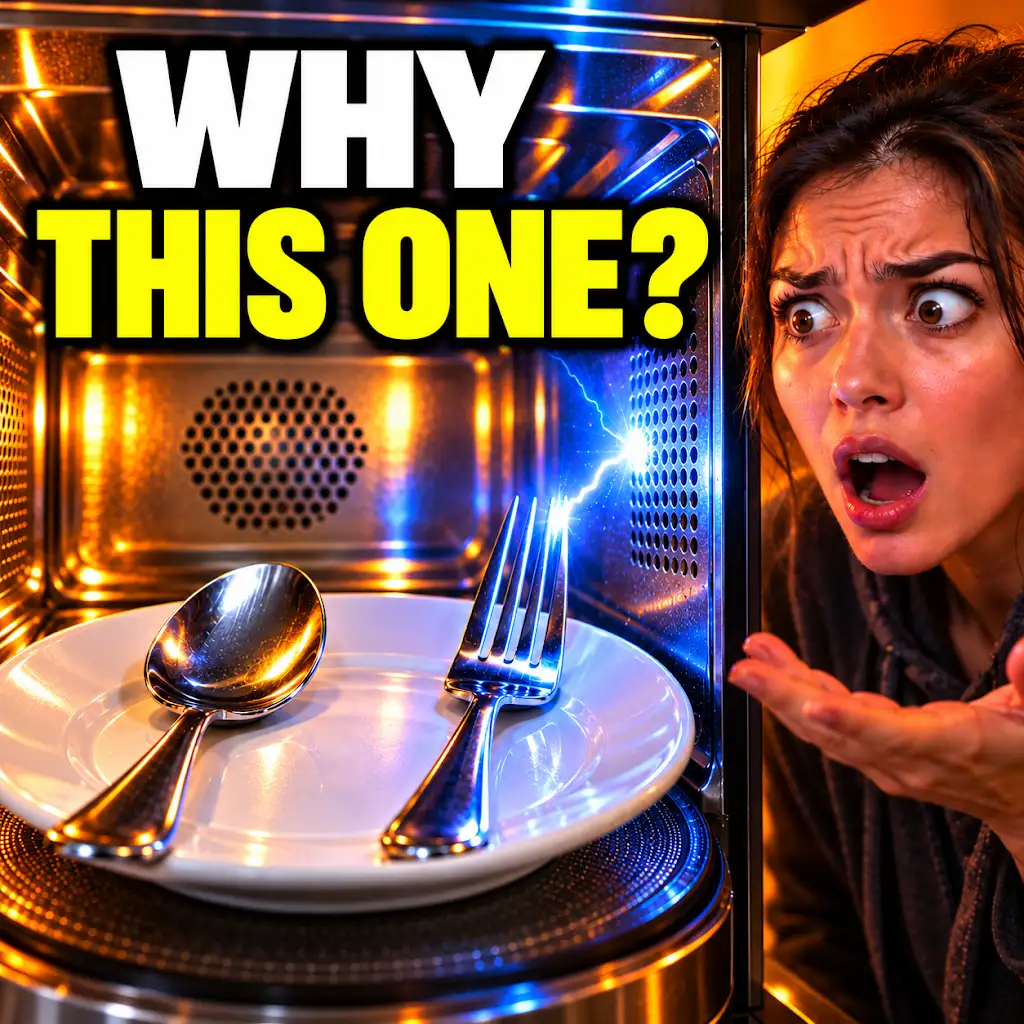
A Fork and a Spoon React Differently in a Microwave. Why?
FAQs
1. Why do microwave doors have metal mesh?
Microwave doors have metal mesh to prevent the microwaves from escaping the appliance. The metal mesh acts as a barrier to contain the microwaves inside the oven while allowing visibility through the door.
2. How does the metal mesh in microwave doors work?
The metal mesh in microwave doors reflects the microwaves back into the oven, preventing them from escaping. This design ensures that the microwaves are contained within the appliance, allowing for safe and efficient cooking.
3. Is the metal mesh in microwave doors safe?
Yes, the metal mesh in microwave doors is safe. It is designed to contain the microwaves within the oven and prevent them from leaking out. When used according to the manufacturer’s instructions, microwave ovens with metal mesh doors are safe for everyday use.
4. Can the metal mesh in microwave doors be damaged?
The metal mesh in microwave doors is designed to be durable and withstand the normal wear and tear of everyday use. However, it is important to avoid damaging the mesh by using abrasive materials or harsh cleaning agents on the door.
5. Are there any precautions to take with microwave doors with metal mesh?
It is important to keep the metal mesh in microwave doors clean and free from any obstructions to ensure that it functions properly. Additionally, it is recommended to follow the manufacturer’s guidelines for safe usage and maintenance of the microwave oven.