You’re holding a mug of steaming coffee, or maybe a bowl of perfectly popped popcorn. You recall the hum of the microwave oven, a familiar sound that signals a quick meal. But have you ever stopped to wonder about the invisible force at work within that appliance, the very essence that heats your food so efficiently? You’re about to embark on a journey into the fascinating world of electromagnetic waves, specifically those that power your microwave: microwaves. This article aims to demystify these waves, exploring their fundamental properties, how they interact with matter, and the ingenious engineering that harnesses their power. Prepare to understand the science behind your quick culinary creations.
When you think of waves, you might conjure images of ripples on water or sound traveling through the air. Electromagnetic (EM) waves are a bit different, yet they share the fundamental characteristic of carrying energy through space. Unlike mechanical waves that require a medium to propagate, EM waves can travel through the vacuum of space. This is how sunlight, a form of EM radiation, reaches Earth from the Sun, a staggering 93 million miles away.
Oscillating Electric and Magnetic Fields
At their core, EM waves are comprised of two intertwined and oscillating fields: an electric field and a magnetic field. Imagine these fields as invisible forces, one pushing and pulling on electric charges, the other influencing magnetic materials. These fields are perpendicular to each other and also perpendicular to the direction the wave is traveling. This makes them transverse waves.
- Electric Field: This field is generated by electric charges. Think of the force you feel when you rub a balloon on your hair and it sticks – that’s an electric field at play. In an EM wave, this electric field oscillates, meaning it continuously changes in magnitude and direction.
- Magnetic Field: This field is associated with moving electric charges (electric currents) and magnetic materials. The Earth’s magnetic field, for instance, protects us from solar winds. Similar to the electric field, the magnetic field in an EM wave also oscillates.
The Interplay: A Self-Propagating Dance
What’s truly remarkable is how these two fields sustain each other. A changing electric field induces a magnetic field, and a changing magnetic field, in turn, induces an electric field. This continuous interplay creates a self-propagating wave that travels outwards, carrying energy. It’s a perpetual motion of sorts, driven by the fundamental laws of electromagnetism, as elegantly described by James Clerk Maxwell’s equations. These equations are the bedrock of our understanding of EM phenomena, unifying electricity, magnetism, and light into a single framework.
The Electromagnetic Spectrum: A Rainbow of Frequencies
EM waves aren’t all the same. They exist across a vast spectrum, differentiated by their frequency and wavelength. Frequency refers to the number of wave cycles that pass a point in one second, measured in Hertz (Hz). Wavelength is the distance between successive crests or troughs of a wave, measured in meters. These two properties are inversely related: higher frequency means shorter wavelength, and vice versa.
- Frequency and Energy: The energy carried by an EM wave is directly proportional to its frequency. Higher frequency waves carry more energy. This is why X-rays and gamma rays, with their extremely high frequencies, are highly energetic and can penetrate matter, while radio waves, with their very low frequencies, carry less energy.
- Wavelength and Interactions: The wavelength of an EM wave dictates how it interacts with matter. For instance, very short wavelengths can interact with the atomic structure of materials, while longer wavelengths might interact with macroscopic objects.
The EM spectrum, from lowest frequency (and longest wavelength) to highest frequency (and shortest wavelength), includes: radio waves, microwaves, infrared radiation, visible light, ultraviolet radiation, X-rays, and gamma rays. Each region of this spectrum has unique properties and applications, from broadcasting your favorite radio stations to the medical imaging capabilities of X-rays.
Electromagnetic waves play a crucial role in the functioning of microwaves, as they are responsible for heating food by exciting water molecules. For a deeper understanding of how these waves behave within the confines of a microwave oven, you can explore a related article that delves into the science behind this phenomenon. To read more, visit this article, which provides insights into the interaction of electromagnetic waves with different materials and the principles of microwave technology.
Microwaves: The Sweet Spot in the Spectrum
Now, let’s zoom in on the specific segment of the EM spectrum that concerns us: microwaves. Microwaves occupy a region of the EM spectrum typically ranging from about 300 megahertz (MHz) to 300 gigahertz (GHz) in frequency, corresponding to wavelengths of about 1 meter down to 1 millimeter. This range places them between radio waves and infrared radiation.
The Frequency Range Matters
The specific frequency range used in microwave ovens is highly deliberate. The most common frequency for domestic microwave ovens is 2.45 GHz (2,450 MHz). This specific frequency was chosen for a very good reason: its effectiveness in heating water molecules.
- The 2.45 GHz Sweet Spot: Water molecules have a particular rotational property. They possess a dipole moment, meaning they have a slightly positive end and a slightly negative end. When exposed to an oscillating electric field, like that of a microwave, these water molecules try to align themselves with the rapidly changing field.
- Molecular Friction: Imagine trying to continuously reorient a compass needle in a room where the magnetic poles are flipping back and forth billions of times per second. The water molecules, in their frantic attempts to follow the oscillating electric field, collide with their neighbors. These collisions generate kinetic energy, which we perceive as heat. This process is known as dielectric heating.
Understanding how electromagnetic waves behave inside microwaves is crucial for grasping the principles of microwave cooking and heating. For a deeper dive into this fascinating topic, you can explore a related article that discusses the science behind microwave ovens and their efficient use of electromagnetic radiation. This article provides insights into how these waves interact with food, leading to even cooking and heating. To learn more, check out this informative piece on Freaky Science.
Beyond Water: Interactions with Other Molecules
While water is the primary target for microwave heating, other polar molecules like fats and sugars also absorb microwave energy and contribute to heating. Non-polar molecules, such as those found in glass or ceramic dishes, are largely unaffected by microwaves, which is why these materials are safe for microwave use.
- Absorption and Reflection: Different materials interact with microwaves differently. Some materials absorb microwave energy efficiently (like food), others reflect it (like metal), and some are relatively transparent to it (like glass and certain plastics). Understanding these properties is crucial for the safe and effective use of microwave technology.
- Dielectric Properties: The way a material interacts with an electric field is described by its dielectric properties. For water, its high dielectric constant and loss tangent make it an excellent absorber of microwave energy at the operating frequency of ovens.
The “Microwave Window”
The range of frequencies used for microwave ovens, particularly 2.45 GHz, is also known as a “microwave window.” This is because it’s a region where the Earth’s atmosphere is relatively transparent to electromagnetic radiation, allowing for communication and sensing applications in this range. However, for heating purposes, the primary advantage lies in the efficient interaction with water.
How Microwaves Heat Your Food: A Microscopic Dance
The magic of a microwave oven lies in its ability to directly heat the food itself, rather than relying on conduction or convection from an external heat source like a conventional oven. This targeted heating mechanism is what makes microwave cooking so rapid.
The Role of Water Molecules
As previously mentioned, water is the key player. Virtually all foods contain a significant amount of water. When you place food in a microwave oven, the microwaves penetrate the food, causing the water molecules within it to vibrate rapidly.
- Friction and Heat Generation: This rapid vibration isn’t just a gentle swaying; it’s a vigorous oscillation. As the water molecules spin and flip-flop in response to the oscillating electric field, they collide with neighboring molecules, both water and other food components. These collisions generate kinetic energy, which translates directly into heat. Think of it like rubbing your hands together very, very quickly – the friction generates heat. In a microwave, this “rubbing” happens at a molecular level, billions of times per second.
- Penetration Depth: Microwaves penetrate food to a certain depth. For a typical microwave oven operating at 2.45 GHz, this penetration depth is usually around 1-2 centimeters. This means that the heat is generated internally, rather than just from the surface inwards. This is why food cooked in a microwave can sometimes be hot in the center while still being cool on the very surface, or vice versa, if the microwave is uneven.
Penetration and Distribution: The Challenges and Solutions
The effectiveness of microwave heating depends on the distribution of water within the food and the ability of the microwaves to penetrate.
- Uneven Heating: One of the common challenges with microwave cooking is uneven heating. This can occur due to:
- Variations in Water Content: Different parts of a food item may have varying concentrations of water. For instance, the flesh of a chicken breast will have more water than the skin.
- Shape and Density: The shape and density of the food can affect how microwaves penetrate and distribute. Thicker or denser areas may absorb more energy, while thinner areas might heat through faster.
- Microwave Field Distribution: The microwave field within the oven cavity is not perfectly uniform. There are areas of higher and lower intensity, leading to “hot spots” and “cold spots.”
- Turning and Stirring: To mitigate uneven
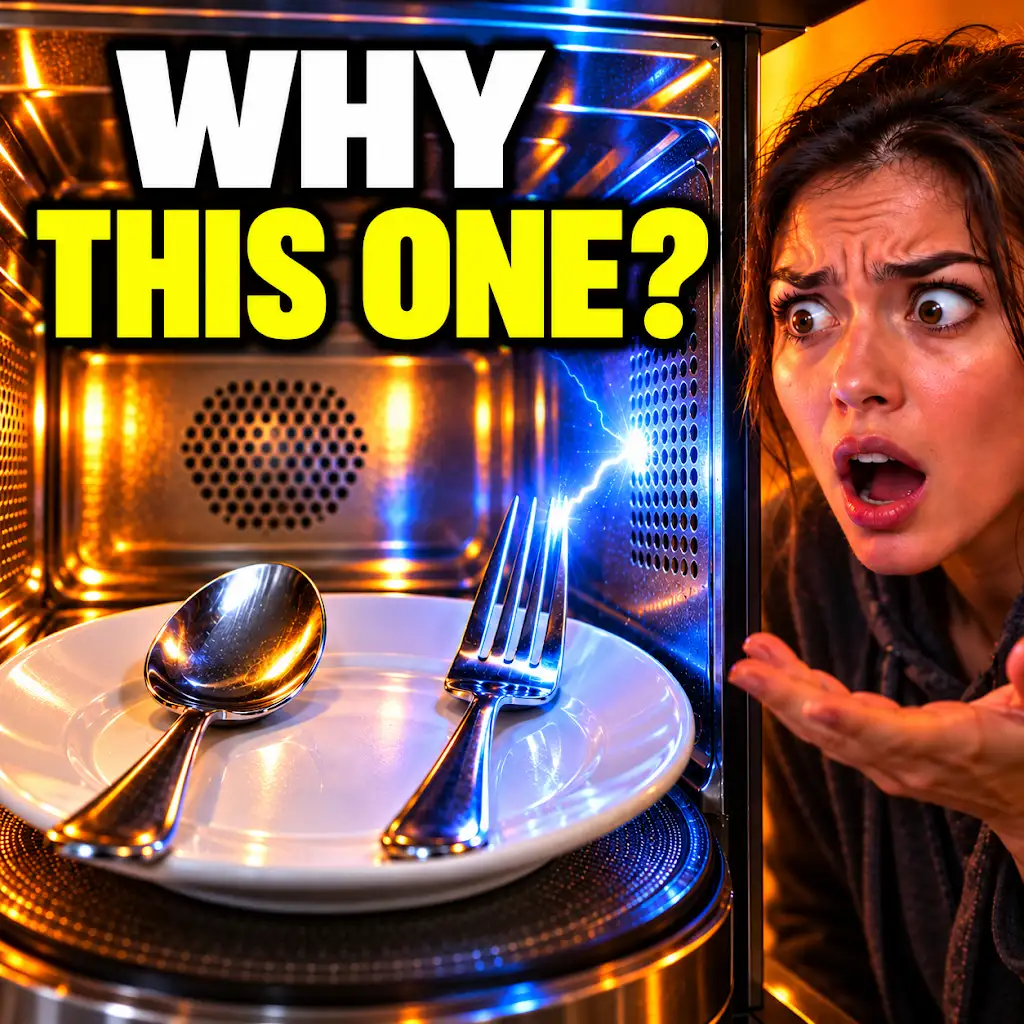
A Fork and a Spoon React Differently in a Microwave. Why?

FAQs
1. What are electromagnetic waves and how do they behave inside microwaves?
Electromagnetic waves are a form of energy that includes visible light, radio waves, and microwaves. Inside a microwave, these waves bounce around and are absorbed by the food, causing the water molecules in the food to vibrate and generate heat.
2. How do microwaves generate electromagnetic waves?
Microwaves generate electromagnetic waves through a component called a magnetron, which converts electrical energy into microwave radiation. This radiation is then distributed throughout the microwave oven to cook the food.
3. What happens to electromagnetic waves when they encounter the metal walls of a microwave?
When electromagnetic waves encounter the metal walls of a microwave, they are reflected back into the cooking chamber. This reflection helps to ensure that the waves are evenly distributed and that the food is cooked thoroughly.
4. Can electromagnetic waves escape from a microwave oven?
Microwave ovens are designed with a metal mesh screen on the door and safety interlocks to prevent the escape of electromagnetic waves. This design ensures that the waves are contained within the oven and do not pose a risk to the user.
5. How do different materials interact with electromagnetic waves inside a microwave?
Different materials interact with electromagnetic waves in different ways. For example, materials that contain water, such as food, absorb the waves and heat up, while materials that do not contain water, such as glass or ceramic, are transparent to the waves and do not heat up as much.