You’ve stood there, haven’t you? Staring into the glowing abyss of your microwave, a crumpled ball of aluminum foil precariously perched on your leftovers. Or perhaps you’re the meticulous type, painstakingly smoothing out every single crease, ensuring a pristine, mirror-like surface. You’ve probably wondered, in those fleeting moments of culinary anticipation, which approach is superior. Is it the haphazard chaos of the crumpled foil, or the serene order of the smooth? You’re about to embark on a journey into the heart of the kitchen science, a battle waged not with swords and shields, but with reflection and radiation. This is the Battle of Foil: Smooth vs. Crumpled in the Microwave.
Before you can even consider the nuances of its form, you need to understand what aluminum foil is in the context of a microwave oven. It’s not just a kitchen staple; it’s a conductor of electromagnetic waves, and its behavior in this environment is a fascinating interplay of physics and everyday practice.
What is Aluminum Foil, Anyway?
At its core, aluminum foil is a thin sheet of aluminum metal, typically only a few thousandths of an inch thick. This thinness is crucial for its flexibility, allowing it to be easily shaped and molded. The aluminum itself is a highly conductive material, meaning it readily allows electrical current to flow through it. This conductivity is what makes it useful for everything from wrapping food to its more controversial microwave applications.
How Microwaves Work (The Abbreviated Version)
Microwave ovens work by generating electromagnetic radiation, specifically in the microwave frequency range. This radiation is produced by a device called a magnetron. The microwaves then bounce around inside the metal cavity of the oven, interacting with the food. Water molecules, fats, and sugars in the food absorb these microwaves, causing them to vibrate rapidly. This vibration is what generates heat, cooking your food. The metal interior of the microwave is designed to reflect these microwaves, keeping them contained and directing them towards your meal.
The Wireframe and the Waves: A Critical Relationship
Here’s where the foil enters the picture, and where things get interesting, and sometimes, a little alarming. Because aluminum foil is a conductor, it interacts directly with the electromagnetic waves. When microwaves hit a conductor, they can be reflected, absorbed, or even induce currents. This is the fundamental principle that dictates whether your foil is your culinary ally or a potential fiery foe. The shape of the foil, its proximity to the food, and its location within the microwave cavity all play a significant role in how these interactions play out.
In exploring the fascinating effects of different materials in the microwave, a related article discusses the intriguing comparison between smooth and crumpled foil. This article delves into the science behind how these variations in foil structure can influence microwave behavior, including the potential for sparks and heat distribution. For more insights on this topic, you can read the full article here: Freaky Science.
The “Don’ts” and the Dangers: Why Foil is Generally Prohibited
Let’s address the elephant in the microwave first. For years, you’ve probably seen the warning labels, heard the pronouncements from kitchen gurus: “No metal in the microwave!” And for good reason. The potential for sparks, arcing, and even fires is very real, and understanding why this happens is key to appreciating the subtle differences between smooth and crumpled.
The Spectacle of Arcing: Sparks Fly!
This is the most dramatic and often the most concerning consequence of improper foil use. When a piece of metal, especially one with sharp edges or points, is placed in a microwave, the electromagnetic waves can induce strong electric currents within it. If these currents become concentrated enough, or if the metal is very close to the oven wall or another piece of metal, the electric field can become so intense that it ionizes the air. This ionization creates a plasma, which we perceive as bright, crackling sparks or arcs. It’s essentially a miniature lightning bolt happening inside your oven.
Sharp Edges and Concentration of Charge
Think about a lightning rod. It’s designed to attract lightning to a specific point. Similarly, sharp points and edges on a piece of metal in a microwave can act as focal points for electric charge. The microwaves, instead of being evenly distributed, can concentrate their energy on these points, leading to a higher likelihood of arcing.
Proximity and the Path of Least Resistance
The distance between the metal and the microwave cavity walls, or other conductive surfaces, is also critical. If the gap is too small, the induced voltage can overcome the insulating properties of the air, creating a conductive path – the arc. This is why a crumpled ball of foil, with its many folds and potential for creating small air gaps, might behave differently than a smooth, large sheet.
The Fire Hazard: More Than Just Sparks
Arcing is not just a visual spectacle; it’s a genuine fire hazard. The intense heat generated by the sparks can ignite nearby food particles or even the foil itself if it gets hot enough. This is particularly true if the foil is in direct contact with fatty or sugary foods, which can burn easily. The lingering smell of burnt foil is a testament to this danger.
Interference with Cooking: The Microwave’s Frustration
Beyond the immediate danger, metal in the microwave can also interfere with the cooking process. The reflective properties of foil can bounce microwaves away from the food, creating cold spots and leading to uneven cooking. The oven’s magnetron might also struggle to effectively deliver energy to your meal if it’s constantly being deflected by a metallic shield.
The Case for Smoothness: Precision and Controlled Reflection
Now, let’s consider the meticulous approach. You, the smooth foil enthusiast, believe that by creating a perfectly flat surface, you are controlling the microwave’s interaction with the foil in a predictable and beneficial way. And in some specific, controlled scenarios, you might not be entirely wrong.
The Ideal Reflector: A Uniform Barrier
A perfectly smooth sheet of aluminum foil, when placed correctly, can act as an excellent reflector of microwaves. The idea here is to create a uniform barrier that shields certain parts of the food from direct microwave exposure. This is often employed when you want to prevent the edges of a pie crust from burning while the center cooks, or to keep the tips of chicken wings from becoming overcooked.
Strategic Shielding: Protecting Vulnerable Areas
The smooth foil acts like a tiny, localized Faraday cage. By strategically placing a smooth piece over a specific area, you can prevent those areas from receiving the brunt of the microwave energy. This requires a delicate touch and an understanding of where your food is most likely to overcook.
Even Distribution of Waves (Potentially)
In theory, a smooth, flat sheet of foil spread out evenly could help distribute the microwaves more evenly across the surface of the food it’s covering. This is because it reflects the microwaves uniformly, preventing them from concentrating in specific spots. However, achieving this perfect evenness in a real-world microwave scenario is challenging.
The Risk of Contact: Still a Potential Problem
Even with a smooth sheet, the risk of arcing isn’t entirely eliminated. If the smooth foil touches the sides of the microwave, or if it’s too close to another piece of metal (like the turntable mechanism), arcing can still occur. The key is that the smoother surface might reduce the likelihood of charge concentration compared to a crumpled ball.
The “Edge Effect” in Smooth Foil
Even a smooth sheet has edges. If these edges are not carefully positioned or if they are very thin, they can still contribute to charge build-up and potential arcing. The goal is to have the foil as flat and as far away from the microwave walls as possible.
When Smoothness Might Be Advantageous
In very specific culinary applications, smooth foil is used with caution. You might see it used to cover the edges of a pie or a lasagna to prevent them from burning. The key is that it’s usually a small piece, carefully placed, and often removed before the cooking is complete to allow the food to brown. This is an advanced technique, not a free-for-all.
The Crumpled Contender: Chaos and Unpredictability

Now, let’s delve into the world of the crumpled foil user. This approach often stems from a desire for convenience or a perhaps a resigned acceptance of the microwave’s quirks. You grab a piece, you twist and turn it into a vaguely food-shaped covering, and you toss it in. But what’s really happening in that chaotic ball?
The Unpredictable Nature of the Crumpled Ball
A crumpled ball of foil is a geometric enigma. It’s a collection of folds, creases, and random points. Each of these features presents a unique interaction with the microwaves. Unlike a smooth sheet, there’s no predictable, uniform reflection. Instead, you have a multitude of tiny surfaces and sharp angles.
Concentration Points Galore: A Magnet for Arcing
The very nature of crumpling creates numerous sharp edges and points. These are precisely the features that can lead to concentrated electric fields and, consequently, arcing. The microwaves don’t know what to do with this jumbled mess, and they can become intensely focused on certain points.
Small Air Gaps: A Double-Edged Sword
The folds and creases in crumpled foil also create small air pockets. These air gaps can, in some instances, act as insulators, potentially preventing direct contact. However, they can also create very narrow pathways where the electric field can become incredibly strong, again leading to arcing. It’s a delicate balance, and one that is often tipped towards danger.
The “Shielding” Effect of Crumpled Foil: Accidental or Intentional?
While the intention might be to shield, a crumpled ball of foil often creates a haphazard shield. It might block microwaves effectively in some areas, but in others, it could create pockets of intense radiation due to the unpredictable reflections. This leads to the classic uneven cooking scenario.
Hot Spots and Cold Spots: A Culinary Lottery
The uneven surface of crumpled foil means that some parts of your food will be shielded more than others. This can result in a situation where one part of your meal is overcooked and dry, while another remains stubbornly cold. It’s a game of chance, and rarely a winning one.
Why the Crumpled Approach is Generally Discouraged
The primary reason the crumpled approach is discouraged is its inherent unpredictability and the high risk of arcing. While it might seem like a quick fix, the potential for sparks and even fire makes it a gamble you’re usually better off not taking.
When it comes to using foil in the microwave, the debate between smooth and crumpled foil often sparks curiosity among users. A related article that delves deeper into the science behind this topic can be found at Freaky Science, where you can explore how the shape of the foil can affect microwave energy distribution and safety. Understanding these nuances can help you make informed choices in the kitchen while ensuring your meals are prepared safely and efficiently.
The “Safe” Use of Foil in the Microwave: Nuance and Specificity
| Experiment | Smooth Foil | Crumpled Foil |
|---|---|---|
| Heating Time | Evenly distributed | Uneven heating |
| Sparkling | Less likely | More likely |
| Food Texture | Retains shape | May crinkle food |
So, if foil is generally a no-go, are there any circumstances where it’s acceptable? Yes, but it requires a deep understanding of the principles at play and a commitment to caution. This is not about throwing caution to the wind, but about employing foil with precision and purpose.
The “Microwave-Safe” Labels: What Do They Mean?
You might have seen foil products specifically marketed as “microwave-safe.” These often refer to specially designed foil containers or sheets that incorporate features to mitigate the risks. This might include perforated areas, specific coatings, or a combination of foil with other microwave-safe materials. However, even with these, it’s crucial to follow the manufacturer’s instructions meticulously.
Understanding the Design Intent
These “safe” products are engineered to manage the interaction of microwaves with the foil. They might be designed to prevent direct contact with arcing-prone areas or to distribute the microwave energy in a more controlled manner. Always read and adhere to the specific guidelines provided.
The “Shielding” Technique: A Precise Art
As mentioned earlier, the primary legitimate use of foil in a microwave is for shielding. This is not about covering the entire dish, but about strategically placing small pieces of foil to protect specific parts of the food that are prone to overcooking.
Pie Crusts and Pastry Edges
This is a classic example. If you’re baking a pie or tart in the microwave, the edges of the crust will often cook much faster than the center. A small strip of smooth foil, carefully placed around the edge, can prevent burning. Crucially, this foil should be removed before the end of the cooking cycle to allow the crust to brown and crisp up.
Tips of Poultry or Fish
Similar to pie crusts, the thinner extremities of poultry or fish can overcook quickly. A small piece of foil can shield these areas, ensuring more even cooking throughout the entire piece.
The Critical Rules for Safe Foil Use:
If you are going to use foil in your microwave, you must adhere to these strict guidelines:
- Use ONLY small pieces: Never cover the entire dish or a large portion of it.
- Use ONLY smooth foil: Avoid any crumpled or creased pieces, as these increase the risk of arcing.
- Ensure NO contact with oven walls: The foil must be at least an inch or two away from the metal walls of the microwave.
- Ensure NO contact with turntable mechanism: The rotating parts can also be conductive and cause issues.
- Remove foil before serving: Once the food is cooked, the foil should be removed.
- Follow manufacturer instructions: If using a “microwave-safe” foil product, always follow the specific directions.
- Watch and listen: If you hear any sizzling, popping, or see any sparks, stop the microwave immediately and remove the foil.
The Verdict: Why Smoothness Edges Out Crumpled (in Theory, with Caution)
When it comes to the Battle of Foil, the evidence points towards smoothness as the theoretically superior choice, but only when used with extreme caution and for very specific purposes. The crumpled ball, while perhaps convenient, is a recipe for disaster.
The Theoretical Edge: Controlled vs. Chaotic Interaction
In a purely theoretical sense, a smooth sheet of foil offers a more predictable interaction with microwaves. It reflects the waves more uniformly, allowing for controlled shielding. The crumpled ball, on the other hand, creates a chaotic jumble of surfaces that are far more prone to concentrating electromagnetic energy and inducing arcing.
The Practical Reality: Danger Outweighs Convenience
However, the practical reality is that even smooth foil presents risks. The slightest misjudgment in placement or a minor imperfection in the foil itself can lead to sparks and potential hazards. This is why most microwave manufacturers and culinary experts strongly advise against using any aluminum foil in the microwave, unless it’s a specifically designed “microwave-safe” product used according to strict instructions.
When in Doubt, Leave it Out
Your safest bet, the culinary equivalent of a comfortable armchair, is to avoid aluminum foil in your microwave altogether. Invest in microwave-safe dishes, glass lids, or parchment paper for covering. These alternatives offer safe and effective ways to achieve your desired cooking results without risking damage to your appliance or, worse, your safety.
So, the next time you’re faced with that culinary dilemma, remember the Battle of Foil. While the allure of a quick shield might be tempting, the clear winner in the fight for safety and predictable cooking is the absence of foil altogether. Embrace the innovations in microwave-safe cookware and let your food heat up without the risk of an electrical pyrotechnic display. Your microwave, and your kitchen, will thank you.
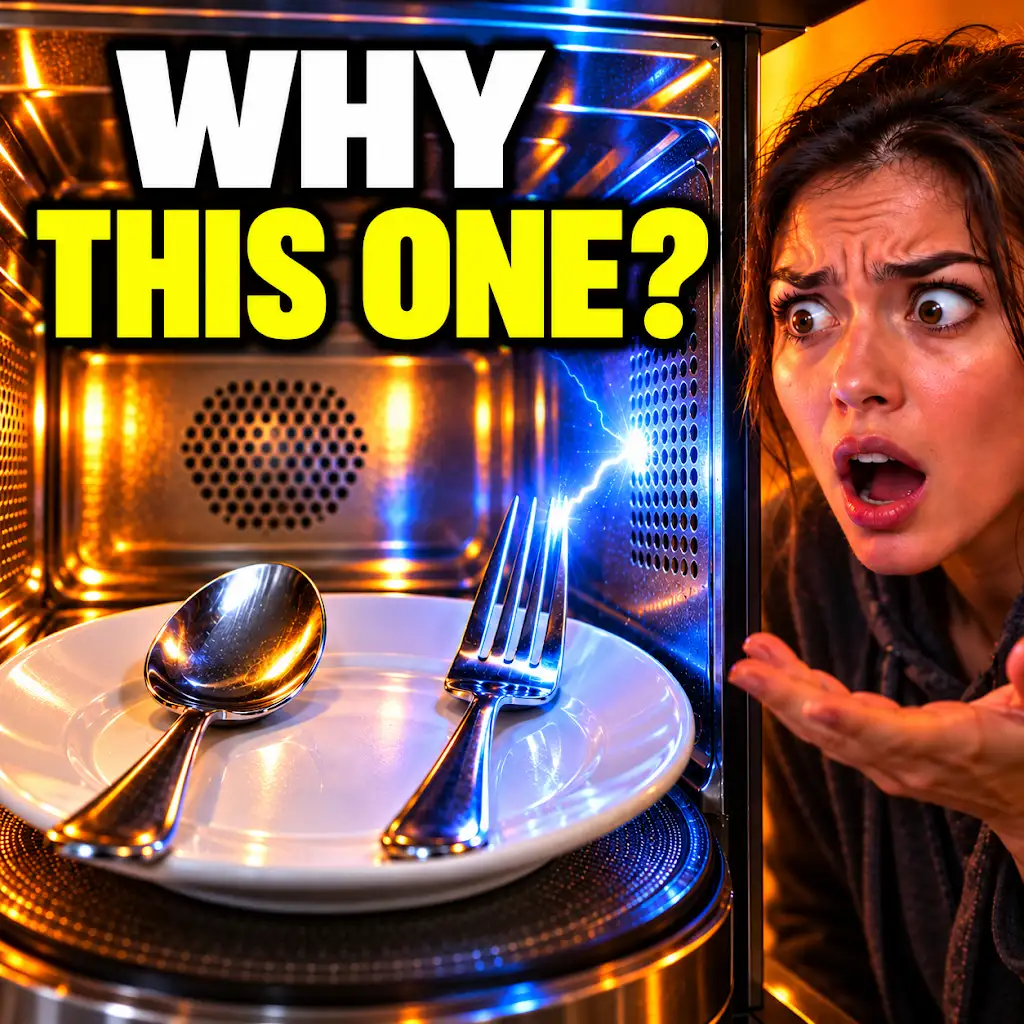
A Fork and a Spoon React Differently in a Microwave. Why?
FAQs
What is the difference between using smooth and crumpled foil in the microwave?
Using smooth foil in the microwave can cause sparks and potential fire hazards, while crumpled foil does not pose the same risk.
Why does smooth foil cause sparks in the microwave?
Smooth foil can cause sparks in the microwave because the smooth surface can create a build-up of electrical charge, leading to potential arcing and sparking.
Is it safe to use crumpled foil in the microwave?
Yes, using crumpled foil in the microwave is generally safe as it does not create the same electrical charge and sparking as smooth foil.
What are the potential dangers of using smooth foil in the microwave?
Using smooth foil in the microwave can lead to sparks, fire hazards, and damage to the microwave and its components.
Are there any safe alternatives to using foil in the microwave?
Yes, using microwave-safe containers, microwave-safe plastic wrap, or microwave-safe paper towels are safe alternatives to using foil in the microwave.