
You’ve probably experienced it: that unsettling flicker of light, that crackling sound, that moment of panic when you realize your fork, or maybe a spoon, is doing something entirely unexpected inside your microwave. It’s a common and slightly terrifying phenomenon, and you might be wondering, “Why on earth is my utensil sparking in here?” You’re not alone in your curiosity, and the science behind this seemingly magical (and potentially dangerous) event is surprisingly straightforward, stemming from the fundamental principles of how microwaves work.
Your microwave oven isn’t some mystical box that conjures heat out of thin air. Instead, it’s a clever application of electromagnetic radiation, specifically microwaves, to excite water molecules within your food.
How Microwaves Heat Food
At its core, a microwave oven utilizes a component called a magnetron. This is a vacuum tube that generates high-frequency electromagnetic waves – microwaves – typically at a frequency of 2.45 gigahertz. These waves are then directed into the cooking cavity of the oven.
The Role of the Magnetron
The magnetron is the powerhouse of your microwave. It generates the microwaves by exploiting the interaction of electrons with magnetic and electric fields. This process creates a beam of electromagnetic energy that is then channeled into the oven cavity.
The Waveguide and Stirrer/Turntable
Once generated, the microwaves travel through a waveguide, a metal channel that directs them towards the food. To ensure more even heating, many microwaves employ a stirrer (a rotating fan-like device) or a turntable to move the food and expose it to the microwaves from different angles. This is crucial because microwaves don’t penetrate food uniformly, and without this redistribution, you’d end up with hot spots and cold spots.
The Electromagnetic Spectrum and Microwaves
It’s helpful to understand where microwaves sit within the broader electromagnetic spectrum. This spectrum encompasses all forms of electromagnetic radiation, from low-energy radio waves to high-energy gamma rays. Microwaves fall between radio waves and infrared radiation. They possess enough energy to cause certain molecules to vibrate but are not as energetic as visible light or X-rays.
Understanding Wavelength and Frequency
The properties of electromagnetic waves are defined by their wavelength and frequency. Wavelength is the distance between successive crests of a wave, while frequency is the number of waves that pass a point in one second. Microwaves, with their specific frequency, are particularly effective at interacting with the dipole moment of water molecules.
When it comes to understanding why a fork sparks in a microwave, it’s essential to explore the science behind electromagnetic waves and metal objects. For a more in-depth explanation, you can check out this related article that discusses the interaction between microwaves and conductive materials. The article provides insights into the dangers of placing metal in microwaves and offers tips on safe microwave usage. To read more, visit this link.
The Crucial Interaction: Microwaves and Water Molecules
The magic of microwave cooking lies in its interaction with water. Most foods contain a significant amount of water, and it’s this water that absorbs the microwave energy and generates heat.
Dipole Moment and Molecular Vibration
Water molecules (H₂O) are polar. This means they have a slight positive charge on one end (the hydrogen atoms) and a slight negative charge on the other (the oxygen atom). This asymmetry is called a dipole moment.
How Microwaves Excite Water
When microwaves enter the food, their oscillating electric field causes these polar water molecules to try and align themselves with the field. As the electric field rapidly flips back and forth (billions of times per second), the water molecules are forced to constantly rotate and vibrate, trying to keep up. This rapid vibration generates kinetic energy, which we perceive as heat.
Other Polar Molecules
While water is the primary target, other polar molecules present in food, such as fats and sugars, can also absorb microwave energy to a lesser extent. This contributes to the overall heating process.
The Problematic Metals: Why Forks Spark
Now, let’s get to the heart of your question: why does a fork spark in a microwave? The answer lies in the conductive properties of metal and how it interacts with the strong electromagnetic fields generated by the microwave.
Metals and Electrical Conductivity
Metals, like the stainless steel or aluminum that forks are typically made from, are excellent electrical conductors. This means that electrons within the metal can move freely.
The Nature of Free Electrons
In metallic solids, the valence electrons are not tightly bound to individual atoms. Instead, they form a “sea” of delocalized electrons that can move throughout the entire metal lattice. This mobility is what makes metals conduct electricity and heat so well.
Reflection and Absorption of Microwaves
When microwaves encounter a metallic object, they don’t behave like they do with food. Instead of being absorbed and causing molecular vibration, metals primarily reflect microwaves. However, the interaction isn’t purely reflective; there’s also an absorption component that leads to significant issues.
The Faraday Cage Effect (Partial)
A solid, continuous metal enclosure can act as a Faraday cage, blocking electromagnetic fields. However, a fork, with its irregular shape and often thin, pointed tines, doesn’t create a perfect Faraday cage within the microwave cavity. This allows some microwaves to penetrate and interact with the metal.
Electric Field Concentration and Charge Accumulation
The problem arises from how the microwaves’ electric field interacts with the metal’s free electrons. When microwaves hit the metal, they cause these free electrons to move rapidly. This movement of charge leads to the accumulation of electrical charge on the surface of the metal, particularly at sharp points and edges.
The Role of Sharp Edges and Points
The sharp points and edges of a fork are critical. These areas concentrate the electric field. Imagine the electric field lines trying to flow around the metal. They get squeezed together at sharp protrusions, creating areas of much higher electric field strength.
The Sparking Phenomenon: Arcing and Discharge
This concentration of electric charge at sharp points is the direct cause of the sparking you observe. It’s a process known as electrical arcing.
Reaching the Dielectric Breakdown Strength
As the electric field strength increases at these sharp points, it can eventually exceed the dielectric breakdown strength of the air surrounding the metal. The dielectric breakdown strength is the maximum electric field a material (in this case, air) can withstand before it begins to conduct electricity.
Air as an Insulator (Normally)
Under normal conditions, air is a good electrical insulator. However, when the electric field becomes sufficiently strong, it can ionize the air molecules. Ionization means stripping electrons from atoms or molecules, creating charged particles (ions and free electrons).
The Birth of a Spark
Once the air is ionized, it becomes conductive. This allows an electrical current to flow through the air, creating a visible arc of plasma. This is the spark you see – a miniature lightning bolt occurring within your microwave.
Plasma Formation
The spark itself is a channel of superheated, ionized gas called plasma. This plasma is incredibly hot and luminous, which is why it appears as a bright flash.
The Crackling Sound
The crackling sound you hear is the rapid expansion of air as it’s heated by the electrical discharge and the resulting shockwaves. It’s the audible manifestation of the energetic breakdown of the air’s insulating properties.
When using a microwave, many people may wonder why a fork can cause sparks, which is a phenomenon related to the metal’s interaction with microwaves. This intriguing topic is explored in more detail in a related article that discusses the science behind microwave cooking and the potential hazards of using metal utensils. For those curious about the underlying principles, you can read more about it in this informative piece on Freaky Science, where the effects of microwaves on various materials are examined. Understanding these interactions can help prevent accidents and ensure safer cooking practices.
Why Some Metals Spark More Than Others and How to Avoid It
| Reason | Explanation |
|---|---|
| Metal in the fork | When a metal object, such as a fork, is placed in a microwave, it can cause sparks due to the electrical currents induced in the metal. |
| Sharp edges | If the fork has sharp edges or points, it can concentrate the electrical currents, leading to sparking. |
| Reflection of microwaves | The metal in the fork can reflect and concentrate the microwaves, leading to sparking and potential damage to the microwave. |
Not all metallic objects will spark in your microwave, and understanding why can help you prevent these incidents. The shape, size, and type of metal all play a role.
The Shape Factor: Sharp vs. Smooth
As discussed, sharp edges and points are a major culprit. Forks, with their tines, are particularly prone to this. A smooth, rounded metal bowl, while still problematic, might not spark as dramatically because there are fewer concentrated points for charge buildup.
The Influence of Surface Area
The surface area of the metal also plays a role. A larger surface area can dissipate charges more effectively, potentially reducing the risk of arcing. However, this is often overridden by the presence of sharp points.
The Role of Thickness and Material Composition
While the shape is paramount, the thickness and composition of the metal can also influence the outcome. Thicker metals might absorb more microwave energy before reaching a critical charge density. Different metal alloys can also have slightly different conductive properties.
Aluminum Foil Nuances
Aluminum foil is a common material that can spark, especially if crumpled or placed too close to the microwave walls. Its thinness and ability to conform to shapes mean it can create numerous sharp edges. However, when used strategically and with caution, in a smooth, single layer, it can sometimes be used to shield parts of food from overcooking by reflecting microwaves, but this is a delicate operation.
The Dangers of Metal in Microwaves
Beyond the visual spectacle, sparks are a sign of intense electrical activity that can be damaging to your microwave and pose a fire hazard.
Damage to the Magnetron
The reflected microwaves can bounce back into the magnetron, the very component that generates them. This can cause overheating and eventual damage to the magnetron, leading to costly repairs or the need for a new microwave.
Fire Hazard
The intense heat generated by the arcing can ignite food debris or packaging materials within the microwave, creating a fire risk. It’s crucial to remove any metallic objects immediately if you see sparks.
Safe Microwave Practices: What NOT to Do
The simplest way to avoid sparking is to avoid putting metal in the microwave in the first place.
Removing All Metallic Items
Before you hit start, take a moment to scan your microwave-safe dishes. Ensure no forks, spoons, knives, or metallic trim on dishes are present.
Understanding “Microwave Safe” Labels
Look for the “microwave safe” symbol on your dishes. This typically indicates that the material is designed to withstand microwave radiation without issue. These are usually glass, ceramic, or certain plastics.
The Case of Metal Racks and Trays
Some microwave ovens come with metal racks or trays. These are usually designed to be used in specific ways and are often insulated to prevent direct contact with the microwave walls. However, always consult your microwave’s manual for guidance on using any included metal accessories. If in doubt, err on the side of caution and avoid using them.
What to Do If You See Sparks
If you do notice sparks, don’t panic, but act quickly.
Immediately Stop the Microwave
The most important step is to immediately stop the microwave by pressing the “Stop” or “Cancel” button.
Open the Door and Remove the Metal
Once the microwave has stopped, carefully open the door and remove the offending metallic item. Be cautious, as the item might be hot.
Inspect Your Microwave
After removing the metal, it’s a good idea to inspect your microwave for any signs of damage, such as burnt spots or melted plastic. If you notice significant damage, it’s best to have it inspected by a professional.
By understanding the science behind microwave cooking and the properties of metals, you can ensure your kitchen adventures are both delicious and safe. So, the next time you see a fork sparking, you’ll know it’s not magic, but rather a fascinating interplay of electromagnetism and electrical conductivity.
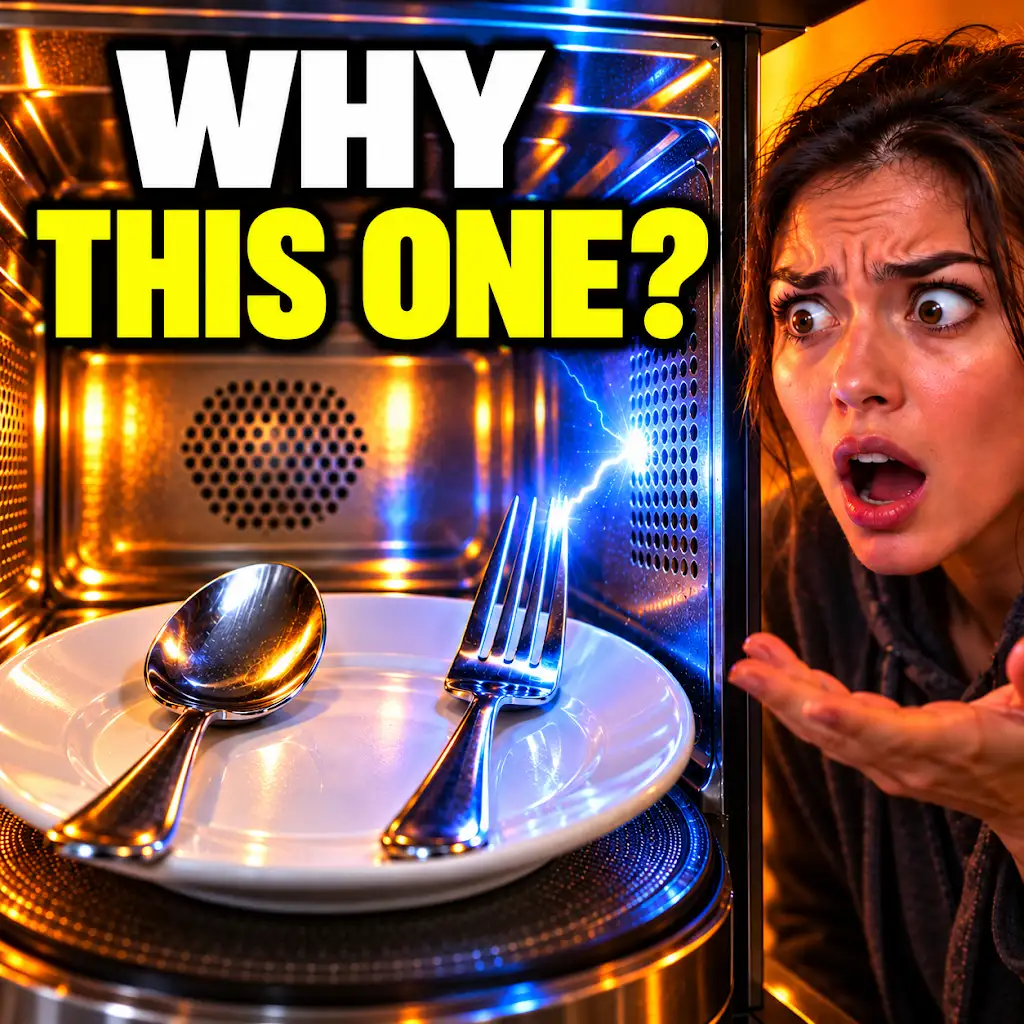
A Fork and a Spoon React Differently in a Microwave. Why?
FAQs
1. Why does a fork spark in a microwave?
Metal objects such as forks have a thin, pointed shape that can cause electrical charges to build up and create sparks when placed in a microwave. This is due to the interaction between the microwaves and the metal, which can lead to a phenomenon known as arcing.
2. Is it safe to put metal in a microwave?
It is not safe to put metal objects, including forks, in a microwave. The electrical charges and sparks created by the interaction between the metal and the microwaves can potentially damage the microwave and pose a fire hazard.
3. What happens when a fork sparks in a microwave?
When a fork sparks in a microwave, it can cause damage to the interior of the microwave, as well as potentially create a fire hazard. The sparks are a result of the electrical charges building up and arcing between the metal object and the microwave’s interior.
4. How can I safely heat food in a microwave?
To safely heat food in a microwave, it is important to use microwave-safe containers and avoid placing any metal objects, including forks, inside the microwave. Additionally, it is important to follow the manufacturer’s guidelines for proper use of the microwave.
5. What should I do if a fork sparks in a microwave?
If a fork sparks in a microwave, it is important to immediately turn off the microwave and carefully remove the metal object using a non-metallic utensil. It is also important to inspect the microwave for any damage and ensure that it is safe to continue using.