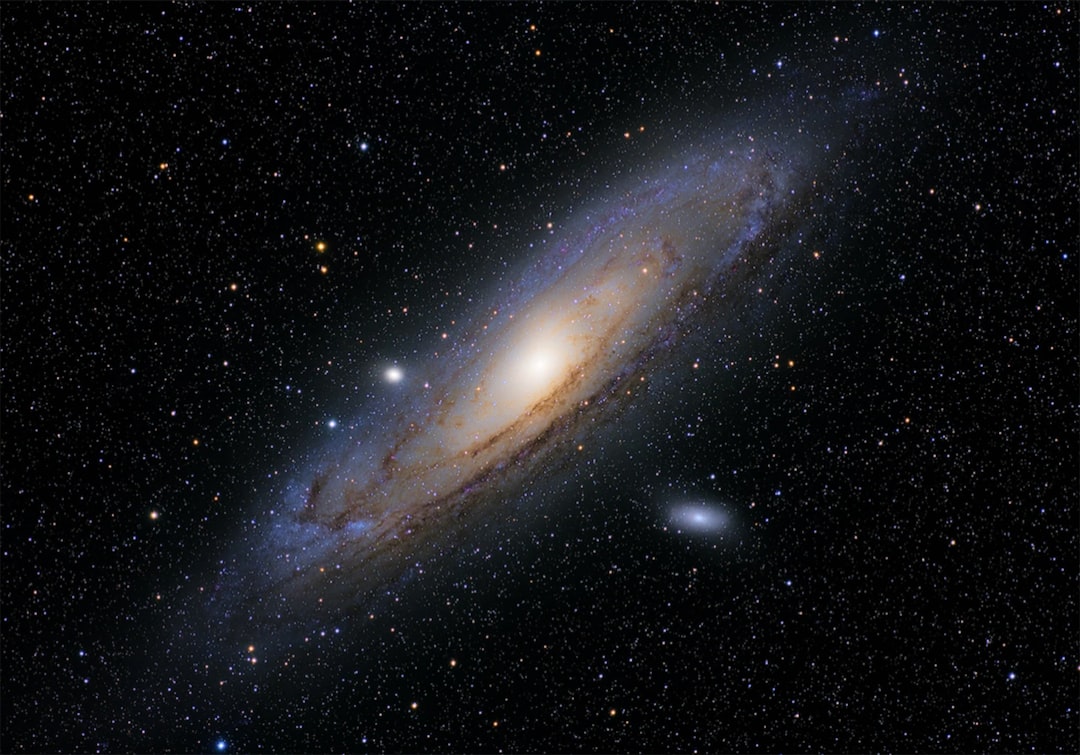
Imagine standing on Earth, gazing up at the velvety night sky. Amidst the familiar constellations, a faint, hazy smudge often catches your eye – the Andromeda Galaxy. It’s a whisper of light, a promise of immensity, and the closest spiral galaxy to our own Milky Way. But what does it truly mean to “see” Andromeda? It’s a question that delves into the very fabric of space and time, and embarking on a journey to Andromeda, even in thought, is a profound exploration of light travel time.
To truly grasp the scale of traveling to Andromeda, you must first understand the ultimate cosmic speed limit: the speed of light. It’s not just a concept; it’s the bedrock of our universe’s workings.
What is Light and Its Speed?
Light, as we perceive it, is electromagnetic radiation that travels in waves. These waves, however, are not bound by the physical constraints we experience in our everyday lives. They zip through the vacuum of space at an astonishing velocity. This speed, denoted by the symbol ‘c’, is approximately 299,792,458 meters per second. To put that into perspective, in one single second, light can circle the Earth roughly 7.5 times. It’s a speed so immense that it defines our understanding of causality – nothing with mass can ever reach or exceed it.
The Unwavering Constant: Why Light Speed Matters
The constancy of the speed of light is one of the most fundamental principles in physics, established by Albert Einstein’s theory of special relativity. This means that regardless of your own motion, you will always measure the speed of light to be the same. This seemingly simple fact has profound implications for how we perceive time and distance, especially over vast cosmic scales. It’s the universal odometer, the ultimate benchmark against which all other speeds are measured, and the very currency of interstellar distances. Without this unwavering constant, our cosmic map would be utterly nonsensical.
The Andromeda Galaxy, our nearest galactic neighbor, is approximately 2.537 million light-years away from Earth, which means that the light we see from it today actually left the galaxy over two million years ago. This fascinating aspect of cosmic distances highlights the vastness of the universe and the time it takes for light to travel across such immense spaces. For a deeper understanding of light travel time and its implications in astronomy, you can read a related article at Freaky Science.
Andromeda’s Distance: A Measure of Light-Years
When we talk about the distance to Andromeda, we’re not using miles or kilometers. We’re using a unit specifically designed for the cosmos: the light-year. This unit, born out of the necessity to express unimaginable distances, directly ties distance to the travel time of light.
Defining the Light-Year
A light-year is precisely the distance that light travels in one Earth year. Given the speed of light we discussed earlier, this translates to an astonishing number. One light-year is approximately 9.461 trillion kilometers (or about 5.879 trillion miles). When you look at Andromeda and think of its distance, you’re looking at a number of these colossal units.
The Astronomical Figure: Andromeda’s True Span
The Andromeda Galaxy is approximately 2.537 million light-years away from us. This means that the light you see from Andromeda tonight began its journey towards your eyes over two and a half million years ago. The photons that strike your retina have been traveling through the void for a period longer than recorded human history. This isn’t just a number; it’s a temporal echo, a glimpse into a past so distant it’s almost unfathomable. To truly comprehend this distance is to grapple with the sheer scale of the universe and our place within it.
The Journey Begins: From Earth to Andromeda
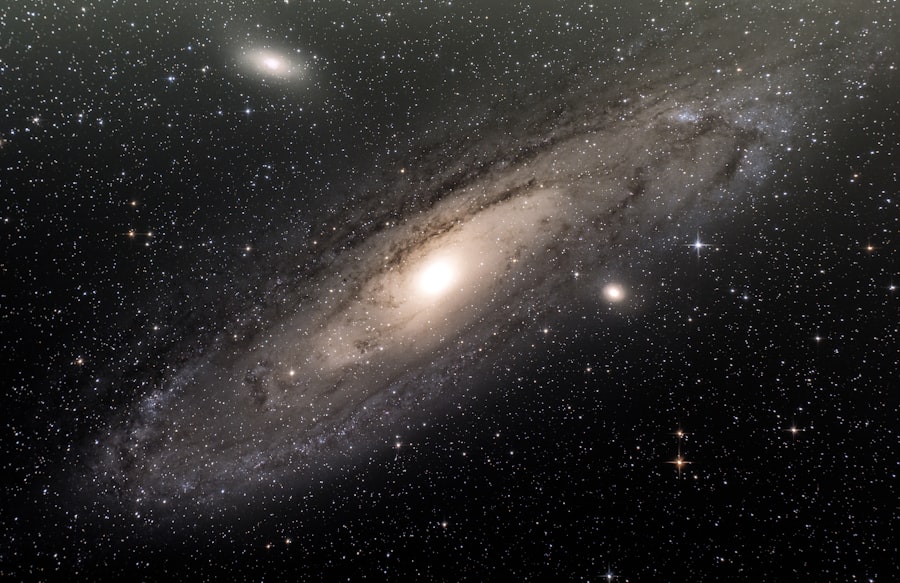
Embarking on a hypothetical journey to Andromeda immediately confronts you with the limitations imposed by the speed of light. Even with our most advanced propulsion systems, the timescale involved is staggering.
Our Current Technological Limits
As of today, humanity’s fastest spacecraft, like the Parker Solar Probe, reach speeds of around 700,000 kilometers per hour (435,000 miles per hour). While this is incredibly fast by terrestrial standards, it’s a mere crawl when compared to the speed of light. To put it into context, if one of our fastest probes were to journey to Andromeda, it would take approximately 4.5 billion years to reach it. This is longer than the age of our own solar system. Our current technology, while impressive, is fundamentally incapable of making such a journey within any meaningful human timeframe.
Theoretical Future Propulsion: A Glimmer of Hope?
The dream of interstellar travel fuels countless scientific inquiries and speculative technologies. Concepts like warp drives, Alcubierre drives, and other forms of exotic propulsion aim to circumvent the speed of light limit, not by exceeding it directly, but by manipulating spacetime itself. These are currently theoretical, requiring immense amounts of energy and potentially new understandings of physics. If such technologies were ever to become a reality, they could drastically shorten the travel time to Andromeda. However, we are talking about the realm of science fiction for now, with no immediate practical application.
The Implications of Light Travel Time: A Cosmic Perspective

The vast distances and the constraints of light travel time profoundly shape our understanding of the universe and our place within it. It’s not just about getting somewhere; it’s about what that journey reveals.
Observing the Past: A Window into Cosmic History
Every star you see, every galaxy you observe, is a snapshot of the past. The light they emit takes time to reach us, acting as a cosmic time machine. When you look at Andromeda, you are not seeing it as it is now, but as it was 2.537 million years ago. This means that any changes that have occurred in Andromeda since then – the birth and death of stars, the evolution of its structure – are not yet visible to us. This concept is crucial for cosmologists studying the early universe, as the light from distant galaxies allows them to observe cosmic events that happened billions of years ago.
The Challenge of Communication: A Delayed Conversation
The speed of light also dictates the speed of communication. If you were to send a radio signal to Andromeda today, it would take 2.537 million years to arrive. If you then received a reply, it would take another 2.537 million years to return. This makes any real-time conversation or interaction with potential extraterrestrial civilizations in Andromeda an impossibility with our current understanding of physics. Our cosmic neighborhood, despite its proximity in galactic terms, is effectively disconnected by the vast gulf of light travel time. This emphasizes the profound solitude we experience in the universe.
The Birth of Stars and Galaxies: A Temporal Dance
The light travel time to Andromeda also influences our understanding of cosmic evolution. When we observe distant galaxies, we are witnessing the universe in its earlier stages. We can see the formation of stars and galaxies that occurred when the universe was much younger. This allows us to piece together the grand narrative of cosmic evolution, from the Big Bang to the present day. The light from Andromeda, in a way, is a historical record, allowing us to study the processes that shaped our own galaxy and the cosmos as a whole.
The Andromeda galaxy, located approximately 2.537 million light-years away from Earth, fascinates astronomers and stargazers alike with its vastness and beauty. Understanding the light travel time from Andromeda not only helps us grasp the scale of the universe but also provides insights into the history of our cosmic neighborhood. For those interested in exploring more about the mysteries of the universe, a related article can be found at Freaky Science, which delves into various astronomical phenomena and their implications for our understanding of space.
The Future of Interstellar Travel: Dreaming Beyond Light
| Data | Metric |
|---|---|
| Distance from Earth to Andromeda galaxy | 2.537 million light years |
| Speed of light | 299,792,458 meters per second |
| Light travel time | 2.537 million years |
While the journey to Andromeda currently feels like an insurmountable challenge, the human spirit of exploration continues to push boundaries, both in imagination and in scientific endeavor.
Bridging the Interstellar Divide: The Quest for Speed
The quest for faster-than-light (FTL) travel, or at least dramatically faster-than-light (FTL) travel, remains a tantalizing prospect. This involves exploring theoretical concepts that bend or warp spacetime, allowing for apparent faster-than-light travel without violating the fundamental laws of physics.
Warp Drives and Wormholes: Theoretical Frameworks
The concept of a “warp drive,” popularized by science fiction, proposes creating a bubble of spacetime that contracts in front of a spacecraft and expands behind it, effectively allowing the spacecraft to travel at speeds faster than light relative to the space outside the bubble. This is inspired by theoretical solutions to Einstein’s field equations. Similarly, wormholes are hypothetical tunnels through spacetime that could connect two distant points, offering a shortcut. However, the existence of stable, traversable wormholes is highly speculative and requires exotic matter with negative energy density.
Fusion and Antimatter Propulsion: Pushing the Envelope of Conventional Means
While not FTL, advancements in propulsion systems like fusion rockets and antimatter rockets could drastically reduce travel times within the solar system and potentially to nearby stars. Fusion rockets, harnessing the power of nuclear fusion, could achieve much higher exhaust velocities than current chemical rockets. Antimatter propulsion, using matter-antimatter annihilation, promises the highest energy density known, potentially enabling speeds that, while still sub-light, could make interstellar journeys measurable in decades rather than billions of years. These are still on the bleeding edge of technological development but represent more grounded advancements compared to theoretical FTL concepts.
The Philosophical Implications: Humanity’s Place in the Cosmos
The vastness of space and the immense light travel times to destinations like Andromeda force us to confront profound philosophical questions about our place in the universe.
Solitude and Connection: Are We Alone?
The fact that it takes light millions of years to reach us from Andromeda underscores the potential isolation of life in the universe. Even if intelligent civilizations exist there, any attempt at direct communication or interaction would be a monumental undertaking spanning epochs. This solitude can be both humbling and inspiring, prompting us to cherish the life we have here on Earth and to continue our search for cosmic companionship.
The Evolution of Consciousness: A Galactic Perspective
The journey to Andromeda, even as a thought experiment, expands our perspective beyond our terrestrial concerns. It encourages us to think in terms of galactic timescales and the long-term evolution of life and consciousness. It challenges us to consider what it truly means to be intelligent beings in a universe so vast and ancient. The very act of contemplating such a journey is an evolution of our own consciousness, a testament to our innate curiosity and desire to understand the unknown. Your journey through Andromeda, measured in light travel time, is not just a physical exploration but a cognitive and philosophical one, pushing the boundaries of your own understanding.

Einstein Says There Is No Universal “Now” in the Universe
FAQs
What is the Andromeda galaxy?
The Andromeda galaxy, also known as Messier 31, M31, or NGC 224, is a spiral galaxy located about 2.537 million light-years from Earth. It is the nearest spiral galaxy to the Milky Way.
How long does light take to travel from the Andromeda galaxy to Earth?
Light from the Andromeda galaxy takes approximately 2.537 million years to reach Earth. This means that when we observe the Andromeda galaxy, we are seeing it as it appeared over 2 million years ago.
What can we learn from studying the light from the Andromeda galaxy?
Studying the light from the Andromeda galaxy allows astronomers to learn about the galaxy’s composition, structure, and evolution. It also provides insights into the early universe and the processes that have shaped galaxies over billions of years.
How does the light travel time from the Andromeda galaxy impact our understanding of the universe?
The light travel time from the Andromeda galaxy serves as a cosmic time machine, allowing us to observe the galaxy as it appeared millions of years ago. This helps astronomers piece together the history and evolution of the universe.
What are some future implications of studying the light from the Andromeda galaxy?
Studying the light from the Andromeda galaxy can provide valuable information about the fate of our own Milky Way galaxy, as it is expected to collide with Andromeda in about 4.5 billion years. Additionally, it can contribute to our understanding of the larger structure and dynamics of the universe.