
The effortless glide of an ice skater, a seemingly magical dance across a frozen surface, has captivated observers for centuries. While the visual spectacle is undeniable, the underlying science that enables this smooth motion is equally fascinating. It’s a delicate interplay of pressure, temperature, and a phenomenon known as “boundary lubrication” that allows those sharp blades to slice through ice with such minimal friction. Far from being a simple matter of sharp metal meeting frozen water, the physics behind ice skating reveals a complex and elegant solution to overcoming resistance.
The most intuitive explanation for why ice skates slide on ice often centers on the idea that the sharp blade melts the ice directly beneath it, creating a thin layer of water that acts as a lubricant. This concept, while broadly correct, is more nuanced than it might initially appear. The immense pressure exerted by the skater’s weight concentrated on the extremely thin edge of the blade is the primary driver of this localized melting.
The Role of Pressure in Lowering the Melting Point
Ice, unlike most substances, becomes less dense when it freezes. This unusual property is due to the crystalline structure of frozen water, where the molecules are held in a relatively open, hexagonal lattice. When pressure is applied to ice, it forces these molecules closer together, disrupting this open structure. According to thermodynamic principles, specifically the Clausius-Clapeyron relation, this compression leads to a decrease in the ice’s melting point. For every atmosphere of pressure applied, the melting point of ice drops by approximately 0.0074 degrees Celsius.
Quantifying the Pressure Exerted by a Skater
Consider an ice skate blade. Its width is typically only a millimeter or two, and its length might be around 30 centimeters. The total surface area of contact between the blade and the ice is therefore remarkably small. When a skater weighing, say, 70 kilograms, stands on one foot, the pressure exerted on the ice is immense. If we assume a blade width of 1.5 millimeters and a contact length of 20 centimeters (the portion actively in contact at any given moment), the contact area is roughly 300 square millimeters, or 3 x 10⁻⁴ square meters. Using the formula pressure = force/area, and knowing that force is mass x gravity (70 kg x 9.8 m/s² ≈ 686 Newtons), the pressure can be calculated. This calculation reveals a pressure on the order of several megapascals, which is equivalent to hundreds of atmospheres.
The Threshold for Significant Melting
While this pressure is substantial, it’s important to note that it’s not enough to melt ice at typical indoor skating rink temperatures (around -3 to -7 degrees Celsius) to a degree that would create a significant, free-flowing layer of water on its own. The pressure-induced melting alone accounts for only a tiny fraction of a millimeter of meltwater. This realization prompts a deeper dive into the mechanisms at play, suggesting that other factors are also contributing to the lubrication.
Ice skates slide on ice primarily due to the unique properties of ice and the design of the skates themselves. The thin blade of the skate reduces the surface area in contact with the ice, which helps to minimize friction. Additionally, the pressure exerted by the skater can cause a thin layer of water to form on the ice surface, further enhancing the glide. For a deeper understanding of the science behind this phenomenon, you can read more in this related article: Freaky Science.
Beyond Simple Melting: The Role of Friction and Heat
If pressure-induced melting alone isn’t the complete story, then friction must play a more significant role in generating the lubricating layer of water. The very act of sliding, of resisting motion, generates heat, and this heat also contributes to melting the ice. This understanding shifts the focus from a purely static pressure effect to a dynamic interaction.
Friction as a Heat Source
As the skate blade moves across the ice, microscopic imperfections on both surfaces come into contact. These imperfections cause resistance to the smooth motion, and this resistance is the essence of friction. The kinetic energy of the skater’s motion is converted into thermal energy at the interface between the blade and the ice. Even though ice is a relatively smooth surface, it is not perfectly so, and the blade, despite being sharpened, also possesses microscopic irregularities.
The Temperature Gradient at the Blade-Ice Interface
The heat generated by friction, combined with the pressure-induced melting, creates a temperature gradient at the interface. While the bulk ice might be at a temperature well below freezing, the thin layer directly in contact with the blade can momentarily reach temperatures at or slightly above 0 degrees Celsius. This localized warming is crucial for maintaining the lubricating film.
The “Friction Melt” Hypothesis
The “friction melt” hypothesis suggests that at typical skating speeds and temperatures, friction-generated heat is the dominant contributor to the thin water layer. As the blade moves, the constant generation of heat keeps the thin layer of ice at the interface melted. This perspective highlights the dynamic nature of the skating process; it’s not a static melting but a continuous process of melting and reforming.
The Phenomenon of Boundary Lubrication

The subtle yet crucial lubricating effect observed in ice skating is a prime example of boundary lubrication, a principle that applies to many friction-reducing scenarios. In this regime, the lubricant layer is extremely thin, often only a few molecules thick, and its effectiveness relies on the specific chemical and physical interactions at the interface.
Understanding Lubrication Regimes
Lubrication can generally be categorized into several regimes, including hydrodynamic, mixed, and boundary lubrication. Hydrodynamic lubrication occurs when a thicker layer of lubricant completely separates the moving surfaces. Mixed lubrication involves a partial separation, with occasional direct contact. Boundary lubrication, as seen in ice skating, is characterized by the lubricant layer being too thin for full separation, meaning that the surfaces are in close proximity, and intermolecular forces play a significant role.
The Role of Adsorption and Molecular Interactions
In boundary lubrication, the lubricating molecules “adsorb” onto the surfaces, forming a film that reduces direct solid-to-solid contact. In the case of ice skating, the water molecules themselves, in their liquid state, act as the boundary lubricant. These water molecules are attracted to the surface of the ice through hydrogen bonding. While it might seem counterintuitive for water to lubricate ice, the specific arrangement and movement of these adsorbed water molecules at the blade-ice interface are key.
The Slipping of Water Layers
The thin layer of water is not a static film. It acts as a collection of fluid layers that can slide past each other relatively easily. The weak hydrogen bonds between water molecules allow for this shear, facilitating the smooth motion of the blade. Think of it like a stack of playing cards; while individual cards might resist sliding, the entire stack can be moved with relative ease. The blade is essentially sliding on these thin, fluid layers of water.
The Importance of Blade Design and Material
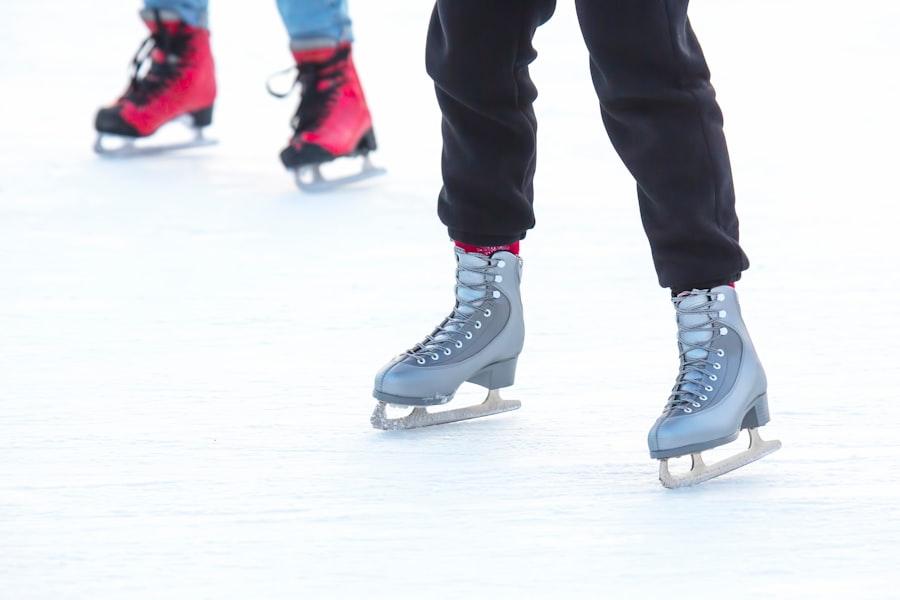
The science behind ice skating isn’t just about the interaction with ice; the design and material of the skate blade itself are equally critical. The sharpness, curvature, and material composition of the blade are all engineered to optimize the sliding process.
The Sharpness of the Blade: Minimizing Contact Area
The extremely sharp edge of an ice skate is not just for aesthetics; it’s a functional necessity. A sharp edge creates a very narrow contact line with the ice, which, as discussed earlier, dramatically increases the pressure exerted by the skater’s weight. This high pressure is essential for initiating and maintaining the melt layer. A dull blade would distribute the force over a larger area, reducing the pressure and thus the melting effect, making skating far more difficult.
The Concave Shape: Enhancing Control and Glide
Most ice skate blades are not flat; they have a concave curvature along their length, often referred to as a “rocker.” This curvature has several important functions. Firstly, it allows the skater to maneuver and turn by tilting the blade onto its edge. Secondly, and more importantly for the glide, it effectively reduces the contact area during straight-line skating. The blade only makes contact with the ice along a small arc, again concentrating the pressure and promoting melting. The degree of concavity can be adjusted to suit different skating disciplines.
Material Properties and Surface Finish
The material of the blade, typically high-carbon stainless steel, is chosen for its strength, durability, and ability to hold a sharp edge. The surface finish of the blade is also crucial. A smooth, polished surface minimizes its own contribution to friction. Any roughness or imperfections on the blade’s surface would create additional resistance and hinder the glide.
Ice skates glide effortlessly over ice due to a fascinating combination of physics and the unique properties of ice itself. The pressure exerted by the blade on the ice causes a thin layer of water to form, which reduces friction and allows for smooth movement. For a deeper understanding of this phenomenon, you can explore a related article that delves into the science behind why ice skates slide so well on ice. Check it out here to learn more about the intriguing science of ice skating.
Beyond the Fundamentals: Factors Influencing the Glide
| Reason | Explanation |
|---|---|
| Low Friction | Ice has a low coefficient of friction, allowing ice skates to slide easily. |
| Pressure Melting | When the blade of the ice skate applies pressure to the ice, it melts slightly, creating a thin layer of water that reduces friction. |
| Smooth Surface | Ice has a smooth surface, which further reduces friction and allows ice skates to glide smoothly. |
While pressure, friction-induced heat, and boundary lubrication are the core scientific principles, several other factors can subtly influence the smoothness of the ice skate’s glide. Understanding these variables allows for a more complete picture of this seemingly simple yet scientifically rich activity.
Ice Surface Condition: The Role of “Good Ice”
The condition of the ice itself plays a significant role in the quality of the glide. “Good ice” is typically smooth, free of significant nicks, scratches, or debris. The process of “zamboning” or resurfacing the ice aims to create this ideal, smooth surface. Any irregularities on the ice surface will interact with the skate blade, increasing friction and reducing the feeling of a smooth glide.
Water Purity and Contaminants
The purity of the water used to create the ice can also have a subtle impact. Dissolved minerals or impurities in the water can affect the ice’s crystalline structure and its interaction with the skate blade. While the effect is generally minor, it is a factor that experienced skaters and ice technicians are aware of. Similarly, debris on the ice, such as dirt or dust, will create friction and disrupt the smooth glide.
Ambient Temperature and Humidity
The ambient temperature of the skating venue and the humidity levels can also subtly influence the melting process. In warmer environments, the ice might be closer to its melting point, requiring less pressure and friction to generate the lubricating layer. Conversely, in very cold environments, the melting process might be slightly slower. Humidity can affect the condensation on the ice surface, which in turn can influence its slipperiness.
The Skater’s Technique and Stance
While not a scientific principle in itself, the skater’s technique and stance are paramount in exploiting the underlying science. A skater’s ability to apply consistent and controlled pressure, maintain a balanced stance, and execute efficient movements directly influences the effectiveness of the melt layer and the overall glide. A poorly executed technique can lead to increased friction and a loss of speed, regardless of the ideal scientific conditions. The efficient transfer of energy through precise movements maximizes the benefit derived from the low-friction interface.
In conclusion, the seemingly effortless slide of an ice skate is a testament to the elegant interplay of physics. The immense pressure exerted by a sharp blade lowers the melting point of ice, while the friction generated during motion creates localized heat, further contributing to the formation of a thin, lubricating layer of water. This thin film, operating under the principles of boundary lubrication, allows the blade to glide with remarkable ease. The precise design of the skate blade, coupled with the condition of the ice surface and the skater’s skillful technique, all converge to create the mesmerizing spectacle of an ice skater’s smooth, fluid motion. It is a perfect example of how fundamental scientific principles, when applied with ingenuity, can lead to seemingly magical results.

Why Ice Is Slippery Is Stranger Than You Think
FAQs
1. How do ice skates slide on ice?
Ice skates slide on ice due to a thin layer of water that forms between the blade and the ice. This layer of water reduces friction, allowing the skater to glide smoothly across the ice.
2. What causes the thin layer of water to form on the ice?
The pressure exerted by the skater’s weight on the ice causes the ice to melt slightly, creating a thin layer of water. This phenomenon is known as “pressure melting” or “ice friction melting.”
3. Why do ice skates slide more easily on colder ice?
Colder ice is harder and less likely to deform under the pressure of the skater’s weight, resulting in a smoother and more consistent layer of water forming between the blade and the ice. This reduces friction and allows for easier sliding.
4. Can the type of ice affect how ice skates slide?
Yes, the type of ice can affect how ice skates slide. Rough or bumpy ice can create more friction and make it more difficult for skates to slide smoothly, while smooth and well-maintained ice provides a better surface for skating.
5. Are there any other factors that can affect how ice skates slide on ice?
Other factors that can affect how ice skates slide on ice include the sharpness and quality of the skate blades, the skater’s technique and skill, and the presence of any debris or impurities on the ice surface.