
The familiar act of erasing a pencil mark, a seemingly simple process, belies a fascinating interplay of physics and chemistry. The eraser, a tool designed to remove graphite from paper, does not achieve this feat through magic or some inert property. Instead, the very mechanism of erasure is a testament to the fundamental principles of friction and material science, and in its wake, it leaves behind a subtle but measurable byproduct: heat. Understanding why this happens requires delving into the microscopic world of materials and their interactions.
The effectiveness of an eraser hinges on its material composition. Unlike paper, which is relatively smooth and porous, the ideal eraser possesses specific characteristics that allow it to adhere to and lift graphite particles. Early erasers, often made of breadcrumbs or rubber, paved the way for the more sophisticated materials we use today. Modern erasers are typically formulated from polymers, such as vinyl, rubber, or a blend of both. These polymers are chosen for their elasticity, their ability to deform without breaking, and their surface texture.
The Microscopic Landscape of an Eraser
Under a microscope, an eraser’s surface is not a smooth, uniform plane. Instead, it is a complex topography of peaks, valleys, and pores. These imperfections are crucial. When an eraser is pressed against paper, its pliable material conforms to the microscopic irregularities of both the paper and the graphite particles embedded within it. This intimate contact is the first step in the erasure process. The larger the contact area at a microscopic level, the greater the potential for interaction.
The Sticky Nature of Polymers
The polymeric nature of most erasers contributes to their ability to grip the graphite. Polymers possess intermolecular forces, such as van der Waals forces, which create a weak attraction between the polymer molecules and the graphite particles. While these forces are individually weak, their collective effect over a vast number of molecules provides a sufficient grip to dislodge the graphite. This is akin to how sticky notes adhere to surfaces; it’s not a strong chemical bond, but a multitude of weak attractions.
The Power of Abrasion and Adhesion
The dual nature of erasure lies in both adhesion and abrasion. Adhesion refers to the sticking together of different substances. In this case, the eraser material adheres to the graphite. Abrasion, on the other hand, is the process of rubbing or grinding away. As the eraser moves across the paper, it not only adheres to the graphite but also exerts a shearing force. This force, combined with the texture of the eraser, scrapes and lifts the graphite particles from the paper’s surface. The eraser essentially acts as a temporary adhesive that, upon being moved, pulls the graphite away with it.
The phenomenon of heat generation during the process of erasing a bit of information is intricately linked to the principles of thermodynamics and information theory. When a bit is erased, it transitions from a state of uncertainty to a state of certainty, which inherently involves energy exchange and results in the production of heat. For a deeper understanding of this concept, you can explore the article on the relationship between information and thermodynamics at Freaky Science, which delves into the science behind how information processing impacts energy and heat generation.
The Friction Factor: Energy Transformation at Play
The act of rubbing an eraser over paper is a quintessential example of friction in action. Friction is a force that opposes motion between surfaces in contact. In the context of erasure, this friction is not merely an obstacle to be overcome; it is the very engine that drives the process. And as with most instances of friction, its byproduct is heat.
Understanding the Mechanics of Friction
When two surfaces are rubbed together, their microscopic irregularities interlock. To overcome this interlocking and cause motion, energy must be expended. This energy is primarily converted into thermal energy, manifesting as heat. The eraser and the paper, with their respective surface textures, create countless points of contact where this energy conversion occurs. The pencil lead itself, a compressed form of graphite, also contributes to this frictional interaction.
The Role of Force and Speed
The amount of heat generated during erasure is directly proportional to the force applied and the speed at which the eraser is moved. A firmer press and a faster swipe will invariably lead to more friction and, consequently, more heat. This is why pressing too hard or rubbing an area repeatedly can make the eraser feel warm to the touch. The energy input from the user’s hand is being dissipated as heat into the eraser and the paper.
Energy Dissipation Pathways
The generated heat does not remain localized solely within the eraser. It dissipates through several pathways:
- Conduction: Heat is transferred through direct contact from the eraser to the paper, and vice versa.
- Convection: While less significant in this scenario due to the limited air movement, some heat can be transferred to the surrounding air.
- Radiation: A minuscule amount of heat is radiated away as infrared energy.
The primary pathway for noticeable heat accumulation is conduction, as the eraser and paper are in close proximity.
The Graphite Transfer: A Microscopic Relocation
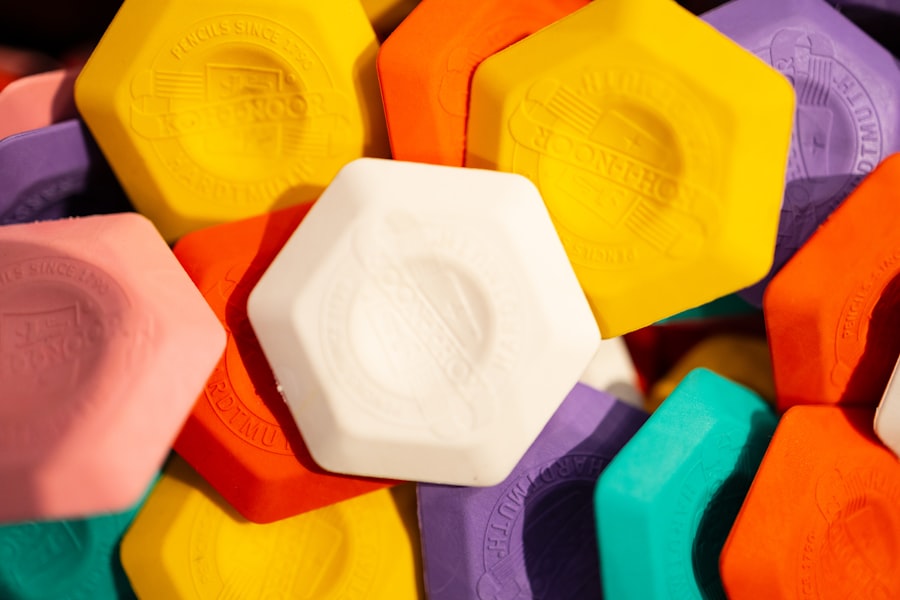
The fundamental goal of erasing is to relocate the graphite particles from the paper to the eraser. This transfer is not a simple evaporation or dissolution; it is a physical displacement driven by the forces at play. The eraser’s ability to adhere to and then lift the graphite is key to this process.
How Graphite Sticks to Paper
Pencil graphite is not a solid rod that is simply deposited onto paper. It is a collection of tiny graphite flakes that are held together by weaker forces. When drawing, the pencil lead is drawn across the paper, and these flakes are deposited into the paper’s fibers. The friction of the drawing process helps to embed these flakes into the microscopic valleys of the paper’s surface, creating a bond that is strong enough to resist being easily brushed away but weak enough to be lifted by an eraser.
The Eraser as a Graphite “Magnet”
The eraser, with its specific surface properties, acts like a selective magnet for these graphite flakes. The polymer molecules in the eraser have a higher affinity for the graphite flakes than the paper fibers do, under the conditions of rubbing. As the eraser moves, it creates a shear stress that breaks the bonds between the graphite and the paper. Simultaneously, the intermolecular forces between the eraser and the graphite pull the flakes onto the eraser’s surface.
The Limits of Eraser Capacity
An eraser cannot absorb an infinite amount of graphite. As more graphite is transferred, the eraser’s surface becomes saturated. This saturation can reduce its effectiveness, making it harder to lift further graphite. The accumulated graphite particles on the eraser’s surface also contribute to its changing texture and can even lead to smudging if the graphite is not removed from the eraser itself. The microscopic friction continues, but the efficiency of graphite transfer diminishes.
The Molecular Dance: Intermolecular Forces at Work

Beneath the macroscopic actions of rubbing and lifting lies a complex molecular dance governed by intermolecular forces. These forces, though weaker than the chemical bonds that hold atoms together, are responsible for holding bulk materials together and dictating their interactions. In the case of erasure, these forces explain both why the eraser sticks to the graphite and why the graphite is lifted.
Van der Waals Forces: The Subtle Attractors
Van der Waals forces are weak, short-range attractions between molecules. They arise from temporary fluctuations in electron distribution within molecules, creating transient dipoles that induce dipoles in neighboring molecules. These forces are crucial in binding nonpolar molecules and are present between all atoms and molecules. The graphite flakes and the polymer chains of the eraser are both composed of molecules, and van der Waals forces create a weak but significant attraction between them.
Dipole-Dipole Interactions and Hydrogen Bonding (Less Significant)
While van der Waals forces are primary, other intermolecular forces might play a minor role depending on the specific composition of the eraser and any contaminants present. If the polymer has polar groups, dipole-dipole interactions could contribute. Hydrogen bonding, a stronger type of dipole-dipole interaction, is less likely to be a significant factor in typical polymer-graphite interactions but could be relevant in specialized erasable inks. However, for standard graphite on paper, van der Waals forces are the dominant players in the adhesion of graphite to the eraser.
The Energetics of Adhesion and Release
When the eraser is pressed against the graphite, the intermolecular forces between the eraser molecules and the graphite particles are established. This formation of attractive forces requires a release of energy, which contributes to the generation of heat. Conversely, when the eraser is pulled away, the graphite is lifted because the eraser-graphite attractive forces overcome the graphite-paper attractive forces. This process involves breaking existing interactions, which requires energy input, but the net result of the rubbing action is the dissipation of energy as heat.
When discussing the phenomenon of heat generation during the process of erasing a bit in digital systems, it is fascinating to consider the underlying principles of thermodynamics and information theory. The act of erasing data is not merely a computational task; it involves a physical transformation that results in the release of energy in the form of heat. For a deeper understanding of this concept, you can explore a related article that delves into the science behind this process. The article explains how the second law of thermodynamics plays a crucial role in the relationship between information and energy, making it an intriguing read for those interested in the intersection of physics and information technology. To learn more, visit this article.
The Scientific Aftermath: Heat as Evidence of Work
| Data/Metric | Description |
|---|---|
| Erasing a bit | When a bit is erased from a storage device or memory. |
| Heat generation | Erasing a bit creates heat due to the energy required to change the state of the storage medium. |
| Energy consumption | The process of erasing a bit requires energy, which is converted into heat. |
| Material properties | The physical properties of the storage medium influence the amount of heat generated during bit erasure. |
The heat generated during erasure is not just a curious anomaly; it is a tangible indicator that work has been done. In physics, work is defined as force applied over a distance. The act of rubbing the eraser across the paper involves applying a force (through friction) and moving it over a distance. This work done is then converted into other forms of energy, with heat being the most observable in this scenario.
Thermodynamics in Action: The First Law
The generation of heat during erasure is a direct application of the First Law of Thermodynamics, the law of conservation of energy. Energy cannot be created or destroyed, only transformed. The mechanical energy applied by the hand, through the movement of the eraser, is converted into thermal energy. This thermal energy increases the kinetic energy of the molecules within the eraser and the paper, leading to a rise in temperature.
Quantifying the Heat (Theoretical Consideration)
While precise quantification is complex, one could theoretically estimate the heat generated. This would involve knowing the coefficient of friction between the eraser and graphite, the normal force applied, the distance over which the eraser is moved, and the specific heat capacities of the eraser and paper materials. The work done against friction (Work = Friction Force × Distance) would be approximately equal to the heat generated. However, the dynamic nature of the graphite transfer and the varying contact points make precise calculation challenging without sophisticated experimental setups.
The Eraser’s Temperature: A Microcosm of Energy Transfer
The slight warming of an eraser after use is a microcosm of larger-scale energy transformations that occur throughout the universe. From the burning of fuels to the operation of engines, the conversion of mechanical energy into heat is a fundamental process. Erasure, in its own small way, demonstrates this principle, turning the kinetic energy of movement into thermal energy through the relentless force of friction. The more thoroughly one erases, the more work is done, and thus, the more heat is generated, leaving a warm trace of the invisible forces at play.

Why the Universe Makes You Pay to Forget
FAQs
What is the process of erasing a bit?
The process of erasing a bit involves changing the state of a memory cell from 1 to 0. This can be done using various methods such as applying an electrical charge to the cell or using a magnetic field to change the orientation of the cell’s magnetic domains.
How does erasing a bit create heat?
When a bit is erased, energy is required to change the state of the memory cell. This energy is dissipated as heat, leading to a rise in temperature in the surrounding area. The amount of heat generated depends on the specific technology used for erasing the bit.
What are the implications of heat generation during bit erasure?
The heat generated during bit erasure can have implications for the overall efficiency and reliability of the memory system. Excessive heat can lead to thermal issues, affecting the performance and lifespan of the memory device. Therefore, it is important to consider heat dissipation mechanisms in memory design.
Are there any methods to minimize heat generation during bit erasure?
Researchers are exploring various methods to minimize heat generation during bit erasure. This includes developing more energy-efficient erasing techniques, improving heat dissipation mechanisms within memory devices, and exploring alternative materials and technologies for memory storage.
What are the potential applications of understanding heat generation during bit erasure?
Understanding the heat generation during bit erasure can have implications for the design of more efficient and reliable memory systems. This knowledge can also be applied to other areas of technology where heat dissipation is a critical factor, such as in the development of high-performance computing systems and data centers.