
You might not think of your trusty kitchen microwave as having much in common with the sunlight warming your skin or the light you use to read this article. After all, one cooks your leftovers with unseen waves, while the other allows you to perceive the world in vivid detail. Yet, beneath their seemingly disparate functions lies a fundamental similarity that connects them: they are both forms of electromagnetic radiation. This realization unlocks a fascinating understanding of how both microwaves and visible light operate, revealing shared principles of wave behavior, energy transfer, and interaction with matter. Prepare to have your perspective on these everyday phenomena fundamentally altered as we unveil the surprising similarities between microwaves and visible light.
To understand the similarities between microwaves and visible light, you must first grasp the concept of the electromagnetic spectrum. Imagine a vast, invisible highway of energy, stretching infinitely in both directions. This highway is populated by a diverse array of waves, each characterized by its unique frequency and wavelength. This is the electromagnetic spectrum, and both microwaves and visible light are distinguished travelers upon it.
A Spectrum of Waves
The electromagnetic spectrum is ordered by the energy carried by these waves. At one end, you have low-energy, long-wavelength waves like radio waves. As you move along the spectrum, the waves become shorter and carry more energy, progressing through microwaves, infrared radiation, visible light, ultraviolet radiation, X-rays, and finally, high-energy, short-wavelength gamma rays. This continuous spectrum means that microwaves and visible light are not isolated phenomena but rather adjacent neighbors, sharing fundamental properties that arise from their electromagnetic nature.
Frequency and Wavelength: The Defining Characteristics
The defining characteristics of any wave on the electromagnetic spectrum are its frequency and wavelength. Frequency refers to the number of wave cycles that pass a fixed point in one second, measured in Hertz (Hz). Wavelength, on the other hand, is the distance between two consecutive crests or troughs of a wave. These two properties are inversely proportional: as frequency increases, wavelength decreases, and vice versa. For instance, microwaves typically have wavelengths ranging from about one millimeter to one meter, with corresponding frequencies in the gigahertz (GHz) range. Visible light, a much narrower band within the spectrum, has wavelengths from approximately 400 to 700 nanometers (nm) and frequencies in the hundreds of terahertz (THz) range. Despite the vast difference in their numerical values, the principle of their relationship remains constant across the entire spectrum.
The Constant Speed of Light
A crucial similarity that unites all electromagnetic waves, including microwaves and visible light, is their speed. In a vacuum, all electromagnetic radiation travels at the speed of light, denoted by the symbol ‘c’, which is approximately 299,792,458 meters per second. This universal speed limit is a cornerstone of physics and underscores the fundamental nature of electromagnetic waves as propagating disturbances in the electromagnetic field. Whether it’s a microwave signal bouncing around in your oven or a photon of light traveling from a distant star, they are all traversing the cosmos at the same incredible velocity.
Microwaves and visible light are both part of the electromagnetic spectrum, differing primarily in their wavelengths and frequencies. While microwaves have longer wavelengths and lower frequencies, visible light occupies a narrow band of wavelengths that our eyes can perceive. For a deeper understanding of how these two forms of electromagnetic radiation relate to each other, you can explore the article available at Freaky Science, which discusses the properties and applications of various types of electromagnetic waves.
Energy Transfer: A Universal Principle
The primary function of both microwaves and visible light, albeit in different applications, is to transfer energy. This energy transfer occurs through the interaction of the electromagnetic waves with matter, and the fundamental mechanisms of this interaction share striking resemblances.
Absorption and Emission: The Dance of Energy
When an electromagnetic wave encounters matter, it can be absorbed or emitted. This process is governed by the energy of the wave and the energy levels of the atoms and molecules within the matter. For instance, visible light is absorbed by pigments in your surroundings, which then re-emit certain wavelengths, allowing you to perceive colors. Similarly, microwaves are absorbed by water molecules. This absorption is the key to how your microwave oven heats food. The microwaves cause the water molecules in the food to vibrate rapidly, and this increased kinetic energy is what we perceive as heat.
Dielectric Heating: A Microwave Specialty
Microwaves excel at a process known as dielectric heating. This occurs when the oscillating electric field of the microwave interacts with polar molecules, such as water, causing them to rotate and align themselves with the field. As the field rapidly reverses direction, the molecules are forced to spin back and forth, generating heat through friction. While visible light can also interact with polar molecules, its energy is generally too low to induce significant dielectric heating in the same way microwaves do. However, the principle of energy transfer through molecular interaction is a shared concept.
Photons and Energy Packets
At a more fundamental level, both microwaves and visible light can be described as behaving like particles called photons. Photons are discrete packets of energy. The energy of a photon is directly proportional to its frequency (and inversely proportional to its wavelength), as described by Planck’s equation: E = hf, where E is energy, h is Planck’s constant, and f is frequency. This means that higher frequency waves, like visible light, carry more energetic photons than lower frequency waves, like microwaves. This quantum mechanical view further solidifies their shared identity as electromagnetic radiation.
Wave Properties in Action: Interference and Diffraction

Beyond their shared spectrum and energy transfer mechanisms, microwaves and visible light exhibit the same fundamental wave properties. These properties, such as interference and diffraction, are hallmarks of wave behavior and are observable for both types of radiation.
Interference: Waves Meeting and Merging
Interference occurs when two or more waves overlap. Depending on the phase relationship between the waves, they can either reinforce each other (constructive interference), resulting in a wave of greater amplitude, or cancel each other out (destructive interference), resulting in a wave of smaller amplitude or even zero amplitude. You can observe interference patterns with visible light, for example, in the shimmering colors of an oil slick or soap bubble. While the wavelengths are much larger, interference can also be demonstrated with microwaves. Engineers use this principle in antenna design to control the directionality of microwave signals, creating focused beams or null zones.
Constructive and Destructive Paths
The outcome of interference hinges on the path difference between the waves. If the waves arrive in phase, meaning their crests and troughs align, they constructively interfere. If they arrive out of phase, with a crest of one wave meeting a trough of another, they destructively interfere. This concept is crucial for understanding how many wave phenomena work, from the formation of patterns in young’s double-slit experiment with light to the signal strength variations in a microwave environment.
Diffraction: Waves Bending Around Obstacles
Diffraction is another wave phenomenon where waves bend or spread out as they pass through an opening or around an obstacle. The amount of bending depends on the size of the opening or obstacle relative to the wavelength of the wave. Shorter wavelengths diffract less than longer wavelengths. You can see visible light diffracting around the edges of a sharp object, creating a faint halo. Similarly, microwaves diffract around objects. This is why you might experience dead spots in your Wi-Fi signal when there are large obstacles in the way; the microwaves are bending around them, but the intensity is reduced.
The Wavelength Matters
The extent to which diffraction occurs is directly related to the wavelength of the radiation and the size of the aperture. Microwaves, with their longer wavelengths compared to visible light, will diffract more significantly around everyday objects and openings of comparable size. This is why a microwave oven is designed with a metal mesh door; the holes in the mesh are smaller than the wavelength of the microwaves, preventing them from escaping while allowing you to see inside. If the holes were larger, the microwaves would diffract out, posing a safety hazard.
Interaction with Matter: Diverse but Related Mechanisms

While the macroscopic effects of microwaves and visible light on matter can seem vastly different—one cooks food, the other allows sight—the underlying principles of their interaction are rooted in the same fundamental physics of electromagnetism.
Resonance and Molecular Vibrations
As mentioned earlier, microwaves are particularly effective at interacting with molecules that have a dipole moment, such as water. This interaction is often a form of resonance. The frequency of the microwave radiation can match the natural vibrational or rotational frequencies of these molecules, leading to efficient energy absorption and increased molecular motion. Visible light, with its higher energy photons, interacts with electrons in atoms and molecules. When a photon of visible light is absorbed, it can excite an electron to a higher energy level. The subsequent return of the electron to its ground state results in the emission of light, which is what we perceive.
The Role of Electron Excitation
For visible light, the interaction is primarily at the electronic level. The energy of visible light photons is precisely tuned to cause transitions in the electron energy levels of many materials. This absorption and subsequent emission of photons are what enable us to see colors. Different substances absorb and reflect different wavelengths of visible light, and our eyes interpret these reflected wavelengths as colors. While microwaves do not typically cause electronic transitions in the same way, their energy is still absorbed by matter, just at a different level of molecular activity.
Reflection, Refraction, and Transmission
Both microwaves and visible light can be reflected, refracted, and transmitted by different materials. The degree to which each occurs depends on the properties of the material and the wavelength of the radiation. For instance, metals are excellent reflectors of both microwaves and visible light. This is why the interior walls of a microwave oven are made of metal to contain the microwaves, and why you can see your reflection in a polished metal surface.
Different Materials, Different Responses
Glass is largely transparent to visible light but can absorb or reflect microwaves depending on its composition and thickness. This difference in transparency is why microwave-safe dishes are made of materials that allow microwaves to pass through them, while conventional ovens use glass or ceramic dishes that are good insulators. The principles of reflection, refraction (bending of light as it passes from one medium to another), and transmission are universal to all electromagnetic waves, with the specific outcomes dictated by the interplay between the wave’s properties and the material’s electrical and magnetic characteristics.
Microwaves and visible light are both part of the electromagnetic spectrum, differing primarily in their wavelengths and energy levels. While microwaves are commonly used for cooking and communication, visible light is essential for our perception of the world around us. For a deeper understanding of how these forms of radiation interact with matter and their various applications, you can explore this interesting article on Freaky Science. This resource provides insights into the fascinating properties of electromagnetic waves and their significance in everyday life.
Applications: From Kitchens to Cosmos
| Property | Microwaves | Visible Light |
|---|---|---|
| Wavelength | 1 mm to 1 meter | 380 nm to 750 nm |
| Frequency | 300 MHz to 300 GHz | 430 THz to 750 THz |
| Energy | Low energy | Higher energy |
| Interaction with matter | Can penetrate some materials | Interacts with materials, causing them to be visible |
The shared fundamental principles of microwaves and visible light lead to a vast array of applications, each leveraging these wave properties in distinct yet related ways. Understanding these similarities helps appreciate the ingenuity behind their technological uses.
Communication and Information Transfer
Both microwaves and visible light are vital for modern communication. Microwaves are used extensively in wireless communication technologies, including Wi-Fi, cellular networks, satellite communication, and radar. Their ability to carry large amounts of data and penetrate certain materials makes them ideal for these applications. Visible light, particularly in the form of lasers, is the backbone of fiber optic communication, transmitting vast quantities of information at incredibly high speeds through glass fibers. The precise control and modulation of both microwave and light signals are key to their success in data transmission.
Modulating the Waves
The process of encoding information onto a carrier wave, known as modulation, is a shared technique for both microwaves and visible light. In microwave communication, information is modulated onto radio frequency carriers. For optical communication, information is modulated onto light waves. The specific modulation schemes differ, but the underlying concept of using the wave’s properties (amplitude, frequency, or phase) to represent data is the same.
Sensing and Imaging
The ability of both microwaves and visible light to interact with matter and be reflected or transmitted makes them invaluable tools for sensing and imaging. Radar systems, which use microwaves, can “see” through fog, rain, and darkness, enabling applications in weather forecasting, air traffic control, and autonomous vehicles. Visible light imaging, from digital cameras to medical MRI (though MRI uses radio waves, the principle of detecting emitted signals is related), allows us to visualize the world around us. Even in infrared imaging, a close cousin to visible light, we are essentially detecting thermal radiation, a form of electromagnetic energy.
Penetration and Resolution
The choice between using microwaves or visible light for imaging depends on the desired penetration depth and resolution. Microwaves can penetrate many opaque materials, providing information about internal structures. Visible light, on the other hand, provides high-resolution surface detail but is easily scattered by opaque objects. The development of advanced sensing technologies often involves combining the strengths of different parts of the electromagnetic spectrum to gain a more comprehensive understanding of an object or environment.
Heating and Energy Applications
The most familiar application of microwaves is in microwave ovens, which utilize their energy absorption properties to heat food efficiently. While visible light isn’t typically used for direct heating in the same way, concentrated beams of visible light, like from lasers or solar concentrators, can generate significant heat. Furthermore, the energy from visible light is harnessed through solar panels to generate electricity, demonstrating another fundamental connection in energy transfer.
Controlled Energy Delivery
The ability to precisely control the delivery of energy is a key feature in both microwave and visible light applications. In a microwave oven, the user selects a power level and time to achieve desired cooking results. In laser applications, the intensity and focus of the light beam can be meticulously controlled for tasks ranging from delicate surgery to industrial cutting. This precise energy delivery, guided by the wave properties of the radiation, underscores their shared capabilities.
In conclusion, the next time you reach for your microwave or bask in the glow of the sun, remember that you are witnessing the power of electromagnetic radiation at work. The seemingly vast differences between these two phenomena dissolve when you delve into the fundamental physics that govern them. From their shared place on the electromagnetic spectrum to their common wave properties and energy transfer mechanisms, microwaves and visible light are more alike than you might have ever imagined. This understanding not only enriches your appreciation for everyday technology but also opens a window into the elegant and interconnected nature of the universe.
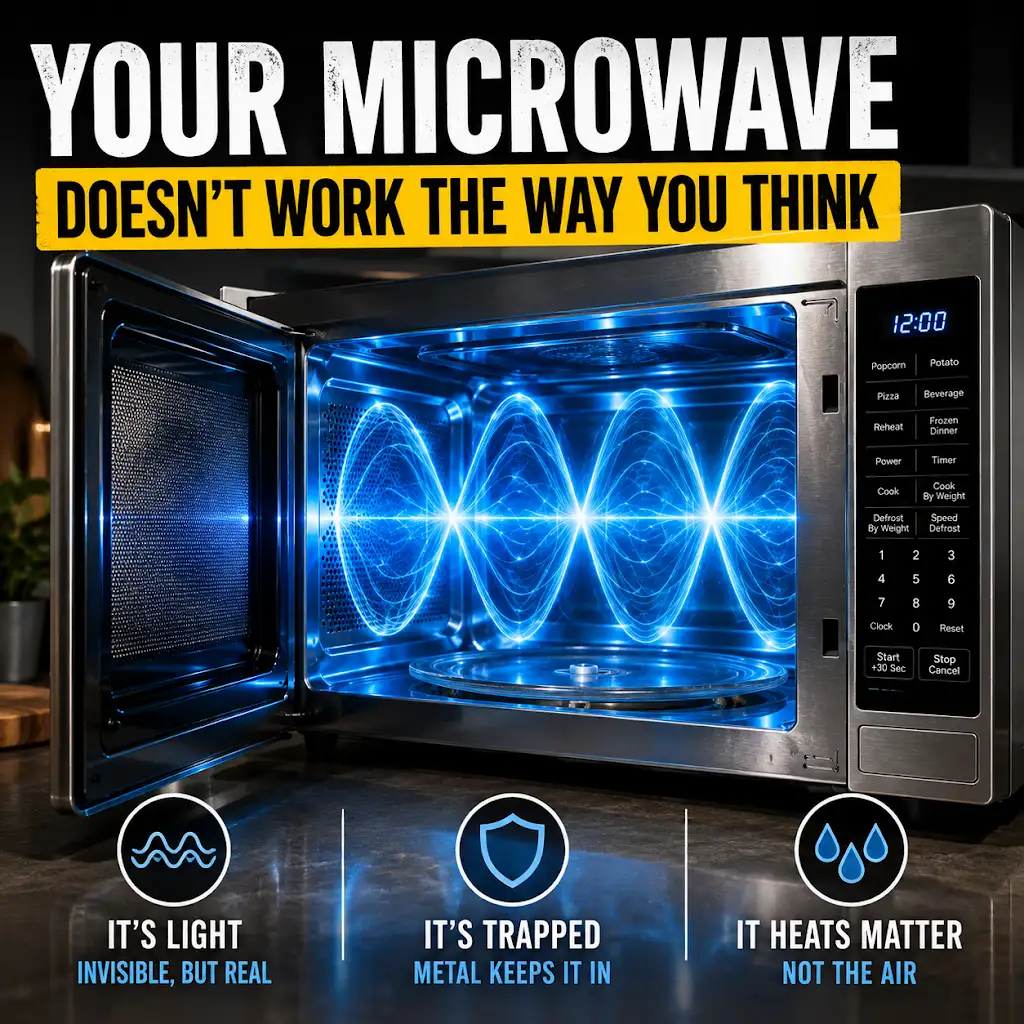
Your Microwave Doesn’t Work the Way You Think
FAQs
1. What is the relationship between microwaves and visible light?
Microwaves and visible light are both forms of electromagnetic radiation, with microwaves having longer wavelengths and lower frequencies than visible light.
2. How are microwaves and visible light used in everyday life?
Microwaves are commonly used for cooking and heating food, while visible light is used for illumination and vision.
3. How do microwaves and visible light differ in terms of their effects on materials?
Microwaves are known for their ability to penetrate materials and cause heating through molecular friction, while visible light can interact with materials to produce color, reflection, and absorption.
4. What are some examples of devices that utilize microwaves and visible light?
Microwaves are used in microwave ovens, radar systems, and communication devices, while visible light is utilized in light bulbs, cameras, and optical sensors.
5. How do microwaves and visible light relate to the electromagnetic spectrum?
Microwaves and visible light are both part of the electromagnetic spectrum, with microwaves having longer wavelengths and lower frequencies, and visible light having shorter wavelengths and higher frequencies.