You might think of your microwave as a magical box that instantly heats your leftovers or boils water with a simple hum. But beneath that convenience lies a fascinating dance of physics and chemistry, a molecular ballet that’s surprisingly intricate. This article will demystify how your microwave oven achieves its seemingly instantaneous heating, focusing on the specific process of how it heats water – a ubiquitous substance in everything you consume. You’ll discover that it’s not about brute force heat, but about precise, high-frequency electromagnetic waves interacting with the very building blocks of water.
Before we delve into the molecular interactions, it’s crucial to understand what microwaves are and how they’re generated. Your microwave oven isn’t just a fancy light bulb; it’s a sophisticated piece of technology designed to produce a specific range of electromagnetic radiation.
What Are Electromagnetic Waves?
Electromagnetic waves, like visible light, radio waves, and X-rays, are disturbances that travel through space, carrying energy. They consist of oscillating electric and magnetic fields that are perpendicular to each other and to the direction of propagation. The key difference between different types of electromagnetic waves lies in their frequency and wavelength. Frequency refers to the number of oscillations per second, measured in Hertz (Hz), while wavelength is the distance between two consecutive peaks of the wave. These two properties are inversely related: higher frequency means shorter wavelength, and vice versa.
The Microwave Spectrum
Microwaves occupy a specific band within the electromagnetic spectrum, typically ranging from about 300 megahertz (MHz) to 300 gigahertz (GHz). For household microwave ovens, the most common frequency used is 2.45 GHz. This particular frequency is chosen for several reasons, which we’ll explore later, but it’s a crucial parameter in how they interact with water molecules.
The Heart of the Matter: The Magnetron
The component responsible for generating these microwaves within your oven is the magnetron. The magnetron is a high-power vacuum tube that converts electrical energy into microwave radiation. It operates by using a combination of magnetic fields and electron streams to create oscillations at the desired microwave frequency. Imagine a tiny, powerful generator specifically tuned to produce these energetic waves. When you turn on your microwave, electricity flows into the magnetron, and it begins to emit microwaves, directing them into the oven cavity.
The Cavity and the Stirrer
Once generated, the microwaves are channeled into the oven’s cooking cavity. This cavity is designed to be a reflective enclosure, bouncing the microwaves around to ensure they reach the food from multiple angles. However, standing waves, regions of high and low microwave intensity, can form within the cavity. To combat this uneven heating, most microwaves have a rotating turntable or a “stirrer,” a fan-like device usually located at the top of the oven. These mechanisms help to distribute the microwaves more evenly throughout the cavity, preventing “hot spots” and “cold spots” in your food.
Microwaves heat water molecules through a process known as dielectric heating, where the electromagnetic waves cause polar molecules, like water, to rotate and generate heat. This phenomenon is explained in detail in the article found at Freaky Science, which delves into the science behind microwave ovens and their efficiency in heating various substances. Understanding this process not only sheds light on everyday cooking but also highlights the fascinating interactions between electromagnetic radiation and matter.
The Star of the Show: Water Molecules
Now that you understand the source of the energy, let’s turn our attention to the target: water. Water molecules are the primary reason why microwaves are so effective at heating food, as most foods contain a significant amount of water. Their unique structure makes them particularly susceptible to the oscillating electric fields of microwaves.
The Polar Nature of Water
Water (H₂O) is not a symmetrical molecule. It consists of one oxygen atom covalently bonded to two hydrogen atoms. Oxygen is much more electronegative than hydrogen, meaning it attracts electrons more strongly. This uneven distribution of electron density creates a polarity within the water molecule. The oxygen atom carries a partial negative charge (δ⁻), while the two hydrogen atoms each carry a partial positive charge (δ⁺). This makes the water molecule a “dipole,” essentially a tiny magnet with a positive end and a negative end.
Hydrogen Bonding: The Intermolecular Glue
Beyond their individual polarity, water molecules are also held together by a special type of intermolecular force called hydrogen bonding. The slightly positive hydrogen atom of one water molecule is attracted to the slightly negative oxygen atom of another water molecule. These hydrogen bonds are relatively weak compared to covalent bonds within a molecule, but they are crucial for water’s properties, such as its high boiling point and surface tension. These bonds create a dynamic network where water molecules are constantly breaking and reforming connections.
The Role of Water Content in Heating
The more water a substance contains, the more effectively it will heat in a microwave. This is why foods with high water content, like vegetables and soups, heat up quickly, while drier foods, like crackers or some breads, will become brittle or even char before they heat through. Fats and sugars also absorb some microwave energy, but to a lesser extent than water. This difference in absorption is why microwave cooking can sometimes lead to uneven heating, with some components of a dish becoming hotter than others.
The Interaction: Microwaves Meet Water

This is where the magic truly happens. The microwaves generated by your oven’s magnetron are precisely tuned to interact with the polar nature of water molecules. The oscillating electric field of the microwaves directly influences the orientation of these tiny dipoles.
The Electric Field’s Embrace
As the microwaves pass through the water-containing food, their oscillating electric field is the primary driver of heating. Imagine an invisible, rapidly flicking switch that constantly reverses its polarity. When the electric field is pointing in one direction, the positive ends of the water molecules will align themselves with it, and the negative ends will align in the opposite direction.
The Wobble and the Friction
When the electric field of the microwave reverses its direction, the water molecules are forced to rapidly reorient themselves to align with the new field. This constant, rapid flipping and turning of the water molecules, trying to keep pace with the oscillating field, creates a tremendous amount of internal friction. Think of it like vigorously rubbing your hands together – the friction generates heat. In the case of water molecules, this molecular friction is the direct source of the heat you feel.
The Frequency Factor: 2.45 GHz Perfection
The specific frequency of 2.45 GHz is not arbitrary. It’s very close to the resonant frequency of water molecules. This means that at this frequency, the water molecules are particularly eager to respond to the oscillating electric field. Their reorientation happens very efficiently, leading to rapid and effective heating. If the frequency were too low, the molecules wouldn’t flip fast enough to generate significant heat. If it were too high, the molecules might not be able to keep up with the rapid oscillations, and the energy might not be absorbed as effectively.
Beyond Rotation: Vibrational and Translational Motion
While rotational motion is the primary mechanism by which water molecules absorb microwave energy, it’s not the only one. The rapid reorientation also influences the vibrational and translational (movement from place to place) motion of the water molecules. This increased molecular kinetic energy, across all degrees of freedom, translates directly into a rise in temperature. The more energetic the molecules become, the hotter the substance gets.
The Result: Heat Generation and Transfer

The molecular friction generated by the reorienting water molecules doesn’t stay localized within individual molecules. This increased kinetic energy is rapidly transferred to neighboring molecules, leading to a bulk temperature increase in the food.
Kinetic Energy and Temperature
Temperature, at its core, is a measure of the average kinetic energy of the particles within a substance. When water molecules are being buffeted and spun by the microwaves, their kinetic energy increases. This increase in average kinetic energy is what we perceive as an increase in temperature. The more intense the microwave field and the more water present, the faster this kinetic energy will build up, and the quicker your food will heat.
Conduction, Convection, and Radiation within the Food
Once the water molecules have gained kinetic energy, this energy is transferred to other components of the food. This happens through several mechanisms:
- Conduction: The vibrating water molecules collide with adjacent molecules (other water molecules, proteins, carbohydrates, etc.), transferring energy directly. This is like a domino effect, where the initial jolt of one molecule sets off a chain reaction.
- Convection: In liquids like water, the warmer, more energetic molecules will move and mix with cooler ones, further distributing the heat. This is why boiling water exhibits convection currents.
- Radiation: While the microwaves themselves are a form of radiation, the hot food also emits infrared radiation, which can contribute to heating.
These processes work together to ensure that the heat generated by the initial microwave absorption is distributed throughout the food, cooking it relatively evenly. However, as mentioned earlier, the efficiency of these transfer mechanisms, coupled with potential variations in microwave intensity within the oven cavity, can sometimes lead to uneven cooking.
Microwaves heat water molecules through a process known as dielectric heating, which occurs when the electromagnetic waves cause the polar water molecules to rotate and generate heat. This fascinating mechanism is explored in more detail in a related article that delves into the science behind microwave cooking and its effects on various substances. For more insights on this topic, you can check out the article here. Understanding how microwaves interact with water not only enhances our cooking techniques but also sheds light on the broader principles of electromagnetic radiation.
Why Microwaves Heat Water (and Not Everything Else Equally)
| Reason | Explanation |
|---|---|
| Electromagnetic waves | Microwaves are a form of electromagnetic radiation that causes water molecules to vibrate and generate heat. |
| Polar molecules | Water molecules are polar, with positive and negative ends, which makes them susceptible to the electric field of microwaves, causing them to rotate and generate heat. |
| Friction | The rapid movement of water molecules due to the microwave energy creates friction, which in turn generates heat. |
The effectiveness of microwave ovens hinges on the specific properties of water. Understanding why water is such a good absorber of microwaves helps explain why other materials behave differently.
Selective Heating
Microwaves are a form of dielectric heating. This means they heat materials that are electrically polar. Water, with its strong dipole moment, is an excellent dielectric. Many other common materials are not as polar or are non-polar altogether.
- Non-polar molecules: Substances like many plastics, glass, and ceramics are made of molecules that don’t have a significant separation of positive and negative charge. These molecules don’t have a strong dipole moment and therefore don’t readily align themselves with the oscillating electric field of microwaves. As a result, they absorb very little microwave energy and remain relatively cool. This is why microwave-safe dishes can go into the oven without heating up.
- Low-loss dielectric materials: Some materials are polar but have a very low loss tangent. This means they don’t dissipate much energy as heat when exposed to microwaves. While they might have some dipole moments, their ability to absorb and convert microwave energy into heat is limited.
- Metals: Metal, however, is a conductor of electricity. When microwaves encounter metal, they induce electric currents on the metal’s surface. These currents can reflect the microwaves, causing arcing and potentially damaging the oven. This is why you should never put metal in a microwave. The energy that would have gone into heating the food is instead reflected or dissipated as sparks.
The “Dryness” Factor
The heating efficiency is directly proportional to the water content. A completely dry substance will not heat effectively in a microwave, regardless of its molecular composition, because there are no polar molecules to interact with the microwaves. This is why you can safely microwave a glass of water, but a dry paper towel will likely just get warm.
The Impact on Food Composition
Beyond water, the presence of fats and sugars in food also contributes to microwave heating, though to a lesser extent. These molecules can also have some polar characteristics or undergo other processes that generate heat. However, water’s dominance in this regard is why it’s considered the primary “heating medium” in microwave ovens. The rapid heating of water molecules is the initial spark that then heats the rest of the food through conduction and convection.
In essence, your microwave oven is a carefully engineered device that exploits the fundamental dipole moment of water molecules. By bombarding them with precisely tuned electromagnetic waves, it forces them into a frantic dance of reorientation, generating friction and, consequently, heat. So, the next time you’re enjoying a steaming cup of tea or a hot meal straight from the microwave, remember the intricate molecular ballet that made it possible. It’s a testament to how understanding the microscopic world can lead to remarkable macroscopic conveniences.
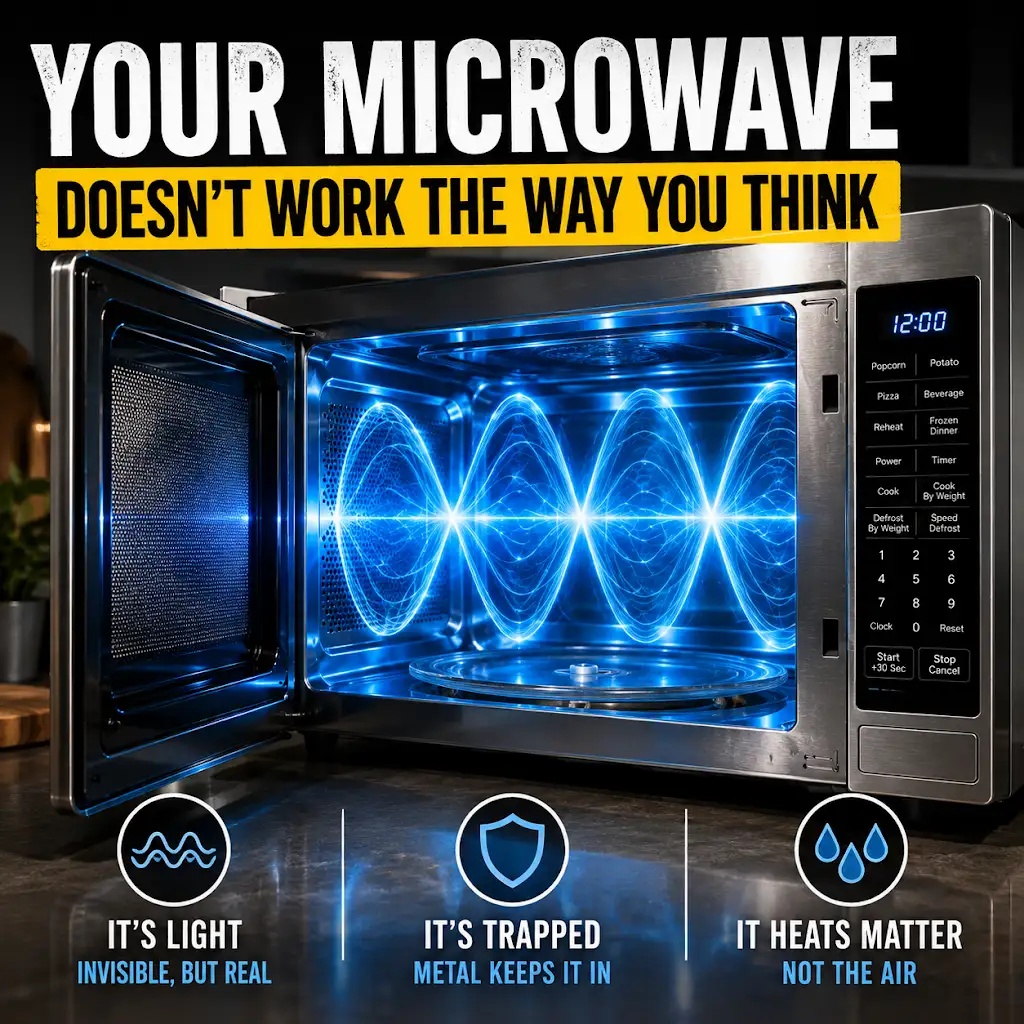
Your Microwave Doesn’t Work the Way You Think
FAQs
1. How do microwaves heat water molecules?
Microwaves heat water molecules by causing them to vibrate at a high frequency, which generates heat as a result of the friction between the molecules.
2. Why are water molecules specifically heated by microwaves?
Water molecules are specifically heated by microwaves because they have a unique molecular structure that allows them to absorb the energy from the microwaves and convert it into heat.
3. What happens to water molecules when they are heated by microwaves?
When water molecules are heated by microwaves, their kinetic energy increases, causing them to move faster and collide with each other, which results in an overall increase in temperature.
4. Can microwaves heat other substances besides water molecules?
Yes, microwaves can heat other substances besides water molecules, but the efficiency of heating varies depending on the molecular structure and composition of the substance.
5. Are there any safety concerns related to heating water in a microwave?
It is important to use caution when heating water in a microwave, as superheating can occur, leading to the water boiling explosively when disturbed. It is recommended to use a microwave-safe container and follow proper heating guidelines to avoid potential safety hazards.