
You’ve probably zapped countless meals, reheated leftovers, and even defrosted frozen goods using your microwave oven. It’s a kitchen staple, a time-saver, and often, a source of mild culinary miracles. But have you ever stopped to ponder the invisible force at play within that humming box? You likely know it involves microwaves, but the question lingers: are these culinary wizards actually a form of light?
The answer, in short, is a resounding yes. Microwaves are, in fact, a type of electromagnetic radiation, and light, in its broadest sense, is also electromagnetic radiation. They exist on the same spectrum, differing only in their wavelength and frequency. To truly grasp this, you need to peel back the layers of this seemingly mundane appliance and delve into the fascinating world of the electromagnetic spectrum. It’s a journey that will transform your perception of your everyday kitchen workhorse.
Imagine a vast highway stretching across the universe, carrying an endless stream of energy. This is your electromagnetic spectrum, a continuous range of all electromagnetic radiation. What differentiates one form of this radiation from another is its energy. This energy is directly related to its frequency and inversely related to its wavelength. Think of it like waves on an ocean: high-frequency waves are choppy and close together, while low-frequency waves are long and undulating.
Radio Waves: The Longest Haul
At the very long end of the spectrum are radio waves. These are the workhorses of communication, carrying signals for everything from your favorite radio station to your Wi-Fi. They have the longest wavelengths and the lowest frequencies, meaning they carry the least amount of energy. Because of their low energy, they can travel vast distances without much degradation, making them ideal for broadcasting.
Microwaves: The Speedy Commuters
Just beyond radio waves, on this cosmic highway, you’ll find microwaves. These are the speedy commuters of the spectrum. They have shorter wavelengths and higher frequencies than radio waves, and consequently, they carry more energy. This increased energy is crucial to their ability to interact with matter in specific ways, which is precisely why they are employed in your microwave oven.
Infrared Radiation: The Gentle Warmers
Moving further along, you encounter infrared radiation. This is what we typically perceive as heat. When you stand near a campfire, you feel its warmth because of the infrared radiation it emits. It has even shorter wavelengths and higher frequencies than microwaves, thus carrying more energy. Infrared cameras, for instance, can detect heat signatures.
Visible Light: The Spectrum We See
This is the portion of the electromagnetic spectrum that your eyes are sensitive to, allowing you to perceive the world in all its vibrant colors. Visible light occupies a narrow band within the spectrum, sitting between infrared and ultraviolet. Each color you see – red, orange, yellow, green, blue, indigo, and violet – corresponds to a slightly different wavelength and frequency within this visible band. Red has the longest wavelength and lowest frequency, while violet has the shortest wavelength and highest frequency.
Ultraviolet Radiation: The Sun’s More Energetic Cousin
Beyond visible light lies ultraviolet (UV) radiation. This is the part of sunlight that can cause sunburns and vitamin D production. It has shorter wavelengths and higher frequencies than visible light, carrying more energy. Prolonged exposure to UV radiation can be harmful to living cells.
X-rays: The Penetrating Beams
X-rays are even more energetic, with very short wavelengths and high frequencies. Their high energy allows them to penetrate soft tissues but be absorbed by denser materials like bone, making them invaluable for medical imaging.
Gamma Rays: The Ultimate Powerhouses
At the very highest energy end of the spectrum are gamma rays. These are the most energetic form of electromagnetic radiation, with the shortest wavelengths and highest frequencies. They are produced by nuclear reactions and are highly penetrating, often used in medical treatments like radiation therapy.
Microwaves, often thought of as a convenient cooking tool, are actually a form of electromagnetic radiation, similar to visible light but with longer wavelengths. For a deeper understanding of this concept and its implications, you can explore the article titled “Are Microwaves Actually Invisible Light?” which delves into the science behind microwaves and their interaction with matter. To read more about this fascinating topic, visit this article.
How Microwaves Work: The Science Behind the Zap
Now that you understand where microwaves sit on the electromagnetic spectrum, let’s delve into how your microwave oven harnesses their power. It’s a sophisticated piece of engineering that cleverly exploits a specific property of microwaves to heat food.
The Magnetron: The Heart of the Microwave
The magic begins with the magnetron. This is a vacuum tube that generates microwaves. When electricity is applied to the magnetron, it creates a stream of electrons that are then propelled by powerful magnets. This process causes the electrons to oscillate at extremely high frequencies, producing microwaves. These microwaves are then directed into the cooking cavity.
The Waveguide: Guiding the Energy
The microwaves generated by the magnetron are channeled through a waveguide, a hollow metal tube. This waveguide acts like a directed pathway, ensuring that the microwaves are efficiently transmitted from the magnetron to the cooking chamber. The shape and dimensions of the waveguide are critical for guiding the microwaves effectively.
The Cooking Cavity: A Reflective Chamber
The interior of your microwave oven is essentially a Faraday cage. This means it’s a metal box that contains the electromagnetic radiation. The metal walls of the cavity are designed to reflect the microwaves. When the microwaves enter the cavity, they bounce around, reflecting off the metal surfaces and the food itself. This constant reflection ensures that the food is bombarded with microwaves from all directions.
The Turntable: Ensuring Even Heating
You’ve likely noticed the turntable in your microwave. This is not just for aesthetics. Since the microwaves within the cavity can create “hot spots” and “cold spots” due to interference patterns, the turntable rotates the food. This rotation ensures that different parts of the food are exposed to the microwaves more evenly, leading to more uniform heating.
Microwaves and Food: A Molecular Dance of Heat

The key to why microwaves heat food lies in their interaction with water molecules. Water is a polar molecule, meaning it has a slight positive charge on one end and a slight negative charge on the other. Microwaves, being electromagnetic waves, have oscillating electric fields.
Exciting Water Molecules
When microwaves enter the food, their oscillating electric fields interact with the polar water molecules. The electric field causes the water molecules to rapidly rotate, trying to align themselves with the changing field. This constant, rapid rotation of water molecules creates friction.
Friction Generates Heat
It’s this friction between the rotating water molecules that generates heat. Think of rubbing your hands together rapidly; the friction creates warmth. The same principle applies at a molecular level within your food. The faster and more vigorously the water molecules rotate, the more heat is produced. This internal friction is what cooks your food from the inside out, or rather, from within the water molecules themselves.
Other Polar Molecules
While water is the primary player, other polar molecules present in food, such as fats and sugars, also contribute to microwave heating. However, water is generally the most abundant polar molecule, making its interaction with microwaves the dominant factor in cooking. Non-polar molecules, like plastics or dry air, are not significantly affected by microwaves and are therefore not heated directly.
The Light Connection: Wavelength, Frequency, and Energy

The fact that microwaves are a form of light is best understood by looking at their properties in relation to the entire electromagnetic spectrum. Light, in its broadest definition, is any form of electromagnetic radiation.
Wavelength: The Size of the Wave
Microwaves have wavelengths that typically range from about one millimeter to one meter. For comparison, visible light has wavelengths in the nanometer range (billions of a meter). Red light, for instance, has a wavelength of about 700 nanometers, while blue light is around 450 nanometers. The longer wavelengths of microwaves allow them to penetrate food more effectively than the shorter wavelengths of visible light.
Frequency: The Rate of Oscillation
The frequency of microwaves is in the gigahertz (GHz) range, typically around 2.45 GHz for most household microwave ovens. This means the electric and magnetic fields of the microwaves oscillate 2.45 billion times per second. Visible light has much higher frequencies, in the hundreds of terahertz (THz) range. The higher frequency of visible light means its electromagnetic waves are oscillating much faster.
Energy: The Driving Force
The energy carried by electromagnetic radiation is directly proportional to its frequency and inversely proportional to its wavelength. Since microwaves have lower frequencies and longer wavelengths than visible light, they carry less energy per photon. This lower energy is why they are primarily used for heating and not for processes that require more energetic interactions, like breaking chemical bonds, which is something UV or X-rays are capable of.
Microwaves are indeed a form of electromagnetic radiation, similar to visible light but with longer wavelengths, which is why they are often described as invisible light. For a deeper understanding of the various types of electromagnetic waves and their properties, you might find this article on Freaky Science particularly enlightening. It explores the spectrum of electromagnetic radiation, including microwaves, and explains how they interact with different materials, shedding light on their practical applications in everyday life.
Debunking Myths and Understanding Limitations
| Question | Answer |
|---|---|
| Are microwaves actually invisible light? | Yes, microwaves are a form of electromagnetic radiation that has a longer wavelength than visible light, making them invisible to the human eye. |
Despite their prevalence, microwaves are often surrounded by myths and misunderstandings. Understanding their true nature and limitations helps to demystify their operation and ensure safe and effective use.
Myth: Microwaves Cook Food by Radiation Poisoning
This is perhaps the most persistent and unfounded myth. Microwaves do not make food radioactive or toxic. The radiation they use is non-ionizing, meaning it does not have enough energy to remove electrons from atoms or molecules. Ionizing radiation, such as X-rays and gamma rays, can damage DNA and cells, but microwaves do not possess this capability. The energy of microwaves is used to excite water molecules, causing them to generate heat. Once the microwave oven is turned off, the microwaves dissipate, and the food is no longer being irradiated.
Myth: Microwaves Destroy Nutrients More Than Other Cooking Methods
While it’s true that some nutrient loss can occur during any cooking process due to heat and water, microwaves are often more efficient at preserving nutrients than other methods. Because they cook food quickly and require less water, there is less leaching of water-soluble vitamins. For example, studies have shown that steaming vegetables in a microwave can retain more vitamin C than boiling them. The key is the speed and reduced water usage.
Myth: Metal is Always Bad in a Microwave
While generally true, the complete prohibition of metal in microwaves is a simplification. Small amounts of smooth, rounded metal, such as the foil lining some food containers, can sometimes be used without issue. However, crinkled or thin metal, like aluminum foil, can cause arcing, which is sparks or flashes of electricity. This is because the sharp edges of the metal concentrate the electric field, causing the air to ionize and conduct electricity. This can damage the microwave and even pose a fire hazard. Always refer to the manufacturer’s instructions for specific guidelines on metal usage.
Limitation: Uneven Heating and “Cold Spots”
As mentioned earlier, microwaves can create areas of uneven heating. This is due to the wave interference patterns within the cooking cavity. The turntable helps to mitigate this, but it’s not always perfect. For optimal results, it’s often recommended to stir food partway through the cooking cycle or to arrange food in a circular pattern on the turntable.
Limitation: Texture and Browning
Microwaves excel at heating but are not designed to brown or crisp food. The browning and crisping we associate with cooking often involve the Maillard reaction and caramelization, which require higher temperatures and direct contact with dry heat sources. While some microwave ovens now come with convection features that can help with browning, standard microwave cooking will not achieve these textures.
Limitation: Not All Materials Are Microwave-Safe
While many plastics and ceramics are microwave-safe, some can leach harmful chemicals into your food when heated. Always look for “microwave-safe” labels on cookware and containers. Glass and ceramic are generally good choices, but ensure they do not have metallic trim or embellishments.
In conclusion, the seemingly magical ability of your microwave oven to heat food is a testament to the fundamental principles of physics. Microwaves, as a specific band of the electromagnetic spectrum, are indeed a form of light. Their unique wavelength and frequency allow them to interact with water molecules, creating friction and thus heat. By understanding this science, you can use your microwave with greater confidence and demystify the invisible force that has become such an indispensable part of your daily life.
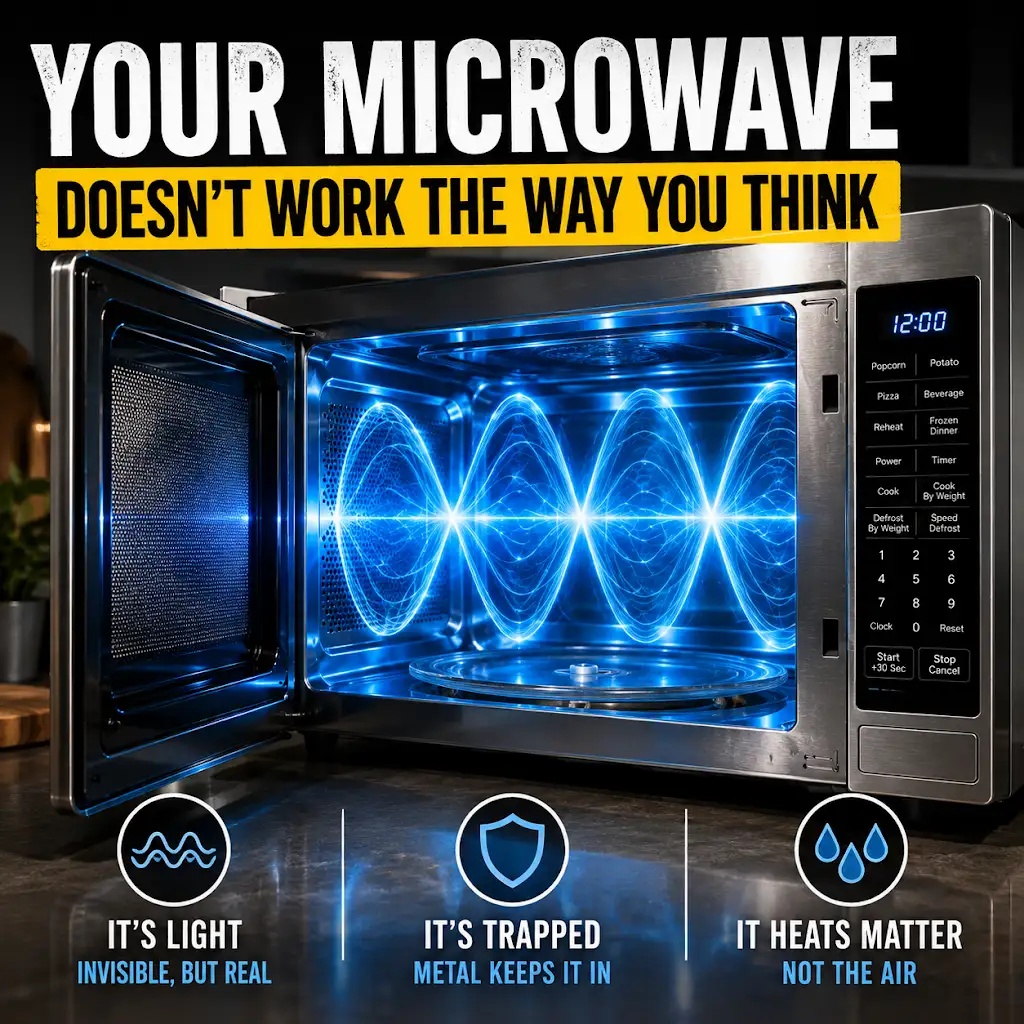
Your Microwave Doesn’t Work the Way You Think
FAQs
1. What is the electromagnetic spectrum and where do microwaves fall on it?
Microwaves are a form of electromagnetic radiation, just like visible light, radio waves, and X-rays. They fall between radio waves and infrared radiation on the electromagnetic spectrum.
2. How do microwaves work in a microwave oven?
Microwaves in a microwave oven work by causing water molecules in food to vibrate, generating heat through friction. This heats the food quickly and efficiently.
3. Can microwaves be harmful to humans?
Exposure to high levels of microwaves can cause tissue damage due to the heating effect, but the levels used in household appliances are considered safe. It’s important to follow safety guidelines and use microwave ovens properly.
4. Are microwaves actually invisible light?
Yes, microwaves are a form of electromagnetic radiation, but they are not visible to the human eye. They have a longer wavelength than visible light, which is why we cannot see them.
5. What are some common uses of microwaves besides cooking food?
Microwaves are used in various applications such as telecommunications, radar systems, medical treatments (like diathermy), and industrial processes like drying and curing materials.