You interact with microwaves and visible light every single day, often without a second thought. One heats your leftovers, the other illuminates your world and allows you to read these very words. Yet, despite their ubiquitous presence, these two forms of electromagnetic radiation are fundamentally different, each possessing unique properties and applications that shape your experience. Understanding these differences isn’t just an academic exercise; it’s about unlocking a deeper appreciation for the invisible forces that govern your reality. Prepare to journey into the electromagnetic spectrum and discover how these two seemingly disparate entities are more alike, and more importantly, more distinct, than you might have imagined.
The Electromagnetic Spectrum: A Universal Family Reunion
Before you can truly compare microwaves and visible light, you need to understand the larger family they belong to: the electromagnetic spectrum. Think of it as a grand, interconnected continuum of energy that travels in waves. These waves are characterized by their frequency (how many waves pass a point per second) and wavelength (the distance between two consecutive wave crests). These two properties are inversely related: higher frequency means shorter wavelength, and vice versa. It’s this precise dance between frequency and wavelength that dictates the behavior and applications of each type of electromagnetic radiation.
The Big Picture: A Gradient of Energy
Your entire electromagnetic spectrum is a smooth gradient, with no abrupt breaks or divisions. It stretches from very low-frequency radio waves, with incredibly long wavelengths, all the way to extremely high-frequency gamma rays, boasting minuscule wavelengths. You can visualize this as a vast, unseen highway, with different types of radiation occupying different lanes, each with its own speed limit (all electromagnetic radiation travels at the speed of light in a vacuum, but their energetic impact varies wildly).
Where Do Microwaves and Visible Light Fit In?
This is where your journey truly begins. Microwaves occupy a specific, relatively narrow band within this spectrum. They sit between radio waves and infrared radiation. Visible light, on the other hand, is a much smaller, but incredibly significant, portion of the spectrum, nestled between infrared radiation and ultraviolet radiation. You can imagine visible light as a tiny, vibrant island in a vast ocean of other electromagnetic phenomena.
The Energetic Divide: Power and Impact
The fundamental difference in their position on the spectrum translates directly into their energy levels. Microwaves, with their longer wavelengths and lower frequencies compared to visible light, carry less energy per photon. Visible light, with its shorter wavelengths and higher frequencies, carries more energy per photon. This energetic disparity is the root cause of many of their contrasting properties and how they interact with matter.
Microwaves and visible light are both forms of electromagnetic radiation, but they differ significantly in their wavelengths and applications. While microwaves have longer wavelengths and are commonly used in communication technologies and cooking, visible light is the range of electromagnetic radiation that is detectable by the human eye and is essential for vision. For a deeper understanding of these differences and their implications, you can read a related article on this topic at Freaky Science.
The Wavelength Riddle: Seeing and Heating
The most intuitive difference between microwaves and visible light lies in their wavelengths, which directly dictates how they interact with the world around you. This is the foundation of their distinct applications, from how you perceive your surroundings to how you prepare your meals.
The Visible Spectrum: Your Window to the World
Visible light, the narrow band of wavelengths your eyes are capable of detecting, is what allows you to experience the richness of color. When white light from the sun or a lamp hits an object, some wavelengths are absorbed, and others are reflected. The wavelengths that are reflected reach your eyes, and your brain interprets them as color. For instance, a red apple appears red because it absorbs most wavelengths of visible light and reflects primarily red wavelengths.
The Rainbow of Perception: From Violet to Red
The visible spectrum is a continuous range of colors, conventionally divided into seven distinct bands: violet, indigo, blue, green, yellow, orange, and red. Each of these colors corresponds to a specific range of wavelengths. Violet has the shortest wavelength (around 380 nanometers), and red has the longest (around 700 nanometers). You can often observe this spectrum in action when light is dispersed by a prism or in the breathtaking arc of a rainbow after a rain shower.
How Light Interacts with Matter: Absorption, Reflection, and Transmission
Your interaction with visible light is governed by three primary processes: absorption, reflection, and transmission. When light hits a surface, some of it might be absorbed, converting the light energy into heat. Some of it might be reflected, allowing you to see the object. And some of it might pass through, which is transmission, as is the case with clear glass. These processes are crucial for everything from how you see your own reflection to how plants perform photosynthesis.
Microwaves: The Power of Penetration
Microwaves, with their significantly longer wavelengths (ranging from about 1 millimeter to 1 meter), behave very differently. Their longer wavelengths allow them to penetrate certain materials that are opaque to visible light. This is why you can’t see through a brick wall with visible light, but a microwave signal can pass through it to communicate with your phone.
Heating Through Dielectric Heating: The Microwave Oven’s Magic
The most famous application of microwaves is the microwave oven. The magic lies in their ability to interact with water molecules. Water molecules are polar, meaning they have a positive and negative end. When microwaves encounter water molecules, their oscillating electric field causes the water molecules to rotate and vibrate rapidly. This friction between molecules generates heat, effectively cooking your food from the inside out.
Beyond the Kitchen: Communication and Radar
Microwaves are not confined to your kitchen. They are the backbone of much of your modern communication. Wi-Fi signals, cellular phone calls, and satellite television all rely on microwaves to transmit information efficiently over distances. Their ability to penetrate atmospheric conditions and travel in relatively straight lines makes them ideal for these applications. Radar systems, used in everything from weather forecasting to aircraft navigation, also utilize microwaves, bouncing them off objects to determine their location and speed.
The Frequency Factor: Energy Levels and Interactions
While wavelength describes the spatial extent of a wave, frequency describes its temporal rate of oscillation. These two are intrinsically linked, and frequency is a direct indicator of the energy carried by a wave.
Visible Light Frequencies: A Vibrant Symphony
The frequencies of visible light are much higher than those of microwaves. For example, the frequency of red light is around 400 terahertz (trillion cycles per second), while violet light is around 790 terahertz. These high frequencies mean that visible light photons carry a considerable amount of energy.
Photons and Energy: The Quantum Perspective
From a quantum perspective, electromagnetic radiation is quantized, meaning it exists in discrete packets of energy called photons. The energy of a photon is directly proportional to its frequency (E = hf, where E is energy, h is Planck’s constant, and f is frequency). This is why visible light photons have more energy than microwave photons. This energy difference explains why visible light can trigger chemical reactions (like in photosynthesis) or cause damage to your eyes (UV radiation, which is just beyond visible light, is a prime example).
Microwave Frequencies: A Gentler Oscillation
Microwaves operate at much lower frequencies. For instance, a typical microwave oven operates at around 2.45 gigahertz (billion cycles per second). This lower frequency means that microwave photons carry significantly less energy than visible light photons. This is why microwaves can pass through many materials without causing significant chemical changes, primarily interacting with the polar molecules like water to generate heat.
The Impact of Frequency on Material Interaction
The frequency of electromagnetic radiation is a critical factor in how it interacts with different materials. At microwave frequencies, materials with permanent or induced dipoles (like water) are particularly susceptible to energy absorption. At visible light frequencies, interactions are more complex, involving electron excitation and the absorption/reflection of specific wavelengths that determine color.
Applications: From Seeing to Cooking and Beyond
The distinct properties of microwaves and visible light have led to a vast array of applications, shaping nearly every aspect of your modern life. Understanding these applications further illuminates their fundamental differences and interconnectedness.
The Ubiquity of Visible Light: Our Visual World
Your entire experience of the physical world is mediated by visible light. It allows you to navigate your surroundings, appreciate art, recognize faces, and read this text. Every act of seeing is a testament to the power of visible light.
Illumination and Vision: The Foundation of Perception
From the natural illumination of the sun to the artificial light sources you use, visible light is essential for vision. Without it, your world would be plunged into perpetual darkness. The way light reflects and refracts off objects allows your eyes to perceive shape, texture, and depth.
Photography and Imaging: Capturing Moments
Photography, a cornerstone of modern memory keeping, relies entirely on capturing visible light. Cameras use lenses to focus light onto sensors, recording the patterns of light and shadow to create images. This ability to freeze moments in time is a direct consequence of visible light’s properties.
Optical Technologies: Lasers and Fiber Optics
Beyond everyday vision, visible light is harnessed in sophisticated technologies. Lasers, which produce highly concentrated beams of light, have applications ranging from barcode scanners to surgical instruments. Fiber optics, which transmit data using pulses of light through thin strands of glass, form the backbone of the internet and high-speed telecommunications.
The Diverse Roles of Microwaves: Communication, Heating, and Sensing
Microwaves, despite being invisible, play a critical role in many essential technologies. Their ability to penetrate certain materials and their efficient transmission make them indispensable.
Microwave Ovens: The Culinary Revolution
As mentioned earlier, the microwave oven has revolutionized your kitchen. It offers a fast and convenient way to reheat and cook food by directly exciting water molecules. This has changed how you prepare meals and manage your time in the kitchen.
Wireless Communication: The Connected World
Your smartphones, laptops, and smart home devices all rely on microwaves for wireless communication. Wi-Fi, Bluetooth, and cellular networks all transmit data using microwave frequencies. This has created a hyper-connected world where information can be accessed and shared almost instantaneously.
Radar and Remote Sensing: Understanding Our Environment
Radar systems, utilizing microwaves, are crucial for a wide range of applications. They are used by meteorologists to track storms, by air traffic controllers to monitor aircraft, and by marine vessels to navigate. Remote sensing technologies also employ microwaves to study the Earth’s surface, providing valuable data for environmental monitoring and resource management.
Microwaves and visible light are both part of the electromagnetic spectrum, yet they differ significantly in their properties and applications. While microwaves are commonly used in cooking and telecommunications, visible light is essential for human vision and photosynthesis in plants. For a deeper understanding of these differences, you can explore a related article that discusses the electromagnetic spectrum in detail. This informative piece can be found here, providing insights into how various wavelengths interact with matter and their practical uses in everyday life.
The Unseen Interactions: How They Affect Matter
The way microwaves and visible light interact with matter is a key differentiator, explaining why one can cook your food and the other allows you to see the vibrant hues of a sunset.
Visible Light’s Dance with Electrons
Visible light primarily interacts with the electrons within atoms and molecules. When visible light photons strike matter, they can be absorbed by electrons, causing them to jump to a higher energy level. This absorption is what creates color. If the absorbed energy is sufficient, it can even break chemical bonds, as seen in the process of photosynthesis.
Absorption and Reflection: The Science of Color
The specific wavelengths of visible light that are absorbed or reflected by a material determine its color. Opaque objects absorb most visible light wavelengths and reflect others, which your eyes perceive as color. Transparent objects allow most visible light to pass through, while translucent objects scatter it.
Photoelectric Effect and Chemical Reactions
At higher energies within the visible spectrum (closer to UV), visible light can also trigger the photoelectric effect, where electrons are ejected from a material. This principle is used in solar cells. Furthermore, visible light can initiate or accelerate certain chemical reactions, playing a vital role in biological processes.
Microwaves’ Molecular Ballet: The Power of Polarity
Microwaves primarily interact with polar molecules, most notably water. The oscillating electric field of microwaves causes these polar molecules to rotate and align with the field. As the field rapidly reverses direction, the molecules try to keep up, leading to friction and the generation of heat.
Dielectric Heating: The Core Mechanism
This process of dielectric heating is the fundamental principle behind microwave ovens. The rapid rotation of water molecules within food generates kinetic energy, which is then dissipated as thermal energy, cooking the food. This is why foods with high water content cook more efficiently in a microwave.
Penetration and Limited Molecular Disruption
Because microwaves have longer wavelengths, they can penetrate many materials that are opaque to visible light. This allows them to heat food more uniformly. However, the energy per photon in microwaves is lower than in visible light, meaning they are less likely to cause the direct breaking of chemical bonds or significant electronic excitation compared to visible light.
The Invisible Threads: Shared Nature and Contrasting Roles
Despite their apparent differences, microwaves and visible light share a fundamental nature as components of the electromagnetic spectrum. This shared heritage reveals both their similarities and the reasons for their distinct evolutionary paths in human technology.
The Electromagnetic Connection: Waves of Energy
Both microwaves and visible light are forms of electromagnetic radiation. This means they are both waves of oscillating electric and magnetic fields that travel at the speed of light. They carry energy and momentum and exhibit wave-particle duality, meaning they can behave as both waves and particles (photons).
Speed and Propagation: Traveling at Light Speed
One of their most significant shared characteristics is their speed. In a vacuum, both microwaves and visible light travel at approximately 299,792,458 meters per second, the universal speed limit for information and energy. This consistent speed is a hallmark of all electromagnetic waves.
Wave-Particle Duality: A Quantum Enigma
Both types of radiation exhibit wave-particle duality. While we often think of them as waves, they also behave as discrete packets of energy called photons. This quantum mechanical property is essential for understanding their interactions with matter at a fundamental level.
The Spectrum’s Gradient: A Continuous Continuum
The electromagnetic spectrum is a continuous gradient, not a series of discrete, isolated entities. Microwaves and visible light are simply different points on this spectrum, distinguished by their frequency and wavelength. This means that there are no sharp boundaries between different types of electromagnetic radiation; rather, there are gradual transitions.
Bridging the Gaps: Infrared and Ultraviolet
Between microwaves and visible light lies infrared radiation, which you perceive as heat. Beyond visible light lies ultraviolet radiation, which can cause sunburn and damage DNA. Understanding these neighboring regions further emphasizes the continuous nature of the spectrum.
The Power of Wavelength and Frequency Tuning
The fact that the spectrum is continuous allows for precise tuning of applications. By adjusting the frequency and wavelength of electromagnetic radiation, scientists and engineers can create devices with specific properties for a myriad of purposes, from communication to medical imaging.
Conclusion: Harnessing the Unseen for a Brighter, Warmer Future
You have embarked on a journey to understand the fundamental differences and surprising similarities between microwaves and visible light. You’ve seen how their positions on the electromagnetic spectrum dictate their wavelengths, frequencies, and ultimately, their energy levels. This knowledge has illuminated their diverse applications, from the way you perceive your world through the vibrant colors of visible light to the convenience of heated meals thanks to microwaves.
You interact with these invisible forces daily, and by understanding them, you gain a deeper appreciation for the technologies that shape your life. From the smartphones in your pockets to the lights that illuminate your homes, microwaves and visible light are silent architects of your modern existence. As you move forward, remember the unseen world around you, a world powered by the intricate dance of electromagnetic radiation, a world that continues to be shaped by our ever-growing understanding and harnessing of its remarkable power. The future, undoubtedly, will see even more innovative applications emerge from our continued exploration of this fundamental force.
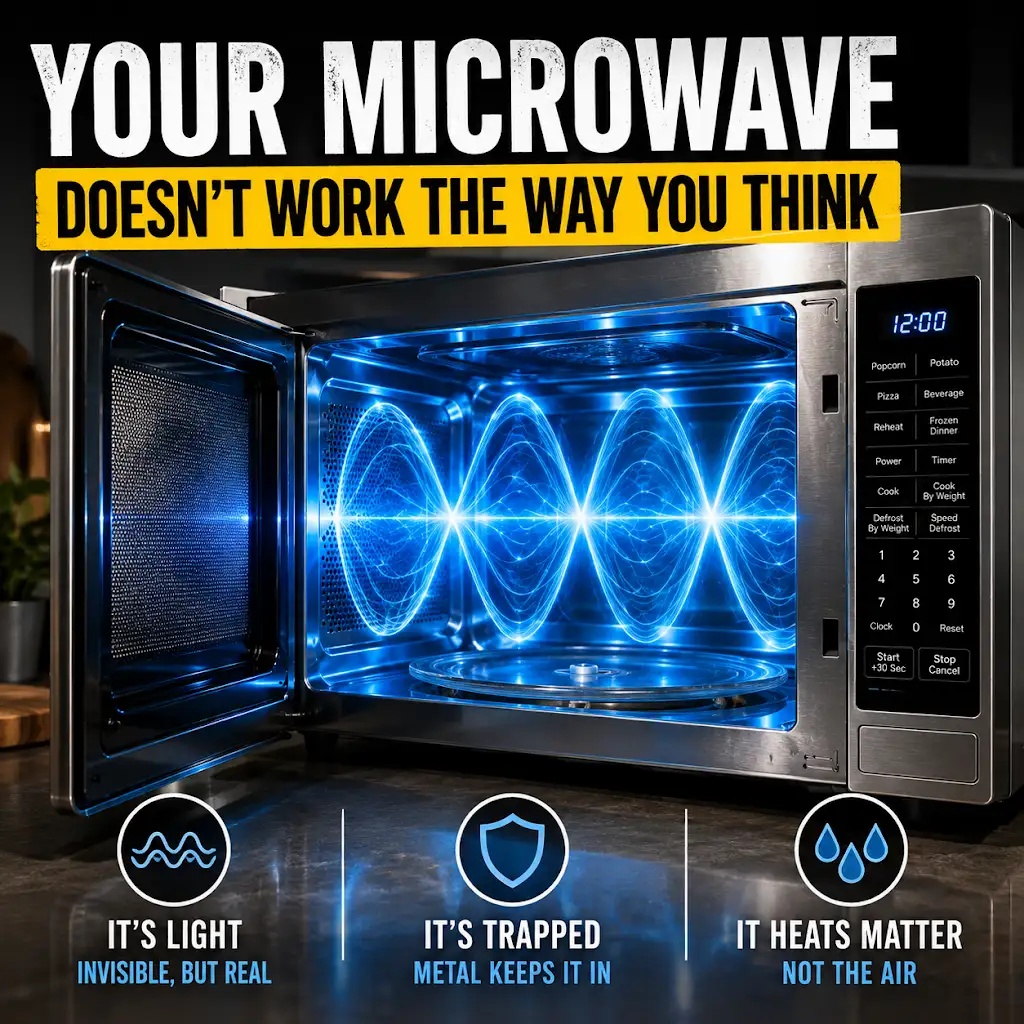
Your Microwave Doesn’t Work the Way You Think
FAQs

What is the difference between microwaves and visible light?
Microwaves and visible light are both forms of electromagnetic radiation, but they differ in their wavelengths. Microwaves have longer wavelengths, typically ranging from 1 millimeter to 1 meter, while visible light has shorter wavelengths, ranging from 400 to 700 nanometers.
How do microwaves and visible light behave differently?
Microwaves and visible light behave differently when interacting with matter. Microwaves are able to pass through many materials, such as plastic, glass, and ceramics, while visible light is absorbed or reflected by these materials.
What are the applications of microwaves and visible light?
Microwaves are commonly used in microwave ovens for cooking and heating food, as well as in telecommunications and radar systems. Visible light is used for illumination, photography, and in various optical technologies.
How do microwaves and visible light affect living organisms?
Exposure to high levels of microwaves can cause heating of tissues and potential harm to living organisms, while visible light is essential for the process of photosynthesis in plants and for vision in animals.
What are the sources of microwaves and visible light?
Microwaves are produced by electronic devices such as microwave ovens and communication antennas, while visible light is emitted by natural sources such as the sun, as well as artificial sources like light bulbs and LEDs.