You’ve probably stood in front of your microwave, maybe even pressing your ear against the door, wondering how that magic box heats your food so quickly without bathing you in harmful rays. It’s a common curiosity, a blend of awe and apprehension about the unseen forces at play. The truth is, your microwave oven is a master of containment, a carefully engineered fortress designed to keep those invisible waves precisely where they belong: cooking your dinner. The secret lies in its shielding, a sophisticated system that meticulously blocks microwave radiation.
Before we delve into how your microwave oven shields you, it’s essential to understand the fundamental principles of microwave cooking itself. This isn’t just about throwing a plate in and hitting start; it’s a fascinating interaction between electromagnetic waves and the water molecules within your food.
What Exactly Are Microwaves?
Microwaves are a form of electromagnetic radiation, falling within a specific range of the electromagnetic spectrum. Think of it as a spectrum that includes everything from radio waves and visible light to X-rays and gamma rays. Microwaves, in particular, occupy the frequency range typically between 300 megahertz (MHz) and 300 gigahertz (GHz). Your microwave oven operates at a specific, regulated frequency, usually around 2.45 GHz. This frequency is chosen for its efficiency in interacting with water molecules, the primary component that gives food its moisture content.
How Microwaves Heat Food: The Molecular Massage
The magic of microwave cooking isn’t about brute force heat from an element. Instead, it’s a far more elegant process involving molecular agitation. When the magnetron within your microwave generates microwaves, these waves are directed into the cooking cavity. As these waves interact with the food, they cause the polar molecules within it, most notably water, to rapidly vibrate and rotate. Imagine millions of tiny molecules doing a frantic dance, bumping into each other. This constant friction and jostling generate heat. It’s this molecular friction that effectively cooks your food from the inside out, a stark contrast to conventional ovens that rely on conduction and convection to transfer heat to the food’s surface.
Why Not All Materials Are Equal
You’ve likely seen symbols on microwave-safe dishes indicating their suitability. This is because microwaves, while potent at exciting water molecules, interact differently with various materials. Metals, for instance, reflect microwaves. This reflection is crucial for the shielding of your oven. Non-metallic materials like glass, ceramic, and certain plastics are either transparent to microwaves or absorb them minimally, allowing the waves to reach your food. Plastics that are not microwave-safe can melt or degrade when exposed to microwave energy, which is why it’s important to use designated containers.
Microwave ovens are designed with shielding to prevent microwave radiation from escaping, ensuring safety during operation. The shielding typically consists of a metal mesh or solid metal enclosure that reflects and absorbs the microwaves, keeping them contained within the cooking chamber. For a deeper understanding of the science behind microwave oven shielding and its effectiveness, you can read more in this related article: Freaky Science.
The Faraday Cage: Your Microwave’s Protective Shell
The most significant element of your microwave oven’s radiation-blocking capability lies in its construction, which essentially forms a Faraday cage. This isn’t some futuristic sci-fi concept; it’s a well-established scientific principle that has been employed for over a century.
What is a Faraday Cage?
A Faraday cage is an enclosure made of conductive material, such as metal mesh or solid metal, that blocks external electromagnetic fields. When an external electric field is applied to the conductive material, the charges within the conductor rearrange themselves in such a way as to cancel out the field’s effect inside the enclosure. Essentially, the conductive shell redistributes the incoming electromagnetic energy, preventing it from penetrating the interior. Think of it like a metal hat that protects your head from lightning – the electricity flows around the hat and to the ground, rather than through you.
The Role of the Metal Cavity
The interior of your microwave oven is constructed from metal. This metal cavity acts as the primary Faraday cage. When the magnetron generates microwaves, they are directed into this metal box. The conductive walls of the cavity reflect these microwaves, keeping them contained within the cooking area. Any microwaves that might attempt to escape are bounced back into the oven, continuing their journey of cooking your food. This continuous reflection is what helps ensure a relatively even cooking process and, more importantly, prevents the radiation from escaping into your kitchen.
The Door: A Special Kind of Faraday Cage
The microwave door is a critical component of the shielding system, and it’s designed with particular care. It’s not just a simple sheet of glass.
The Metal Mesh Grille
If you look closely at the glass of your microwave door, you’ll notice a dark, metallic mesh embedded within it. This is not just for aesthetics; it’s a finely tuned part of the Faraday cage. The holes in this mesh are significantly smaller than the wavelength of the microwaves being used by the oven (which is about 12.2 cm for 2.45 GHz). According to the principles of electromagnetic shielding, a Faraday cage is effective when the openings in its conductive material are considerably smaller than the wavelength of the radiation it’s intended to block. Because the holes in the mesh are so small, they effectively prevent the microwaves from passing through. The metal itself reflects the waves, and the small openings prevent them from “leaking” out.
The Interlocking Door Seal
Beyond the mesh, the door also features a robust interlocking seal. This seal, often made of rubber or a similar flexible, conductive material, ensures a tight fit between the door and the oven cavity when the door is closed. This tight seal is crucial to prevent any gaps or openings where microwaves could potentially escape. Any tiny gap could act as an antenna, allowing radiation to leak. The seal ensures that the continuity of the conductive enclosure is maintained, bolstering the effectiveness of the Faraday cage.
The Magnetron: The Source and Its Containment
The magnetron is the heart of your microwave oven, the component responsible for generating the very waves that cook your food. Its design and placement are also critical to the overall shielding strategy.
Generating the Waves
The magnetron is a vacuum tube that converts electrical energy into microwave radiation. It utilizes a combination of magnetic fields and electron streams to produce high-frequency electromagnetic waves. While the magnetron itself is a complex piece of technology, its operation is designed to be highly directional, with the generated microwaves being channeled specifically into the cooking cavity.
Shielding the Source
The magnetron itself is housed within its own metal enclosure, adding another layer of containment. This prevents any stray microwaves generated during the magnetron’s operation from escaping before they are even directed towards the food. The microwaves are then guided through a waveguide, a metal channel that directs them into the oven cavity. This waveguide is also designed to prevent leakage.
Beyond the Faraday Cage: Additional Layers of Protection

While the Faraday cage formed by the metal cavity and the specially designed door are the primary lines of defense, your microwave oven incorporates other features to ensure your safety.
The Waveguide and Mode Stirrer
As mentioned, a waveguide channels the microwaves from the magnetron into the cooking cavity. This is typically a rectangular metal tube designed to efficiently transmit microwave energy. Within the cavity, to ensure more even cooking, some microwaves employ a mode stirrer or a turntable.
The Turntable’s Role in Even Cooking (and indirectly, safety)
The turntable rotates the food, ensuring that different parts of the food are exposed to the microwaves more evenly. This reduces the likelihood of “hot spots” and “cold spots” and contributes to better cooking results. While its primary function is cooking efficiency, by ensuring microwaves are interacting with the food as intended, it indirectly supports the overall safety by minimizing the chance of microwave energy being reflected back in uncontrolled ways.
The Mode Stirrer for Enhanced Distribution
Some microwaves, instead of or in addition to a turntable, use a mode stirrer. This is a fan-like rotating element, usually made of metal, located at the top of the cavity. As it rotates, it alters the pattern of the microwaves bouncing around inside the oven, further distributing the energy and promoting more uniform heating. This redistribution of energy within the cavity is key to effective cooking and also ensures that the microwaves are contained and interacting with the food as intended.
Interlock Switches: The Ultimate Safety Net
Perhaps the most immediate and intuitive safety feature is the interlock switch system. These switches are designed to immediately shut off the magnetron the moment the door is opened.
Preventing Operation with an Open Door
There are typically multiple interlock switches, strategically placed around the door frame. As soon as the door is unlatched or opened even slightly, these switches are activated. This activation sends a signal to the control circuitry, instantaneously cutting off power to the magnetron. This is a critical safety mechanism, preventing any microwave radiation from being generated or escaping while the oven is accessible. It’s like a dead man’s switch for the magnetron.
Redundancy for Reliability
The presence of multiple interlock switches ensures redundancy. If one switch were to malfunction, the others would still be able to detect the door opening and shut off the magnetron. This layered approach to safety is a hallmark of appliance design, prioritizing user protection.
Microwave ovens are designed with shielding to prevent radiation from escaping, ensuring safety while cooking. The shielding typically consists of a metal mesh or solid metal that reflects microwaves back into the cooking chamber. This design not only protects users from exposure but also enhances the efficiency of the cooking process. For a deeper understanding of the science behind this technology, you can explore a related article that discusses the principles of microwave oven shielding in detail. Check it out here.
Understanding Radiation Leakage and Safety Standards
| Aspect | Explanation |
|---|---|
| Microwave Radiation | Microwave ovens emit electromagnetic radiation with a frequency of around 2.45 GHz. |
| Shielding Material | The oven cavity is lined with metal, typically steel, which acts as a shield against the radiation. |
| Reflection | The metal lining reflects the microwave radiation, preventing it from escaping the oven. |
| Absorption | Any radiation that is not reflected is absorbed by the metal, further reducing leakage. |
| Door Design | The oven door is also lined with metal mesh to prevent radiation from escaping while allowing visibility. |
It’s natural to be concerned about radiation, but it’s important to understand the context of microwave radiation and the rigorous testing your oven undergoes.
Microwave Radiation vs. Ionizing Radiation
It’s crucial to distinguish between microwave radiation and ionizing radiation like X-rays or gamma rays. Ionizing radiation has enough energy to strip electrons from atoms, which can damage biological tissue and DNA. Microwave radiation, on the other hand, is non-ionizing. Its primary effect on biological tissue is heating, similar to how it heats food. The concern with microwave ovens is primarily about excessive heating of tissues due to leakage, not the DNA-damaging effects of ionizing radiation.
Regulatory Standards and Testing
Microwave ovens are subject to strict safety standards and regulations in most countries. In the United States, the Food and Drug Administration (FDA) sets these standards. These regulations limit the amount of microwave radiation that can leak from an oven to a very low level, far below what is considered harmful.
The FDA’s Limits
The FDA limits microwave radiation leakage to 5 milliwatts per centimeter squared (mW/cm²) at a distance of about two inches from the oven surface, and this limit is significantly lower at greater distances. This is an extremely low level, and your oven is tested to ensure it meets these stringent requirements before it can be sold.
Regular Inspections and Maintenance
While modern microwave ovens are built to be robust, like any appliance, they can degrade over time. The door seal, in particular, can become worn or damaged. If you notice any physical damage to your microwave oven door, the seals, or the mesh grille, it’s advisable to have it inspected by a qualified technician. A damaged oven could potentially leak more radiation than is permissible. However, for a properly maintained and undamaged oven, the shielding is highly effective.
What to Look for in a Properly Shielded Oven
The excellent news is that when you purchase a microwave oven from a reputable manufacturer, you are buying a product that has undergone extensive design and testing to ensure its shielding capabilities.
The Importance of the “Microwave Safe” Label
When buying microwave cookware, always look for the “microwave safe” label. This indicates that the material has been tested and deemed suitable for use in a microwave. Using non-microwave-safe dishes can lead to uneven heating, potential damage to the dish, and in rare cases, could interfere with the oven’s performance and shielding in unintended ways.
Signs of Potential Issues
As mentioned, physical damage is the primary indicator of a potential shielding issue. Look for:
- Damaged Door Seals: Any cracks, tears, or missing sections in the rubber or gasket around the door.
- Bent or Warped Door: If the door doesn’t close flush or appears misaligned.
- Damaged Mesh Grille: Any visible holes or significant damage to the metallic mesh embedded in the glass.
- Broken Hinges: A door that hangs loosely.
If you observe any of these issues, it’s wise to discontinue using the microwave oven until it has been inspected and repaired by a professional. For the vast majority of users, however, your microwave oven’s sophisticated shielding system works silently and effectively, allowing you to enjoy the convenience and speed of microwave cooking with confidence. You are protected by a well-engineered Faraday cage, complete with its intricate door design and a series of interlock switches, all working in concert to keep those cooking waves exactly where they belong – inside the box.
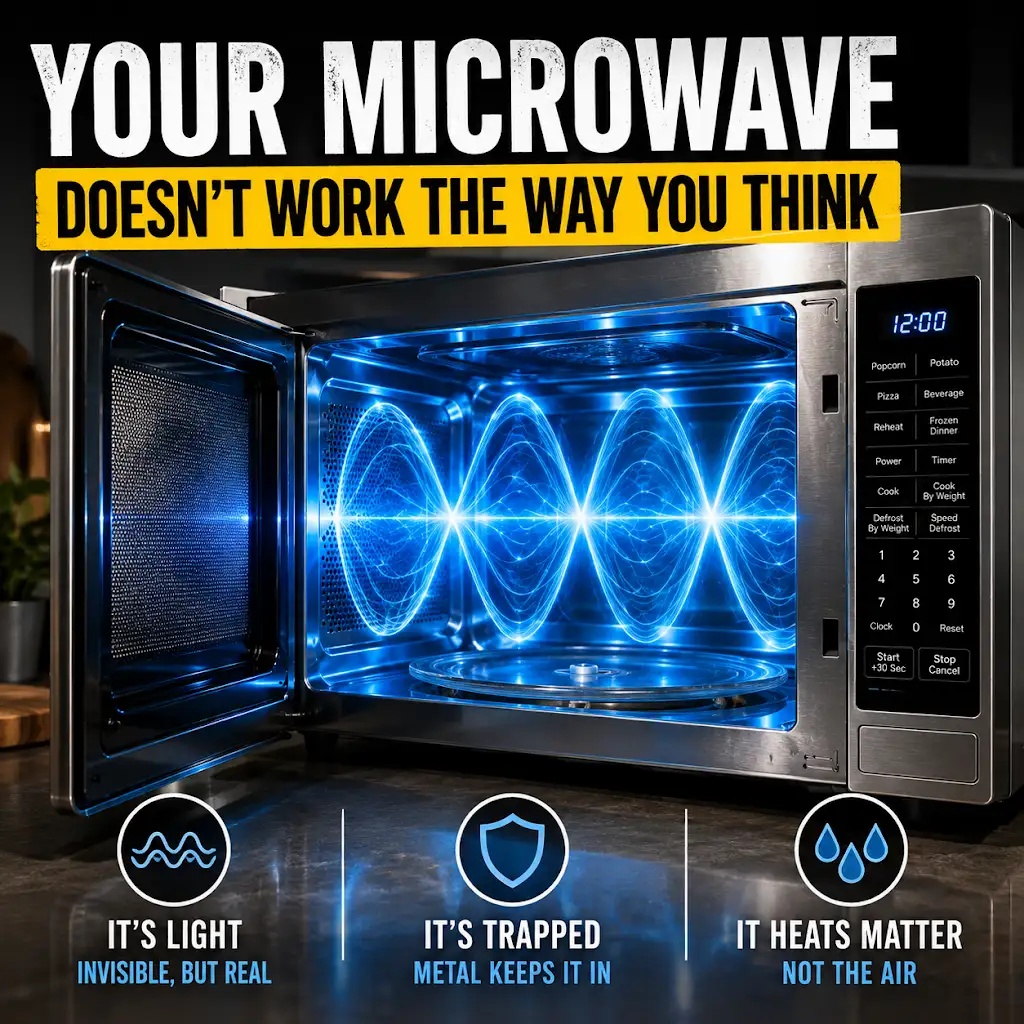
Your Microwave Doesn’t Work the Way You Think
FAQs
What is microwave oven shielding?
Microwave oven shielding refers to the metal casing and mesh screen inside the microwave oven that prevents the microwaves from escaping and causing harm to people or interfering with electronic devices.
How does microwave oven shielding work?
Microwave oven shielding works by reflecting the microwaves back into the oven, preventing them from escaping and causing harm. The metal casing and mesh screen are designed to contain the microwaves within the oven.
Why is microwave oven shielding important?
Microwave oven shielding is important because it prevents the harmful microwaves from escaping and causing harm to people or interfering with electronic devices. It also ensures that the microwave oven operates safely and efficiently.
What materials are used for microwave oven shielding?
Microwave oven shielding is typically made of metal, such as steel or aluminum, which is capable of reflecting the microwaves and containing them within the oven.
Can microwave oven shielding degrade over time?
Yes, microwave oven shielding can degrade over time due to wear and tear, which may result in the escape of microwaves. It is important to regularly inspect and maintain the shielding to ensure the safe operation of the microwave oven.