You’ve probably seen it happen, or perhaps you’ve been warned against it by a well-meaning aunt or a science teacher. You accidentally leave a fork, or a spoon, or even a piece of aluminum foil, inside your microwave oven, and suddenly, a mesmerizing (and slightly terrifying) light show erupts. Sparks fly, crackling noises fill the air, and you instinctively hit the off button, wondering what exactly went wrong. Why do forks, and other metallic objects, spark in microwaves? It’s a question that delves into the fascinating physics of electromagnetism and material science, and understanding it can make you a more informed and safer microwave user.
To understand why metal rebels against the microwave, you first need to grasp how these culinary workhorses operate. Microwaves aren’t just another form of heat; they harness a specific type of electromagnetic radiation to excite the water molecules within your food.
Generating the Waves
At the heart of every microwave oven is a device called a magnetron. This ingenious component is responsible for generating microwaves, which are essentially radio waves with a specific frequency, typically around 2.45 gigahertz. When you set your microwave to cook, the magnetron gets to work, converting electrical energy into this powerful electromagnetic radiation.
The Cavity and the Waves
These generated microwaves are then channeled into the cooking cavity of the oven. The inside of your microwave isn’t just a plain box; it’s designed to reflect these waves. The metallic walls of the oven act like a mirror for microwaves, bouncing them around the cavity. This ensures that the waves are distributed as evenly as possible, reaching all parts of your food from multiple angles. This constant bouncing and redirection is crucial for efficient heating. Without it, the microwaves would simply escape or clump in certain areas.
Targeting Water Molecules
The magic of microwave cooking lies in its ability to directly interact with certain molecules in your food, primarily water. Microwaves have a unique property: they are adept at agitating polar molecules. Water molecules are inherently polar, meaning they have a slightly positive end and a slightly negative end. When microwaves penetrate the food, their oscillating electric field causes these water molecules to rapidly spin back and forth, attempting to align themselves with the changing field.
The Dance of Dipoles
This rapid spinning generates friction between the water molecules, and it’s this friction that produces heat. Imagine millions of tiny dancers frantically trying to turn in sync with a rapidly changing beat. The collisions and interactions between these dancers are what create the warmth that cooks your meal. This is why foods with higher water content, like vegetables and soups, tend to cook faster in a microwave than drier items.
Not Just Water: Fats and Sugars
While water is the primary target, other polar molecules like fats and sugars also contribute to microwave heating. However, their response to microwave radiation is generally less pronounced than that of water. The efficiency of microwave heating can vary significantly depending on the composition of the food you’re trying to cook.
Microwave ovens are convenient appliances, but using metal objects like forks can lead to dangerous sparks and potential fires. This phenomenon occurs because microwaves cause the metal to heat up rapidly, creating electrical arcs that can ignite nearby materials. For a deeper understanding of this topic and related scientific explanations, you can read more in this article on Freaky Science: Freaky Science.
Metal’s Misunderstanding: Why Conductors React Differently
Now, let’s bring in our metallic troublemakers. Metals are fundamentally different from the water molecules in your food. They are excellent conductors of electricity, and this conductivity is the key to their dramatic reaction in a microwave.
Free Electrons: The Conductors’ Secret Weapon
Metals are characterized by their abundance of “free electrons.” These are electrons in the outer shells of metal atoms that are not tightly bound to any particular atom. They are free to move throughout the metal’s structure. Think of it like a bustling city with many people who can move around freely, rather than a tightly controlled military parade.
The Electric Field’s Influence
When microwaves enter the oven, they carry an oscillating electric field. This electric field exerts a force on charged particles, and in the case of metals, it exerts a force on those abundant free electrons. As the electric field oscillates, it pushes and pulls these free electrons back and forth at an incredibly high speed.
Pushing and Pulling the Electron Sea
Imagine the microwaves as a giant, invisible hand rapidly pushing and pulling on the surface of a metallic object. This force causes a massive surge of electrons to move within the metal. This rapid movement of electrons is essentially an electric current. The faster the microwaves oscillate, the faster the electrons are forced to move, creating intense localized currents within the metal.
A Microscopic Frenzy
The sheer speed and density of this electron movement within the metal can become incredibly intense, especially at sharp edges, points, or thin parts of the metallic object. It’s like a microscopic traffic jam that quickly escalates into chaos.
The Birth of Sparks: Arcs and Ionization

This rapid electron movement and the resulting electrical currents are what ultimately lead to the spectacular light show you witness. The sparks you see are not just random flashes; they are a manifestation of a phenomenon called electrical arcing, which involves the ionization of air.
Overcoming the Insulator: Air’s Breakdown Voltage
Air, for the most part, is an electrical insulator. This means it doesn’t readily conduct electricity. However, like all insulators, air has a limit. If the electrical field becomes strong enough, it can overcome air’s insulating properties, forcing it to conduct. This is known as the dielectric breakdown of air.
The Critical Threshold
The electric field created by the rapidly oscillating electrons within the metal can become incredibly concentrated, especially at sharp points or edges of the metal. When this electric field strength reaches a critical threshold, it can rip electrons away from the air molecules surrounding the metal.
Creating a Plasma Conduit
This process, known as ionization, transforms the neutral air molecules into charged ions and free electrons. These newly created charged particles can then conduct electricity, forming a temporary pathway, or plasma, between the metallic object and other conductive surfaces in the microwave, such as the oven walls or even other parts of the same metallic object.
The Visible Flash: Light from Excited Gases
The sparks themselves are the visible light emitted as these ionized gas molecules return to their neutral state. When electrons recombine with ions or when charged particles collide, they release energy in the form of photons, which are particles of light. The colors of the sparks (often white, blue, or yellow) depend on the specific gases present and their energy states. It’s a miniature lightning strike happening inside your microwave, fueled by the microwave’s own energy.
The Crackling Sound: Energy Release
The crackling or popping sound you hear is the rapid expansion of the air as it’s heated by the intense electrical discharge. It’s the sonic byproduct of the energy being released during the arcing process.
Not All Metals Are Equal: The Role of Shape and Size
You might notice that not every piece of metal behaves the same way in a microwave. A fork might spark violently, while a completely enclosed metal bowl might not seem to do much at all (though it will prevent your food from cooking). The shape, size, and even the thickness of the metallic object play significant roles in determining its microwave reaction.
The Faraday Cage Effect: Protection by Enclosure
A completely enclosed metallic object, like a metal bowl with a lid or a metal food container, can act as a Faraday cage. A Faraday cage is a conductive enclosure that blocks external electromagnetic fields. In a microwave, if the metal completely surrounds the food, the microwaves cannot penetrate the enclosure to reach the food. However, the outside of the metal will still be interacting with the microwaves.
Reflecting and Containing
The metal walls of the Faraday cage will reflect the microwaves, preventing them from entering. The microwaves will bounce off the exterior surface. If the metal is smooth and has no sharp edges or thin sections that can concentrate electric fields, the risk of arcing might be reduced. However, this is a delicate balance, and even a perfectly formed Faraday cage can eventually lead to problems if the microwave energy builds up sufficiently.
Sharp Edges and Points: The Spark Magnets
As mentioned earlier, sharp edges, points, and thin protrusions on metallic objects are prime locations for spark generation. These are the areas where electric fields can become extremely concentrated.
Electric Field Concentration
Think of it like water flowing over a smooth rock versus water being forced through a narrow nozzle. The pressure and speed of the water are much higher at the nozzle. Similarly, electric fields become highly concentrated at these sharp points, dramatically increasing the likelihood of reaching the dielectric breakdown voltage of the air and initiating arcing. This is why the prongs of a fork or the tines of a whisk are particularly problematic.
Smooth Surfaces and Thick Objects: Reduced Risk, Not Elimination
Smoother, more rounded, and thicker metallic objects generally pose less of a risk for sparking compared to their sharp-edged counterparts. The absence of sharp points means less concentration of electric fields.
Uniform Distribution of Charge
With smoother surfaces, the electrical charge tends to distribute more evenly, reducing the extreme localizations that lead to arcing. However, it’s important to remember that even a smooth metal object will still interact with microwaves, and under the right conditions, arcing can still occur, especially if the object is in close proximity to other conductive surfaces.
When it comes to understanding why forks spark inside microwave ovens, it’s fascinating to explore the science behind it. The metal in forks can create electric arcs when exposed to the microwave’s electromagnetic waves, leading to those startling sparks. For a deeper dive into this phenomenon and other related topics, you can check out this informative article on Freaky Science, which explains the principles of microwave cooking and the interactions of various materials within the appliance.
The Real Danger: More Than Just a Light Show
| Reasons for Forks Sparking Inside Microwave Ovens | Explanation |
|---|---|
| Metallic Material | Forks are made of metal, which can cause arcing and sparking inside the microwave due to the reflection of microwaves. |
| Electric Current | When a fork is placed inside the microwave, it can act as a conductor and create an electric current, leading to sparking. |
| Damage to Microwave | Sparking can occur if the microwave’s interior or the fork itself is damaged, causing irregularities in the microwave’s electromagnetic field. |
| Unsafe Cooking Practice | Placing metal objects like forks inside a microwave is an unsafe cooking practice and can lead to sparking and potential damage to the appliance. |
While the sparks can be visually dramatic, the real danger of microwaving metal goes beyond mere aesthetics. It poses significant risks to both your microwave oven and your safety.
Damage to the Magnetron: The Heart of the Problem
The most serious consequence of arcing metal inside a microwave is damage to the magnetron. The magnetron is a sensitive and expensive component. The intense electrical discharges and the resulting surges of reflected microwave energy can overheat and damage the magnetron, potentially rendering your microwave unusable.
Reflected Energy Surges
When microwaves hit a reflective object like metal, they don’t get absorbed. Instead, they are reflected back into the oven cavity. If these reflected waves are not properly managed, they can bounce back and forth between the metal and the microwave walls, creating high-energy standing waves. These concentrated energy surges can be directed back towards the magnetron, causing it to overheat and fail.
Fire Hazards: The Ultimate Risk
In some cases, the intense heat generated by arcing can ignite surrounding materials, leading to a fire inside your microwave. Paper, plastic, or even food particles that come into contact with the superheated sparks can catch fire, creating a serious fire hazard.
Igniting Packaging and Food Residues
If you’ve accidentally microwaved metal with food packaging that contains foil or metallic inks, the sparks can easily ignite these materials. Even small food residues left on the oven walls can become fuel for a microwave fire if they are exposed to the intense heat of arcing.
Risk of Electrical Shock: A Less Common, But Possible Threat
While less common, there is a theoretical risk of electrical shock if the arcing is particularly severe and involves contact with exposed electrical components or if you attempt to retrieve a sparking object while the microwave is still operating.
Intentional Contact and Internal Wiring
Never attempt to remove a metal object while the microwave is running, especially if it is sparking. The internal wiring of a microwave carries high voltages, and the arcing can create a path for current to flow, posing a risk of shock. Always ensure the microwave is unplugged before attempting any internal inspection or cleaning.
Safe Microwaving Practices: Avoiding the Sparking Spectacle
Understanding the science behind why forks spark in microwaves empowers you to avoid these dangerous situations. Adhering to simple guidelines will ensure your microwave remains a safe and efficient appliance.
The Golden Rule: No Metal, Unless Specified
The most crucial rule is simple: do not put metal in the microwave unless the manufacturer’s instructions or the item’s packaging explicitly states it is microwave-safe. This includes utensils, dishes with metallic trim, foil (unless specifically used for shielding as directed), and even some food packaging.
Reading Labels and Instructions
Always take a moment to read the care instructions on your dishes and packaging. Many items that appear to be safe for microwave use have subtle metallic elements that can cause problems. When in doubt, err on the side of caution and use ceramic, glass, or microwave-safe plastic.
Embrace Microwave-Safe Materials
Opt for materials specifically designed for microwave use. Glass, ceramic, and most plastics are excellent choices. These materials absorb microwave energy and convert it into heat, allowing your food to cook without causing dangerous reactions.
The Advantages of Non-Metallic Cookware
Non-metallic cookware is ideal because it allows microwaves to penetrate and interact directly with the food. This leads to efficient and even cooking without the risk of electrical hazards. Many manufacturers offer a wide range of microwave-safe dishes, bowls, and containers.
What About Microwave-Specific Foil Shielding?
You might have seen or heard of using aluminum foil to shield parts of food from overcooking, like the tips of chicken wings. This is a specialized technique that can be safe when done correctly, but it requires a thorough understanding of the principles involved.
Strategic Placement and Limited Use
Aluminum foil acts as a reflector. When used strategically, it can deflect microwaves away from delicate parts of the food, allowing the rest to cook without burning. However, the foil must be applied smoothly and carefully, avoiding any sharp edges or crumpled sections that could concentrate electric fields. It’s also crucial to use only small, strategic pieces and never completely enclose food in foil. Always follow the specific instructions provided by a reputable source for this technique.
Dealing with Accidental Metal Inclusion
If you accidentally put metal in the microwave, don’t panic, but act quickly and safely.
Immediately Stop the Microwave
The moment you realize you’ve included metal, immediately press the “Stop” or “Cancel” button. Do not wait for the cooking cycle to finish.
Unplug for Added Safety
For an extra layer of safety, unplug the microwave from the wall outlet before attempting to remove the metal object. This ensures there is no power running through the appliance.
Careful Removal
Once the microwave is stopped and unplugged, carefully open the door and remove the metallic item. Be cautious, as the object itself might be hot from residual energy.
By understanding the science behind the sparks, you can transform a potentially hazardous situation into a learning opportunity. Microwaves are powerful tools, and with a little knowledge and caution, you can continue to enjoy their convenience safely. Remember, the goal is delicious food, not a dazzling light show.
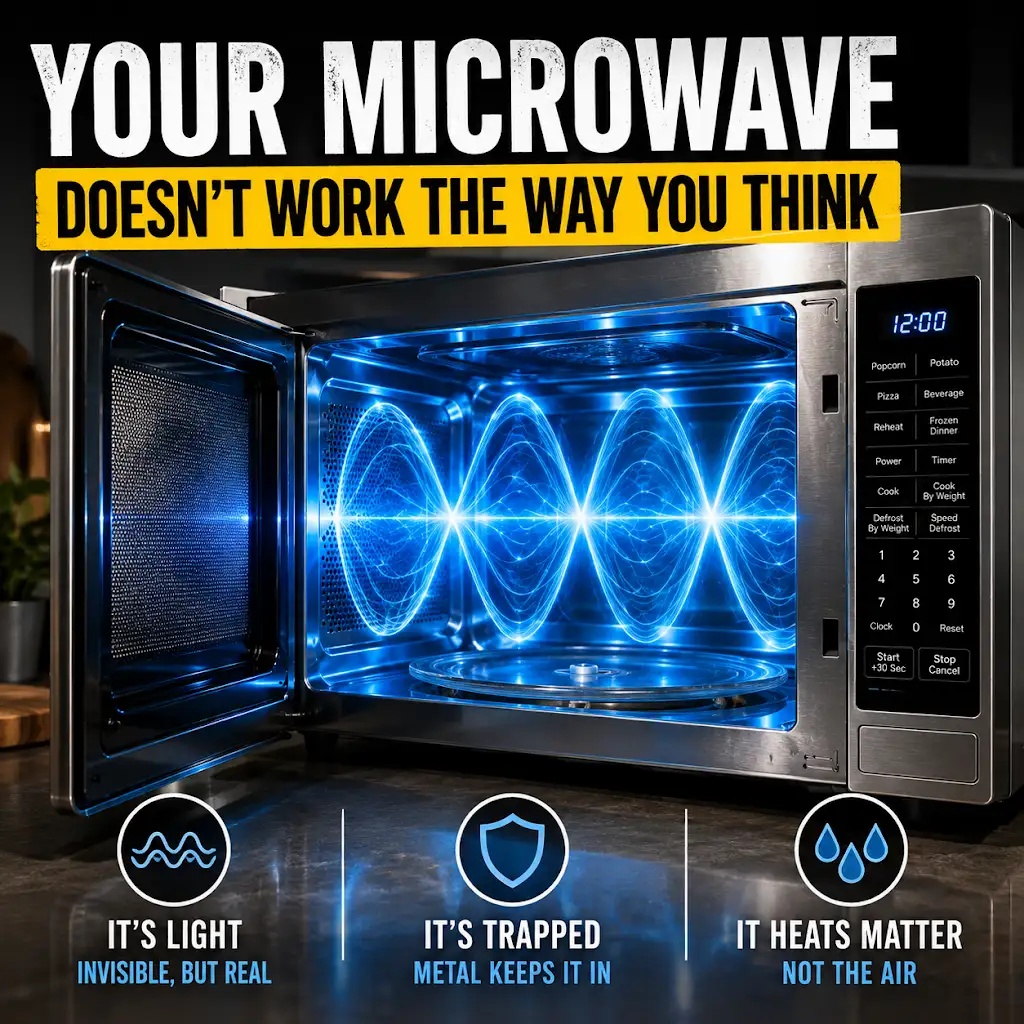
Your Microwave Doesn’t Work the Way You Think
FAQs
What causes forks to spark inside microwave ovens?
Metal objects such as forks have sharp edges and points, which can create a high concentration of electric fields when exposed to microwaves. This can lead to sparking and potentially damage the microwave.
Is it safe to put metal objects, such as forks, in a microwave?
No, it is not safe to put metal objects in a microwave. Metal can cause sparking, arcing, and potentially damage the microwave, as well as pose a fire hazard.
What should I do if a fork sparks inside my microwave?
If a fork sparks inside your microwave, immediately turn off the microwave and unplug it. Allow the microwave to cool down and inspect for any damage. Do not use the microwave until it has been checked by a professional.
Can I use metal utensils in a microwave if they are labeled as “microwave-safe”?
Even if a metal utensil is labeled as “microwave-safe,” it is still not recommended to use it in a microwave. Metal can still cause sparking and potential damage to the microwave, regardless of the labeling.
What are safe alternatives to using metal utensils in a microwave?
Safe alternatives to using metal utensils in a microwave include using microwave-safe glass, ceramic, or plastic utensils. These materials do not pose the same risk of sparking and damage as metal objects.