You’ve probably zapped a mug of coffee, reheated last night’s leftovers, or even cooked a lightning-fast meal in it. The microwave oven is a staple in most kitchens, a silent workhorse that offers unparalleled speed and convenience. But have you ever stopped to wonder about the magic – or rather, the science – happening inside that humming metal box? It’s not really magic, of course. It’s a fascinating application of physics, specifically the principles of electromagnetic radiation. Let’s peel back the layers and unravel the physics behind how your microwave oven transforms cold food into a steaming delight.
At its core, a microwave oven is a sophisticated application of electromagnetic radiation. You’re not just “heating” food; you’re bombarding it with a specific type of energy wave.
What are Electromagnetic Waves?
Imagine light, radio waves, and X-rays. They all belong to the same family: electromagnetic waves. These waves are composed of oscillating electric and magnetic fields that travel through space at the speed of light. The key difference between them lies in their frequency and wavelength. Frequency refers to the number of wave cycles that pass a point per second, measured in Hertz (Hz). Wavelength is the distance between two consecutive crests or troughs of a wave. These two properties are inversely related: higher frequency means shorter wavelength, and vice versa.
The Microwave Spectrum
Microwaves occupy a specific band within the electromagnetic spectrum, typically ranging from 300 megahertz (MHz) to 300 gigahertz (GHz). This is a relatively narrow slice, but it’s precisely this range that makes them so effective for cooking. For household microwave ovens, the most commonly used frequency is 2.45 GHz. This frequency is chosen for a very important reason, which we’ll delve into shortly.
Generating the Waves: The Magnetron
The powerhouse of your microwave oven is a device called a magnetron. Think of it as a vacuum tube that generates microwave radiation. Inside the magnetron, electrons are propelled by a strong magnetic field. As these electrons move, they interact with resonant cavities within the tube, causing them to oscillate at the desired microwave frequency (2.45 GHz). This oscillation generates the high-power microwave radiation that will eventually heat your food. The magnetron is a marvel of engineering, capable of producing hundreds, even thousands, of watts of power in a very compact form.
To gain a deeper understanding of the physics behind microwave ovens, you might find the article on Freaky Science particularly insightful. It explores the principles of electromagnetic radiation and how microwaves interact with food molecules to heat them efficiently. For more detailed information, you can read the article here: Freaky Science. This resource will enhance your comprehension of the science that makes microwave cooking possible.
The Mechanism of Heating: Dielectric Heating
So, you have these microwave waves zipping around inside your oven. How do they actually heat your food? The answer lies in a phenomenon known as dielectric heating.
The Role of Water Molecules
Most foods, especially those you’re likely to microwave, contain a significant amount of water. Water molecules (H₂O) are not simple, symmetrical spheres. Instead, they are polar molecules. This means that they have a slightly positive charge on the hydrogen atoms and a slightly negative charge on the oxygen atom, creating a dipole. Think of it like a tiny, natural battery.
The Dance of the Dipoles
When microwave radiation, which is an oscillating electric field, enters the food, it interacts with these polar water molecules. The electric field causes the water molecules to try and align themselves with the field. As the electric field rapidly oscillates back and forth (at 2.45 billion times per second!), the water molecules are forced to rotate and twist in an attempt to keep up. This rapid rotation and jostling creates friction between the molecules.
Friction Generates Heat
It’s this molecular friction that generates heat. Imagine rubbing your hands together very quickly; they get warm. The same principle applies at the molecular level within your food. The faster and more vigorously the water molecules are forced to move, the more heat is produced. This is why foods with higher water content tend to heat up more effectively and quickly in a microwave.
Why 2.45 GHz?
The specific frequency of 2.45 GHz is ideal because it’s particularly good at exciting water molecules. At this frequency, the water molecules can efficiently rotate and absorb the energy from the microwaves. Other frequencies might be absorbed by different components of food, or they might not be as effective at causing the water molecules to vibrate. It’s a sweet spot that maximizes heating efficiency for a wide range of foods.
Beyond Water: Other Polar Molecules
While water is the primary driver of microwave heating, other polar molecules present in food, such as fats and sugars, also contribute. These molecules also have a degree of polarity and can be excited by the microwaves, further contributing to the overall heating process. However, their contribution is generally less significant than that of water.
The Microwave Oven’s Architecture
The magnetron is the heart, but the rest of the oven’s components work in concert to ensure efficient and safe heating.
The Waveguide
The microwaves generated by the magnetron don’t just magically appear in the cooking cavity. They are channeled through a hollow metal tube called a waveguide. This waveguide directs the microwave energy from the magnetron to the cooking chamber. The waveguide is carefully designed to minimize energy loss and ensure that the microwaves are efficiently delivered where they are needed.
The Stirrer or Turntable
One of the challenges in microwave cooking is ensuring even heating. Because microwaves tend to travel in straight lines, hotspots can form, and other areas might remain cooler. To combat this, microwave ovens employ either a stirrer fan or a turntable.
The Stirrer Fan
In some models, a metal fan, often located at the top of the cooking cavity, rotates. This fan reflects and redirects the microwaves, scattering them throughout the cavity and helping to distribute the energy more evenly. You might hear a whirring sound when the oven is operating, which is the stirrer fan doing its job.
The Turntable
More commonly, you’ll find a rotating turntable at the bottom of the oven. This platform gently rotates the food, ensuring that all sides are exposed to the microwave radiation over the cooking time. This continuous movement is crucial for achieving more uniform heating and preventing some parts of your food from becoming overcooked while others remain cold.
The Faraday Cage
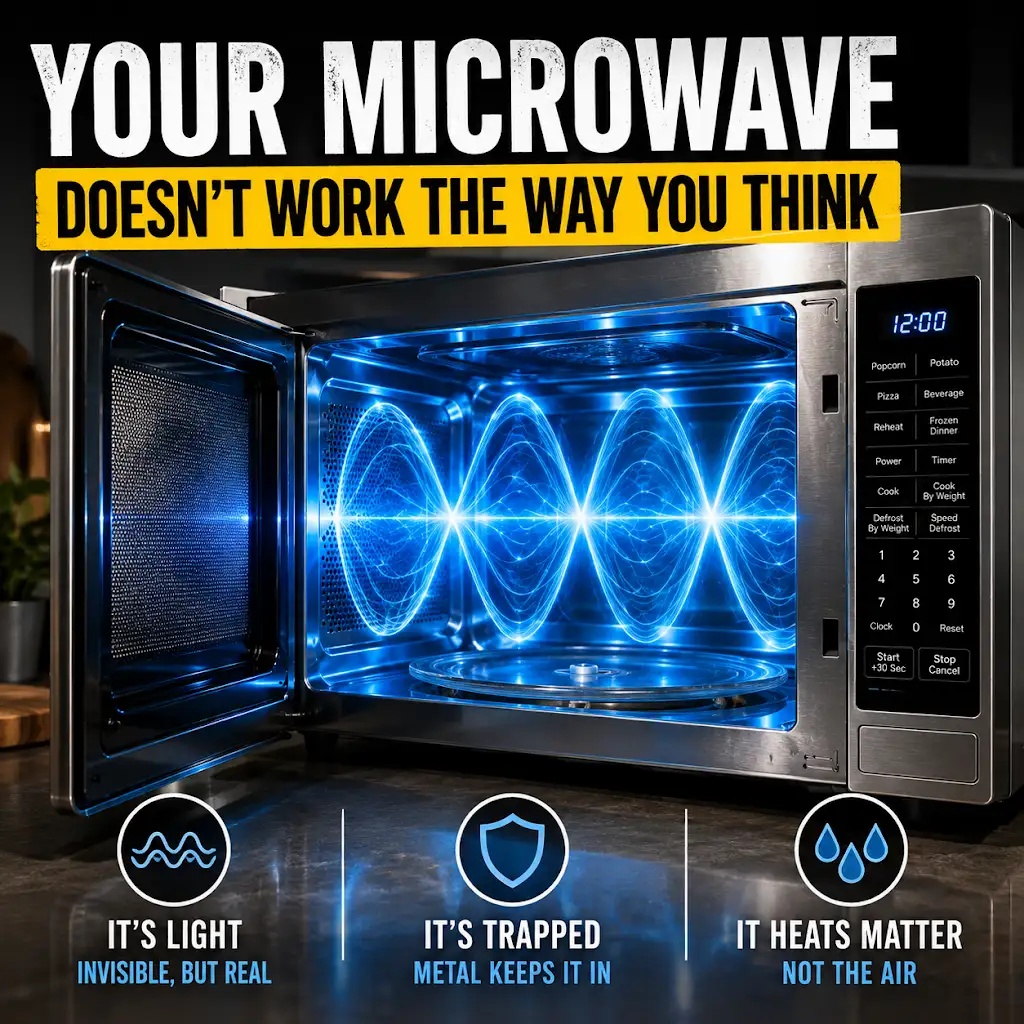
Safety is paramount, and microwave ovens are designed with robust safety features. The entire cooking cavity, along with the door and its mesh screen, acts as a Faraday cage.
What is a Faraday Cage?
A Faraday cage is an enclosure made of conductive material that blocks external electromagnetic fields. In a microwave oven, this cage prevents the microwave radiation from escaping the oven and exposing you to potentially harmful levels of energy. The metal walls of the oven cavity and the metal mesh embedded in the glass of the door are all part of this crucial safety mechanism.
The Door Seal and Mesh
The door is particularly important. The metal mesh in the door has holes that are much smaller than the wavelength of the microwaves. This allows you to see inside the oven while effectively trapping the microwaves within. The door seal also plays a vital role in preventing any stray radiation from leaking out. Microwave ovens have safety interlocks that immediately shut off the magnetron when the door is opened, further enhancing safety.
The Interaction with Food: Absorption and Penetration

Understanding how microwaves interact with food is key to mastering microwave cooking. Not all food components are affected equally.
Absorption and Reflection
When microwaves encounter food, they can be absorbed, reflected, or transmitted. As we’ve discussed, polar molecules like water readily absorb microwave energy. However, some materials, like metals, are highly reflective. This is why you should never put metal in a microwave oven. The reflected microwaves can bounce back to the magnetron, potentially damaging it, and they can also cause arcing and sparks within the oven.
Penetration Depth
Microwaves don’t just heat the surface of your food; they penetrate it to a certain depth. The penetration depth depends on the dielectric properties of the food and the frequency of the microwaves. For typical foods at 2.45 GHz, the penetration depth is usually around 1 to 1.5 inches. This means that heat is generated not only on the surface but also within this inner layer.
Conduction and Convection Within the Food
Once the microwaves have deposited energy within the food, the heat is transferred to the rest of the food through conduction and convection. The heat generated in the outer layers of the food will gradually conduct inwards. For thicker items, the heat generated in the penetrated layer will then move towards the center. This is why thicker foods might require more cooking time or might benefit from being cut into smaller pieces or stirred partway through.
Factors Affecting Heating
Several factors influence how effectively and quickly your food heats up in a microwave:
- Water Content: As mentioned, higher water content leads to faster and more efficient heating.
- Food Density and Thickness: Denser and thicker foods will take longer to heat as the microwaves need to penetrate further, and heat transfer within the food is slower.
- Fat and Sugar Content: While water is the primary absorber, fats and sugars also absorb microwaves to some extent, contributing to heating.
- Food Shape and Arrangement: The shape and how you arrange food in the microwave can affect evenness of heating. Spreading food out in a single layer is generally better than piling it up.
- Starting Temperature: Cold food will, of course, take longer to heat than room temperature food.
Understanding the physics behind microwave ovens can greatly enhance your cooking experience and safety in the kitchen. For those interested in delving deeper into the science of how microwaves work, a related article can provide valuable insights. You can explore this topic further by visiting this informative article, which explains the principles of microwave energy and its interaction with food. By grasping these concepts, you can optimize your microwave usage and achieve better cooking results.
Beyond Heating: Other Applications and Considerations
| Concept | Description |
|---|---|
| Microwave Frequency | The typical frequency used in microwave ovens is 2.45 GHz, which is in the range of radio waves. |
| Microwave Generation | Microwaves are generated by a magnetron tube and then distributed throughout the oven cavity. |
| Dielectric Heating | Microwaves cause polar molecules in food to rotate and generate heat through dielectric heating. |
| Standing Waves | Standing waves are formed in the oven cavity, leading to areas of high and low microwave intensity. |
| Reflection and Absorption | Reflection and absorption of microwaves by the food determine the heating pattern and efficiency. |
While heating food is the most common use, the principles of microwave technology have broader applications, and there are important safety and operational considerations to keep in mind.
Industrial and Scientific Uses
The same principles of dielectric heating are utilized in various industrial and scientific applications. For example, microwave ovens are used in:
- Sterilization: Hospitals and laboratories use microwave sterilization for certain medical equipment.
- Drying: Industries employ microwave drying for materials like paper, wood, and ceramics.
- Chemical Synthesis: Microwave reactors are used in laboratories to speed up chemical reactions.
- Food Processing: Larger-scale microwave systems are used in the food industry for pasteurization, tempering, and cooking.
Safety First: Operating Your Microwave Responsibly
Microwave ovens are designed to be safe when used correctly. However, it’s important to be aware of a few key points:
- Never Operate an Empty Oven: Running a microwave oven with nothing inside can damage the magnetron. The microwaves need something to absorb their energy.
- Inspect for Damage: Regularly check the oven door, seals, and interior for any signs of damage. If you notice anything amiss, discontinue use and have it inspected by a professional.
- Use Microwave-Safe Cookware: As discussed, avoid metal. Glass, ceramic, and certain plastics are generally safe. Always check the manufacturer’s recommendations for your cookware. Look for labels that indicate “microwave safe.”
- Beware of Superheating: Water can sometimes be superheated in a microwave, meaning it gets hotter than its boiling point without visibly boiling. Disturbing superheated water can cause it to erupt violently. Stirring liquids before and after heating can help prevent this.
- Allow for Standing Time: Many recipes call for “standing time” after microwaving. During this period, heat continues to distribute throughout the food through conduction, leading to more even cooking.
The Future of Microwave Technology
While the basic principles of microwave cooking have remained largely the same, ongoing research and development are exploring ways to improve efficiency, speed, and even cooking quality. Innovations might include more precise control over microwave distribution, the development of new materials for cookware, and perhaps even entirely new methods of microwave-based food preparation.
So, the next time you press the start button on your microwave, take a moment to appreciate the intricate interplay of physics that’s taking place. From the humming magnetron to the dancing water molecules, it’s a testament to how scientific understanding can transform everyday life. You’re not just heating food; you’re harnessing the power of electromagnetic waves in a truly remarkable way.
Your Microwave Doesn’t Work the Way You Think
FAQs
What is the physics behind microwave ovens?
Microwave ovens use electromagnetic radiation at a frequency of 2.45 GHz to heat food. The microwaves cause water molecules in the food to vibrate, generating heat through friction.
How does the magnetron in a microwave oven work?
The magnetron in a microwave oven converts electrical energy into microwave radiation through the interaction of electric and magnetic fields. This radiation is then directed into the cooking chamber.
Why do some materials heat up in a microwave oven while others do not?
Materials that contain water, such as food, heat up in a microwave oven because the water molecules absorb the microwave radiation and convert it into heat. Materials that do not contain water, such as glass or ceramics, do not heat up as much.
What safety precautions should be taken when using a microwave oven?
It is important to use microwave-safe containers and avoid metal objects in the microwave, as they can cause arcing and damage the oven. Additionally, it is important to follow the manufacturer’s instructions and never operate the microwave oven with the door open.
How does the size and shape of the cooking chamber affect the cooking process in a microwave oven?
The size and shape of the cooking chamber can affect the distribution of microwave radiation and the way food heats up. A larger chamber may require longer cooking times, while a smaller chamber may result in more even heating.