You’re standing in front of your microwave, a cold, sad-looking plate of leftovers in your hand. You press a few buttons, hear the familiar hum, and in a few minutes, voilà! Dinner is served. It’s a convenience you likely take for granted, a modern marvel that simplifies your life. But have you ever stopped to wonder what’s actually happening inside that metal box? What’s the science behind how your microwave transforms that chilled meal into a steaming, edible feast? It’s more fascinating than you might think, a delicate dance of electromagnetic waves and molecular vibrations that fundamentally alters your food.
You might envision microwaves as tiny ovens that blast your food with heat. While they do heat food, the mechanism is quite different from conventional ovens, which rely on infrared radiation and convection. Your microwave is, in essence, a controlled generator of electromagnetic radiation within a specific frequency range.
The Heart of the Matter: The Magnetron
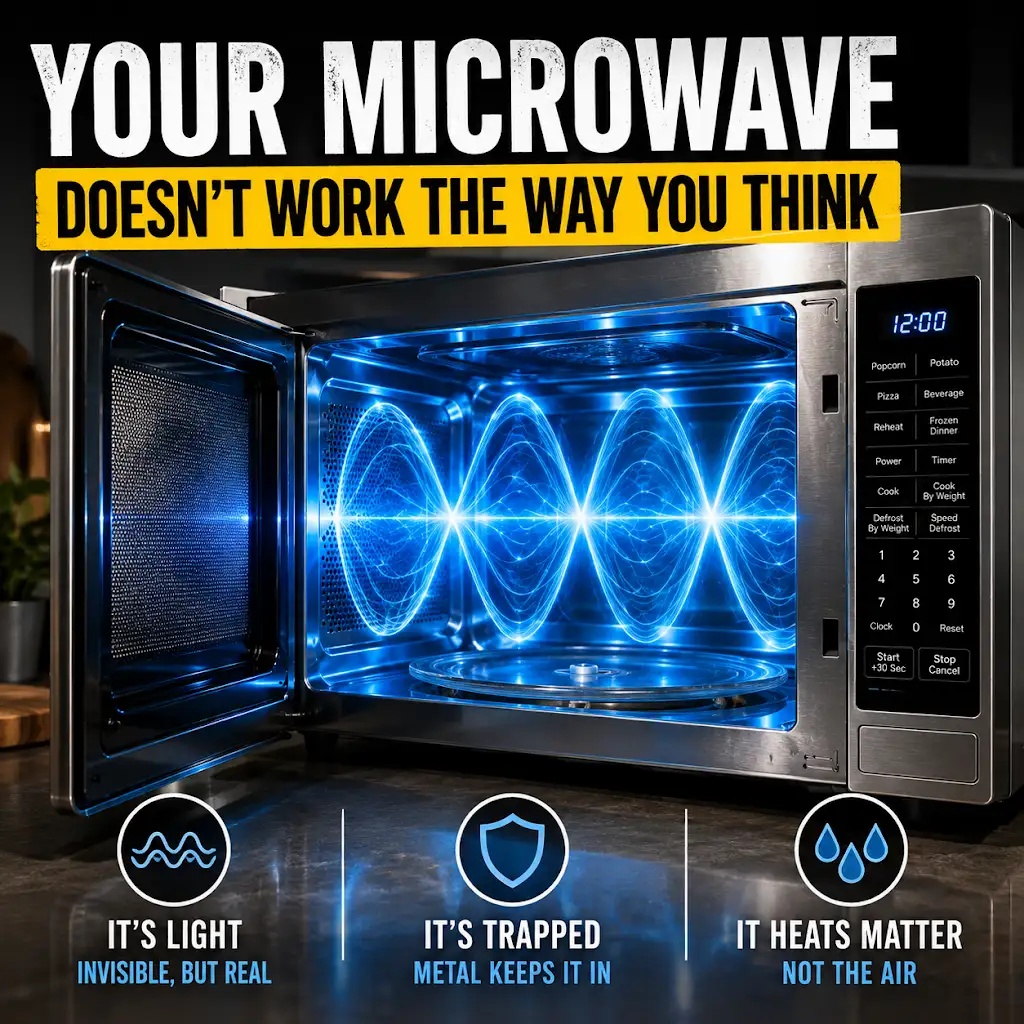
The unsung hero of your microwave is the magnetron. This isn’t some magical component; it’s a vacuum tube that uses a magnetic field to control the flow of electrons. When electricity is applied, the electrons are forced to spiral, generating high-frequency radio waves, specifically in the microwave spectrum, typically around 2.45 gigahertz (GHz). This frequency is crucial for its interaction with food.
A Wave of Energy: Understanding Electromagnetic Radiation
Electromagnetic radiation, as you know, exists on a spectrum. Radio waves, visible light, X-rays – they are all forms of electromagnetic energy. Microwaves fall between radio waves and infrared radiation. The key to their heating power lies in their wavelength and frequency, which are perfectly tuned to interact with specific molecules in your food.
The Cavity and the Stirrer: Directing the Energy
Once generated, these microwaves are channeled into the cooking cavity. This is the metal box where your food resides. The metal walls of the cavity reflect the microwaves, bouncing them around. This reflection is essential to ensure the energy is distributed as evenly as possible throughout the food. However, microwave energy can create “hot spots” and “cold spots” due to interference patterns. To combat this, most microwaves incorporate a rotating turntable or a mode stirrer (a fan-like device that reflects microwaves in different directions) to promote more uniform heating.
Microwave radiation interacts with food in fascinating ways, primarily through the process of dielectric heating, which causes water molecules in the food to vibrate and generate heat. For a deeper understanding of this phenomenon and its implications for cooking and food safety, you can explore the related article at Freaky Science. This resource provides insights into the science behind microwave cooking and how it affects the nutritional value of various foods.
The Molecular Dance: Water’s Role in Microwave Heating
The primary reason microwaves are so effective at heating food is their interaction with water molecules. Water is a polar molecule, meaning it has a slight positive charge on one end and a slight negative charge on the other.
Polarity and Dielectric Heating
When microwaves pass through your food, their oscillating electric field exerts a force on these polar water molecules. Imagine them as tiny magnets being rapidly flipped back and forth by an invisible force. This rapid flipping and reorientation of water molecules causes them to collide with each other, generating kinetic energy, which you perceive as heat. This process is known as dielectric heating.
Beyond Water: Other Polar Molecules
While water is the dominant player, other polar molecules present in food, such as fats and sugars, also contribute to microwave heating. However, their dielectric properties are generally less pronounced than water’s, meaning they heat up less efficiently. This is why foods with a higher water content tend to cook faster and more evenly in a microwave.
The Impact of Ice: A Slower Reaction
You’ve probably noticed that frozen food takes longer to cook. This is because in ice, water molecules are locked into a rigid crystalline structure. They can’t rotate and align with the oscillating electric field of the microwaves as readily as they can in liquid form. This significantly reduces the efficiency of dielectric heating until the ice begins to melt.
The Not-So-Mysterious Heating Patterns: Hot and Cold Spots

Despite the efforts of turntables and stirrers, you’ve likely encountered the frustrating reality of microwave cooking: some parts of your food are piping hot, while others remain stubbornly lukewarm. This phenomenon is directly linked to how microwaves interact with the food.
Standing Waves and Interference
Microwaves, like all waves, can interfere with each other. When they reflect off the metal walls of the oven, they can create “standing waves.” These are patterns where the waves reinforce each other at certain points (leading to hot spots) and cancel each other out at others (leading to cold spots). The arrangement of food within the microwave cavity can also exacerbate these patterns. Denser, thicker sections of food can absorb more energy, leading to localized overheating.
Food Density and Composition
The density and composition of your food play a significant role in how it heats. A dense, compact piece of food will absorb and retain heat differently than a lighter, airier one. Areas with higher water content will heat more quickly. This is why it’s often recommended to arrange food in a circular pattern on the plate, with denser areas towards the outside, to encourage more even cooking.
The Importance of Stirring and Standing Time
To mitigate the effects of hot and cold spots, stirring your food partway through the cooking process is a crucial step. This redistributes the heat and brings the colder parts into contact with the hotter areas. Similarly, allowing food to “stand” for a few minutes after microwaving is important. During this standing time, heat continues to conduct and distribute evenly throughout the food, equalizing temperatures and ensuring a more consistent outcome.
The Science of Texture and Transformation: More Than Just Heat
Microwave cooking isn’t just about raising the temperature of your food; it also influences its texture and how it cooks internally. Understanding these interactions can help you achieve better results.
Moisture Loss and Steam Generation
The rapid heating of water molecules in your food leads to the generation of steam. This steam can escape the food, leading to a loss of moisture. This is why some microwaved foods can become dry or rubbery if cooked for too long or without adequate covering. Conversely, the trapped steam within certain foods, like vegetables, can contribute to a softer, more tender texture.
Fat and Sugar Interactions
Fats and sugars also undergo changes during microwave cooking. Fats melt and can redistribute within the food, contributing to its texture and mouthfeel. Sugars can caramelize, though this process is often less pronounced than in conventional ovens due to the different heating mechanisms. The rapid heating can sometimes lead to a chewier texture in baked goods compared to oven-baked equivalents, as the starch gelatinization process is accelerated.
The Maillard Reaction: A Different Kind of Browning
You’ve likely noticed that microwaved food rarely browns or develops a crispy crust like food cooked in a conventional oven. This is because the Maillard reaction, the complex series of chemical reactions responsible for browning and developing savory flavors, requires higher temperatures and a drier environment than is typically achieved in a microwave. While some surface browning can occur in specific circumstances, don’t expect a beautifully seared steak from your microwave.
Microwave radiation interacts with food in fascinating ways, primarily by exciting water molecules, which generates heat and cooks the food evenly. For a deeper understanding of this process and its implications for cooking and nutrition, you can explore a related article on the topic. This resource provides insights into the science behind microwave cooking and its effects on food quality. To learn more, check out this informative piece on Freaky Science.
Safety and What You Should and Shouldn’t Microwave
| Interaction | Effect |
|---|---|
| Dielectric Heating | Causes polar molecules in the food to rotate and produce thermal energy |
| Penetration Depth | Determines how deeply the microwaves can travel into the food |
| Uniformity | Uneven distribution of microwaves can lead to uneven heating of the food |
| Standing Waves | Can cause hot and cold spots in the food due to interference patterns |
While microwaves offer unparalleled convenience, there are important safety considerations to keep in mind. Not everything is safe or even suitable for microwave cooking.
The Dangers of Metal: Arc and Spark
You know not to put metal in your microwave, but do you know why? Metal reflects microwaves, and when sharp or thin pieces of metal are present, the concentrated electrical charges can build up and discharge, creating sparks or “arcing.” This can damage your microwave and, in severe cases, pose a fire hazard. Even seemingly innocuous items like twist ties with metal closures can cause problems.
The Threat of Overheating Liquids: Steam Explosions
Microwaving liquids, especially water, carries a risk of “superheating.” This is when the liquid is heated beyond its boiling point without visibly boiling. If disturbed – by adding a spoon, sugar, or even just moving the container – the liquid can suddenly erupt, causing serious burns. It’s always best to stir liquids before and during microwaving, and to use microwave-safe containers that are not perfectly smooth on the inside to encourage nucleation sites for boiling.
Plastic Concerns: Leaching and Melting
While many plastic containers are labeled as “microwave-safe,” it’s important to use them with caution. Some plastics can leach chemicals into your food when heated, especially fatty or acidic foods. Always look for containers specifically designed for microwave use and avoid using cracked or damaged plastic. Glass and ceramic are generally safer alternatives for microwaving.
What Not to Microwave
Beyond metal, certain foods and items are best avoided in the microwave. Whole eggs in their shells can explode due to internal steam buildup. Chili peppers can release capsaicin vapors that can irritate your eyes and throat. Brown paper bags can release flammable fumes. And, of course, never microwave anything that is not intended for food.
By understanding the science behind how your microwave works, you can not only use it more effectively but also more safely. It’s a testament to human ingenuity, a small appliance that has profoundly changed how we prepare and consume food, all through the power of invisible waves and the energetic dance of molecules.
Your Microwave Doesn’t Work the Way You Think
FAQs
1. What is microwave radiation and how does it interact with food?
Microwave radiation is a form of electromagnetic radiation that has the ability to penetrate food and cause the water molecules within the food to vibrate, generating heat. This heat cooks the food from the inside out.
2. Does microwave radiation change the nutritional content of food?
Microwave radiation can cause some loss of nutrients in food, but it is generally considered to be a gentler cooking method compared to others, such as boiling or frying. The amount of nutrient loss depends on factors such as cooking time and the type of food being cooked.
3. Can microwave radiation cause any health risks in food?
When used according to manufacturer’s instructions, microwave radiation does not pose any health risks to food. It is important to use microwave-safe containers and follow recommended cooking times to ensure food safety.
4. How does microwave radiation affect the taste and texture of food?
Microwave radiation can affect the taste and texture of food by cooking it quickly and evenly. However, some foods may not brown or crisp as well in a microwave compared to other cooking methods, which can impact the overall texture and flavor.
5. Are there any precautions to take when using microwave radiation to cook food?
It is important to use microwave-safe containers and cover food with a lid or microwave-safe wrap to prevent splattering. Stirring or rotating the food during cooking can also help ensure even heating. Additionally, it is important to follow recommended cooking times and power levels to avoid overcooking or undercooking food.