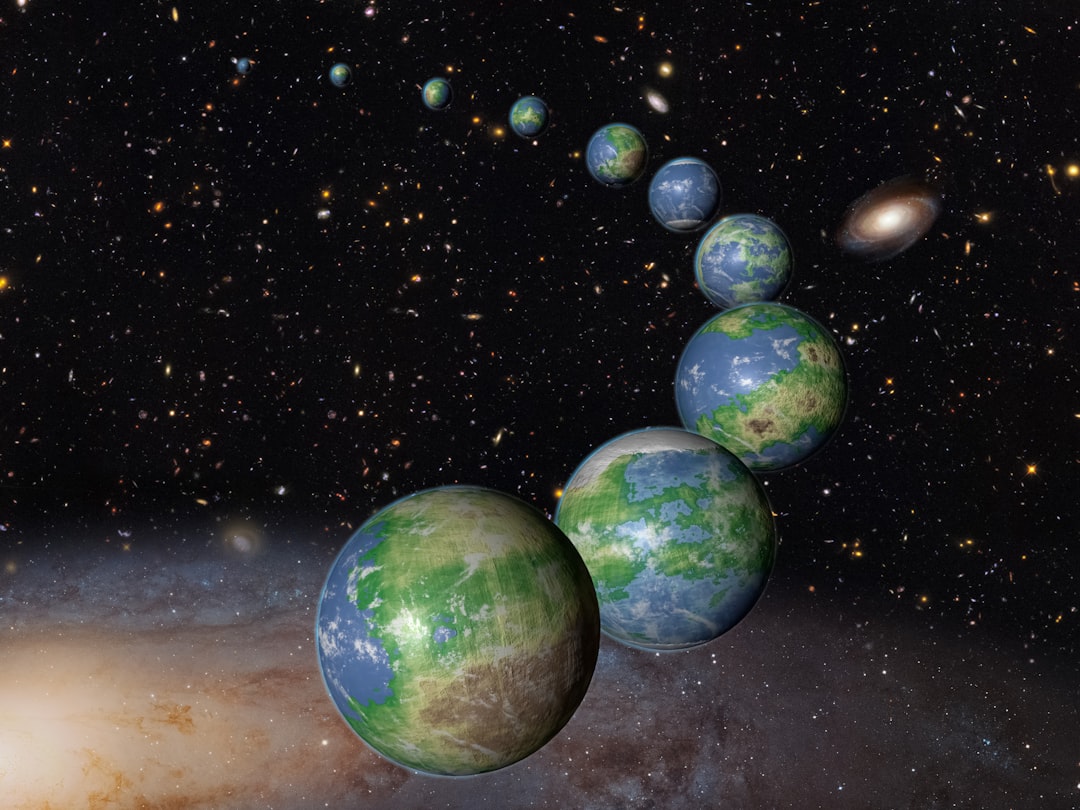
The Level Four Multiverse Theory: An Exploration of Infinite Possibilities
The concept of a multiverse, a collection of potentially infinite universes beyond our own observable cosmos, has long been a staple of both science fiction and theoretical physics. While various multiverse models propose different mechanisms for the existence of these other realities, one particularly intriguing and conceptually expansive framework is the Level Four Multiverse Theory. This theory, rooted in aspects of mathematical and physical universality, posits a structure of reality far grander and more abstract than many other proposals. It is a concept that challenges our fundamental understanding of existence, placing mathematics not merely as a tool for describing reality, but as a potential progenitor of it.
The Level Four Multiverse Theory, as conceptualized by physicists like Max Tegmark, departs significantly from more intuitive multiverse scenarios. It moves beyond the idea of different physical constants or initial conditions within spatially separated regions of spacetime. Instead, it suggests that all mathematically possible structures correspond to separate physical realities. This is a profound shift in perspective, implying that the very fabric of existence is dictated by what can be rigorously described by mathematics.
Mathematical Universality: The Core Tenet
At its heart, the Level Four Multiverse is built upon the principle of mathematical universality. This principle suggests that any logically coherent and self-consistent mathematical structure can, in principle, exist as a universe. This differs from theories that might suggest bubble universes forming from inflationary cosmology, or universes bracketing our own via quantum fluctuations. Here, the criterion for existence is purely mathematical consistency, not a specific physical mechanism of creation or separation.
What Constitutes a “Mathematically Possible Structure”?
Defining “mathematically possible structure” is crucial. It refers to abstract systems of rules, objects, and relationships that can be formally described. These are not just equations we use to model our universe, but entire self-consistent formalisms. This could include set theory, group theory, topological spaces, or even entirely novel mathematical frameworks that have yet to be conceived. The key is that within these structures, contradictions do not arise, and operations are well-defined.
The Role of Formal Systems
Formal systems, comprising axioms, inference rules, and theorems, are the bedrock of this idea. If a formal system is non-trivial (i.e., it contains at least one interesting mathematical object) and free from internal contradictions, then according to the Level Four Multiverse theory, it corresponds to a real universe. This implies a vast and potentially uncountable landscape of universes, each governed by its own unique set of mathematical laws.
Beyond Physical Laws
Unlike lower-level multiverses that might share fundamental physical laws but differ in their parameters (e.g., the strength of gravity, the values of fundamental constants), Level Four universes can possess entirely different fundamental laws. These laws would not be derived from our familiar physics but would emerge from the inherent properties of the chosen mathematical structure. This means universes could exist where concepts like spacetime as we understand it might not even be relevant, or where causality operates in ways completely alien to our everyday experience.
Different Geometries and Dimensions
The geometric properties of these universes could vary wildly. While our universe appears to be roughly flat and three-dimensional at large scales, other Level Four universes could be curved, higher-dimensional, or even possess topologies that are fundamentally impossible to visualize within our current comprehension. The mathematical framework would dictate these properties, not a prior physical substratum.
Novel Forces and Particles
Similarly, the fundamental forces and particles that populate these universes would be dictated by their underlying mathematical structures. This could lead to universes with an entirely different set of fundamental interactions, or where particles possess properties that we cannot even imagine under our current physical models.
The level four multiverse theory, which posits the existence of universes with entirely different physical laws and structures, offers a fascinating perspective on the nature of reality. For those interested in exploring this concept further, a related article that delves into the implications and intricacies of multiverse theories can be found at Freaky Science. This resource provides a comprehensive overview of various multiverse models and their potential impact on our understanding of the cosmos.
Levels of Multiverse Classification: Contextualizing Level Four
To properly understand the significance of the Level Four Multiverse Theory, it is helpful to place it within the broader classification of multiverse models. Physicist Max Tegmark has proposed a hierarchy of four levels, each representing an increasingly abstract and expansive conception of reality. The Level Four Multiverse stands at the apex of this classification.
Level I: The Infinite Universe
The simplest form of multiverse is the Level I, which arises naturally from the assumption of an infinite, homogeneous, and isotropic universe. If our universe is spatially infinite and the distribution of matter and energy is relatively uniform on large scales, then all possible initial conditions within the observable universe will eventually repeat. This implies that there are regions of space, far beyond our cosmic horizon, that are identical to our own observable universe, down to the last atom.
Observable Horizons and Cosmic Inflation
The concept of an observable horizon is central here. Due to the finite speed of light and the finite age of the universe, we can only see a portion of it. Cosmic inflation, a period of rapid expansion in the early universe, is often invoked to explain the observed homogeneity of our universe and to suggest that the universe as a whole is likely much larger than our observable Hubble volume. If inflation is eternal, it can lead to an infinite number of Hubble volumes, each potentially with different initial conditions.
The Repetition of Initial Conditions
In an infinite universe, any finite arrangement of particles and energy will eventually be replicated. This is a statistical argument based on the finite number of possible quantum states within a given volume. Therefore, in an infinitely large universe, there are infinitely many regions that are identical to our own, as well as regions with slightly or drastically different configurations of matter.
Level II: The Bubble Universes
The Level II Multiverse arises from inflationary cosmology, specifically from the idea of eternal inflation. In this scenario, inflation never completely stops everywhere. Instead, it continues in some regions, while in others it ends, creating “bubble universes” that pinch off from the inflating background. These bubble universes can have different physical constants and even different numbers of spacetime dimensions.
Eternal Inflation and Pocket Universes
Eternal inflation suggests that the inflationary epoch in the early universe is ongoing in many regions of a larger meta-universe. Where inflation ends in a particular region, a separate universe, often referred to as a “pocket universe,” is born. These pocket universes are causally disconnected from each other, meaning no information can travel between them.
Variation of Physical Constants
The key characteristic of Level II universes is the potential for variation in their fundamental physical constants and laws. As these bubble universes form from different points where inflation ends, the quantum fluctuations that determine these constants can result in different values from one bubble to another. This offers a potential explanation for the fine-tuning problem in our own universe, where constants appear to be precisely set for the existence of life.
Level III: The Many-Worlds Interpretation
The Level III Multiverse is a consequence of the Many-Worlds Interpretation (MWI) of quantum mechanics. According to MWI, every quantum measurement that has multiple possible outcomes causes the universe to split into multiple branches, with each branch representing one of the possible outcomes. This leads to an ever-branching tree of parallel universes.
Quantum Superposition and Decoherence
In quantum mechanics, a particle can exist in a superposition of states, meaning it can be in multiple states simultaneously until measured. The act of measurement, or more accurately, decoherence, causes the superposition to collapse into a single definite state in our experience. MWI posits that instead of collapsing, the universe branches, with each branch realizing one of the possible outcomes.
The “Now” as a Branching Point
In MWI, the present moment is a constant branching point. Every decision, every random quantum event, leads to a new set of parallel universes. This interpretation avoids the seemingly problematic act of wave function collapse and offers a deterministic view of quantum mechanics at the fundamental level, albeit at the cost of an unimaginable number of parallel realities.
The Mathematical Universe Hypothesis and Level Four

The Level Four Multiverse Theory is intrinsically linked to what is known as the Mathematical Universe Hypothesis (MUH), which is essentially the philosophical underpinning of this highest level of multiverse. The MUH proposes that our physical reality is not just described by mathematics, but is a mathematical structure.
The Equivalence of Existence and Mathematical Description
The core claim of the MUH is that any self-consistent mathematical structure that is sufficiently complex to contain conscious observers is a real, existing universe. This means that we are not special cases of mathematical existence; rather, all such mathematical structures are equally real.
Implications for “Realness”
This radical idea challenges our intuitive understanding of “realness.” We typically associate reality with physical existence, with tangible objects and forces. The MUH suggests that mathematical entities, such as numbers, sets, and abstract concepts, are not merely abstract tools but possess their own form of existence.
Physical Laws as Mathematical Properties
If our universe is a mathematical structure, then its physical laws are simply the inherent properties of that structure. There is no external “why” for these laws beyond their internal mathematical consistency. This provides a potentially elegant, albeit abstract, explanation for the existence and nature of physical laws.
The Limits of Our Perception and Mathematics
A significant challenge in considering the Level Four Multiverse is the limitation of our own cognitive and perceptual abilities. We are evolved to understand our specific physical reality, which is governed by a particular set of mathematical laws. Comprehending universes governed by entirely different mathematical frameworks is a formidable, perhaps even impossible, task.
The Analogy of Chessboard Universes
Consider the analogy of different games. Our universe might be akin to a complex game of chess, with its precise rules and predictable outcomes. A Level Four universe could be a game with entirely different pieces, board, and rules – a game we might not even be able to recognize as a game, let alone play.
The Problem of Verification
A major hurdle for any multiverse theory is the practical problem of verification. How can we possibly detect or interact with universes that are, by definition, governed by fundamentally different mathematical structures, and potentially exist in ways that are beyond our current ability to measure or even conceive?
The Nature of Consciousness in Level Four
The MUH also raises profound questions about the nature of consciousness. If all mathematically possible structures exist as universes, and some of these structures are sufficiently complex to give rise to consciousness, then where does consciousness reside? Does it emerge from specific configurations of mathematical objects, or is it a more fundamental property of certain types of mathematical structures?
Consciousness as a Mathematical Property
One interpretation is that consciousness is a property that emerges within specific complex mathematical structures. Just as complex physical systems can exhibit emergent properties like temperature, consciousness could be an emergent property of certain computational or informational structures.
The Anthropic Principle in a New Light
The anthropic principle, which states that the universe must have properties that allow for the existence of observers like us, takes on a new dimension. If all mathematical structures exist, then it is not surprising that we find ourselves in a universe that supports our existence. We are simply in one of the universes where the mathematical structure allows for conscious observers.
Implications and Challenges of the Level Four Multiverse

The implications of embracing the Level Four Multiverse Theory are far-reaching, touching upon our understanding of fundamental reality, the nature of science, and even our place in the cosmos. However, the theory also presents significant philosophical and scientific challenges.
Reconceptualizing Scientific Inquiry
If all consistent mathematical structures are real, then the focus of scientific inquiry could shift. Instead of solely seeking to discover the fundamental laws of our universe, science might also involve exploring the vast landscape of possible mathematical structures and their potential manifestations as universes.
The Search for Universality versus Specificity
This could lead to a dual approach: on one hand, physicists continue to refine our understanding of the specific mathematical structure that constitutes our universe. On the other hand, mathematicians and theoretical physicists might explore the properties of entirely different mathematical frameworks, not for their utility in describing our reality, but for their inherent existence as other realities.
The Role of Mathematics as Discovery
The MUH elevates mathematics from a descriptive tool to a constitutive element of reality. The act of discovering new mathematical truths would, in a sense, be the act of discovering new universes. This suggests a profound interconnectedness between abstract thought and existential reality.
The Problem of Falsifiability
The most significant scientific challenge to the Level Four Multiverse Theory, like many other multiverse concepts, is the issue of falsifiability. If these other universes are fundamentally inaccessible and their existence cannot be empirically tested, then how can the theory be considered scientific in the traditional sense?
The Absence of Empirical Evidence
Direct empirical evidence for universes with entirely different mathematical laws is, by definition, unlikely. Unlike variations in physical constants within our own universe (which might be detectable through cosmological observations), or even separate bubble universes (which might produce gravitational echoes), Level Four universes operate on a plane of existence that may be beyond our current observational capabilities.
Theoretical Consistencies as a Guide
Proponents of the theory often default to the elegance and internal consistency of the mathematical framework itself as a primary form of justification. If a theory leads to a coherent and far-reaching cosmological picture, and if the underlying mathematical principles are robust, then it holds theoretical weight.
The Infinite Landscape of Possibilities
The sheer scale of what the Level Four Multiverse suggests is almost beyond comprehension. An infinite number of realities, each governed by its own unique mathematical logic, would exist simultaneously. This is a profound departure from the more constrained visions of multiverses offered by lower levels.
Universes Without Observers?
A key question arises: do all these mathematical universes necessarily contain conscious observers? If consciousness is an emergent property of sufficiently complex mathematical structures, then it is possible that many, perhaps most, of these universes are devoid of any form of sentient experience.
The Meaning of Our Existence
In such a vast and diverse multiverse, what is the significance of our own universe? Does the existence of infinite other realities diminish or enhance the importance of our own? This is a philosophical question that the Level Four Multiverse Theory forces us to confront. It suggests that our universe is simply one instance among an infinite set of possibilities, perhaps with no inherent specialness beyond its capacity to give rise to conscious beings like ourselves whose mathematical nature allows them to contemplate their own existence.
The level four multiverse theory presents a fascinating perspective on the nature of reality, suggesting that all possible mathematical structures exist and correspond to their own universes. For those interested in exploring this concept further, a related article can be found at Freaky Science, which delves into the implications of such a multiverse and how it challenges our understanding of existence itself. This exploration not only broadens the horizons of theoretical physics but also invites philosophical inquiries about the nature of reality and our place within it.
Philosophical and Existential Ramifications
| Aspect | Details |
|---|---|
| Level | Level Four Multiverse Theory |
| Definition | Proposed theory that suggests the existence of multiple universes, each with its own set of physical laws and constants |
| Characteristics | Universes are disconnected and do not interact with each other |
| Evidence | Currently speculative and theoretical, with no direct empirical evidence |
| Implications | If true, it would have profound implications for our understanding of the cosmos and our place within it |
The Level Four Multiverse Theory, with its assertion that all consistent mathematical structures correspond to physical realities, extends beyond the realm of physics and into deep philosophical territory, raising questions about the nature of existence, consciousness, and the ultimate structure of reality.
The Limits of Human Intuition
Our intuition is shaped by our experiences in this particular universe. The concepts of space, time, causality, and even fundamental forces are deeply ingrained. The Level Four Multiverse proposes realities where these familiar concepts might not apply, or might operate in fundamentally different ways, pushing the boundaries of our intuitive understanding.
Imagining the Unimaginable
Trying to truly grasp a universe governed by, for example, the mathematics of abstract algebra rather than the differential equations of physics is an intellectual exercise of the highest order. It requires moving beyond visualization and embracing purely abstract conceptualization.
The Role of Mathematics in Our Cognition
This theory also prompts reflection on the nature of mathematical thought itself. If mathematics is the language of existence, then perhaps our brains, in their ability to conceive of and manipulate complex mathematical structures, are tapping into a fundamental aspect of reality.
Redefining “Cosmology”
If the Level Four Multiverse is accepted, then the term “cosmology” itself would need to be redefined. It would no longer be the study of our single, observable universe, but rather the study of the entire landscape of possible mathematical realities.
The Universe as a Mathematical Object
This perspective sees the universe not as a physical entity that we describe with mathematics, but as a fundamental mathematical object that manifests as physical reality. The universe is, in essence, a computation or a formal system.
The Ultimate “Theory of Everything”
The ultimate goal of physics has often been a “Theory of Everything” that would unify all fundamental forces and particles. In the context of the Level Four Multiverse, the ultimate “Theory of Everything” might be a meta-mathematical framework that encompasses all possible self-consistent mathematical structures.
The Question of Purpose and Meaning
In a universe where our own reality is just one of an infinite number, the existential questions of purpose and meaning become even more poignant. Does our existence have inherent meaning, or is meaning something we construct within our specific mathematical reality?
Our Universe as a “Special” Case
Although the theory suggests that our universe is not inherently special in its existence, it may be special in its capacity to support life and consciousness, allowing us to contemplate these very questions. This is a form of the anthropic principle, where the properties of our universe are selected by our existence and our ability to observe and question.
The Freedom of Exploration
Conversely, the vastness of the Level Four Multiverse could also be seen as liberating. It implies an infinite playground for existence and experience, a testament to the boundless nature of mathematical possibility. Our own reality, while perhaps not unique in its existence, is unique in our experience of it, offering an endless frontier for exploration and understanding. The Level Four Multiverse, therefore, stands not just as a scientific theory, but as a philosophical paradigm that compels us to reconsider the very foundations of reality and our place within it.
FAQs
What is the level four multiverse theory?
The level four multiverse theory is a concept in theoretical physics that suggests the existence of multiple universes, each with its own set of physical laws and constants. This theory posits that these universes exist in a higher-dimensional space and may interact with each other in various ways.
How does the level four multiverse theory differ from other multiverse theories?
The level four multiverse theory differs from other multiverse theories in that it proposes the existence of universes with different fundamental physical laws and constants, rather than simply multiple copies of our own universe or variations of it. This theory suggests a more complex and diverse multiverse structure.
What evidence supports the level four multiverse theory?
Currently, there is no direct experimental evidence to support the level four multiverse theory. It is a speculative concept based on mathematical models and theoretical physics. Some physicists argue that certain aspects of the fundamental physical constants and laws in our universe could be explained by the existence of a level four multiverse.
How does the level four multiverse theory impact our understanding of the universe?
The level four multiverse theory challenges our traditional understanding of the universe as a single, self-contained entity with fixed physical laws and constants. If proven true, it would revolutionize our understanding of the nature of reality and the fundamental principles governing the cosmos.
What are the implications of the level four multiverse theory for the future of physics?
The level four multiverse theory has profound implications for the future of physics, as it suggests the existence of a vastly complex and diverse cosmic landscape beyond our current understanding. If confirmed, it would open up new avenues for research and exploration, potentially leading to breakthroughs in our understanding of the fundamental nature of the universe.