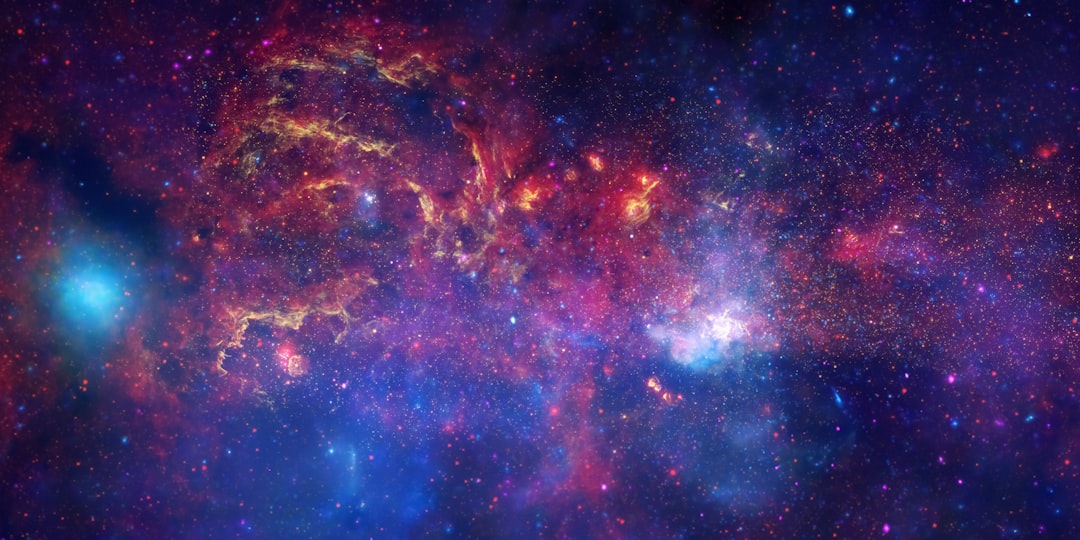
So, what exactly is this “dark matter” everyone’s talking about? In a nutshell, it’s the stuff that makes up most of the universe, but we can’t see it, touch it, or detect it directly in any way we’re used to. We know it’s there because of how it affects the things we can see, like stars and galaxies. Think of it like an invisible scaffolding holding the cosmos together.
Why Do We Even Think It Exists?
It’s a fair question. If we can’t see it, how can we be sure it’s real? The evidence for dark matter isn’t a single smoking gun; it’s more like a collection of observations that don’t quite add up without it. These puzzles have been around for decades, and until dark matter came along as a potential explanation, astronomers were scratching their heads.
Galaxies Spinning Too Fast
One of the earliest clues came from studying galaxies. Astronomers observed that stars on the outer edges of galaxies were moving much faster than they should be, based on the amount of visible matter (stars, gas, dust) contained within.
The Expected vs. The Observed
Imagine a merry-go-round. The horses on the outer edge are moving faster than those closer to the center. In a galaxy, gravity is what keeps stars in orbit. Based on the calculated gravitational pull from the visible stars and gas, the outer stars should be moving slower, or they should have flung themselves off into space. But they don’t. They whirl around at speeds that suggest there’s a lot more gravitational pull than we can account for.
Vera Rubin’s Pioneering Work
The work of Vera Rubin and her colleagues in the 1970s was crucial here. They meticulously measured the rotation speeds of many spiral galaxies and consistently found these “flat rotation curves,” meaning the speed didn’t drop off as expected in the outer regions. This suggested an unseen mass providing the extra gravity.
Galaxy Clusters Don’t Hold Together
Beyond individual galaxies, astronomers looked at collections of galaxies – called clusters. These are massive structures, and like galaxies, they are held together by gravity.
The Bullet Cluster: A Cosmic Collision
One of the most compelling pieces of evidence comes from studying what happens when galaxy clusters collide. The “Bullet Cluster” is a famous example. When two clusters smashed into each other, the visible matter (hot gas) mostly slowed down and got stuck in the middle due to its interaction. However, the galaxies themselves, and importantly, the inferred dark matter, passed right through each other. This separation of visible matter from the gravitational influence is very strong evidence for an invisible component.
Gravitational Lensing: Bending Light
Another key technique is gravitational lensing. Massive objects warp the fabric of spacetime around them, causing light from more distant objects to bend as it passes by. By observing how light from distant galaxies is distorted, astronomers can map the distribution of mass, both visible and invisible. These lensing maps consistently show far more mass than is visible in the galaxies and gas.
The Early Universe: Seeds of Structure
The very early universe, shortly after the Big Bang, was remarkably uniform. But today, we see a universe filled with vast structures like galaxies and galaxy clusters. How did these structures form from such a smooth starting point?
Cosmic Microwave Background Radiation (CMB)
The CMB is like a baby picture of the universe, showing us what it looked like when it was only about 380,000 years old. Tiny temperature fluctuations in the CMB are the seeds of the large-scale structures we see today.
The Need for Extra Gravity
If the only matter present was the “normal” matter we see, these tiny fluctuations wouldn’t have had enough gravitational pull to grow into the cosmic web of galaxies and clusters we observe. Dark matter, with its additional gravity, provided the necessary scaffolding for these structures to form and grow over billions of years.
One of the most intriguing topics in modern astrophysics is dark matter, often referred to as the most mysterious substance in the universe. This elusive material makes up about 27% of the universe’s total mass-energy content, yet it remains undetectable by conventional means. For those interested in exploring this enigmatic subject further, a related article can be found at Freaky Science, which delves into the latest research and theories surrounding dark matter and its implications for our understanding of the cosmos.
What Could Dark Matter Be?
This is where things get really interesting, and frankly, pretty baffling. Since we can’t detect dark matter directly, we have to rely on its gravitational effects to infer its properties. This has led to a wide range of theoretical possibilities.
Not Just Dark Stuff We Already Know
First off, it’s not just a case of missed stars or black holes. Scientists have calculated the potential contribution of these “normal” baryonic matter components and they just don’t add up to the amount of missing mass needed.
Dim Stars and Brown Dwarfs
While there can be dim stars and brown dwarfs (failed stars) that are hard to see, surveys have been done to try and detect them. The numbers just don’t come close to explaining the missing mass.
Black Holes
Primordial black holes (formed in the early universe) are a possibility, but current observational constraints make it unlikely that they constitute the bulk of dark matter.
The Leading Candidates: WIMPs and Axions
Two of the most actively researched candidates for dark matter are WIMPs and axions.
WIMPs (Weakly Interacting Massive Particles)
These are hypothetical particles that are thought to be much heavier than protons and neutrons (hence “Massive”) and interact very rarely with normal matter (hence “Weakly Interacting”). The idea is that they would have been produced in the early universe and then just sort of hung around, gravitationally influencing everything without getting into too much trouble with other particles.
The Search Underground
Experiments around the world are trying to detect WIMPs. These often involve super-sensitive detectors placed deep underground, shielded from cosmic rays and other background noise. The hope is that a WIMP might occasionally bump into an atom in the detector, producing a faint signal. So far, no definitive detection has been made, which is putting pressure on some WIMP models.
Axions
Axions are another type of hypothetical particle, much lighter than WIMPs. They were originally proposed to solve a problem in particle physics unrelated to dark matter, but it turned out they could also serve as a dark matter candidate.
Different Detection Strategies
Detecting axions requires different approaches than WIMPs. Researchers are looking for ways axions might convert into photons (light particles) in the presence of strong magnetic fields. Again, the search is ongoing and challenging.
Other Possibilities
The realm of dark matter doesn’t end with WIMPs and axions. Scientists are exploring other ideas too.
Sterile Neutrinos
These are hypothetical cousins of the neutrinos we know about, but they wouldn’t interact via the weak force, making them very hard to detect.
Modified Gravity Theories
Some scientists propose that perhaps our understanding of gravity itself is incomplete, and that the observed effects could be explained by a modification of Einstein’s theory of general relativity at large scales, rather than by the existence of new particles. While these theories are intriguing, they often face challenges in explaining all the observational evidence as smoothly as the dark matter hypothesis.
How Do We Try and Find It?
If dark matter is invisible and elusive, how on earth do scientists go about trying to pinpoint it? It’s a bit like trying to find a ghost – you have to look for the effects it has on the things around it.
Direct Detection Experiments
These experiments aim to catch a dark matter particle interacting directly with a detector here on Earth.
The Principle of the Search
Imagine a really, really quiet room with incredibly sensitive microphones. You’re not trying to hear a whisper directly, but you’re hoping that if a tiny little moth flies by and bumps into something, the sound might be picked up. Direct detection experiments are similar, using highly pure materials and extreme shielding to detect the faint recoil of an atomic nucleus if a dark matter particle were to collide with it.
Challenges and Successes (So Far)
The main challenge is background noise. Cosmic rays, radioactivity in the detector materials, even seismic vibrations can mimic a dark matter signal. While there have been a few tantalizing hints over the years, none have been definitively confirmed. This has led to refined experimental designs and a deeper understanding of potential false positives.
Indirect Detection Experiments
Instead of trying to see dark matter itself, these experiments look for the byproducts of dark matter interactions.
Annihilation and Decay
The idea is that if dark matter particles interact with each other (annihilate) or decay, they could produce ordinary particles that we can detect.
Gamma Rays, Neutrinos, and Antimatter
These byproducts could include gamma rays, neutrinos, or even antiparticles like positrons. Telescopes that detect gamma rays from regions where dark matter is expected to be abundant (like the center of our galaxy or dwarf galaxies) and neutrino observatories are looking for an excess of these signals.
Where to Look
Regions with high concentrations of dark matter are prime targets. The galactic center is a particularly interesting place because it’s thought to be a “sink” for dark matter. Dwarf galaxies orbiting the Milky Way are also being studied as they are believed to be quite dark matter-dominated and relatively free of normal astrophysical processes that could create similar signals.
Looking at the Universe Itself
We can also use observations of the cosmos on a grand scale to infer the presence and properties of dark matter.
Gravitational Lensing (Again!)
As mentioned before, gravitational lensing is a powerful tool. By studying how light from distant galaxies is distorted by the gravity of intervening matter, cosmologists can create maps of the distribution of mass. These maps reveal that the visible matter is just a fraction of the total mass present.
The Cosmic Microwave Background (CMB)
The patterns of temperature fluctuations in the CMB provide a snapshot of the early universe. The precise shape of these patterns tells us about the composition of the universe, including the relative amounts of normal matter, dark matter, and dark energy. The standard cosmological model that best fits the CMB data requires a significant component of dark matter.
What Are the Implications if We Don’t Find It?
The search for dark matter is not just an academic exercise. If we can’t find it, or if the evidence starts to point away from it, it would mean our entire understanding of cosmology and fundamental physics needs a significant overhaul.
Rethinking Gravity
One of the most direct implications would be that our current understanding of gravity, particularly Einstein’s general relativity, might be incomplete or incorrect at certain scales.
Modified Newtonian Dynamics (MOND)
Theories like MOND (Modified Newtonian Dynamics) propose that gravity behaves differently in very low-acceleration environments, such as the outskirts of galaxies. These theories can explain some of the galactic rotation curves without invoking dark matter, but they struggle to explain other observations, like the Bullet Cluster.
Challenges to MOND
A key hurdle for MOND-like theories is explaining the observed behavior of galaxy clusters and the patterns in the CMB. Often, modifications are introduced to these theories to try and account for these, but they can become as complex as the dark matter hypothesis.
New Physics is Needed
If dark matter is indeed a new type of particle, then its discovery would not only solve the dark matter mystery but also open a window into entirely new physics beyond the Standard Model of particle physics.
Beyond the Standard Model
The Standard Model describes the fundamental particles and forces we know about, but it doesn’t explain things like gravity or the existence of dark matter. Discovering a new particle would mean we’ve found a tangible piece of this “new physics.”
The “Higgs of Dark Matter”?
The Higgs boson discovery was a massive confirmation of the Standard Model. Finding dark matter could be a similar landmark, revealing fundamental building blocks of the universe we never knew existed.
The Fate of the Universe
The amount and distribution of dark matter play a role in the evolution and eventual fate of the universe. Depending on its properties, it could influence whether the universe continues to expand forever or eventually collapses.
Dark Energy’s Role
It’s also worth noting that dark matter isn’t the only mystery out there. Dark energy, which is causing the universe’s expansion to accelerate, is another significant unknown. The interplay between dark matter and dark energy is crucial for understanding the universe’s large-scale structure and its ultimate destiny.
One of the most intriguing topics in modern astrophysics is dark matter, often referred to as the most mysterious substance in the universe. This elusive material makes up a significant portion of the cosmos, yet it remains undetectable by conventional means. For those interested in exploring this enigma further, a fascinating article can be found at Freaky Science, which delves into the latest theories and discoveries surrounding dark matter and its implications for our understanding of the universe.
The Big Picture: A Universe of Mysteries
The enigma of dark matter highlights just how much we don’t know about the universe. What we can see and interact with – the stars, planets, and ourselves – are only a tiny fraction of what’s out there.
A Journey of Discovery
The ongoing scientific quest to understand dark matter is a testament to human curiosity and our drive to unravel the universe’s secrets. It’s a slow, painstaking process, involving countless researchers, sophisticated instruments, and a willingness to question deeply held assumptions.
The Power of Indirect Evidence
It’s remarkable how much we’ve learned about something we can’t directly observe. The consistency of dark matter’s effects across different astronomical scales – from individual galaxies to the largest cosmic structures – provides strong, albeit indirect, evidence for its existence.
What We Know for Sure (So Far)
We know that most of the matter in the universe is “dark.” We know it exerts gravity and influences the formation of cosmic structures. We know that the leading contenders for its identity are hypothetical particles that interact very weakly with normal matter. And we know that the search is far from over.
The Scientific Process in Action
The exploration of dark matter is a prime example of the scientific method at work. We observe phenomena that don’t fit our current models, we hypothesize explanations, we design experiments and observations to test those hypotheses, and we refine our understanding as new data emerges. It’s a journey of constant learning and re-evaluation.
A Humble Reminder
Ultimately, the enigma of dark matter serves as a humbling reminder of the vastness and complexity of the cosmos. It suggests that the universe is likely stranger and more wonderful than we can currently comprehend, and that there are fundamental discoveries waiting to be made.
FAQs
What is the most mysterious substance in the universe?
The most mysterious substance in the universe is dark matter. It is invisible and does not emit, absorb, or reflect light, making it extremely difficult to detect.
What is the significance of dark matter?
Dark matter makes up about 27% of the universe, while ordinary matter (such as stars and galaxies) makes up only about 5%. Understanding dark matter is crucial for understanding the structure and evolution of the universe.
How is dark matter detected?
Dark matter is detected indirectly through its gravitational effects on visible matter, such as stars and galaxies. Scientists also use techniques such as gravitational lensing and studying the cosmic microwave background to infer the presence of dark matter.
What are some theories about the nature of dark matter?
There are several theories about the nature of dark matter, including the possibility that it is made up of yet-undiscovered particles, such as weakly interacting massive particles (WIMPs) or axions. Other theories propose modifications to the laws of gravity at large scales.
What are the current efforts to study dark matter?
Scientists are conducting experiments in underground laboratories to directly detect dark matter particles. They are also using telescopes and other instruments to study the distribution and behavior of dark matter in the universe. Additionally, particle accelerators are being used to search for dark matter particles.