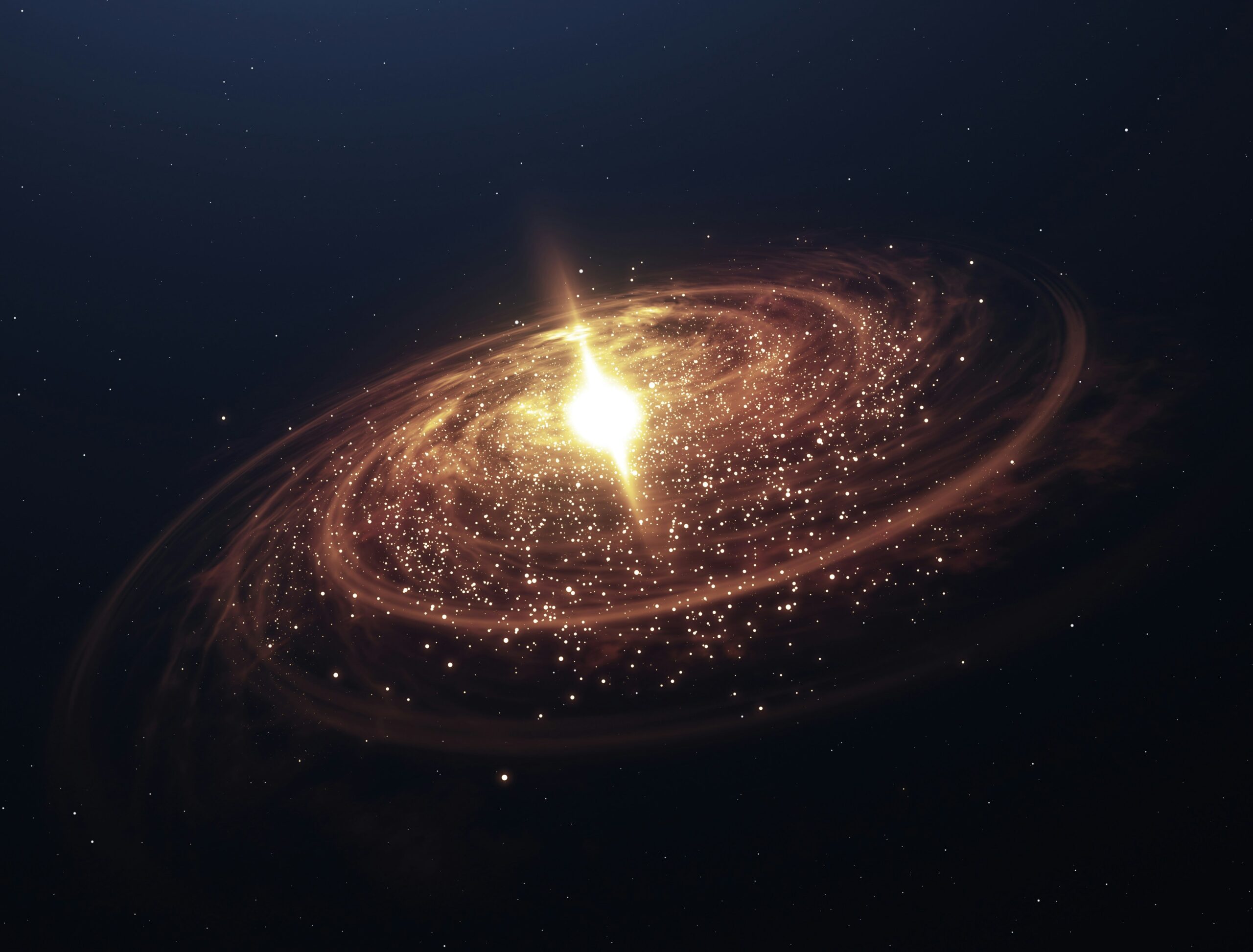
The universe, a vast and enigmatic expanse, is not exempt from the fundamental laws of physics. While its genesis has been extensively studied, its ultimate fate remains a subject of intense scientific inquiry. The physics of the end of the universe explores the various theoretical scenarios that could lead to its dissolution, each dictated by the interplay of gravity, energy, and the ceaseless expansion that defines its current state. These theories, rooted in cosmic observations and the principles of general relativity and quantum mechanics, paint a picture of an existence that, like all things in the cosmos, is subject to ultimate change.
The observed accelerated expansion of the universe, a discovery that earned the 2011 Nobel Prize in Physics, is the cornerstone upon which most end-of-universe scenarios are built. This phenomenon, attributed to a mysterious force known as dark energy, suggests that the universe is not merely expanding, but doing so at an ever-increasing rate. Understanding the nature of dark energy is therefore paramount to predicting the universe’s ultimate destiny.
Dark Energy: The Enigmatic Driver of Cosmic Expansion
Cosmological Constant or Quintessence?
The simplest explanation for dark energy is the cosmological constant, denoted by the Greek letter Lambda ($Lambda$). This concept, originally introduced by Albert Einstein to maintain a static universe (a notion he later abandoned), represents an intrinsic energy density of spacetime itself. If dark energy is a cosmological constant, its density remains constant as the universe expands, meaning that as space grows, the total amount of dark energy increases, leading to ever-faster expansion.
Alternatively, dark energy could be a dynamic field, often referred to as quintessence. Unlike the cosmological constant, quintessence’s energy density can change over time and space. This introduces a greater degree of uncertainty and complexity into cosmological models, as its behavior is not as precisely defined. The observed data currently favors a constant or very slowly varying dark energy density, making the cosmological constant the leading candidate, but ongoing observations are crucial for refining our understanding.
The Impact of Dark Energy’s Strength
The ultimate fate of the universe is intrinsically linked to the strength and properties of dark energy. If dark energy’s density remains constant, as in the cosmological constant model, the expansion will continue indefinitely, leading to specific end-of-universe scenarios. If, however, dark energy’s influence were to change, for instance, by weakening over time, the expansion could slow down, halt, or even reverse. The current evidence strongly suggests that dark energy is not diminishing in strength, but rather dominating the universe’s dynamics.
For those intrigued by the physics of the end of the universe, a fascinating article can be found at Freaky Science, which delves into the various theories surrounding cosmic fate. This piece explores concepts such as the Big Freeze, Big Crunch, and Heat Death, providing insights into how these scenarios could unfold based on current scientific understanding. To read more about these intriguing possibilities, visit Freaky Science.
The Big Freeze: A Slow Descent into Cold, Dark Inertia
The Big Freeze, also known as the Heat Death of the Universe, is arguably the most widely accepted scenario for the universe’s end, assuming the continued dominance of dark energy and a constant expansion rate. This scenario describes a gradual process of equilibrium and decay, rather than a singular catastrophic event.
Entropy’s Unstoppable March
The second law of thermodynamics dictates that in any closed system, entropy, a measure of disorder, always increases. The universe, for all practical intents and purposes, can be considered a closed system. As the universe expands and its constituents become more dispersed, the overall entropy increases. In the context of the Big Freeze, this means that usable energy will become increasingly scarce.
Galaxies Drifting Apart: The Great Isolation
As the expansion of space accelerates, galaxies will eventually recede from each other at speeds exceeding the speed of light (this does not violate relativity, as it is space itself expanding, not objects moving through space). This will lead to a phenomenon known as cosmic isolation. Eventually, all galaxies beyond our local group will be so distant that their light will no longer be able to reach us, rendering them forever invisible and inaccessible. Our local group itself might eventually merge into a single, vast elliptical galaxy.
Stellar Cessation: The Dimming of the Cosmic Lights
Stars, the engines of light and heat in the universe, have finite lifespans. The Big Freeze envisions a future where all stars have exhausted their nuclear fuel. Massive stars will have long since died in spectacular supernova explosions, leaving behind stellar remnants like white dwarfs, neutron stars, and black holes. Less massive stars, like our Sun, will eventually swell into red giants before shedding their outer layers and becoming white dwarfs. These white dwarfs will then slowly cool over billions upon billions of years, eventually becoming cold, dark, and inert “black dwarfs”—a theoretical object not yet observed because the universe is not old enough for any to have formed.
The Fading of Black Holes
Even black holes, the most enduring objects in the cosmos, are not eternal. Through a process known as Hawking radiation, named after physicist Stephen Hawking, black holes are predicted to slowly emit particles and energy, gradually losing mass. Smaller black holes evaporate more quickly, while supermassive black holes would take an unimaginably long time to dissipate. This gradual evaporation further contributes to the universe’s cooling and the dissipation of energy.
Proton Decay: The Ultimate Dissolution?
A more speculative, yet potentially crucial, aspect of the Big Freeze scenario involves the hypothetical decay of protons. If protons are not absolutely stable, as some Grand Unified Theories (GUTs) suggest, they would eventually decay into lighter particles like positrons and photons. This would mean that even the fundamental building blocks of ordinary matter would cease to exist, further reducing the universe’s complexity and energy content. The timescale for proton decay, if it occurs at all, is immense, far exceeding the current age of the universe, making it a phenomenon that would unfold over eons.
The Big Rip: A Violent Tearing of Spacetime Itself

The Big Rip is a more dramatic and violent end to the universe, predicated on a hypothetical form of dark energy known as phantom energy. Phantom energy is characterized by an equation of state parameter, $w$, which is less than -1. If dark energy were phantom energy, its density would not only be constant but would increase as the universe expands. This would lead to a runaway effect with devastating consequences.
The Accelerating Acceleration
In the Big Rip scenario, the acceleration of cosmic expansion would not only continue but intensify. The force of dark energy would effectively overwhelm all other forces in the universe, including gravity, the electromagnetic force, and even the strong nuclear force, in a progressively aggressive manner.
A Cascade of Destruction
The consequences of this escalating acceleration would be catastrophic. First, galaxy clusters would be torn apart. Then, individual galaxies would be ripped asunder. The gravitational bonds holding stars and planets together would be severed. Eventually, the planets themselves would disintegrate, followed by the atoms and subatomic particles that comprise them. In the ultimate moment of the Big Rip, spacetime itself would be torn apart, leading to a complete and abrupt dissolution of all structure and existence.
Observational Constraints
While the Big Rip provides a compelling theoretical endpoint, current cosmological observations do not strongly support it. The equation of state parameter for dark energy, $w$, appears to be very close to -1, consistent with a cosmological constant, but not definitively less than -1, which would be required for the Big Rip. However, the possibility remains, and precise measurements of dark energy’s properties are ongoing.
The Big Crunch: A Cosmic Reversal and a Potential Rebirth
The Big Crunch represents a starkly different end-of-universe scenario. It is the antithesis of the Big Freeze and the Big Rip, proposing that the expansion of the universe could eventually halt and reverse due to the overwhelming influence of gravity.
A Universe Dominated by Matter and Energy
For a Big Crunch to occur, the total density of matter and energy in the universe would need to be sufficiently high to overcome the outward push of expansion. In this scenario, gravity would eventually win out over the outward momentum, causing the expansion to decelerate, stop, and then begin to contract.
The Collapse of Cosmic Structures
As the universe contracted, galaxies would move closer together, eventually colliding and merging. The cosmic microwave background radiation, a relic of the Big Bang, would become hotter and more intense. Temperatures would rise dramatically as all matter and energy were compressed into an ever-smaller volume.
The Singularity: An Inevitable Conclusion?
The Big Crunch predicts that the universe would ultimately collapse into an infinitely dense and hot singularity, similar in nature to the singularity hypothesized at the beginning of the Big Bang. This would effectively erase all existing structure and information.
The Cyclical Universe Hypothesis: A Big Bounce?
Some theoretical models propose that a Big Crunch might not be the absolute end, but rather a prelude to a new cycle of cosmic expansion. This “Big Bounce” or “Cyclic Universe” theory suggests that the universe undergoes a series of expansions and contractions, with each crunch leading to a new big bang and a fresh start. However, there are significant theoretical challenges in explaining how such a bounce could occur and how information could be preserved or reset across cycles. Current observations of accelerated expansion make the Big Crunch scenario appear unlikely, but the possibility of a different cosmological constant or evolving dark energy cannot be definitively ruled out.
The study of the end of the universe is a fascinating topic that intertwines various branches of physics, including cosmology and thermodynamics. For those interested in exploring this subject further, a related article discusses the potential scenarios for the universe’s ultimate fate and the scientific theories that underpin these ideas. You can read more about it in this insightful piece on the physics of the end of the universe, which you can find here. Understanding these concepts not only deepens our knowledge of the cosmos but also raises profound questions about existence itself.
The Big Slurp: A Quantum Tunneling Event
“`html
| Concept | Description |
|---|---|
| Entropy | The measure of disorder or randomness in a closed system, which is expected to increase as the universe ages. |
| Heat Death | A hypothetical ultimate fate of the universe in which it has diminished to a state of no thermodynamic free energy and therefore can no longer sustain processes that consume energy. |
| Expansion | The ongoing increase in the size of the universe, which is expected to continue until the universe becomes too diffuse to support the formation of new stars and galaxies. |
| Dark Energy | A mysterious form of energy that is thought to be responsible for the accelerating expansion of the universe. |
“`
The Big Slurp is a more peculiar and speculative scenario for the universe’s end, rooted in quantum field theory and the nature of the vacuum. It proposes that the universe might currently exist in a “false vacuum” state, which is not the lowest possible energy state for the vacuum.
The True Vacuum: A State of Lower Energy
Similar to how a ball perched on a hill can be in a metastable state (a false vacuum), but could roll down to the valley below (the true vacuum) to achieve a lower energy state, the universe might be in such a precarious energy configuration. If this is the case, there exists a possibility of quantum tunneling, a phenomenon where a system can spontaneously transition to a lower energy state, even if there is an energy barrier preventing it.
The Bubble of True Vacuum
If the universe experiences quantum tunneling, a bubble of true vacuum would spontaneously appear somewhere in spacetime. This bubble would expand outwards at the speed of light, carrying with it a region of spacetime with fundamentally different physical laws.
The Annihilation of Everything
As this bubble of true vacuum expands, it would effectively overwrite the existing universe. The fundamental constants of nature could change dramatically within the bubble, rendering all existing structures, particles, and forces unstable and prone to immediate dissolution. This event would not be a gradual cooling or tearing, but an instantaneous obliteration of everything as we know it.
The Unpredictability of Quantum Events
The Big Slurp is inherently difficult to predict or observe directly because quantum tunneling events are probabilistic in nature. It could happen at any moment, anywhere in the universe, or it may never happen. However, if the universe is indeed in a false vacuum state, the existence of this possibility, however remote, adds another layer of uncertainty to our understanding of the cosmos’s ultimate fate. Current measurements of the Higgs boson’s mass and other parameters suggest that our universe might indeed be in a metastable vacuum state, making the Big Slurp a theoretical possibility that cannot be entirely dismissed.
The physics of the end of the universe, while dealing with abstract concepts and immense timescales, is a testament to humanity’s enduring curiosity about its place in the cosmos. From the slow fade of the Big Freeze to the violent cataclysm of the Big Rip, and from the cyclical potential of the Big Crunch to the quantum strangeness of the Big Slurp, these theoretical scenarios highlight the dynamic and ever-evolving nature of existence. While the precise outcome remains unknown, the scientific endeavor to understand it offers profound insights into the fundamental laws that govern reality. The universe, in its eventual conclusion, will undoubtedly be a reflection of the intricate and powerful forces that shaped its beginning.
FAQs
What is the ultimate fate of the universe according to physics?
According to current understanding in physics, the ultimate fate of the universe is either the “Big Freeze” or the “Big Rip.” The Big Freeze scenario predicts that the universe will continue to expand at an accelerating rate, eventually leading to a state of maximum entropy where all energy is evenly distributed and no more work can be extracted from it. The Big Rip scenario suggests that the expansion of the universe will continue to accelerate to the point where it tears apart all bound structures, including galaxies, stars, and eventually even atoms.
What role does dark energy play in the end of the universe?
Dark energy is believed to be the driving force behind the accelerating expansion of the universe. If dark energy continues to dominate the universe’s energy density, it will eventually lead to the Big Freeze or the Big Rip, depending on its properties. The exact nature of dark energy is still not fully understood, and ongoing research is aimed at better understanding its role in the fate of the universe.
How does the second law of thermodynamics relate to the end of the universe?
The second law of thermodynamics states that the entropy, or disorder, of a closed system will always increase over time. This has implications for the ultimate fate of the universe, as it suggests that the universe will eventually reach a state of maximum entropy, where no more work can be extracted from it. This aligns with the Big Freeze scenario, where the universe becomes a cold, uniform expanse with no more potential for energy transfer or work.
What is the role of black holes in the end of the universe?
Black holes play a significant role in the end of the universe, as they are believed to slowly evaporate over time through a process called Hawking radiation. As the universe continues to expand and the background temperature decreases, black holes will emit more radiation, eventually leading to their complete evaporation. This process will contribute to the overall increase in entropy and the eventual heat death of the universe.
Are there any proposed theories for the end of the universe that differ from the Big Freeze or Big Rip?
Some alternative theories for the end of the universe have been proposed, such as the “Big Crunch” and the “Big Bounce.” The Big Crunch suggests that the expansion of the universe will eventually reverse, leading to a collapse and a possible new Big Bang. The Big Bounce proposes that the universe could undergo a cycle of contraction and expansion, with each cycle leading to a new universe. However, current observational evidence and theoretical models favor the Big Freeze or Big Rip scenarios as the most likely outcomes.