Unraveling Bubble Nucleation in Space
The formation of bubbles, a seemingly mundane phenomenon on Earth, becomes a complex and fascinating area of scientific inquiry when transported to the microgravity environment of space. On our planet, gravity exerts a constant influence, pulling liquids downwards and dictating how bubbles rise, merge, and coalesce. In space, however, this pervasive force is largely absent, opening a Pandora’s box of new physical behaviors. Understanding bubble nucleation – the initial and critical step in bubble formation – in this unique setting is not merely an academic curiosity; it holds significant implications for a wide range of space-based applications, from life support systems to advanced materials manufacturing.
The Genesis of a Gas Sphere: Nucleation
Bubble nucleation is the process by which a new thermodynamic phase, in this case, a gaseous phase, begins to form within a liquid. Imagine a tiny seed of gas, a nascent bubble, sprouting in the vast expanse of the liquid. This seed must overcome an energy barrier to grow. On Earth, this barrier is influenced by several factors inherent to our gravitational reality.
The Role of Surfaces and Impurities
The formation of bubbles often requires a nucleation site. These sites are typically imperfections or irregularities on container walls, dissolved gas molecules, or suspended particles within the liquid. These imperfections provide a surface where the surface tension forces are less dominant, making it energetically favorable for the gas to accumulate. Think of it as a sheltered cove in a stormy sea; these sites offer a refuge for the emerging bubble against the overwhelming forces of the liquid. Without these sites, spontaneous nucleation in pure liquids would require an extraordinary amount of energy, a phenomenon known as homogeneous nucleation, which is rarely observed in everyday circumstances.
The Pull of Gravity: Bubble Dynamics on Earth
Once a bubble has nucleated and grown to a discernible size, its fate is largely dictated by gravity.
Buoyancy: The Upward Journey
The inherent density difference between a gas bubble and the surrounding liquid is the driving force behind buoyancy. The liquid, being denser, effectively “pushes” the less dense gas bubble upwards. This upward movement is a familiar sight when one boils water or shakes a carbonated beverage. The bubbles, like tiny balloons filled with air, rise to the surface.
Bubble Coalescence and Breakup: A Constant Dance
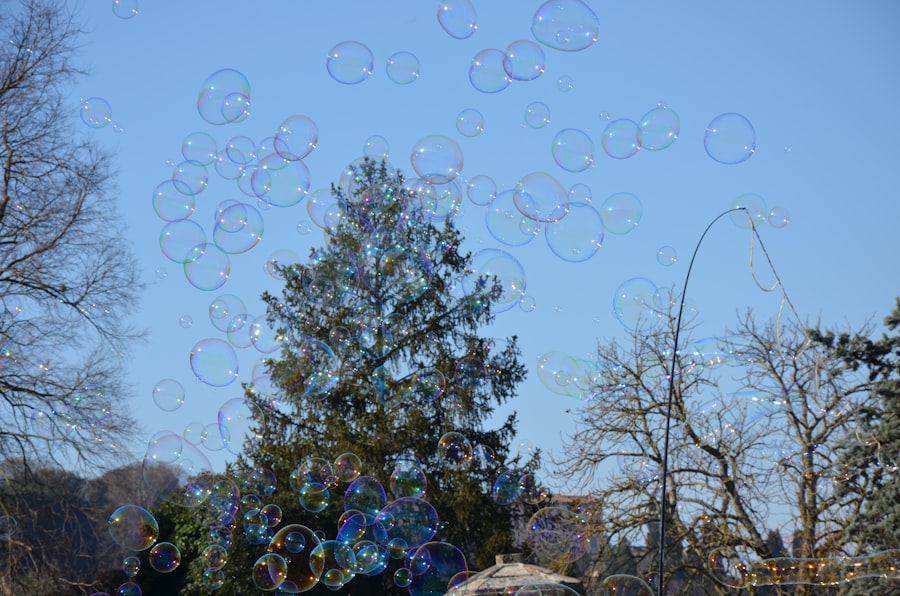
As bubbles rise, they often collide with one another. If the conditions are right, these bubbles can merge, or coalesce, to form larger bubbles. Conversely, under certain flow conditions and with sufficient agitation, larger bubbles can break apart into smaller ones. This dynamic interplay between coalescence and breakup significantly influences the size distribution and overall behavior of bubbles in a liquid.
Bubble nucleation in space is a fascinating phenomenon that has implications for various fields, including astrophysics and materials science. For a deeper understanding of this topic, you can explore a related article that delves into the mechanisms and implications of bubble formation in the vacuum of space. This article provides insights into how bubbles can influence the behavior of materials and fluids in microgravity environments. To learn more, visit Freaky Science.
The Weightless Realm: Bubble Nucleation in Microgravity
The absence of significant gravitational acceleration in space fundamentally alters the dynamics of bubble formation and behavior. What was once a predictable rise to the surface transforms into a more complex, often counterintuitive, scenario.
The Absence of Buoyancy: A Floating Sphere
In microgravity, the buoyant force that drives bubble rise on Earth is virtually eliminated. This means that a nucleated bubble, once formed, does not spontaneously ascend. Instead, it tends to remain in close proximity to its nucleation site, or it may drift slowly with any ambient fluid motion. Imagine trying to push a balloon underwater on Earth; it constantly wants to float upwards. In space, that persistent upward push is gone, and the balloon would simply hang in the water.
Surface Tension Dominance: A Powerful Embrace
With buoyancy largely removed, surface tension becomes the dominant force governing bubble behavior in microgravity. Surface tension, the cohesive force between liquid molecules at the surface, acts to minimize the surface area of the liquid. For a bubble, this means it will tend to form and maintain a spherical shape, as a sphere has the minimum surface area for a given volume. This spherical shape is crucial because it affects heat and mass transfer characteristics compared to the elongated or distorted shapes bubbles often adopt on Earth.
Nucleation Site Persistence: The Anchor of Formation
On Earth, nucleation sites can be dislodged by the constant fluid motion caused by bubble rise. In microgravity, however, nucleation sites can remain more stable. This persistence can lead to continuous bubble generation from the same location, potentially impacting the stability of multiphase flows.
Investigating Bubble Nucleation: Terrestrial Analogues and Space Experiments
Understanding bubble nucleation in space requires careful observation and experimentation. While direct experimentation in orbit is the most definitive approach, terrestrial analogues provide valuable insights and serve as a training ground for future space missions.
Gravitational Effects on Nucleation
Researchers have long studied how gravity influences nucleation processes. Experiments simulating reduced gravity, such as those conducted on parabolic flight aircraft, offer a glimpse into microgravity phenomena, albeit for very short durations. These experiments allow scientists to observe how bubble detachment from nucleation sites changes, and how bubble shapes deviate from their Earth-bound counterparts.
The Need for Orbital Laboratories
To truly unravel the complexities, prolonged exposure to microgravity is essential. Spacecraft, such as the International Space Station (ISS), equipped with specialized fluid physics modules, become invaluable laboratories.
The Role of Dissolved Gases
The behavior of dissolved gases in liquids is particularly sensitive to gravity. In space, the diffusion of dissolved gases and their subsequent aggregation to form nucleation sites can be significantly different. Experiments on the ISS aim to precisely measure these diffusion rates and understand how they contribute to bubble formation.
Heat and Mass Transfer in Microgravity Bubbles
The shape and behavior of bubbles influence how heat and mass are transferred within a liquid. This is critical for applications like boiling heat transfer in power systems or the transport of nutrients in bioreactors. Studying bubble nucleation and subsequent growth in space helps optimize these processes.
Advanced Applications of Microgravity Bubble Nucleation Research
The insights gained from studying bubble nucleation in space extend far beyond fundamental scientific curiosity. They have tangible applications in both space exploration and Earth-based technologies.
Life Support Systems for Long-Duration Missions
Future long-duration space missions, such as those to Mars, will require robust and efficient life support systems. These systems often rely on the transfer of gases and liquids, where bubble formation and behavior play a critical role.
Water Purification and Oxygen Generation
Understanding how bubbles form and behave during water purification processes in microgravity is essential for ensuring a continuous supply of potable water. Similarly, the efficiency of oxygen generation systems, which may involve electrochemical or biological processes that produce gas bubbles, is directly impacted by microgravity conditions. Imagine trying to filter water on Earth with bubbles constantly clinging to the filter; in space, this problem is magnified without gravity to help them detach.
Waste Management
The management of waste, including the potential for gas evolution from biological or chemical processes, also needs to be addressed in a microgravity environment. Controlled bubble nucleation and behavior are crucial for efficient and safe waste processing.
Advanced Materials Manufacturing in Space
The unique environment of space offers opportunities to manufacture materials with properties unattainable on Earth. Bubble nucleation plays a part in several of these processes.
Foam Production
Microgravity is ideal for creating uniform, high-performance foams. The absence of buoyancy-driven convection and gravitational settling allows for better control over bubble size and distribution during foam formation. This can lead to lighter, stronger, and more insulating materials for spacecraft construction or advanced consumer products.
Semiconductor Crystal Growth
Some semiconductor crystal growth processes involve the formation of gas bubbles that can disrupt the crystal lattice. Understanding and controlling bubble nucleation in these processes in microgravity can lead to the production of purer and more perfect crystals for advanced electronics. Think of trying to grow a perfect crystal in a liquid filled with unwanted tiny air pockets on Earth. In space, you have a better chance of a pristine growth environment.
Combustion and Propulsion Systems
The behavior of bubbles in propellant tanks and during combustion processes is critical for spacecraft propulsion.
Propellant Management
The presence of gas bubbles in liquid propellants can lead to combustion instability and reduced engine performance. Research into bubble nucleation and behavior in microgravity aids in developing better methods for propellant management and ensuring reliable engine operation.
Extinguishing Fires in Space
Fires in space present a unique challenge, as fluid dynamics are altered. Understanding how bubbles form and interact during fire suppression, which often involves the injection of extinguishing agents that can form bubbles, is crucial for astronaut safety.
Bubble nucleation in space is a fascinating phenomenon that has implications for our understanding of various astrophysical processes. Researchers have been exploring how bubbles form in microgravity environments, which can differ significantly from those on Earth. For a deeper dive into this topic, you can check out a related article that discusses the intricacies of bubble formation in different conditions. This article provides valuable insights into the mechanisms at play and can be found here. Understanding these processes not only enhances our knowledge of space but also has potential applications in various scientific fields.
Future Directions and Unanswered Questions
| Parameter | Description | Typical Values in Space | Relevance to Bubble Nucleation |
|---|---|---|---|
| Temperature | Thermal energy level affecting nucleation rate | 3 K (cosmic microwave background) to thousands of K near stars | Lower temperatures reduce nucleation rate; higher temperatures increase it |
| Pressure | Ambient pressure in space environment | 10^-14 to 10^-9 atm (interstellar medium) | Extremely low pressure favors bubble formation due to reduced external forces |
| Supersaturation Ratio | Ratio of vapor pressure to equilibrium vapor pressure | Varies widely depending on local gas composition | Higher supersaturation promotes bubble nucleation |
| Surface Tension | Energy required to form a new surface | Depends on fluid; e.g., water ~0.072 N/m at 20°C | Higher surface tension increases energy barrier for nucleation |
| Critical Radius | Minimum bubble radius for stable growth | Nanometer scale, varies with conditions | Determines whether a bubble will grow or collapse |
| Nucleation Rate | Number of bubbles formed per unit volume per second | Highly variable; from near zero to 10^6 bubbles/m³/s | Quantifies bubble formation speed under given conditions |
| Gas Composition | Type of gases involved in nucleation | Hydrogen, helium, water vapor, CO2, etc. | Influences vapor pressure and nucleation dynamics |
Despite significant progress, the field of bubble nucleation in space is still a frontier of scientific exploration. Many questions remain unanswered, driving ongoing research and future mission planning.
The Impact of Interfacial Properties
The nature of the liquid-gas interface and the interaction of the liquid with solid surfaces are critical factors in nucleation. Further research is needed to fully understand how these interfacial properties behave and influence nucleation in microgravity.
Modeling and Simulation: A Computational Bridge
Developing accurate computational models and simulations of bubble nucleation and multiphase flow in microgravity is crucial. These models can help predict behavior, design experiments, and optimize space-based processes without the need for constant orbital testing.
The Long-Term Effects of Radiation
The space environment is characterized by higher levels of radiation. The potential impact of this radiation on the nucleation process and the stability of nucleating sites is an area that warrants further investigation.
Exploring Exotic Fluids and Mixtures
Current research often focuses on common fluids like water and cryogenic propellants. Future investigations could explore bubble nucleation in more exotic fluids and complex mixtures relevant to various space applications, such as advanced refrigerants or unique chemical solutions.
Ultimately, unraveling the mysteries of bubble nucleation in space is a journey that requires a multidisciplinary approach, combining physics, chemistry, engineering, and astronautical science. The insights gained will not only pave the way for more ambitious space exploration but also offer transformative technological advancements here on Earth. The humble bubble, when lifted from its terrestrial confines, becomes a powerful lens through which we can understand fundamental physics and unlock new possibilities for humanity.
FAQs
What is bubble nucleation in space?
Bubble nucleation in space refers to the process where tiny bubbles form within a liquid or a supercooled vapor due to changes in pressure or temperature. This phenomenon is significant in various astrophysical and cosmological contexts, such as the early universe or within certain celestial bodies.
How does bubble nucleation occur in the vacuum of space?
In the vacuum of space, bubble nucleation can occur when a liquid or supercooled vapor experiences rapid changes in pressure or temperature, causing localized regions where gas bubbles spontaneously form. This can happen during phase transitions or due to cosmic radiation influencing the medium.
Why is bubble nucleation important in astrophysics?
Bubble nucleation is important in astrophysics because it helps explain phase transitions in the early universe, such as during cosmic inflation or the formation of matter structures. It also plays a role in the behavior of fluids in stars and planetary atmospheres under extreme conditions.
Can bubble nucleation affect spacecraft or space missions?
Yes, bubble nucleation can affect spacecraft systems, especially those involving fluids like fuel or cooling liquids. Uncontrolled bubble formation can lead to cavitation, reduced efficiency, or damage to components, so understanding and managing nucleation is crucial for mission safety and performance.
What factors influence bubble nucleation in space environments?
Factors influencing bubble nucleation in space include temperature, pressure, the presence of impurities or nucleation sites, radiation levels, and the physical properties of the fluid involved. Variations in these conditions can either promote or inhibit the formation of bubbles.