
Galaxy clusters, behemoths of the cosmos, are the largest gravitationally bound structures in the universe, each containing hundreds to thousands of galaxies. While galaxies themselves are luminous, a significant portion of a galaxy cluster’s mass is invisible to optical telescopes. This unseen component, known as dark matter, dominates the cluster’s gravitational pull. However, within these cosmic titans lies another substantial, and in fact more easily observable, component: hot, ionized gas, often referred to as X-ray gas. This pervasive plasma, filling the vast intergalactic space between galaxies, is a crucial probe for understanding the formation, evolution, and composition of galaxy clusters, offering a window into the cosmic depths.
The X-ray gas found in galaxy clusters is not a mere wispy nebula. It is a colossal reservoir of plasma, far more massive than all the stars within the constituent galaxies combined. This gas, primarily composed of hydrogen and helium, is heated to extreme temperatures, reaching tens to hundreds of millions of Kelvin. At these scorching temperatures, the gas emits profusely in the X-ray portion of the electromagnetic spectrum, making it detectable by specialized X-ray telescopes orbiting Earth.
What is X-ray Gas?
X-ray gas is a state of matter where atoms have been stripped of their electrons due to extremely high temperatures. This ionization process creates a plasma, a soup of positively charged ions and free electrons. In the dense cores of galaxy clusters, the gas is so hot that its particles collide with immense energy, triggering the emission of X-rays. This emission is the primary signal that astronomers use to survey and study these vast cosmic structures.
The Dominant Component of Baryonic Matter
When considering the total mass of a galaxy cluster, dark matter reigns supreme, accounting for the lion’s share. However, baryonic matter – the stuff that makes up ordinary objects, including stars, planets, and ourselves – is also crucial. Within galaxy clusters, the baryonic component is overwhelmingly dominated by this hot X-ray gas. Stars within galaxies represent only a fraction of the total baryonic content, with the intracluster medium (ICM), the X-ray gas, being the dominant player. This means that studying the X-ray gas is essential for understanding the overall composition and evolution of the baryonic universe within these massive structures.
Origins of the Intracluster Medium
The origin of this immense reservoir of hot gas is intrinsically linked to the formation and hierarchical merging of galaxy clusters. As smaller structures, like groups of galaxies, and individual galaxies merge to form larger clusters, they bring along their own gas content. The gravitational forces at play in these merging events compress and shock this gas, heating it to extreme temperatures. Furthermore, active galactic nuclei (AGN) – the supermassive black holes at the centers of galaxies – also play a significant role. Outflows from these accreting black holes can inject enormous amounts of energy into the surrounding ICM, further influencing its temperature, density, and distribution.
Recent studies have highlighted the significance of X-ray gas in galaxy clusters, revealing how it contributes to our understanding of cosmic evolution and the formation of large-scale structures in the universe. For a deeper insight into this topic, you can explore the article available at Freaky Science, which discusses the properties of X-ray emissions and their implications for astrophysics.
Unveiling the Secrets of Galaxy Clusters through X-ray Emissions
The X-ray emission from the intracluster medium is not uniform. It exhibits intricate patterns and variations in intensity, temperature, and chemical composition that encode vital information about the cluster’s history and physics. By meticulously analyzing these X-ray signatures, astronomers can reconstruct the complex processes that have shaped these cosmic giants over billions of years.
Spectral Analysis: A Cosmic Thermometer and Composition Probe
The spectrum of X-ray light emitted by the ICM acts as a sophisticated scientific instrument. By dissecting this light into its constituent wavelengths, astronomers can deduce the temperature of the gas. Different elements, when heated to the same temperature, emit X-rays at characteristic energies or wavelengths. Thus, by identifying the spectral lines present in the X-ray emission, astronomers can determine not only the temperature but also the abundance of various elements, such as oxygen, iron, and silicon, within the ICM. This elemental abundance provides clues about the nucleosynthesis that occurred in the stars of the member galaxies and how this enriched material has been dispersed into the ICM.
Imaging the Cosmic Landscape: Density and Structure
X-ray telescopes provide direct images of the distribution of hot gas within galaxy clusters. These images reveal the intricate structures within the ICM, such as filaments, bubbles, and shocks, which are diagnostic of the dynamic processes occurring within the cluster. The brightness of the X-ray emission is directly related to the density of the gas. Therefore, by mapping the X-ray intensity, astronomers can create detailed maps of the gas density distribution, revealing the underlying gravitational potential of the cluster, sculpted by both dark matter and the hot gas itself.
Studying Cluster Mergers: Cosmic Collisions of Giants
Galaxy clusters are not static entities. They are constantly evolving, with mergers being a fundamental process in their growth. When two galaxy clusters collide, their ICMs interact violently, creating spectacular phenomena. X-ray observations have captured these cosmic collisions in remarkable detail. For instance, the famous “Bullet Cluster” provides compelling evidence for the separation of dark matter from baryonic matter during a cluster merger. The X-ray gas, being a fluid, was slowed down by drag forces and collided, while the dark matter, interacting only gravitationally, passed through unimpeded, creating a distinct offset visible in X-ray and gravitational lensing maps.
The Role of X-ray Gas in Cosmic Evolution

The hot gas in galaxy clusters is far more than just a passive bystander. It actively participates in and influences the evolution of the cluster and its constituent galaxies. Its presence and properties provide crucial insights into fundamental cosmological questions.
Probing the Cosmic Microwave Background Polarization
Precise measurements of the temperature and polarization of the Cosmic Microwave Background (CMB) have provided a wealth of information about the early universe. However, the ICM’s interaction with CMB photons, known as the Sunyaev-Zel’dovich (SZ) effect, can leave subtle imprints on the CMB. This effect arises because hot electrons in the ICM scatter CMB photons. This scattering can either boost or lower the energy of the photons, depending on the relative motion of the cluster and the CMB rest frame. Studying the SZ effect allows astronomers to measure the mass and properties of galaxy clusters, providing an independent probe of cosmology.
Understanding the Baryon Cycle: Galactic Feedback
The hot ICM plays a pivotal role in what astronomers call the “baryon cycle.” This refers to the continuous flow of baryonic matter within the universe, from galaxies to the intergalactic medium and back. While galaxies are expected to be the birthplaces of stars, observations show that many massive galaxies in clusters contain significantly less gas than expected, with much of it having been expelled or prevented from cooling and forming stars. This phenomenon is attributed to “galactic feedback,” where energy and momentum injected by AGN and supernovae in galaxies heat and expel the surrounding gas, effectively regulating star formation. The X-ray gas in clusters acts as the ultimate reservoir for this expelled material and a crucial site for studying the impact of feedback.
Constraining Cosmological Parameters
Galaxy clusters are sensitive tracers of the large-scale structure of the universe. Their abundance and properties at different cosmic epochs are directly related to the underlying cosmology, including the density of matter, the amount of dark energy, and the rate of structure formation. By counting and characterizing galaxy clusters across a range of redshifts using X-ray observations, astronomers can place strong constraints on these fundamental cosmological parameters. This makes galaxy clusters powerful tools for testing and refining our models of the universe.
The Instruments of Discovery: X-ray Telescopes
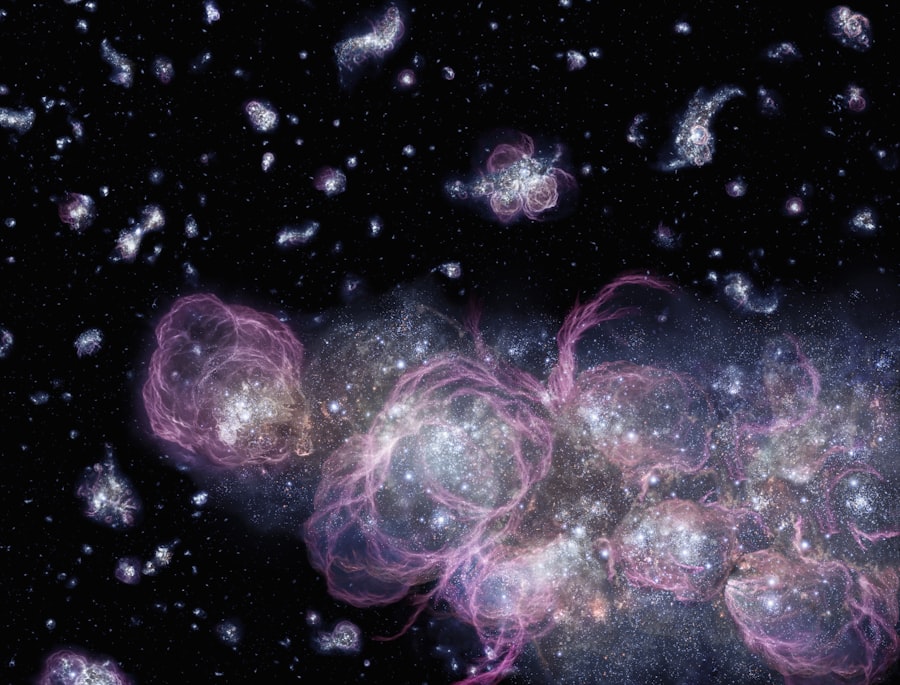
Observing the faint X-ray emissions from the diffuse ICM requires highly sensitive and specialized instruments. Over the decades, a series of groundbreaking X-ray observatories have revolutionized our understanding of galaxy clusters.
Early Pioneers: Uhuru and Einstein Observatory
The Uhuru satellite, launched in the late 1960s, was one of the first dedicated X-ray observatories. It provided the first catalog of X-ray sources, including some of the earliest detections of extended X-ray emission from galaxy clusters. The Einstein Observatory, launched in 1978, was a significant leap forward. It was the first fully imaging X-ray observatory, allowing astronomers to resolve the spatial structure of the hot gas in clusters for the first time. These early missions laid the groundwork for future, more advanced observations.
The Golden Age of X-ray Astronomy: Chandra and XMM-Newton
The launch of NASA’s Chandra X-ray Observatory and ESA’s X-ray Multi-Mirror Mission (XMM-Newton) in 1999 marked a new era in X-ray astronomy. Chandra’s exceptional spatial resolution allows for detailed studies of the intricate structures within galaxy clusters, including the identification of individual galaxies within them and the mapping of gas dynamics with unprecedented clarity. XMM-Newton, with its broader spectral coverage and collecting area, excels at characterizing the temperature, composition, and overall properties of the ICM across large regions of clusters. Together, these observatories have provided a wealth of data that has transformed our understanding of galaxy clusters.
Future Prospects: More Sensitive Observations
The scientific quest to explore the cosmic depths using X-ray gas continues with ongoing and upcoming missions. Future X-ray observatories are being designed with even greater sensitivity, broader energy coverage, and improved spectral and spatial resolution. These advancements will enable astronomers to probe fainter and more distant clusters, study the ICM in greater detail, investigate the properties of the circumgalactic medium (the gas halo surrounding individual galaxies), and further refine our understanding of cosmic evolution and fundamental physics.
Recent studies have shed light on the role of X-ray gas in galaxy clusters, revealing its significance in understanding the large-scale structure of the universe. For a deeper exploration of this topic, you can check out an insightful article that discusses the implications of X-ray emissions and their relationship with dark matter. This article provides a comprehensive overview of the findings and their impact on cosmology, making it a valuable resource for anyone interested in the intricate dynamics of galaxy clusters. To read more, visit this link.
Challenges and Future Directions
| Galaxy Cluster | Redshift (z) | X-ray Gas Temperature (keV) | Gas Mass (10¹⁴ M☉) | Total Mass (10¹⁴ M☉) | X-ray Luminosity (10⁴⁴ erg/s) | Core Radius (kpc) | Electron Density (10⁻³ cm⁻³) |
|---|---|---|---|---|---|---|---|
| Perseus Cluster | 0.018 | 6.5 | 1.2 | 6.5 | 8.3 | 80 | 4.5 |
| Coma Cluster | 0.023 | 8.2 | 1.5 | 10.0 | 7.0 | 250 | 3.0 |
| Abell 2029 | 0.077 | 9.0 | 2.0 | 12.5 | 12.0 | 120 | 5.2 |
| Abell 2142 | 0.090 | 8.5 | 1.8 | 11.0 | 10.5 | 150 | 4.0 |
| Abell 1689 | 0.183 | 9.5 | 2.3 | 14.0 | 15.0 | 100 | 6.0 |
Despite the significant progress made, the study of X-ray gas in galaxy clusters still presents numerous challenges and avenues for future research.
The Missing Baryon Problem in Clusters
While the ICM dominates the baryonic content of galaxy clusters, a persistent puzzle known as the “missing baryon problem” remains. Observations suggest that the total amount of baryonic matter in galaxy clusters, when extrapolated to the entire universe, does not perfectly match the predictions from Big Bang nucleosynthesis and the CMB. This implies that a fraction of baryonic matter might be hiding in regions not easily observable in X-rays, perhaps in warmer or cooler gas phases, or in very diffuse halos. Understanding the distribution and state of all baryonic matter is crucial for a complete picture of cosmic structure formation.
The Role of Magnetic Fields
The ICM is a magnetized plasma. While magnetic fields are not directly observable in X-rays, they are suspected to play a significant role in the dynamics and physics of the ICM, influencing gas flows, turbulence, and particle acceleration. Developing methods to indirectly probe and quantify the strength and configuration of magnetic fields within galaxy clusters is an active area of research. This could involve studying non-thermal X-ray emission or polarization.
Linking Cluster Properties to Large-Scale Structure Formation
Establishing robust correlations between the properties of galaxy clusters, as revealed by X-ray observations, and their positions within the cosmic web is a key goal. Understanding how the environment influences cluster growth and evolution can shed light on the processes that drive the formation of the largest structures in the universe. This involves combining X-ray data with surveys that map the large-scale distribution of galaxies.
In conclusion, the X-ray gas within galaxy clusters is not just an astronomical curiosity; it is a fundamental component of the universe that serves as a powerful probe of cosmic depths. Through the meticulous analysis of its X-ray emissions, astronomers are unraveling the intricate tales of galaxy cluster formation, evolution, and the fundamental physics that governs our cosmos. As new instruments and observational techniques emerge, our understanding of these luminous, yet often invisible, oceans of hot gas will undoubtedly continue to expand, bringing us closer to comprehending the grand narrative of the universe.

WATCH NOW ▶️ Our Galaxy Is Sliding Toward a Cosmic Drain
FAQs
What is X-ray gas in galaxy clusters?
X-ray gas in galaxy clusters refers to the hot, diffuse plasma that fills the space between galaxies within a cluster. This gas emits X-rays due to its extremely high temperature, often reaching tens of millions of degrees Kelvin.
How is X-ray gas detected in galaxy clusters?
X-ray gas is detected using space-based X-ray observatories such as the Chandra X-ray Observatory and XMM-Newton. These telescopes capture the X-ray emissions from the hot gas, allowing astronomers to study its properties and distribution.
Why is the study of X-ray gas important in understanding galaxy clusters?
Studying X-ray gas helps astronomers understand the total mass and structure of galaxy clusters, including the distribution of dark matter. The gas also provides insights into the cluster’s formation, evolution, and the physical processes occurring within it.
What causes the gas in galaxy clusters to become so hot?
The gas is heated to high temperatures primarily through gravitational compression as the cluster forms and grows. Collisions and mergers between galaxies and smaller clusters also contribute to heating the gas to X-ray emitting temperatures.
Can X-ray gas affect the galaxies within a cluster?
Yes, the hot X-ray gas can influence galaxy evolution by stripping gas from galaxies as they move through the cluster, a process known as ram-pressure stripping. This can affect star formation rates and the overall development of galaxies within the cluster.